Readers, as I write this, it is difficult for me to fathom that it was 5 years ago when I was sitting in that tiny internet cafe in Paris, creating the blog that would become such a source of joy for me in years to come. And what a 5 years it has been.
When I began Backlots in that March of 2011, I never could have guessed what would be accomplished in just a few years’ time. There would be interviews with some of the great classic film biographers, coverage of prestigious classic film festivals, fun blogathons, and even an interview with Joan Fontaine. I am deeply grateful for the opportunities I have been afforded due to Backlots, and especially appreciative of you, the readers, for keeping me going for 5 years strong.
The blog has changed in many ways since 2011, and due to my current Marion Davies work, the content and blogging schedule has changed with it. But one thing that has remained constant is that I continue to treasure my blogging on Backlots, and am immensely proud of all that it has and will continue to bring to the online classic film community.
So, readers, here’s to us. Happy 5 years on Backlots!
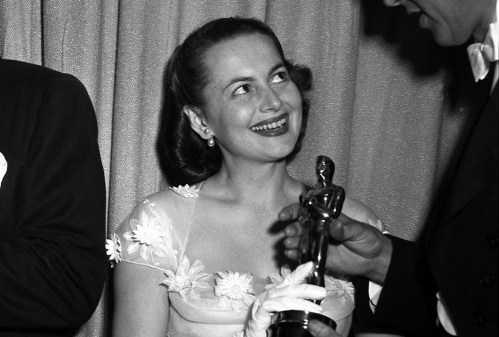
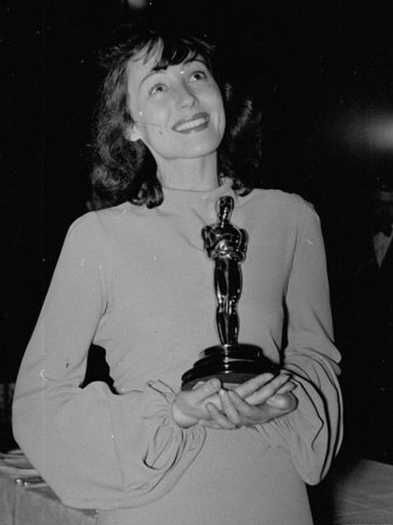
Olivia de Havilland accepts her Best Actress Oscar for The Heiress (1949).
Tonight is Oscar night. As Los Angeles prepares for an evening of glamor, style, and nightmarish street closures (it once took me an hour to walk to the store one block away when I was in Hollywood on Oscar night), we look back on the films and performances that most moved us this year, and honor them with the industry’s highest award.
This year’s Oscar lineup has had its fair share of criticism, and a shakeup of Academy voting rules in the face of this criticism has further rocked the industry. This is a post all its own, and a very worthy topic for analysis on a classic film blog due to the members the new rules affect, but I would like to save that discussion for after the Oscars. Today, I would like to focus on celebrating the history of the awards, historic wins, historic snubs, and those for whom Oscar was always just out of reach.
JANET GAYNOR: The first performer to win Best Actress
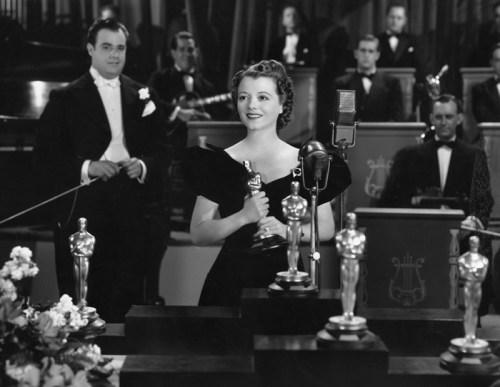
At the first Academy Award ceremony in 1929, held in the Blossom Room at the Roosevelt Hotel, Janet Gaynor was named the Academy’s first Best Actress for her work in three films–Sunrise: A Song of Two Humans, Seventh Heaven, and Street Angel. The entire ceremony, hosted by Douglas Fairbanks, lasted for 15 minutes and all the awards had been announced ahead of time.
Here is Janet Gaynor in those three films.
Notice that this first Oscar ceremony came right on the cusp of sound technology. The Jazz Singer, the first film to have a synchronized dialogue track, was disqualified from the ceremony because the organizers felt that it was unfair to have sound films compete with silents.
Historic win
HATTIE MCDANIEL: The first African-American to win an Oscar
For her performance as Mammy in Gone With the Wind (1939), Hattie McDaniel won the first Academy Award presented to an African-American performer. The aftermath of Gone With the Wind had not been easy for McDaniel. Jim Crow laws had been raging in the South for over 40 years, and Hattie McDaniel had suffered huge amounts of discrimination based around where and how she could travel with the film. She was unable to attend the gala premiere in Atlanta, and even at the Oscars ceremony where she was an odds-on favorite to win, she was unable to sit with the rest of her Gone With the Wind co-stars, instead having to walk from the back of the room to accept her award.
Hattie McDaniel’s legendary Oscar has since been lost. After her death, she willed the statue to Howard University, where it was rumored to have been stolen and thrown in the Potomac River during civil rights protests in the 1960s. But an investigation into its whereabouts gives more credence to the idea that inadequate intake procedures at the university during the time of its arrival was responsible for its being misplaced.
JOAN FONTAINE: Wins for Suspicion
After having been defeated by Ginger Rogers in Kitty Foyle the previous year when she was nominated for Rebecca, Joan Fontaine ended up winning for Suspicion (1941) during the Academy Award ceremony in 1942. She was up against her sister, Olivia de Havilland, nominated for Hold Back the Dawn.
Fontaine’s win for Suspicion is historic in several ways. With her win, she became the sole person who has ever won an acting Oscar for a Hitchcock film. In addition, she and Olivia de Havilland are the only siblings who have ever won lead acting Oscars. Olivia won her first Oscar just a few years later, for To Each His Own, and a second three years later for The Heiress.
Olivia de Havilland hugs sister Joan Fontaine on Oscar night when Joan won for Suspicion.
Oscar Overlooks
BARBARA STANWYCK
Though nominated four times for the Academy Award, Barbara Stanwyck never won a competitive Oscar. One of the most chameleonic actresses on the screen, her nominations reflected her versatility and range, but each time she lost out to another actress. Here are some clips from each of Barbara Stanwyck’s nominated performances, along with the winning performances.
1937: Barbara Stanwyck nominated for Stella Dallas
LOST TO: Luise Rainer, The Good Earth
1941: Barbara Stanwyck nominated for Ball of Fire
LOST TO: Joan Fontaine, Suspicion
1944: Barbara Stanwyck nominated for Double Indemnity
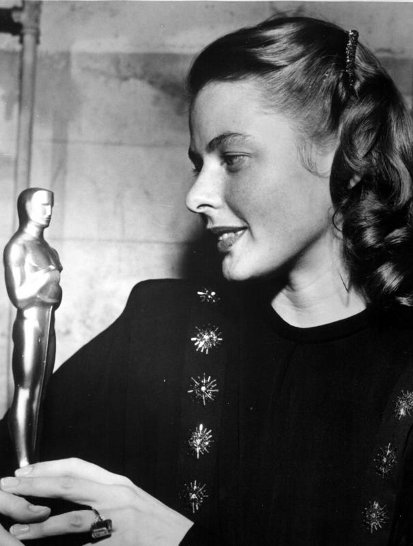
LOST TO: Ingrid Bergman, Gaslight
1948: Barbara Stanwyck nominated for Sorry Wrong Number
LOST TO: Jane Wyman, Johnny Belinda
Finally, in 1982, she got her due.
MYRNA LOY
While Stanwyck was at least given the honor of being nominated, the great Myrna Loy never even received a nomination. It is considered one of the Academy’s greatest oversights, considering Myrna Loy’s long and illustrious career, and especially her role in the huge Oscar winner The Best Years of Our Lives in 1946, and her much-beloved portrayal of Nora Charles in The Thin Man.
The Academy finally gave Myrna an honorary award, at least 70 years late, which she accepted with a simple “You’ve made me very happy. Thank you very much.”
Thanks for reading, and be sure to watch the Oscars this evening at 5 PM Pacific time! And if you’re in Los Angeles, stay off those roads.
A few nights ago, I went to my local movie theater in Berkeley to see a movie I had been looking forward to ever since I heard that it was part of the Cannes Film Festival last year. Entitled Ingrid Bergman-In Her Own Words, this beautiful documentary based on the diaries of Ingrid Bergman and supplemented by interviews with her children, was something I couldn’t miss.
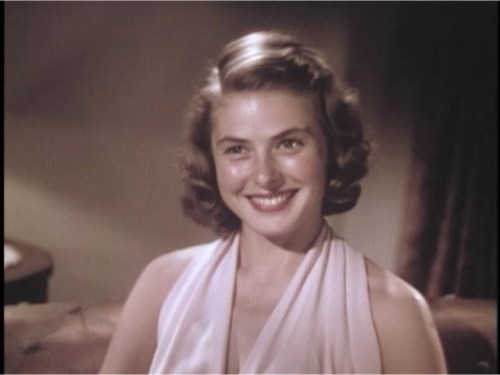
I fell in love with Ingrid Bergman before I had even reached my junior high years. The first time I saw Casablanca was at the Paramount Theatre in Oakland, when I was 11 years old. I knew I was watching something special–not just because the theater was packed to the gills and the line stretched around the block to get in, but because once the movie started, I couldn’t take my eyes off the unusually beautiful woman on the screen. I loved her mysterious accent, those expressive eyes, and the comforting timbre of her voice. She was unlike anything I had seen before in my 11 years, and it was right then and there that I experienced the appeal and charm of Ingrid Bergman.
By the age of 13, I had read all the biographies, seen her complete filmography, and had become fascinated by a woman who not only exuded one of the gentlest, most alluring personalities on the screen (and who I found much warmer and more comforting than Greta Garbo), but who, I found, lived her personal life her own way, beholden to no one.
For me as an Ingrid Bergman devotee and aficionado, the documentary was beautifully done. Woven together with excerpts from her own diary, letters to friends and interviews with her family members, it was a loving tribute to a charming, complex woman who valued her freedom above all else. From her early childhood in Sweden to her Hollywood years, her relationships with her children, and her final years and death, it helped to fill in gaps in my understanding of Ingrid Bergman as a human being, and to better understand her reasons for many of her life choices.
One of the most interesting aspects of Ingrid Bergman’s life, to me, has always been the tragic nature of her childhood, and how, in spite of losing her entire family by the time she was 14, she was able to overcome the immense obstacles of her life and fulfill her lifelong dream of becoming an actress. I came away from the movie with a new perspective on Ingrid Bergman’s childhood. It was not in spite of these obstacles, I found, that she was able to become as successful and brilliant an actress as she became. It was because of them. Entries from her childhood diary outline how she never felt at home unless she was acting, as it took her away from her grim reality of her surroundings. Another aspect of Ingrid Bergman’s life that the documentary highlighted was Ingrid’s penchant for carrying a camera onto her sets and filming 16mm home movies. We often see photos of Ingrid behind a camera, shooting scenes from her sets or home movies of her children. Cinema was Ingrid’s life, and whether behind or in front of the camera, she was most comfortable when enmeshed in that world.
Before leaving for Hollywood, Ingrid married brain surgeon Petter Lindstrom, and their daughter Pia was born in 1938. Ingrid was a loving mother, if not always a present one, to Pia when she was young, and interviews with Pia for the documentary are strikingly different from those with her other three children. Pia’s interviews are more analytical, less sugar-coated than her siblings’, and while she clearly loved her mother, Pia does not make any excuses for Ingrid’s frequent absences and prioritizing her career and romantic life over her children. The interviews with her siblings, all carrying the surname “Rossellini,” are warm, understanding, and loving in contrast.
While filming Stromboli in Italy in 1949, Ingrid Bergman fell in love with Roberto Rossellini, whom she had admired for many years and to whom she had written to ask for a role in one of his films. Ingrid’s status as a married woman with a pre-teen daughter complicated their relationship, and the scandal with Rossellini shocked the world when it was revealed that Ingrid had become pregnant with Rossellini’s child. The two married several months after the birth of their son, Roberto Jr., and a few years later Ingrid gave birth to a pair of twins, Isotta Ingrid (known now simply as “Ingrid”) and Isabella. Following the scandal with Rossellini, Ingrid Bergman was blacklisted from movies both in the United States and her native Sweden, labeled a “blot on the Swedish flag” and unfit to make movies in the United States due to morality concerns. She didn’t make another movie in either country until 1956, but when she did, it was a smash–Ingrid’s American comeback in Anastasia garnered her her third Oscar.
The documentary touches on this part of Ingrid’s life with sensitivity and grace, and the perspectives of her children on the aspects of her personality that may have contributed to it were very insightful. The lasting impression that one gets from the documentary is that Ingrid Bergman was a woman who could not be tied down, a fascinating and complicated woman ahead of her time.
Because of my longstanding love for Ingrid Bergman, it is difficult for me to know how the general public might feel about this documentary. The documentary assumes some basic knowledge about Ingrid Bergman and classic Hollywood in general, and when several members of the audience walked out of the movie, I hypothesized that they likely lacked the background needed to fully appreciate its message. I would absolutely recommend it to someone with a passing knowledge of classic Hollywood. To someone who does not have that background, I might suggest reading a Bergman biography and watching a few of her movies before watching this documentary.
But for those of us fully converted to Bergman-ism, it is pure joy.
The 14th annual Noir City festival, the spectacular tribute to film noir that has become a must-see San Francisco tradition, took place last week at the Castro Theatre. The festival is one big noir extravaganza, with the theater packed to the gills every day and every night for ten days straight. It was truly an event to experience, and one that I was thrilled to have been able to attend.
While the programming at Noir City is always top-notch, programmed by the man who has come to be known as the “czar of Noir,” Eddie Muller, this year had some truly unusual and unique offerings for the noir aficionados and for the uninitiated alike. Paired with noir classics like The Two Mrs. Carrolls and Rear Window were creatively programmed films like The Red Shoes that rose above the traditional definitions of noir to give the audience an entirely new vision of the genre.
One of the films that most fascinated me in the Noir City program this year was a 1946 detective/murder mystery called The Dark Corner, starring Lucille Ball and Mark Stevens. By 1946, film noir had reached its zenith, the genre having been molded and firmly established during the years of World War II. Dark alleyways, shadowed angles, cigarettes and hard drinking characterized a noir film, as did the appearance of a savvy and smart femme fatale who often drives the plot.
Earlier in 1946, Lucille Ball had walked out on her contract at MGM. She was having problems at the studio and problems at home, her marriage to Desi Arnaz on the brink of collapse. At the studio, she was being cast almost exclusively in glamorous roles, ones that she knew didn’t fit her well and where she was being cast aside for the more established MGM stars like Judy Garland. In search of something different to propel her career forward and to take her mind off her home troubles, she left MGM and freelanced for several years. The Dark Corner, filmed at 20th Century Fox, was one of the first movies she did following the termination of her contract at MGM, and if Lucy had wanted to depart from MGM-type glamor roles in taking this role, she succeeded.
Playing a secretary in love with her boss who has a sinister past, Lucille Ball’s role is that of the smart, savvy version of the femme fatale. It suits her well, and the audience’s eyes are rarely off her when she is onscreen. As for the movie itself, as a murder mystery and detective story in one, The Dark Corner is so noir that it almost parodies itself. Audiences at the Castro Theatre are unusually well-educated in their cinema, and never was that more clear than when the audience laughed in delight at those scenes where Mark Stevens lights a match on his shoe at breakfast, or drinks several glasses of gin in one sitting. San Francisco knows its noir, and a self-aware movie like The Dark Corner was a fun choice for this audience.
The Two Mrs. Carrolls is an old favorite of mine. The only film to pair cinematic legends Humphrey Bogart and Barbara Stanwyck, it tells the story of a mentally unstable painter who endeavors to kill all the women he loves after painting their portraits. It, too, is a prototypical noir, even taking hints from earlier dark movies and weaving them into the plot in similar ways. A clear example of this is the idea of the painter poisoning his wives with milk, one of the main themes of Hitchcock’s Suspicion, from 6 years earlier.
Humphrey Bogart brings Barbara Stanwyck a glass of poisoned milk in The Two Mrs. Carrolls.
Cary Grant brings Joan Fontaine a glass of milk in Suspicion.
The treatment of Barbara Stanwyck as the naive, sweet second wife who is haunted by the first, The Two Mrs. Carrolls also echoes a second Hitchcock film, Rebecca, in which the innocent, sweet Second Mrs. De Winter is tortured by the memory of the ever-present first wife. In Rebecca, the first wife’s memory is poison in itself, leaving in its wake fear, destruction and death. In The Two Mrs. Carrolls, the first wife is the saving grace of the second, with hints about her demise leading the second wife to figure out what her husband is plotting. Where in Rebecca the first wife’s memory may be characterized as the villain, in The Two Mrs. Carrolls she may be characterized as the hero.
Thank you to Noir City for another great year, and I look forward to next year’s programming!
From beautiful, unseasonably warm New York City, where I have spent the past week engulfed in research, I wish you a very happy holiday! Here are some photos of classic Hollywood stars celebrating.
The Marion Davies Children’s Clinic, 1954
Marion Davies founded her children’s clinic in 1926, and every year she sponsored a party for the patients and their families, which included entertainment for the children and a Christmas turkey and groceries for the parents. Here in 1954, she celebrates with the children and Santa Claus, played by her husband, Horace Brown.
During the war, many celebrities participated in fundraising activities for the war effort. In this scene, Bette Davis plays a mother teaching her onscreen children the value of war bonds.
Judy Garland sings “Silent Night,” 1937.
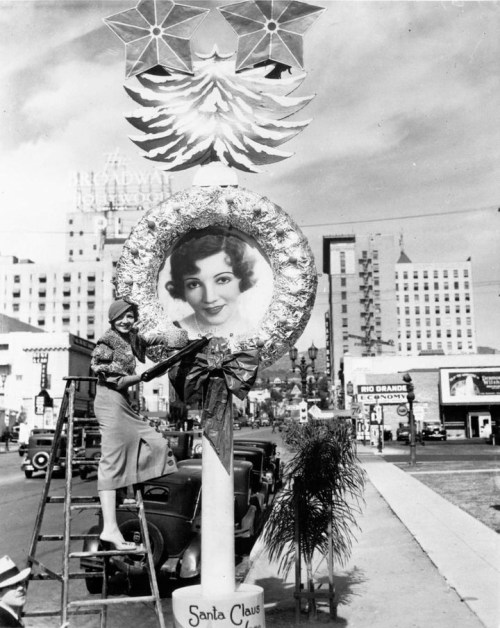
Claudette Colbert with her Christmas wreath, 1932.
Angela Lansbury sings “We Need a Little Christmas,” from the original Broadway cast recording of Mame.
Colleen Moore sings Christmas carols.
Lucille Ball with a wreath in the late 1930s.
Here’s to a wonderful day today, and see you next time!
With his swashbuckling persona, jaw-dropping acrobatics and million dollar smile, Douglas Fairbanks was the definition of what it means to be a movie star. Known equally well for being half of the most influential celebrity power couple of the 1920s, and for his lavish estate known as Pickfair that he owned with wife Mary Pickford, Fairbanks was the personification of Hollywood fame combined with silent-era high living.
Douglas Fairbanks in The Mark of Zorro (1920).
In her new book, The First King of Hollywood: The Life of Douglas Fairbanks, longtime Fairbanks expert and historian Tracey Goessel writes in exquisite and meticulous detail of the star’s life, rise to fame and his sometimes difficult marriage to Mary Pickford. It is a book written with obvious love, and crafted to give the reader a full and accurate picture of a complex character.
There is truly no one better to write this book than Tracey Goessel. A Fairbanks devotee for decades, she is on the board of the San Francisco Silent Film Festival and has contributed enormously to the visibility of both Douglas Fairbanks and Mary Pickford in the world of silent film for many years. When I heard that a Douglas Fairbanks biography by Tracey Goessel was coming out, I knew immediately that it was going to be definitive.
Right from the beginning, Goessel gives us the reasons why the man known as “Doug” in the industry (though Mary Pickford always called him “Douglas”) remains important 76 years after his death. Goessel notes the fact that we have Fairbanks to thank for the Oscars (he co-founded the Academy of Motion Picture Arts and Sciences), for Gone With the Wind and The Wizard of Oz (he gave Victor Fleming his start), and for the latest releases from United Artists (he co-founded the company). Her assertions are thought-provoking and accurate. There are very few silent stars who remain as relevant and modern as Douglas Fairbanks, both in his legacy and his onscreen persona.
D.W. Griffith, Mary Pickford, Charlie Chaplin and Douglas Fairbanks signing the contract that established United Artists.
Goessel’s level of detail about Fairbanks’ early life is nothing short of astounding. She has traced his family tree and stories connected with it back several generations, and provides several wonderful stories regarding the early life of the man who would become Douglas Fairbanks. She shows how his early aptitude for mischief, drama and acrobatics affected his rise to fame and shaped who he became onscreen. My favorite story from his early years in film deals with an early role in a film called The Habit of Happiness. Goessel relates that in order to make the blue-collar extras laugh in a scene where they were supposed to be entertained, Doug told the smuttiest jokes he could think of–so smutty, that the lip-readers in the preview audience were offended.
Before his film stardom, Fairbanks was in a Broadway play in New York when a group of Biograph players, including Mary Pickford, came to see the show. D.W. Griffith said to Mary regarding Doug: “Now there’s a fellow who will someday make a great impression in pictures.” He made a great impression on Mary as well, and they began a relationship, marrying in 1920 very shortly after Mary procured a divorce from her then-husband Owen Moore. As husband and wife they lived at Pickfair, a monumental estate at 1143 Summit Drive in Los Angeles that was host to countless industry parties and get-togethers.
Again, the level of detail in Goessel’s account is marvelous. We are shown the inner workings of the most powerful couple in Hollywood, including all its difficulties when they both stray from fidelity–Mary with Buddy Rogers and Douglas with Lady Sylvia Ashley–and despite trying to make their marriage work, they simply couldn’t.
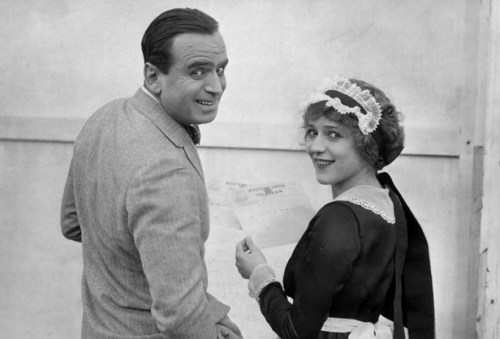
Mary Pickford and Douglas Fairbanks.
Another triumph of this book is the interweaving of what was going on in Hollywood with the events of Fairbanks’ life. A prime example is the attention that is given to the advent of sound in the mid-1920s, during which all of Hollywood was waiting on baited breath to see what would become of this new technology. Pickford and Fairbanks were in the audience when John Barrymore’s Don Juan premiered, the first full-length film to feature a Vitaphone score, and from the beginning he wasn’t too thrilled with the prospect of sound on film. Indeed, Douglas Fairbanks was one of sound’s victims–his second-to-last film, ironically, was The Private Life of Don Juan.
This is highly recommended reading for anyone with an interest in Hollywood of any era. The modern film aficionado will see countless links to the modern era, while the classics fan will see the rise and fall of one of the all-time great film stars. Tracey Goessel has written a book fit for Douglas Fairbanks. And that’s saying a great deal.
If you would like to order it, here is the link to the book on Amazon.
Yesterday afternoon at the Castro Theatre in San Francisco, the San Francisco Silent Film Festival hosted its annual Day of Silents, featuring a magnificent lineup of silent films from around the world that whet the festivalgoer’s appetite for the larger festival taking place in June. This year’s Day of Silents included a diverse offering of films that seemed to have something for everybody.
The day started with a screening of The Black Pirate (1926), a Douglas Fairbanks mainstay and one of the first films to be shot in two-strip Technicolor. We were lucky enough to have Tracey Goessel, the author of the new Douglas Fairbanks biography The First King of Hollywood (a very solid and informative read, expect a review on the blog very soon) on hand to introduce the film, and Tracey related a few interesting anecdotes about the filming. Fairbanks’ beard made photography with primitive two-strip Technicolor a bit difficult, and they often had to stop and apply more makeup so that his face wouldn’t turn green in the Technicolor process. But sometimes they couldn’t get to his beard before the Technicolor affected his coloring, so every now and then in the film, Fairbanks’ face turns a slight shade of green.
Doug looking a bit green.
The movie stars a remarkably beautiful Billie Dove as Fairbanks’ love interest, at the height of her fame and beauty. The plot involves Doug trying to rescue her from a terrible fate, and, of course, he succeeds in the end. The final kiss between Fairbanks and Billie Dove is not between Fairbanks and Billie Dove at all–in fact, for the kissing scene, Mary Pickford was brought in and what we see is a kiss between the biggest Hollywood power couple of the 1920s.
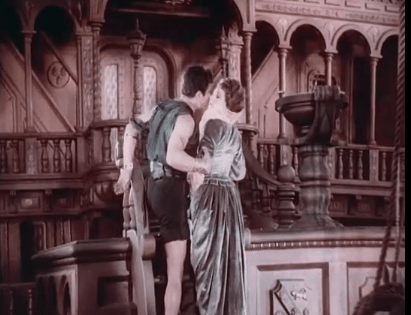
Doug and Mary at the end of The Black Pirate.
The Black Pirate is a typical Douglas Fairbanks movie, which is to say that it thrills, delights, and incites countless moments of awe at Fairbanks’ swashbuckling acrobatics. Watching a Douglas Fairbanks movie is one of life’s particular cinematic joys, as his brand of daring stunts, achieved without a double, combined with his million-dollar smile and exuberant personality, have scarcely been matched by anyone else in all of film history. He created the prototype, and though many have tried to replicate what he does, few have succeeded. As far as I can think, the person who came closest to replicating what Douglas Fairbanks did was Errol Flynn, with his damsel-in-distress, swordfighting onscreen persona. But even he, with his slight build and boyish face, lacks the unique charisma of the suavely charming, almost sassy Fairbanks.
If you haven’t seen The Black Pirate, the complete film is available to watch on youtube. I highly recommend it.
Some other highlights of the festival included a beautiful series of home movies filmed in China between 1900 and 1948, and a showing of Houdini’s 1919 film The Grim Game. The Grim Game feels almost like a filmed magic show, as the entire plot of the film didn’t matter so much–it was a show piece for Houdini’s talents. The audience laughed with delight when Houdini’s character was in jail and locked up in chains–replicating the famous photo of the magician.
There was also a subplot that led up to the inevitable famous trick of Houdini escaping from a straitjacket while hanging upside down from a building. Again, the audience knew exactly what was coming, and muttered among themselves knowingly when Houdini had his straitjacket put on.
The Grim Game was recently restored and shown at the TCM Classic Film Festival in Hollywood, and since then has been making the rounds at several festivals around the country. It is a must-see for Houdini fans and anyone interested in magic, as there are some truly remarkable feats accomplished by Houdini in the film.
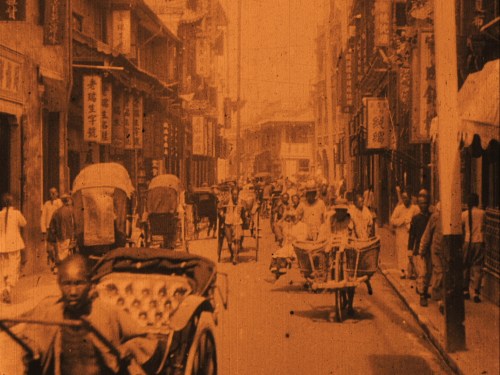
The home movies around China were simply breathtaking. Shot by a wide variety of amateur filmmakers, they showed the different provinces of China over a nearly 50-year span, marking the significant historical and social changes that the country went through. In the movies filmed around 1900, we saw nearly everyone in traditional Chinese dress, surrounded by wooden buildings and shops bearing names written only in Chinese characters. By 1915, we were beginning to see evidence of American and European trade and influence, with European men and women riding bicycles through the streets and shop signs transliterated into Latin lettering. By 1930, people had begun to adopt western-style clothing in the cities, and you see the roots of industrialization that were beginning to take shape. It was a beautiful and enlightening history lesson, through the most informative lens we have–the home movie.
Beijing, 1910.
As always, the San Francisco Silent Film Festival delivers the highest quality silent film experience I have ever had the pleasure to have. I am so fortunate to be able to take part in it every year, and I hope that, if you have never been, you will be able to make it out to the larger festival in late May/early June. Stay tuned for details as it gets closer.
In light of the terrifying events in Paris yesterday, like the rest of the world I have been struggling with how to respond. I have deep ties to Paris, both personal and familial, and 2015 has been one of the city’s most terror-filled years in recent memory. Though all of my friends and relatives have responded to my inquiries and are, thankfully, unhurt, there are 127 families today who cannot say the same. The best way I can think of to fight the fear and shock of yesterday is to reiterate the love I have for Paris, and to tell of some of the wonderful cinematic moments that the city has given me.
In 2011, I spent 6 months in Paris as a student at the Institut Catholique de Paris. I was very excited to be there, but I wondered how I was going to get through 6 months with only the classic movies I had brought with me. I had managed to find a French version of Hold Back the Dawn (of all movies) at the DVD store in the Carrousel du Louvre, but other than that I was operating with the slim pickings that I could fit in my suitcase.
On my first day of class, my keen classic movie ear overheard a student talking about Casablanca across the room. I went over to contribute to the conversation, and the student mentioned that he had seen it in a theater in the 6th arrondissement and that this theater shows classic movies every night. Every night! He happened to have a flyer with him, and he gave it to me and told me I should check it out.
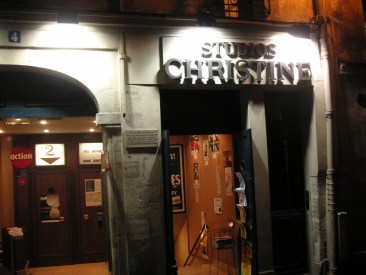
Well, check it out I did. That evening. Upon my arrival, I discovered that the theater in question was the Action Christine, tucked away on the tiny rue Christine near the Odéon metro stop. It has been a theater specializing in classic Hollywood since 1973, and is located inside a historic building with a carriage entrance from the 1600s. I was in love.
The movie they were playing that night was My Man Godfrey, and when I went to the ticket window, the woman on duty asked my age. I was 25 at the time, and the woman told me that guests under 26 get in for only 3 euros. So I filled out an application with some ID proving my age, and I got a discount card that let me in the theater for only 3 euros, each time I decided to come to the movies.
Needless to say, with a 3 euro price tag, I went nearly every evening. At the rue Christine I saw All About Eve, Tobacco Road, Leave Her to Heaven, It Happened One Night, Gentlemen Prefer Blondes, A Star is Born, Mildred Pierce, and countless others. It became my ritual after school to head east on the metro and get off at Odéon, sometimes get a frozen yogurt up the street and then go to the Action Christine.
Shortly thereafter, I saw a flyer at the Action Christine advertising a movie theater on the rue de l’École de Medecine, just up the street. The next day, I went to check it out and it was another Action theater, also playing Hollywood classics! This one was called the Action Desperado, located just a few blocks from the school of medicine, after which the street was named.
For the rest of my time in Paris, I kept schedules for both the Action Christine and the Action Desperado displayed prominently in my apartment. Sitting in those tiny, darkened theaters, watching “my people” on the screen, I felt so happy and joy-filled that I couldn’t stay away. I started to get homesick around month 4, and I credit the classic movies at the Action Christine and Action Desperado for giving me that dose of home that I so desperately needed.
Today, the theaters still run the classics. Glancing at the schedule for the Action Christine (now called Christine 21, as the owners have changed), there seems to be a Marilyn Monroe theme today, with The Misfits, All About Eve, The Seven Year Itch, and Bus Stop playing in those two tiny theaters that I know so well. They’re also having showings of Bringing Up Baby, The Scarlet Empress, Duck Soup, and The Informer.
On some of the darkest days of our history, movies have had the power to lift us up and carry us to a different, more decent world. So if you’re in Paris today, on a day when you can expect to be overwhelmed with grief, sadness, and tragedy, go to one of these theaters and be transported, while at the same time giving love and support to one of the hidden cinematic treasures of the beautiful city that is Paris.
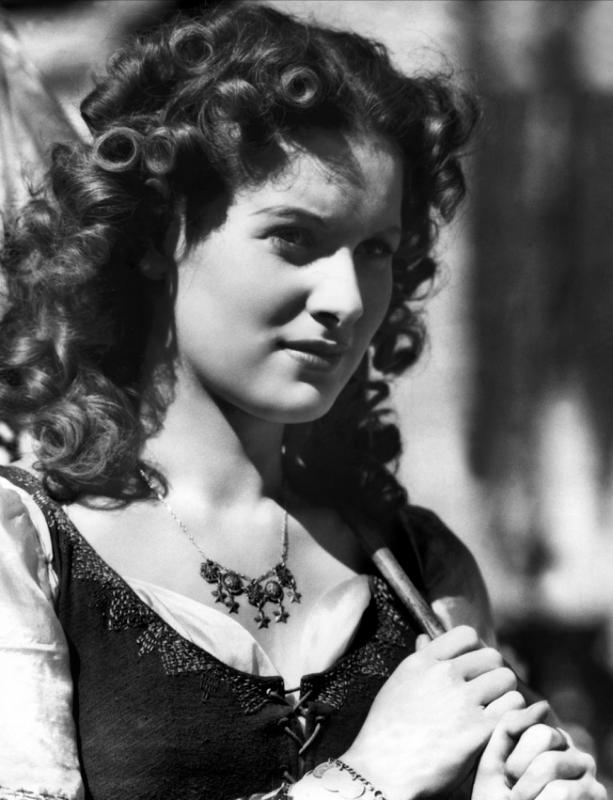
Maureen O’Hara, whose subtle Irish beauty and fiery red hair made her a favorite of director John Ford, died yesterday in her sleep at 95. In recent years she had moved from her home in the south of Ireland to Boise, Idaho, to be with her family, and was continuing to make appearances as late as 2014, when she appeared at the 2014 TCM Classic Film Festival.
Born Maureen FitzSimons in the Dublin neighborhood of Ranelagh on August 17, 1920, Maureen had a few bit parts in 1938 before making her formal debut with her mentor Charles Laughton in Jamaica Inn in 1939, which was followed by The Hunchback of Notre Dame (1939) and Dance, Girl, Dance (1940). In 1941, she played Angharad in How Green Was My Valley directed by John Ford, with whom she would go on to make 5 feature films and whom she would always name him as her favorite director.
With Walter Pidgeon in How Green Was My Valley (1941).
She became an American citizen in 1946, and raised issues with the naturalization documents that listed her as English instead of Irish. She successfully lobbied to have the documents changed, and it marked the first time in American history that an Irish person was declared a citizen of Ireland, independent of Great Britain. “It was one hell of a victory for me,” she later wrote, “because otherwise I would have had to turn down my American citizenship. I could not have accepted it with my former nationality being anything other than Irish, because no other nationality in the world was my own.”
Her bright red hair made Maureen a natural for Technicolor, and with John Ford directing, she made The Quiet Man with frequent co-star and long time friend John Wayne in 1952. In The Quiet Man, set in Ireland and filmed in Cong, County Mayo, Maureen was able to show the national pride for which she had fought so hard 6 years earlier, and was able to speak a bit of Irish Gaelic while the beautifully photographed Technicolor accentuated the Irish landscape.
In an interesting side note, the dialogue in this clip translates to a situation in which she had “sent her husband from her bed,” and was written in Irish Gaelic in order to avoid the censors.
She married several times, but the love of her life was Charles Blair, a pilot who died in a plane crash in 1978. She had one daughter, Bronwyn, with William Price, and in her last years lived with her grandson, Conor.
With daughter Bronwyn.
I was lucky enough to meet and spend time with Maureen O’Hara in 2011, while I was studying abroad in France and had the opportunity to travel to Ireland for the Maureen O’Hara Classic Film Festival, organized by several friends of mine and taking place near her home in Glengarriff, County Cork. The festival included showings of several Maureen O’Hara movies on the big screen, as well as a signing event where Maureen signed my copy of her book, ‘Tis Herself.
Because my friends organized the event, I had the great privilege to be invited to join Maureen for a chat in the hotel pub on the last night of the festival, where she joked, told stories, and was just as fiery and wonderful as I had hoped she would be.
This is a video made by my friend Sara, who helped to organize the festival and who showed this movie on the big screen with Maureen there. It moved Maureen to tears at the festival, and it now moves me to tears remembering her.
Starting tomorrow and continuing through the month of October, TCM will partner with Women in Film Los Angeles to focus on the women behind the camera with their much-anticipated Trailblazing Women programming. Spanning from the earliest days of cinema to the present day, TCM and WIF will present a diverse array of viewing choices that highlight some of the most noteworthy films honoring women’s role in the shaping the history of Hollywood.
Co-hosted by film historian Cari Beauchamp (be sure to read her fascinating essay on Trailblazing Women here), actress Illeana Douglas, director Amy Heckerling and several other notable women in Hollywood, the series will kick off with early films of Lois Weber, Alice Guy-Blaché and Frances Marion, including a showing of the first film ever directed by a woman, Alice Guy-Blaché’s La Fée aux choux (1896).
La Fée aux choux (1896).
The full schedule can be found here. If you’re unsure what to look for, please be sure to read the editorial by my good friend, employee of Rotten Tomatoes and expert on women in film, Marya E. Gates. Marya has spent the past year watching solely films directed by women, and has written a thorough rundown of all the highlights of TCM’s programming.
The programming will air on Tuesdays and Thursdays in TCM’s prime time spots. In this era when women are still shockingly underpaid and undervalued in the industry, it is a key time to bring these issues to the forefront in a meaningful way, and this programming is the perfect way to do just that.
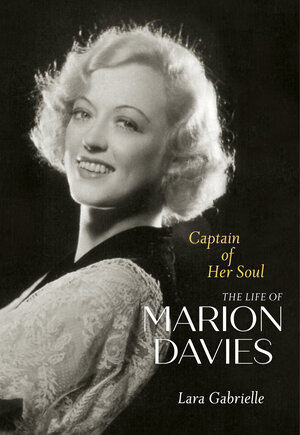
Captain of Her Soul: The Life of Marion Davies is now available at your favorite bookseller! Click hereto order it, and visit mariondaviesbook.com for all the latest.
Backlots is devoted to honoring and celebrating all aspects of classic film and is written by Lara Gabrielle, a California-based classic film writer and historian. Lara is the author of CAPTAIN OF HER SOUL: The Life of Marion Davies (UC Press, 2022).
Here you will find pieces on frequently seen classics and some lesser-known gems, as well as book reviews, festival coverage, and pieces on the history, theory and culture of film as it relates to the study of classic cinema.
Enjoy the site, and thanks for reading!
AFFILIATIONS & AWARDS
2019 CMBA Award for Best Profile of Classic Movie Performer or Filmmaker--"The Activism of Myrna Loy"
Winner of the 2018 CiMBA Award for Best Classic Movie Series, BACKLOTS AT THE COURTHOUSE: OLIVIA DE HAVILLAND VS. FX
Winner of the 2014 CiMBA Award for Best Profile of a Classic Movie Performer or Filmmaker: A Q&A WITH JOAN FONTAINE IN HONOR OF HER 96TH BIRTHDAY
Winner of the 2011 CiMBA Award for Best Classic Movie Discussion, THE FINAL SCENE OF THE HEIRESS
I am honored to be a judge of the Animal Film Festival in Grass Valley, CA.
EVENTS
BACKLOTS ON THE WEB
Join us at the Backlot Commissary, the place for Backlots' readers to share content and discuss movies!
Walter Pidgeon and Greer Garson in "Mrs. Miniver."






























_03.jpg)

 Backlots