Yesterday, right in the middle of the San Francisco Silent Film Festival, I found out that Celeste Holm passed away. Unable to break away from festival coverage, I haven’t had a chance to address her passing until now, but news of her death is already circulating through the classic film world and her loss is being intensely felt.
A follower on twitter messaged me yesterday with a direct question: “What do you plan as a tribute to Celeste Holm?” The follower didn’t ask “Do you plan a tribute?” or “Have you thought of a tribute?” The question was asked in such a way that it was a given that I was going to make a tribute to her in some form or another. I think that really says a lot about Celeste Holm. She had an impact on classic film that I think too often goes unnoticed or unappreciated, but to classic film fans, she was one of the greats and provided an incredibly important backbone of so many of our great movies.
Here are some of Celeste Holm’s most celebrated films:
Though never by any means a lead actress, she was nonetheless a star, in a similar way t0 the stardom of Thelma Ritter–no matter how small her part was, she was always noticeable, and never expendable in a film. She always helped to carry the story.
Celeste Holm’s later life was marked with problems. In 2004 she married a man named Frank Basile, 48 years her junior, much to the chagrin of her sons who viewed Basile as a golddigger. Basile cut Celeste, now suffering from dementia, off from all contact with her sons, and I don’t know if she saw them at all before she died. My guess is that she did not. Celeste Holm deserved so much better from her later years, and it’s tragic that this not only happened to her, but it’s the story of the lives of many senior citizens now–I know she isn’t the only one this has happened to.
I celebrate her life here with a series of photos. Thanks for reading.
Dear readers, the San Francisco Silent Film Festival has come to a close. Today’s films were all perfect picks for the closing day of a festival, and though I will miss all the live-tweeting and blogging that I have been doing for the past few days, I have had a great time and I look forward to seeing what the festival has in store for next year!
Here is a rundown of today’s events:
First film: THE MARK OF ZORRO
You may think you know Zorro, but you don’t know Zorro until you have seen this original 1920 version with Douglas Fairbanks as the eponymous hero. Produced by his own company, Fairbanks Pictures, the actor gave himself free rein to do whatever he wanted for the film–and that, for him, meant making any desired changes to the original story and, most significantly, doing all his own stunts. Under the studio system, there were often strict rules about stars doing their own stunts, and studios often wouldn’t let their stars get away with it for insurance purposes. Few stars can boast that they did all of the daredevil work themselves, and Douglas Fairbanks is one of them (Gene Kelly is another who did many of his own stunts).
Here is a clip of Douglas Fairbanks doing a particularly impressive stunt sequence in the film:
The movie itself is immensely entertaining and amusing, and in my opinion it loses NOTHING to time. It’s just as fresh and relevant as it was in 1920, and it really feels like you are watching a movie that could have been made yesterday. I had a lot of fun with this one! To top off the thrilling experience of seeing it on the big screen, a number of members of the Fairbanks family were there for the screening, and one of them looked exactly like Douglas Fairbanks, Jr. in his later years, which was interesting to see.
Second film: THE DOCKS OF NEW YORK
My friend Marya over at Cinema Fanatic, whom I sat with throughout the festival, was particularly excited about this film. Directed by Josef von Sternberg, known primarily for his dark German films and his collaborations with Marlene Dietrich, The Docks of New York was a step away from what he was used to, and from how audiences perceived his work. It is a beautifully simple plotline about a young woman (based on dialogue later, it may be inferred that she is a prostitute) rescued from a suicide attempt by a ship worker named Bill–they fall in some semblance of love and marry quickly in a bar. The next day she is indicted for “stealing some clothes” (clothes used to warm her after her suicide attempt in the icy East River) and sentenced to 30 days. Bill takes the blame for her, is sentenced to 60 days, and the film ends with the woman telling him she’ll wait for him. Elegant and to the point. The speaker before the film compared it to a poem–a simple structure that simply provides a base for emotional output. As he said: “Who knew von Sternberg had a heart?”
Third film: EROTIKON
A funny farce about a woman courted by two suitors is Erotikon, a 1920 Swedish movie concerning an entymologist who seems to know more about bugs than women. The real merits of this film, for me, were aesthetic. The intertitles were really beautiful, written in lovely script with little drawings above the words relating to the current scene. The highlight of the screening for me was to hear the Swedish subtitles read aloud in English rather than seeing them projected on the screen–the man doing it was very funny, and his delivery of the lines often left me giggling well into the next scene.
Fourth film: STELLA DALLAS
If a person knows Stella Dallas at all, it is normally the famous 1937 version with Barbara Stanwyck that immediately comes to mind. However, this 1925 version of the story is the original, and no less heartbreaking than the famous one. The story goes that Stella Dallas, a rather uneducated woman with a young daughter, separated from her husband due to the distance of his work, is trying to give her daughter the best life she can. As the daughter grows, her friends begin to pick on Stella for being a “different” kind of person, and Stella begins to feel that she is not adequately providing for her daughter. Sending her daughter off to live with her wealthier father in New York and finally procuring a divorce so the father can marry a more “suitable” wife, Stella is a selfless woman with great insecurities. I don’t want to give away the ending, but suffice it to say that at the end, Stella is changed, and not necessarily for the better. This story reminded me a little bit of Mildred Pierce, but without the ingratitude that Veda carries, and it is a much softer, gentler story about a mother’s sacrifices.
Fifth film: THE CAMERAMAN
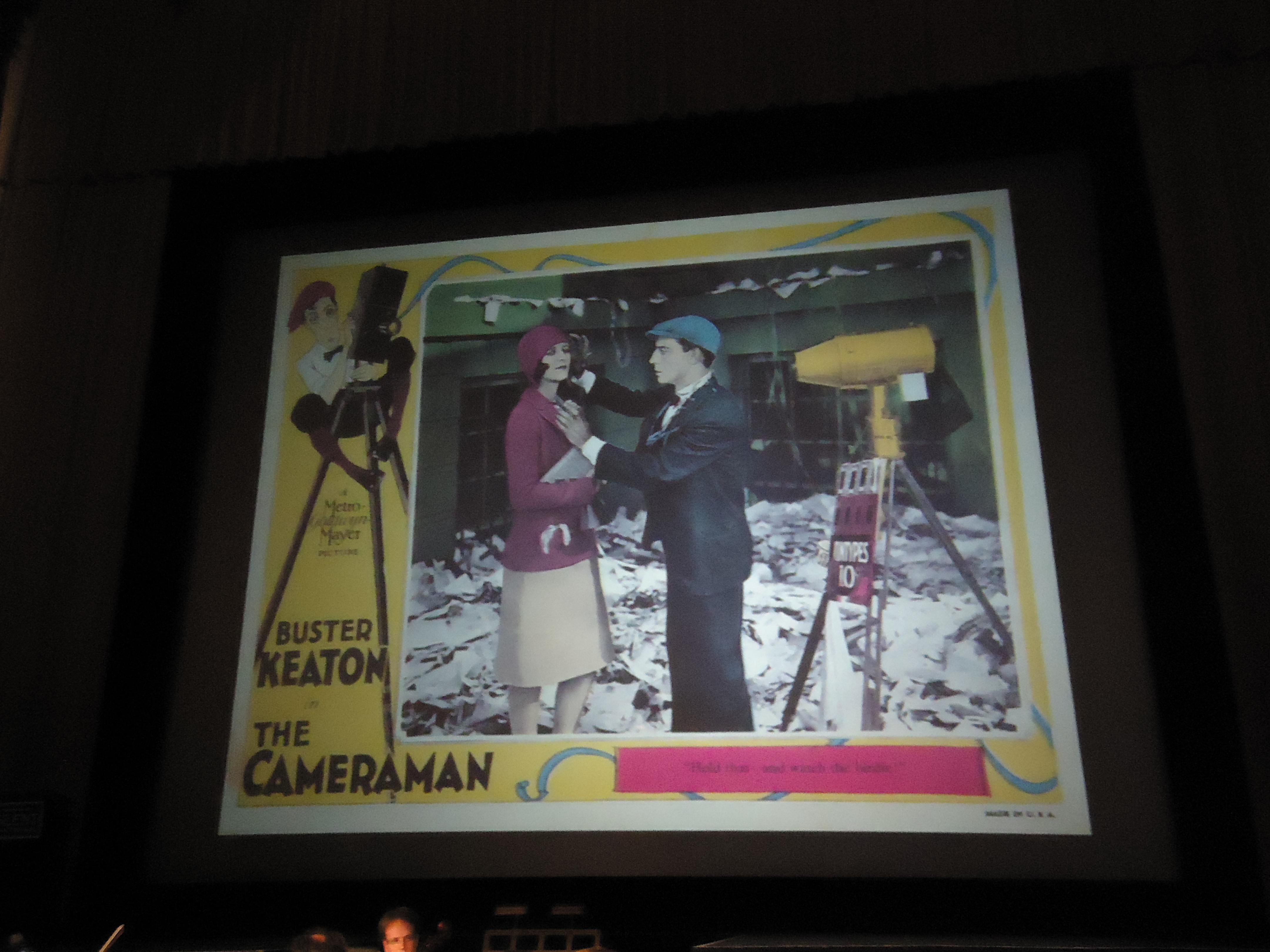
The final film of the festival was what has been called the last great Buster Keaton movie–1928’s The Cameraman. In it, Keaton plays the typical Buster Keaton character–an awkward, clumsy who also possesses a heart of gold and a sweet nature. In this movie, Buster tries to break into the photography business, mostly because a girl he likes works in the office, and he ends up causing mayhem everywhere. Buster Keaton has a very paradoxical aspect about him–in being clumsy, he is agile. I suppose in order to act clumsy, you have to be agile in order to make it work, but his stunts are those of an unusually coordinated person. I adore Buster Keaton, I think he is one of the most endearing characters onscreen, and his legend is well-deserved.
The showing was sold out, and to close the festival, the sponsor, Fandor, handed out Buster Keaton masks and told everyone to hold their Buster Keaton mask over their face for a picture. The audience picture should be up on Fandor soon, so if you’d like, go check them out at fandor.com.
Another special treat from tonight was a special showing of A Trip to the Moon, right before The Cameraman. That movie, no matter how many times I see it, never fails to give me chills and inspire awe.
Here is the complete film of A Trip to the Moon:
That’s it for my festival updates! Regularly scheduled blogging on this site should resume tomorrow.
Thanks for reading, and I can’t wait for next year!
As is a running theme throughout the festival, today’s lineup focused on recent restorations of newly discovered or newly constructed prints. For me, the most interesting restoration story from today had to do with The Spanish Dancer, and how the film was put together like a puzzle, using pieces found all over the world individually. The pieces were spliced together, and the complete film began to emerge as a whole unit, as it had never been seen since its release in 1923. It is remarkable how resourceful archivists can be in their determination to restore and preserve–it gives me security that these films are safe in their hands, and that we will be able to keep them to show future generations.
Here are the movies we saw today:
First film: FELIX THE CAT
The day began at 10:00 with a series of Felix the Cat cartoons. As they were shown on the big screen in original 35 mm with live music, the showing of the cartoons was introduced by Leonard Maltin as a historic event–they are very rarely seen this way. Indeed, it felt like a historic event. We saw 7 cartoon shorts featuring Felix, and they came alive with the help of some great avant-garde live music. The titles of the shorts:
• Felix Loses Out
• Felix the Cat Trips Thru Toyland (which had some pretty intensely disturbing scenes. It surprised me that they would allow things like hangings in a kids’ cartoon.)
• Felix the Cat Flirts with Fate (my personal favorite, in which Felix goes to Mars. In one scene, Felix begins to do the Charleston in a Mars restaurant, and a waiter says to him “Listen buddy, you can’t do the Charleston on Mars!”)
• Felix the Cat in Blunderland
• Felix the Cat Weathers the Weather
• Felix the Cat in Eskimotive
• Felix the Cat in Jungle Bungles.
Second film: THE SPANISH DANCER
This may be my favorite movie of the day. It was introduced in such a way that didn’t give me much hope for it, but it turned out to be a smart, focused plot following a clever, witty, script. I found myself really enjoying it! Starring Pola Negri and Antonio Moreno, it tells the story of a gypsy girl in love with a count, and when the count is condemned to death for breaking one of the King’s decrees, the gypsy girl goes to great lengths to try to save him. It’s a complex plot, but that’s the basic idea, and I would highly recommend that you see this film when it is released, so I don’t want to give away any major plot points. Another interesting tidbit about this film is that the young prince, whom the gypsy girl saves from falling off a horse at one point in the movie, is played by none other than a 6-year-old girl named Dawn O’Day who would later become known as the 1940’s movie actress Anne Shirley.
Third film: THE CANADIAN
This was a sweet story about love and marriage, and how a woman can make a complete turnaround in her personality when provided with satisfactory circumstances. A sort of cold fish snob by the name of Nora Marsh comes to live with her brother in a roughneck part of Alberta, Canada, and immediately makes a bad impression with her haughty manners and tendency to look down on others. She has no domestic abilities whatsoever, and constantly irritates her brother’s wife. Finally though, she somewhat suddenly proposes marriage to the houseman, and they move in together. It was not a match made in heaven, and they were unhappy for quite some time, due to various hardships they encounter. However, by the end all is mended in a quaint, sweet way that I described to my friend Marya as “very Canadian.” There just doesn’t seem to be a bad bone in this whole movie.
Fourth film: SOUTH
This was a very unusual and special screening of the documentary footage taken by cameraman Frank Hurley on the infamous Shackleton expedition through the frozen Antartctic. Breathtaking film of the landscape of Antarctica as well as profiles of the animals Shackleton encountered, make this film a really intriguing and different documentary. It looks markedly different than any other true-to-life film that I have seen from that era–instead, it resembles more something like March of the Penguins. To top off the unusualness of the film, Shackleton’s original script from when the film was screened upon its first release, was read by an actor accompanying the score.
Fifth film: PANDORA’S BOX
By this point in the evening, I was beginning to feel some exhaustion, but was eager to see this film. The movie was supposed to start at 7:00, but after the staff cleared the theater to do soundchecks after South, they didn’t re-open for Pandora’s Box at 7:00 as expected. We were told that it would be another 15 minutes or so, but it was a full 45 minutes after 7:00 that they finally re-opened the theater. The movie itself didn’t start until 8:15, and for someone who has been sitting in a theater taking notes and viewing 4 movies over the course of 8 hours, that was too late. I nearly fell asleep in the middle of Pandora’s Box due to the hour and my exhaustion, but managed to keep myself awake long enough to talk about the film in this post. It was a very interesting story of how this film came to be–there exists no original negative, all the footage they have comes from the original restoration that was done years ago, and the funding for this restoration comes from none other than Hugh Hefner, of all people. The film is an exquisite example of German expressionist filmmaking, that reached a height in Berlin in the 1920’s and was the genesis of countless other philosophic movements within filmmaking over the past 90 years. The film tells the story of a woman, Lulu, who simply allures men and enjoys them. When she accidentally/is forced to commit a murder, she is sentenced to 5 years in prison but manages to escape. The ensuing details all lead to Lulu’s further spiraling into problems and ultimately…well, I won’t give away the ending. This showing was only the second time this restoration had been seen by a North American audience, and it was the world premiere of a new score for the film, which was absolutely stunning.
I can’t say that I was wild about the restoration. It made the image too modern, too perfect. A movie from this era should be grainy, it should have a specific look to it that was lost in this restoration. It looked like it came from a DVD, or should have been a scene in The Artist. I’m glad they restored it, but it would have been more appealing to me if they had taken care not to wipe away all the grain.
Unfortunately, due to the extremely late start of Pandora’s Box, I was not able to stay for the sixth film: THE OVERCOAT, owing to my own exhaustion as well as concerns for getting home safely and in time to write this post. I was disappointed, as I had planned on reviewing every film for this blog, but I felt I needed to take care of my health first. Sometime in the future, I will get a copy of The Overcoat and review it here, to make up for missing it at the Silent FIlm Festival.
Today was the first full day of the San Francisco Silent Film Festival, and today’s lineup featured a very diverse selection of films–ranging from all-American flirtatious Clara Bow in Mantrap to the troubled toymaker played by Ruan Lingyu in Little Toys, a rarely seen Chinese film allegory for the struggle against Japanese occupation in the early 1930’s. Temptation drives a pharaoh from riches to rags in The Loves of Pharaoh, and temptation draws men to the mysterious and alluring Nina Petrovna in The Wonderful Lie of Nina Petrovna. If a theme were to be chosen for today, it was certainly a day for woman characters who wielded the power in relationships.
The day began, however, with a tie-in to the showing of the new restoration of Wings last night, by way of a talk by Paramount archivist Andrea Kalas who oversaw the restoration of the print. She talked a bit about how the restoration came about, and showed side-by-side examples of how the print looked pre-restoration, versus how it is seen today. It seems that there was severe nitrate deterioration on the film, and in order to get it looking the way it does now, extensive work had to be done–much of it digital. She shared her goals for the Paramount archive, and expressed a desire to prioritize film restoration and preservation in the archive, utilizing digital restoration as much as possible as she believes this is the way the film may be best restored. In response to skepticism about digital technology for film, she replied that we can’t simply ignore that this digital technology exists and the truth is that a film can be beautifully restored using digital technology, why not?
After Andrea Kalas’ presentation came Grover Crisp, who is the head of restoration at Columbia. He talked about the restoration of Dr. Strangelove, which happens to be one of my favorite black comedies. One thing that strikes me about the restoration of Dr. Strangelove is that it really does look like a completely different film post-restoration–the tint of the black and white photography is noticeably different, and it looks much more modern in the restored print. I think I may be alone in preferring the original print to the restored one, but that might just be due to the fact that I’m so familiar with the original print. He also showed us a clip from a newly restored version of Lawrence of Arabia–and it took my breath away. This might be the most fantastic restoration job I have ever seen. You can see every little dot on O’Toole’s face, every wrinkle, specks in his eyes. It’s just spectacular. So if you see it in the store in the coming months, I think it will be worth whatever it costs.
Since there were so many films today, I am going to list them and provide some info on them individually underneath.
First film: LITTLE TOYS
Directed by Sun Yu and starring the beautiful Ruan Lingyu, a legendary classic actress in China, this rarely-seen gem is a thinly veiled allegory for the situation of China under the Japanese occupation. It highlights the life of a simple toymaker trying to make ends meet and keep up with the competition of mass-produced Japanese toys. It’s hard to talk about this movie without giving anything away, so let’s just say that her life takes a series of tragic, devastating turns, and she ends up on the street. The end of the film is a call for action against the enemy, the intertitles of which have never been shown, due to the Japanese censors at the time, and now the current censors in the People’s Republic of China. Beautiful film, with great acting by Ruan Lingyu and also by the children, of which there are many.
Second film: THE LOVES OF PHARAOH
This was Ernst Lubitsch’s last European film before signing a contract with Paramount and moving to the United States. Dealing with a pharaoh who loves a young Greek slave girl who loves another man, it is the story of how one woman can destroy a man. By the end of the film, the Pharaoh (played by Emil Jannings) is a mess, having lost his crown and everything he has because of his love for a woman who loves another. Many parts of the film have been lost, and the intertitles have been translated from a multitude of different languages, so the film today has a bit of a stilted quality to it due to the frequent still shots inserted where film has been lost, and the bright digital rendering of the intertitles is indicative of some problems with obtaining the originals. Still, it is a pretty fantastic thing to watch.
Third film: MANTRAP
I want to start this out by saying that I love Clara Bow. I think she is at once the cutest, the sexiest, and the most coquettish star of her era, and she has a quality that just draws you to her. I believe that was “it,” the indescribable allure that people refer to when they speak of Clara Bow, and that which earned her the nickname “The It Girl.” Mantrap is definitely a vehicle for Clara Bow–there is not much to the plot other than her flirting with people and earning the desire of two men at the same time. Yet it works so extremely well, because it has no pretenses about what it is. It is basically a movie made just to say “How about some Clara Bow to brighten your day?” The man who talked at the beginning of the film discussed the ability of Clara Bow to brighten people’s days–I really want to do a profile of Clara Bow here because she’s such a fascinating character, but for now, I will just say that despite a horrific upbringing she had in destitute poverty, she always exuded a bouncing, bubbling energy that was very infectious. It is also interesting to note that this movie was directed by Victor Fleming, 13 years before The Wizard of Oz and Gone With the Wind, and he and Clara Bow were an item for some time.
Oh and by the way, the ending for this movie is absolutely darling.
Fourth film: THE WONDERFUL LIE OF NINA PETROVNA
What a movie to end the night! Suffice it to say that I have now found myself an overnight fan of Brigitte Helm, the German actress who played Nina Petrovna in this film. Take a look at this clip, and play special attention to her glances.
I believe these are perhaps the most suggestive and seductive glances I have ever seen in any film. The entire audience literally gasped and murmured in awe of them whenever they happened. The story was of a “kept woman” who incites jealousy when she begins a relationship with a young lieutenant. She is the center of the story, and the men are powerless around her–in fact, the very last shot seems to be rather a tease or a snicker at the man who tries to control her. Very interesting movie.
Well readers, the day has finally come! I have been anticipating this festival for many months, and July 12 has always seemed like an eternity away. But tonight, I arrived at the Castro at 6:00, and the evening began! I encountered Marya of YAM Magazine along the way along with fellow blogger Phil at Phil’s Film Adventures, and we schmoozed about movies, festivals and such until it was time to go in.
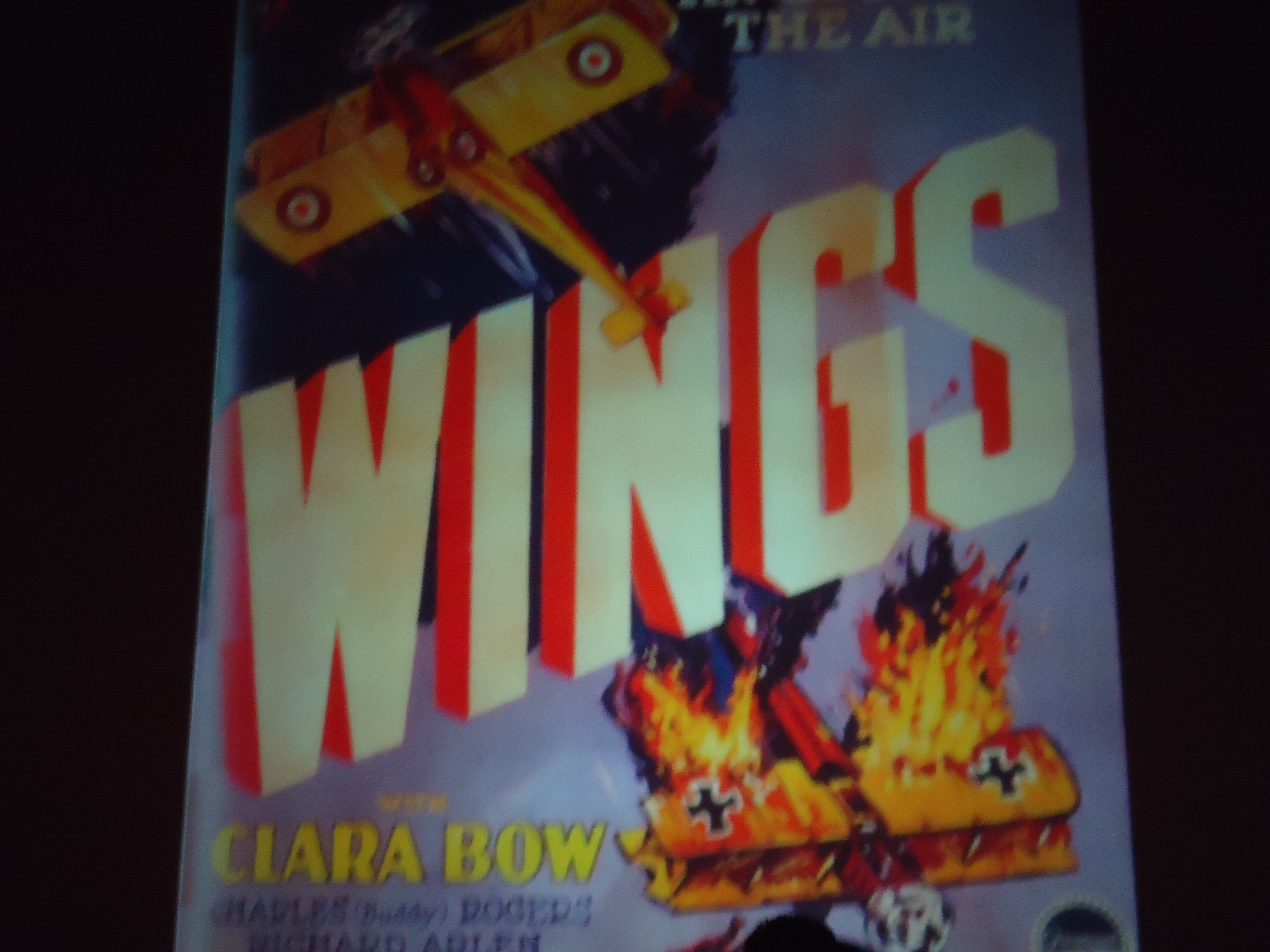
On the screen upon entrance was a long montage of pictures celebrating the festival, Wings, and the 100th anniversary of Paramount Pictures. Most of the images were focused on Clara Bow (the star of Wings), but there were a number of other films represented through photos and lobby cards–notably a colorful, eye-catching lobby card of The Spanish Dancer, to be shown later at the festival. Interspersed between the photos were sponsors’ ads, as well as bits of trivia about Clara Bow, Wings, and Paramount Pictures. Here are some of the bits that I found particularly interesting:
After Clara Bow made Ladies of the Mob, her fan mail urged her to stick to comedy. One letter read: “We don’t want to see you suffer. You stand for happiness with us. Keep on dancing and laughing.”
At the height of her fame, Bow received more fan mail than any other star–in the form of 8,000 fan letters per week.
The company of Wings once waited around for 18 days in order to get the most perfectly clouded sky to meet director William Wellman’s satisfaction for the aviation scenes.
Before the film, the president of the board of the San Francisco Silent Film Festival came up to speak about the theme of the festival this year–the 100th anniversary of Paramount Pictures. He gave a brief history of the company, beginning with its foundation as the Famous Players Lasky studio, to its eventual merger with W. Hutchinson to become Paramount Pictures. It turns out that Paramount Pictures was founded on July 12, 2012–precisely 100 years to the day of the start of this festival. He also introduced the orchestra that would be performing live accompaniment, the MonAlto Motion Picture Orchestra, and also a team of foley directors that would be providing a creative touch to the film–adding a layer of foley sound that would complement the music and the action onscreen. The largest bulk of the foley set was a gigantic bicycle that was used to make airplane sounds during the aviation scenes–the foley artist would spin the bicycle wheel and run a strip of cardboard across the rubber to make a whooshing noise such as fighter airplanes do in the sky. It was remarkably well done, and a fantastic idea.
The bicycles used for sound effects.
Next to speak was William Wellman, Jr., the son of director William Wellman. He gave some insight into the making of the film, and how his father was chosen as director. B.P. Schulberg, the assistant producer at Paramount, advised the studio to choose Wellman because he believed that only an experienced fighter pilot could do justice to such a story. Wellman was a decorated army veteran, and upon being chosen to direct the film, he not only produced one of the most monumental aviation pictures ever made, but he invented the technology that paved the way for all the rest. Nothing like this had ever been done before, and in my opinion, nothing like it has really been done since.
Wings is a movie that stands the test of time in many ways. A gripping account of the lives of soldiers during World War I, it is at different points suspenseful, sad, sweet, and funny, and the movie works all the emotions with great aplomb. It also tells the story of mistaken and forsaken love, and above all, the importance of deep friendship. It could easily have been made today, as the story is timeless and classic and the technology extremely advanced. There are many scenes that are very affecting, and certain points nearly brought me to tears. It is truly an epic film in every sense of the word.
After the movie was over, there was an opening night party, but as I had to get back home to write this post, I couldn’t stay. It was already very late by the time the movie got out, and though I would have loved to have stayed, I had to think about this post and about getting up early for the festival lineup tomorrow.
I hope you’ve enjoyed my commentary so far, stay tuned for tomorrow’s update! Tomorrow’s schedule is jam-packed!
As the San Francisco Silent Film Festival begins tonight, I am enabling a live twitter feed to Backlots so that you may follow all the action as it happens right here on the site. It promises to be a wonderful evening, as the opening night film is Wings, starring Clara Bow, and there is an opening night party after the film. Until the festivities start, you will see previous posts on Backlots’ twitter account, which you can “follow” if you haven’t already.
As a way to bring the very latest in classic film happenings to my readers, I have compiled a list of some of the classic film events for the month of July. I hope that some of you will be able to see some of these! If you are, please let me know how they went–I very much want to attend TCM’s nationwide screening of Singin’ in the Rain, but alas, it conflicts with the San Francisco Silent Film Festival for which I have press accreditation, so I have to prioritize those screenings. Tough life, right? Anyway, here are what I consider to be the major events for the month of July:
Here is the screening that I so badly want to go to. For the 60th anniversary of Singin’ in the Rain, TCM is presenting a big screen showing of the movie in theaters across the country on July 12. It promises to be quite the event. And if you haven’t seen Singin’ in the Rain on the big screen before, you’re in for a treat–it is one of my all-time favorite movies to watch on the big screen. The colors come so alive, and the musical numbers are simply nothing like you remember them on your 25″ TV set. Keep a special eye out for the Broadway Rhythm number and how beautiful it looks on the big screen. It was clearly meant for the theater.
For tickets, click on the poster and follow the instructions on the website.
The 17th annual San Francisco Silent Film Festival kicks off July 12 and continues through July 15 in San Francisco, CA. The festival is highly renowned and very highly regarded, Leonard Maltin has called it “in a class by itself” and is a frequent guest speaker. The centerpiece film for this year’s festival is Pandora’s Box (1925), and other films being shown include Mantrap, Stella Dallas, Wings, and The Spanish Dancer. All showings will be at the Castro Theatre, and I have been honored to receive full press accreditation for the festival, so if you can’t make it, you can follow along right here! Last year’s festival was stellar–you can read my reviews of Die Frau, nach der Man sich sehnt and He Who Gets Slapped by clicking on the links.
For tickets, please visit the official website at http://www.silentfilm.org or click here. If you’re traveling from outside the area, I would advise you to book your hotel NOW. Even though I live just across the bay, there is one night that I will have to spend in San Francisco, and I had a terrible time trying to find a room. All the hotels are filling up fast due to a parade happening that weekend. Something to plan for!
As of June 26, The Artist has been released on DVD! It is now available in all the usual places–movie stores, online, Redbox, and to be ordered on Amazon.com. If you haven’t seen it yet, you are missing out on an incredible piece of cinema. However, like Singin’ in the Rain, it was simply meant to be seen on the big screen, so I’m interested to see how it holds up on DVD. I do believe that it is still playing at a few select theaters around, but I think you’d be hard-pressed to find one, so it looks like if you haven’t seen it, you’ll have to settle for the DVD version. Maybe they’ll re-issue it in theaters someday!
Olivia de Havilland celebrating her 33rd birthday with William Wyler and Miriam Hopkins on the set of “The Heiress.”
Olivia de Havilland is one of the very last surviving major players of classic cinema. A strong personality combined with a finely tuned sense of discipline and practicality has helped to spare her the ills that so often befall Hollywood stars of that generation, and having successfully navigated the system, has lived her life in relative harmony and quiet since retiring (mostly) from the screen in the 1960’s. She made a few appearances in small movies in the 1970’s, but for the most part she chose to focus on raising her children and living a quiet life in Paris, where she has resided since 1953.
I could go on and on about Olivia and my love for her, as a person and as an actress, but suffice it to say that she is one of the most gifted actresses we have ever seen on the screen, and one of the most genuinely considerate people I have ever met. I seem to talk about her in superlatives, because that is what she exudes–the best. I would say that it is a stroke of extremely good luck that she has lived for so long, but it seems to me that it’s more than luck and good genes–she is just meant to be here for a good while longer. She often speaks of feeling as though she has a purpose, what many people cite as a huge boost to longevity. In excellent health and even more excellent spirits, Olivia de Havilland is poised to live to 120.
I won’t go into my story of meeting her, as I’ve already done that once here (if you haven’t read it and wish to, you can click on the entry here or read my guest entry on Joan and Olivia: Sisters of the Silver Screen), I will simply say that it was a great pleasure and an honor to be in the presence of not only one of the great screen actresses of our time, but also one of the kindest people.
Here are some of my favorite photos and videos of Olivia de Havilland through the years. Happy 96th birthday Olivia, and may we be blessed with sharing 96 more years on this earth with you.
With sister Joan Fontaine after Joan won her Oscar for “Suspicion,” 1942 Oscar ceremonies.
As Alice in a community production of “Alice in Wonderland,” in her hometown of Saratoga, CA, age 16.
Winning the Oscar for The Heiress, 1949
Receiving the National Medal of Arts in 2008. It is worth noting that Olivia is a lifelong committed and active Democrat, extremely critical of the war in Iraq and George Bush’s policies. However, here she puts aside personal politics and is gracious and appreciative. We can learn a lot from this attitude of hers that politics is not everything, and we can put our personal feelings aside when they are not relevant.
Recognition for Olivia with a standing ovation at the 2011 César Awards. The acknowledgment of her begins at 1:18.
Well readers, I am back, bright-eyed and bushy-tailed from my cello master class, and ready to tackle Backlots’ next big event, which is my coverage of the renowned San Francisco Silent Film Festival. Leonard Maltin referred to the festival as “in a class all by itself,” and I feel honored and privileged to have been granted press credentials to such an event. Here is a peek at what I will be covering.
Beginning today, I will be taking 1 week off to go down to Carmel to play in a cello master class. Some of you may know that I have been playing the cello since I was 10, attended an arts high school, and have studied with some really great teachers, so this master class is going to be very rewarding and fulfilling for me. However, sadly, there is no internet access there, so I won’t be able to make any posts until I return next Sunday. But be sure to check back then, as I will undoubtedly have a lot of downtime to think about some great classic film subjects to tackle when I return.
I leave you with a documentary made in 1967 (re-edited in 1981) about my favorite cellist, Jacqueline du Pré.
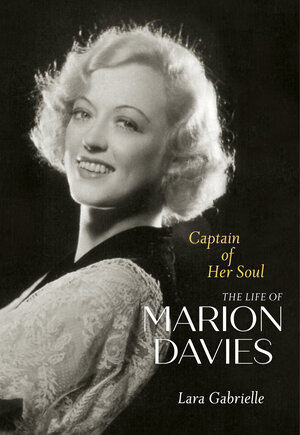
Captain of Her Soul: The Life of Marion Davies is now available at your favorite bookseller! Click hereto order it, and visit mariondaviesbook.com for all the latest.
Backlots is devoted to honoring and celebrating all aspects of classic film and is written by Lara Gabrielle, a California-based classic film writer and historian. Lara is the author of CAPTAIN OF HER SOUL: The Life of Marion Davies (UC Press, 2022).
Here you will find pieces on frequently seen classics and some lesser-known gems, as well as book reviews, festival coverage, and pieces on the history, theory and culture of film as it relates to the study of classic cinema.
Enjoy the site, and thanks for reading!
AFFILIATIONS & AWARDS
2019 CMBA Award for Best Profile of Classic Movie Performer or Filmmaker--"The Activism of Myrna Loy"
Winner of the 2018 CiMBA Award for Best Classic Movie Series, BACKLOTS AT THE COURTHOUSE: OLIVIA DE HAVILLAND VS. FX
Winner of the 2014 CiMBA Award for Best Profile of a Classic Movie Performer or Filmmaker: A Q&A WITH JOAN FONTAINE IN HONOR OF HER 96TH BIRTHDAY
Winner of the 2011 CiMBA Award for Best Classic Movie Discussion, THE FINAL SCENE OF THE HEIRESS
I am honored to be a judge of the Animal Film Festival in Grass Valley, CA.
EVENTS
BACKLOTS ON THE WEB
Join us at the Backlot Commissary, the place for Backlots' readers to share content and discuss movies!
Walter Pidgeon and Greer Garson in "Mrs. Miniver."


























_03.jpg)

 Backlots