Opening Night of Noir City 13: WOMAN ON THE RUN (1950), BORN TO BE BAD (1950)

The 1407 seat Castro Theatre was packed solid last night for the opening night of what has become a veritable San Francisco tradition, the Film Noir Foundation’s Noir City film festival.

For the past 13 years, film aficionados passionate about the dark side of classic cinema have flocked to San Francisco to experience this distinctly American genre on the big screen, with films spanning several decades introduced by none other than “the czar of Noir” himself, Eddie Muller. Muller, the head of the Film Noir Foundation and a legend in the cinematic world, is a native San Franciscan and the Film Noir Foundation itself is a San Francisco organization, fitting tokens for a city already deeply steeped in the noir tradition.

But what is film noir? It remains a genre difficult to describe in words, but for cinephiles, it is unique and unmistakable. Usually in black and white (with a few exceptions, Gene Tierney’s beautiful Technicolor noir Leave Her to Heaven is the obvious one), a noir film deals in the dark underbelly of society, riddled with crime, murder, and mystery. Often a beautiful and evil woman takes center stage, a woman who has become known as the famous “femme fatale,” manipulating the men around her and driving them to madness.

Leave Her to Heaven (1945).


Noir films are character-driven, born out of the gangster genre of the 1930s and developing into maturity alongside the United States’ involvement in World War II. The Production Code was solidly in place by the time film noir developed into a genre, and the plotlines often skate smoothly along the rules against sexuality on film, sometimes coming dangerously close to breaking them. Take a look at this scene from Double Indemnity (1944).

The coy and subtle games that the noir genre plays with the Production Code are integral to its makeup, and I question whether the genre could have developed, as we know it, without the implementation of the Production Code. But that’s another post all its own.

The theme of this year’s festival is “Unholy Matrimony,” and all films screened will have something to do with married life…noir style. Last night we were treated to two films set in San Francisco, a world premiere restoration of Woman on the Run, a 1950 Ann Sheridan film, and Born to be Bad, starring my beloved Joan Fontaine in an atypically nasty role. Woman on the Run was the opening film, and Eddie Muller prefaced the screening with a story about its unusual background. The original negative was lost in a fire at Universal many years ago, and the film was presumed lost. Then another copy was found, quite unexpectedly, but in dismal condition. It was restored by the Film Noir Foundation with a generous grant from the Hollywood Foreign Press Association, and this was the print we saw last night.

The story is one of intrigue and mistaken identity–a man witnesses a murder and then runs from the police to avoid going to protective custody and having to identify the killer, thereby risking his own life. To find him, the police go to his wife, who seems intent on helping her husband avoid them. In her effort to protect him, she befriends a man who she thinks will help her husband…who turns out to be the last person who would be helping him.

It is quite a suspenseful and well made movie, and I was pleasantly surprised with how entertaining it was to watch. I was struck by the beauty of Ann Sheridan who, as she aged, looked quite a lot like Rita Hayworth. In her heyday, she was known as “the Oomph Girl,” but never achieved the superstardom of some of her contemporaries, which is unfortunate, and her career declined prematurely. She has a pleasingly deep voice, and much of her acting is done with her eyes, the mark of a true artist.

The second film was Born to be Bad, a movie I’ve seen several times due to my connection with Joan Fontaine. In it, Joan plays Christabel Caine, a man-stealing usurper who destroys the engagement of a couple, then goes on to have affairs with several more men. It is a very unusual role for Joan Fontaine, who is known for playing doe-eyed, naive, well-behaved ladies. She never truly rises to the occasion of this character of the man-hungry snake and it’s not her greatest role, though she’s never looked more beautiful and she radiates charm. It’s a fun movie to watch and it was wonderful to see it on the big screen.

Also, the poster is one of my all-time favorites.

I will be attending Noir City screenings all this week. Stay tuned for further coverage!
 

Backlots at Noir City X-Mas–O. HENRY’S FULL HOUSE

Hello, readers! I’m coming to you from Los Angeles International Airport, where I am off to France for a few weeks. But before I go, and given that it’s Christmas tomorrow, I want to give you my report of Noir City X-Mas, which I attended last week at San Francisco’s Castro Theatre.

Noir City is a San Francisco tradition. The main festival attracts film fans nationwide, and has become an integral part of San Francisco film culture. San Francisco itself has a noir feel to it, and has been the setting for many key films of the genre, so it seems fitting that this city has the honor of hosting Noir City every year.

And for the past 5 years, film fans have enjoyed an extension on the main Noir City festival–Noir City X-Mas, in which Christmas-themed noir films (or Christmas-themed films with a noir connection) are shown at the Castro Theatre. This year I attended with a friend of mine, and we enjoyed a showing of a film I have been wanting to see for many years.

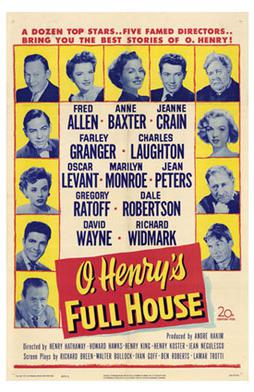
O. Henry’s Full House (1952) is not a noir per se (though one sequence certainly is), but, as Noir City founder Eddie Muller pointed out beforehand, the history of the author O. Henry is one right out of the noir playbook. Employed by the First National Bank of Austin in 1891, he was charged with embezzlement in the mid-1890s and spent three years in jail, where he wrote many of his stories. The movie consists of a series of short vignettes, all written by O. Henry and featuring a smattering of the brightest stars in Hollywood. A young Marilyn Monroe appears alongside Charles Laughton, Anne Baxter alongside Jean Peters, Jeanne Crain with Farley Granger, and Fred Allen with Oscar Levant, in a very funny sequence that was originally cut from the film called “The Ransom of Red Chief.”

Fred Allen and Oscar Levant, perhaps two of the dryest comedians ever to exist, seem a match made in cinematic heaven. But for 1952 audiences, their comedic stylings were too much to handle. Described by Eddie Muller as “postmodern” comedians ahead of their time, many of the jokes in “The Ransom of Red Chief” went over the heads of 1952 audiences and hence the sketch was deemed a waste. But today, this sequence is uproariously funny and a supreme example of O. Henry’s legendary ironic wit. The story of two drifters who scheme to kidnap a child for ransom and their choosing of the most ill-behaved child in town, both Allen and Levant are at the top of their game and the little boy looks to be having a ball of a time playing the most obnoxious child on the planet.

The highlight of the movie is perhaps its best-known sequence, “The Gift of the Magi,” in which Jeanne Crain and Farley Granger are a poor couple very much in love with each other, but with little money for Christmas presents. Desperately wanting to give the other a gift, each of them makes a huge sacrifice–Jeanne Crain cuts and sells her hair while Farley Granger pawns his beloved watch. Their presents for each other? A watch holder and a barrette. Though initially rather materialistic in tone, the sketch ends on a humanistic tone, in which each of them realizes that their love is enough.

All sequences feature wonderful twist endings, and each one is introduced by none other than John Steinbeck, who is the perfect accidental curmudgeon with his pipe, raspy voice, and cranky expression. It’s great fun to see Steinbeck on film, in his only film appearance despite so many of his novels turned into movies.

Thank you to the Film Noir Foundation, for giving us Noir City X-Mas for these past few years. I very much look forward to next year!

Announcing the Fourth Annual Dueling Divas Blogathon!

Readers, I have been so bogged down with research that this is the first moment I am getting to announce our annual Dueling Divas Blogathon! Usually, the blogathon takes place in December, but this year I am going to need to push it back a bit due to various research obligations during the months of December and January.

So hear ye, hear ye–dust off those jungle red nails and get ready, because Backlots’ 4th Annual Dueling Divas Blogathon is coming to the blogosphere on January 31, 2015! We have had so much fun with this blogathon over the past 3 years, and I can’t wait to see what this year holds.

If you haven’t participated in the past, here is a rundown of how it works.

In the weeks leading up to the blogathon, send me your topic so that I can add you to the list of participants. Your topic may be related to any of the following:

  • Classic film personalities who had a rivalry in real life, either over a particular film role or over a personality clash, ie Bette Davis and Joan Crawford
  • Classic film characters who had a rivalry on the screen, ie Mildred and Veda from Mildred Pierce
  • Any dual role played by an actor or actress in a classic film, ie Hayley Mills in The Parent Trap.

You don’t need to feel limited to a single duel between two personalities or characters. You can talk about various clashes a single actor had (ahem…Bette Davis) or duels within a group. In the past, I have written about the duels in The Women, which was a lot of fun.

When you have chosen your topic, comment on this post with what you would like to write about, and I will keep a running list of participants.

Please feel free to take the banner below to advertise on your own site. I look forward to seeing all of the creativity that has been the signature of this blogathon in previous years!

Here are the participants thus far:

NOW VOYAGING will discuss the legendary sister actresses Olivia de Havilland and Joan Fontaine

FLICK CHICK will take a look at the duel between Sandy and Pamela in The Prime of Miss Jean Brodie.

GOLDDIGGER OF 1933 will tell us about the duel between Lina Lamont and Kathy Selden in Singin’ In the Rain.

SILVER SCREENINGS will get creative and talk about 2 divas who LITERALLY duel, Gregory Peck and David Niven in The Guns of Navarone.

CINEMAVENS (a new blog to be up and running by the time Dueling Divas gets underway) will also get creative and pit Libeled Lady against Easy to Wed.

BARRYBRADFORD.COM will tell us about the duels between Vicki Frederick and Laurene Landon in All the Marbles.

SISTER CELLULOID will write about Kay Francis vs. Carole Lombard in In Name Only.

I SEE A DARK THEATER will take on Rags Ragland’s dual role in Whistling Dixie.

MOON IN GEMINI will give us a post about Barbra Streisand’s dual role in On a Clear Day You Can See Forever.

CRITICA RETRO will get murderous with Olivia de Havilland’s portrayal of a suspicious pair of twins in The Dark Mirror.

CHRISTINA RICE will tell us about Bette Davis and Ann Dvorak in Housewife.

See you soon!

imageedit_4_3109370235

CMBA FORGOTTEN STARS BLOGATHON: Eleanor Boardman

Hello readers, and happy Halloween! I’ve been so busy these days that I didn’t have time to put together my Hitchcock Halloween blogathon, but stay tuned in the coming days for the announcement of Backlots’ 4th annual Dueling Divas blogathon, which will go on this year as usual!

Today is the final day of this year’s CMBA Blogathon, in which members of the esteemed Classic Movie Blog Association are writing about stars that have been lost in the annals of history. So many stars of yesteryear have faded due to unfortunate circumstance, and as classic film writers, we are doing our small part to bring back some of the glory that these stars enjoyed in their heyday.

The star that I have chosen for the blogathon is the talented and beautiful Eleanor Boardman, a hugely popular star in the silent era with enormous acting talent and uniquely soft yet defined features. Retiring in 1935 and spending a long and healthy retirement out of the spotlight, hers was the definition of a full life, lived her own way. In addition to having been a movie star, Boardman also spent time as a correspondent for the Hearst newspapers and worked in France for the International News Service, writing a column about American life in Paris.

Eleanor Boardman was born in Philadelphia on August 19, 1898, into a strict Presbyterian family. The method by which young Eleanor became an actress is disputed–by her own account, she left home to study art and interior design at the Academy of Fine Art, while former husband King Vidor claims that she rebelled against the stifling atmosphere of her home life to choose a career path of which her parents did not approve. But what we do know is that as a teenager, Eleanor was named the “Eastman Kodak Girl” and by 1922, she had come to the attention of Goldwyn Pictures, who gave her a contract for $750 a week. She moved to California to begin work and soon met and fell in love with up-and-coming director, King Vidor, who had seen pictures of her as a teenager and was immediately smitten.

In 1923, Boardman made Three Wise Fools with Vidor and subsequently made five more films with him as director in the next four years. The most masterful of the six films that Boardman made with Vidor is The Crowd (1928), a beautiful and sorrowful look at a man in social and economic turmoil. Eleanor Boardman plays his long-suffering wife, and gives a magnificent and nuanced portrayal of a woman conflicted between her love for her husband and her obligation to herself. The movie is one of my personal favorite silent films, and it is clear that Vidor understood instinctively how to direct Boardman toward her best work.

Eleanor Boardman and James Murray in THE CROWD (1928).

Vidor and Boardman finally married in 1926, in a ceremony that was supposed to be a double wedding with John Gilbert and Greta Garbo at the Beverly Hills home of Marion Davies. But when Garbo failed to show, Gilbert was left alone at the altar with Boardman and Vidor, who proceeded with the marriage. The photos from this event are immensely uncomfortable.

Boardman’s marriage to King Vidor produced two daughters, Antonia (born in 1927) and Belinda (born in 1930). But in 1931, shortly after the birth of their daughter Belinda, the marriage began to fail and they divorced the same year.

Following her divorce from Vidor, Boardman met writer Harry d’Abbadie d’Arrast, with whom she would spend the rest of her life. Boardman decided to retire from films in 1935, and in 1940 she married Arrast. Shortly after the marriage, she was hired by William Randolph Hearst’s International News Service to go to Paris to write a column entitled “Americans in Paris,” to appear in the newspapers once a week. She spent a year in Paris writing the column, meeting socialites and writing to her heart’s content, until she contracted tuberculosis and was forced to abandon the job to go to Switzerland to recover.

With Arrast.

She returned to the United States with Arrast, and following his death in 1968 Boardman moved to Montecito, CA. She spent her remaining years in Montecito until her death at age 93 in 1991.

I was lucky enough to talk to Eleanor Boardman’s daughter, Belinda, a few months ago. The spitting image of her mother, Belinda talks articulately and beautifully about the full life she led with her illustrious mother and father, the parties and social scene of Hollywood, and the careers of her parents. Her words about her mother are always kind. Eleanor Boardman’s star burned brightly for a short period of time, but that was exactly how she wanted it. She lived her life her way.

Thanks to the CMBA for hosting this blogathon. Some of the material for this article comes from an interview conducted by Alan Greenberg with Eleanor Boardman in the 1980s. I have the privilege of access to portions of this interview, and have used it to fill in information about the life of this fascinating star. Many thanks also to Alan Greenberg for letting me listen to it.

See you next time!

HOLLYWOOD’S HISPANIC HERITAGE BLOGATHON: Rita Hayworth and the Loss of Hispanic Identity

In the above scene, we are presented with a dichotomy that may not be immediately apparent if one is not familiar with Rita Hayworth’s unique position in Hollywood. In The Loves of Carmen, Rita plays the legendary Carmen, made famous by the popular opera and Prosper Merimee’s book on which it was based. Carmen is a Spanish gypsy, in love with soldier Don Jose, and their love combined with Carmen’s wild nature turns tragic for them both. For Rita, playing Carmen should have been the role of a lifetime. She was fiercely proud of her Spanish blood, and her own grandmother had, like Carmen, been a Spanish woman working in a cigarette factory. But professionally, Rita was in constant limbo in regard to her identity as a Hispanic in Hollywood. The character of Carmen presents a particular irony, as Rita had been all but stripped of her Hispanic heritage within the Hollywood system.

Rita Hayworth was born Margarita Carmen Cansino in New York City to a Spanish father and an Irish-American mother. Her father had been a professional dancer in his hometown of Sevilla, Spain, and Margarita showed the same aptitude as a child. The family moved to California and she became her father’s dance partner at the age of 12. She spent her childhood performing traditional flamenco and Spanish folk dances with her father, up and down the coast between San Diego and Tijuana, Mexico. Steeped in the mixture of her father’s Spanish Roma traditions and the Mexican culture of the dance halls in which she performed, Margarita easily saw herself as Hispanic and identified with the Spanish-speaking locals of Tijuana as much as (or more than) she identified with her American peers.

Dancing with her father.

At the age of 16, Margarita garnered her first film role, a bit part in Cruz Diablo which was billed as a “Spanish Robin Hood.” From there, her career slowly grew, with small, stereotypically ethnic roles in Under the Pampas Moon, Charlie Chan in Egypt, and Paddy O’Day with Jane Withers. With her long, jet-black hair and low hairline, it was difficult for Hollywood to know where to place her in an industry dominated by white, non-Hispanic standards of beauty. In order for her potential to be realized in this milieu, shortly following her signing with Columbia in 1936, studio chief Harry Cohn began altering her image.

She underwent painful electrolysis to shorten her “ethnic” hairline, and dyed her deep black hair a light shade of red. When they were finished, she was a  no longer Margarita Cansino–in addition to whitewashing her physical image, Columbia changed Margarita’s name to Rita Hayworth (a variation on her mother’s maiden name, Haworth).

For the rest of her career, Rita played either non-Hispanic characters, or Hispanic characters with an American overtone.

In Blondie on a Budget, one of her first movies after the transformation, she plays Dagwood’s old girlfriend, an all-American girl named Joan Forrester.

In You Were Never Lovelier, she plays an Argentinian, but an extremely Americanized one.

In Gilda, she plays an American living in Argentina.

In 1948, in The Loves of Carmen, Rita finally got the chance to play a character close to her own heart. But instead of Margarita Cansino in the role, we see Rita Hayworth, the product of a Hollywood that could not promote the career of a young woman with jet-black hair and a low hairline. The Loves of Carmen is a tragic double standard that is difficult to get past, but as much as the studio tried to whitewash her image, they couldn’t take away her identity. In Rita’s dance sequence in the village, Margarita Cansino is still there, dancing the way she did as a child.

This is an entry for the Hollywood’s Hispanic Heritage Blogathon. Many thanks to Kay and Aurora!

See you next time!

TREASURES FROM THE WARNER ARCHIVE: In Name Only

Readers, it has been a long time since my last installment of Treasures From the Warner Archive! I’ve been so bogged down with various film-related projects over the past several months that I feel as though it has been decades since my post about Going Hollywood. But we will fix that this evening with a look at In Name Only, a magnificently cast movie that should have skyrocketed to the top of the list of the most famous Carole Lombard films, but somehow never really made it there.

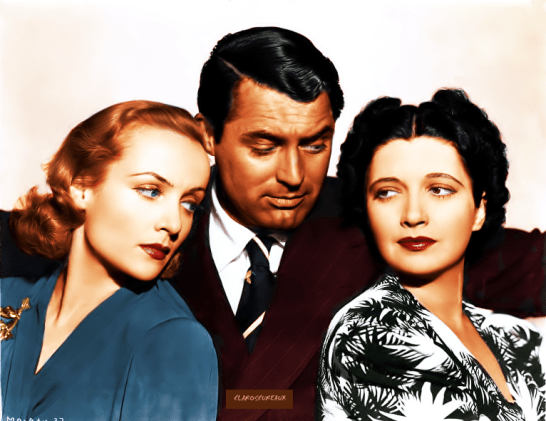
Alec Walker (Cary Grant) doesn’t love his wife, Maida (Kay Francis), but feels stuck in the marriage until he meets Julie (Carole Lombard), and falls in love with her. Maida, however, is not so willing to give him up and uses her cunning and wiles to keep him with her at all costs.

The story of a young man stuck in a loveless marriage who tries to marry the woman he loves is a familiar yarn in these post-Code years, but this is certainly one rife with a great deal of physical beauty. Cary Grant and Carole Lombard bring their own recognized brands of attractiveness to their roles, but it is Kay Francis who steals the show in this regard.

Kay Francis is one of the most under-celebrated beauties of her time. A talented and sought-after actress in the pre-Code days, she was named “box office poison” in 1938 and her career faltered. Carole Lombard, renowned for using her power to revive the careers of her fellow actors, demanded that Kay Francis be her co-star in In Name Only. With Francis’ raven-black hair, olive complexion and alto voice, she should have been in competition with the likes of Hedy Lamarr and Lana Turner. But instead, despite Carole Lombard’s best efforts, she was relegated to character roles for the rest of her career and never truly regained the momentum that her star power had achieved in the early 1930s. A sad ending for a talented and shining star.

kayparamount

This movie may have garnered more attention had it not been released in the legendary year of 1939. Though it is a solid effort, it had no chance of going up against the hype that was afforded The Wizard of Oz, Gone With the Wind, Stagecoach, Goodbye Mr. Chips, and Mr. Smith Goes to Washington. More than anything, I think the failure of In Name Only to live up to its potential was due to the fact that it had the misfortune to be released in the most celebrated year in cinema history.

See you next time!

CiMBA Award #2!

Hello, dear readers!

2014PROFILE

We have just finished the voting period for the CiMBA Awards, the annual blogging award given out by the Classic Movie Blog Association ,and I am proud to say that for my interview with Joan Fontaine, conducted in September of last year, Backlots has received the award in the category of Best Profile of a Classic Movie Performer or Filmmaker.

This is Backlots’ second time receiving a CiMBA Award. The first was in 2011 for “The Final Scene of The Heiress,” and as both my awards have come from articles relating to the sisters de Havilland, I’m beginning to think that this family is good luck. Thank you to the CMBA for this honor. I am thrilled and privileged to have the recognition of such an esteemed group of bloggers.

Joan Fontaine passed away at the age of 96 shortly after she answered my questions for this interview. I cherish the unique and precious opportunity to have been in touch with her, and I will remember her kindness and generosity always. I accept this award for Joan.

SILENT AUTUMN 2014

5c4df-son-of-the-sheik

Every year between their regular annual festivals, the San Francisco Silent Film Festival presents a smaller, single day event at which patrons are treated to all the vibrancy and excitement of the regular festival, on a smaller scale. In the past, the event has taken place in the winter, but as this year’s large festival took place 2 months earlier than years past, what was previously Silent Winter became Silent Autumn in 2014. As usual, Backlots was there for the action.

The day began with Laurel and Hardy shorts, and though Saturday public transportation schedules impeded my ability to see all of them, I arrived in time to catch the final short. What I saw was choice. I have seen a good deal of Laurel and Hardy, and as a friend of mine put it, “It says a lot about Laurel and Hardy that when you just think about them, you smile.” Though I much prefer their silent comedies to their sound work, I must agree that seeing them in any situation puts a smile on the film fan’s face. I regret not seeing all the shorts, but I’m very lucky that I got there in time for the next showing…a rare treat.

Next up was Son of the Sheik, Rudolph Valentino’s final film and featuring a new score by the Alloy Orchestra. Introducing the movie was noted Valentino author (and friend of Backlots’) Donna Hill, who discussed in detail the intricacies of filming and Valentino’s life at the time. It was a glorious movie with a magnificent score, and Donna’s introduction was a perfect segue into the experience. Valentino has been well-represented at the San Francisco Silent Film Festival this year. The opening night movie of the main 2014 festival was The Four Horsemen of the Apocalypse, a real crowd-pleaser and a Valentino staple, and Son of the Sheik seems to be the ideal way to round out a very Valentino-centric year.

On the lineup after Son of the Sheik was a program from the BFI called A Night at the Cinema in 1914, showcasing several clips and shorts from that year recreating what a night at the cinema might have looked like. An eclectic program, featuring footage of the Austro-Hungarian royal family shortly after the assassination of Archduke Franz Ferdinand, a clip of a representative from the Shackleton Antarctica expedition inspecting the dogs that were to go on the trip, and an early Charlie Chaplin short set in, of all things, a movie theater. My favorite of the program was an uproariously low-budget short film called “Lieutenant Pimple and the Stolen Submarine.” Decades before Plan 9 From Outer Space, this short made the best of its low budget, complete with painted sea creatures and deliciously bad special effects. I have no doubt that if it were released today, it would become an instant cult classic.

“Lieutenant Pimple and the Stolen Submarine” (1914)

Following a lengthy dinner break came what was arguably the cornerstone of the festival, a showing of Buster Keaton’s comedy masterpiece The General. Though this film is shown often at silent film events and festivals, it never fails to draw a crowd and at 7:00, the Castro Theater was filled with devoted Buster Keaton fans waiting to see his most famed work. My mother, who became a budding silent film fan after I brought her to see Wings at the San Francisco Silent Film Festival several years ago, accompanied me to this screening and, I am proud to say, has now seen her first Buster Keaton film.

The General, Buster Keaton’s most famous feature-length film, tells the story of a train engineer in Georgia who is rejected from the army but ends up making quite an impact on the war anyway, in a way that only Buster Keaton can. Accompanied by the Alloy Orchestra, we saw Keaton and his co-star Marion Mack perform clever gags and alarmingly advanced stunts, as well as what is considered to be the most expensive stunt performed in the history of silent film (a train toppling over a burning bridge). One of the things that strikes me most about The General is the characterization of Keaton’s female lead. She is a truly feminist character, often the brains behind solving the film’s complications, unafraid to get herself dirty or scale the side of the train. It is a refreshing look at the “damsel in distress,” as this damsel could clearly take care of herself.

Buster Keaton and Marion Mack in THE GENERAL (1926)

The next film was The Cabinet of Dr. Caligari, but my mom needed to get home and like a good daughter, I went with her. But yet again, the San Francisco Silent Film Festival met and exceeded my expectations, living up to my oft-repeated assertion that the San Francisco Silent Film Festival is the best festival of its kind on the West Coast.

The main festival is in late May of 2015, and Backlots will be there as always. Stay tuned!

TCM PRE-CODE FRIDAYS: The Women of RED DUST (1932)

All September long, TCM is shining the spotlight on those films made during the illustrious years of 1929-1934, the saucy and seductive era we call “pre-Code.” In the days prior to codified morality on film, writers and filmmakers were free to tell the stories they thought their audiences would accept, and these films often defy the stereotypes that mainstream audiences visualize when they  conceptualize classic film.

In pre-Code Hollywood, sex and seduction drove plots and defined characters. Women and men knew what they had, and weren’t afraid to flaunt it. It was an open, expressive time for film, and a time to push the social envelope and challenge audiences to analyze those things outside their comfort zone.

At the height of the pre-Code era came Red Dust (1932), a story about an American rubber farmer (Clark Gable) in Indochina who is torn between a stable relationship with one woman, and a steamy affair with another. One woman is a prostitute, and the other a refined lady of the city.

Think you know which one is the stable relationship, and which is the steamy affair?

The prostitute Vantine cares for Dennis Carson after he is shot by the jealous woman with whom he is having an affair (Mary Astor).

The film forces the audience to rethink pre-conceived notions of morality and goodness by switching expected characterizations of women. In this film, it is Jean Harlow’s character of the prostitute Vantine who represents core, upstanding virtue. Though she is a lady of the night, she strives to maintain her standards and dignity when the cards are stacked against her.

Early in the film, after a passionate night with Dennis, the rubber farmer offers her money without a word of judgment. Here we learn two things: though Dennis has just spent the night with a prostitute, he holds his head high the next morning and does what he feels is right. He holds core values and does not shame or feel shamed. We also learn that Vantine is more than just your average prostitute. She yearns for sincere love and a stable partner. When Dennis offers Vantine the money, she sweetly refuses, letting Dennis know that she enjoyed the evening with him.

Mary Astor’s character, a classy, ladylike woman named Barbara, soon arrives in Indochina with her husband, who is to work as an engineer on the rubber plantation. Dennis is attracted to Barbara, and sends her husband away on a long trip whereupon he begins to seduce her.  Dennis is so enamored with Barbara that she persuades her to leave her husband for him, but he soon has a change of heart when he learns just how much her husband loves Barbara. Dennis pretends never to have loved her, and Barbara, in a rageful moment, shoots him. When her husband runs in, they simultaneously cover their relationship and provide Barbara an alibi by saying that Dennis had tried unsuccessfully to seduce her. The film ends with Vantine sitting by Dennis’ side on the bed, reading him bedtime stories.

Visual symbolism. The prostitute, shunned by society, sits on a higher plane than the woman whom society labels as dignified.

This gray moral area and complex characterization of a female character is common in pre-Code cinema, but becomes far less so when one examines movies released from late 1934 on. The modification of the Hays Code in July of 1934 signified a major shift in the portrayals of women on film, and erased once and for all any gray moral area that may have existed prior to the Code’s enforcement. The Hays Code clearly stipulated that there should be no doubt as to where morality existed and where it did not, especially in regard to women, spelling out a clear message for the audience and leaving little room for speculation or analytical thought. In response to these new rules, filmmaking itself experienced a massive upheaval after the enforcement of the Code, and a new cinematic technique developed. In order to make the movies they wanted to make, screenwriters, directors, producers, and actors had to come up with subtle ways to trick the censors and make the film’s message as clear as it could be. The result was the biting innuendo, suggestive costuming, and creative use of props and dialogue that make up the landscape of post-Code cinema.

A movie like Red Dust, however, is a hallmark of the pre-Code era, and would have been nearly impossible to make had it been attempted just a few years later. We’re lucky that it was made when it was.

See you next time!

Upcoming at Backlots

Hello, dear readers! I have returned from my East Coast trip and boy, is it going to be a busy month here on the site! Here are a few things to expect this September:

SILENT AUTUMNLaurelandHardy

On September 20, Backlots will be attending the San Francisco Silent Film Festival’s Silent Autumn event. It promises to be a great day, filled with Laurel and Hardy, Valentino, Chaplin, and Keaton, good company, and world-class speakers. If you’re in the area, it is not to be missed. As my regular readers know, I have huge respect for the San Francisco Silent Film Festival, and attendance at their small events is a great introduction to the larger festival in May. For more information, click here. I hope to see you there!

TCM FRIDAY NIGHT SPOTLIGHT: CLASSIC PRE-CODE

Throughout the month of September, TCM will be highlighting classic pre-codes during their Friday Night Spotlight block. Every Friday this month, viewers will be treated to some of the greatest and most influential films made before the dawn of the restrictive Hays Code, a unique and fascinating period in film history. From Baby Face and The Divorcee to Three on a Match and Design for Living, this is some of the raciest programming you will see on TCM and is not to be missed. For my analysis of the pre-code era, check out a post I wrote a few months ago on the topic.

THE CIMBA AWARDS

Once again, I am in charge of managing the annual CiMBA Awards given out by the Classic Movie Blog Association. The awards will be given out in late September, and I will be announcing the winners here. Stay tuned at the end of the month for the best posts that classic movie blogs had to offer this year. Good luck to all nominees!

Have a wonderful weekend, readers, and see you next time!