Yearly Archives: 2011

STAR OF THE WEEK: Norma Shearer

As we seem to be on somewhat of a birthday kick here at Backlots (so many stars were born in August!), this week we are celebrating the August 10 birthday of Norma Shearer, an actress personifying, for me, what it truly means to be a star. She began her career in silents, and unlike many of her contemporaries, eased seamlessly into talking pictures without blinking an eye. Her soothing, gentle voice was a real asset to her in making that transition, and her charming demeanor appealed to audiences both in the silent era and after movies began to talk.

She was born Edith Norma Shearer in Montréal, Quebec to a financially stable but emotionally volatile family. Her father had his own construction company, but struggled with what is now termed bipolar disorder, which would also affect Norma’s older sister Athole. Her mother Edith was a flamboyant socialite who encouraged her daughter to become a concert pianist–but when Norma showed more interest in becoming an actress, her mother was not opposed. She was concerned, however, about what she thought to be Norma’s lack of beauty–shoulders too broad, hands too big, and a lazy right eye–and this was something that Norma noticed, too. Despite her reservations, she became determined to overcome these obstacles in her appearance, moved to New York, and landed a small role in a picture called The Stealers at Universal in 1921. She eventually made the trip to Hollywood, and having undergone treatment for her eye, she managed to procure a contract with Mayer Studios (soon to become MGM), headed by Louis B. Mayer and vice-president Irving Thalberg.

In "Pleasure Mad" (1923)

After a rocky start there, she was cast in Pleasure Mad, and when the company became MGM Studios in 1924, she was already becoming a big star. She was cast in their first official production, entitled He Who Gets Slapped (see Backlots’ review of this film here), and soon afterward she fell in love with MGM’s vice president, Irving Thalberg. They were married in 1927, and remained so until his death in 1936.

With new husband Irving Thalberg. Shearer converted to Judaism to marry him.

Shearer began in talking pictures in 1929, two years after The Jazz Singer (credited as the first “talking picture”) was released. The picture, The Trial of Mary Dugan, was a tremendous success, and Shearer’s career in talking pictures was assured. In 1930 she convinced her husband to allow her to play the lead role in a new film entitled The Divorcée, a racy piece about a woman who has an affair with her husband’s best friend. That film, too, was a hit, and Shearer won the Academy Award for Best Actress of 1930 for her role.

By this time, because of her success in films as well as her marriage to Thalberg, Shearer was known as “The Queen of MGM.” She was nominated 6 times for the Academy Award, and Joan Crawford, her MGM rival, famously complained that it was impossible to compete with her because “she’s sleeping with the boss.” Ironically enough, Crawford was Shearer’s stand-in during the filming of Lady of the Night (1925), in which Shearer played a dual role, when Crawford was an aspiring starlet.

Crawford, right, playing Norma Shearer's double in "Lady of the Night" (1925)

After her husband’s death in 1936, Shearer began to cut back on film roles. She starred in Idiot’s Delight with Clark Gable in 1939, followed by The Women, a hilarious comedy starring an all-female cast, also in 1939. She retired for good in 1942, and married a second husband, Martin Arrougé. She lived a secluded life after retirement, and died in 1983 following a battle with Alzheimer’s disease.

Norma Shearer is one of the great ladies of the early motion picture years. I am always happy when I see her movies playing at the classic movie theaters around my house, because it means that her glamor, acting talent, and beauty (and yes, she WAS beautiful, despite all she thought to the contrary) are not forgotten.

Here are some clips. Happy birthday, Norma!

Lady of the Night, 1925

The Women, 1939

Idiot’s Delight (1939) had two endings. Here are both of them. For those who haven’t seen the movie, I won’t say which is the real one!

Happy birthday to Billie Burke!

What a birthday weekend! Yesterday was, of course, the 100th birthday of Lucille Ball, for which a brilliant blogathon was organized over at True Classics, and today marks what would have been the 127th birthday (whew!) of one of the truly underrated character actresses of the 1930’s, the marvelous Billie Burke.
Mary William Ethelbert Appleton Burke (whose name was probably longer than she was) is primarily known for being the kindly Glinda in The Wizard of Oz. She was also featured prominently in such comedies as Dinner at Eight and Everybody Sing, and became known for her birdlike voice and for playing dizzy, scatterbrained characters. She was nominated for an Academy Award in 1938 for Merrily We Live,  and another of her claims to fame is that she was, at one point, married to Florenz Ziegfeld.

It’s a shame that Billie Burke is not so well-remembered today as some of her contemporaries. If people know her at all, it is for her role as Glinda, and though we can’t really be surprised, many of her other roles are just as good, if not even better (and better suited to her talent), than Glinda.

Here is a small tribute. Happy birthday, Billie Burke!

Dinner at Eight, 1933

Topper, 1937

Everybody Sing, 1938

Merrily We Live, 1938

The Wizard of Oz, 1939

With husband Florenz Ziegfeld.

LOVING LUCY BLOGATHON–Lucy’s Lasting Legacy

Lucille Ball is one of entertainment’s most enduring icons. She has been visible for nearly 80 years, and I would venture to say that there are very few people alive today who have not known and loved Lucy for the better part of their entire lives.

I myself discovered Lucille Ball when I was in early elementary school. My best friend and I became obsessed with “I Love Lucy” around the 2nd grade, and we subsequently watched every episode of the series, then moved on to the “Lucy/Desi Comedy Hour” and “The Lucy Show.” We just couldn’t get enough of her. And I think we weren’t alone in this–my dad also seemed to know a good deal about Lucille Ball as a person (he was the one who taught me, at the age of 7, that she had been a starlet and a model, and that at one point had gone by the name Dianne Belmont), so it was evident that he was in love with Lucy, too. She just had a certain something that resonated with people. And I don’t think it was just her comedic genius–there was something about HER that attracted people to her.

Since its series finale in 1957, “I Love Lucy” has proven to be a mainstay in syndication, and has essentially never gone off the air. 54 years after the show ended, it is shown in dozens of languages across the world and continues to get stellar ratings (in fact, the Hallmark Channel is so confident in the ratings of “I Love Lucy” that they are hosting an entire weekend-long marathon of the show in honor of Lucille Ball’s 100th birthday today). Can you imagine a show today still playing in 50 + years, broadcast in different languages all over the world? I can’t think of ANY modern show that will stand the test of time like “I Love Lucy” has.

Since this is a classic film blog, I would like to talk a little bit about Lucille Ball’s early film roles. Alas, they have been somewhat obscured by her absolutely blinding success with “I Love Lucy,” enough that whenever I see a film with Lucille Ball on the big screen, I hear mutterings from the audience “Is that Lucille Ball???” People are surprised that she had any career at all before “I Love Lucy,” and I think it’s a shame, because some of those early roles are very noteworthy and she could have had a monumental success in films had “I Love Lucy” not come along–in my opinion, she would probably have remained a character actress, because of that Eve Arden-esque wit and backtalk at which she was so clever. She did, however, have some good starring success in her early years with Dance, Girl, Dance, the film she made in 1940 with Maureen O’Hara, Du Barry Was a Lady in 1943, and in a number of other quality films at MGM.

Dancing “The Jitterbug Bite” in Dance, Girl, Dance.

She also had a good deal of success in radio, which is not surprising given that unique voice we all know so well. The character of Lucy Ricardo was, in fact, inspired by Lucy’s character on a radio program called “My Favorite Husband,” done in 1948 with Richard Denning.

It’s interesting to note that her voice essentially never changed, from her first moment on the screen straight through the 1960’s. It was then that the smoking caught up to her and gave her the distinctive smoker’s voice that became a trademark of Lucy’s later career. The uniqueness of her voice is something that people don’t often comment on, yet I would imagine that if people closed their eyes and watched an early Lucille Ball film, even if they didn’t know she was in it, they would be able to identify her instantly.

This interview, done in 1973, shows her not only as a lovely human being, but also her immense intelligence. She responds to each question carefully and thoroughly, and knows exactly what she is saying and why she is saying it. The thoroughness, perfectionism and business-savvy qualities in Lucille Ball are legendary. It is said that on the set of “I Love Lucy,” if she found a scene to not be funny, she she would often tell the director so, and proceed to argue with him until she got her way. She knew what was funny and what was not, and she was not about to sacrifice the show to an unfunny scene. Obviously, Lucy’s way always got huge laughs.

The famous scene from the episode “Lucy Does the Tango.” This scene contains the longest studio laugh in the history of the show, and one of the longest in the history of television.

Lucille Ball’s legacy has been strong for many decades, and it shows no sign of stopping now. With the huge amounts of “I Love Lucy” memorabilia being sold at high prices, with the show frequently on in syndication, the plethora of Lucy impersonators and the millions of fans devoted to her, I think we’re going to have Lucy for a long, long time to come.

Thank you to the people over at True Classics for hosting this wonderful blogathon.

Backlots is on the LAMB!


Thank you to the Large Association of Movie Blogs for deeming Backlots quality enough for inclusion in the association! We’re movin’ on up!

Necessary video:

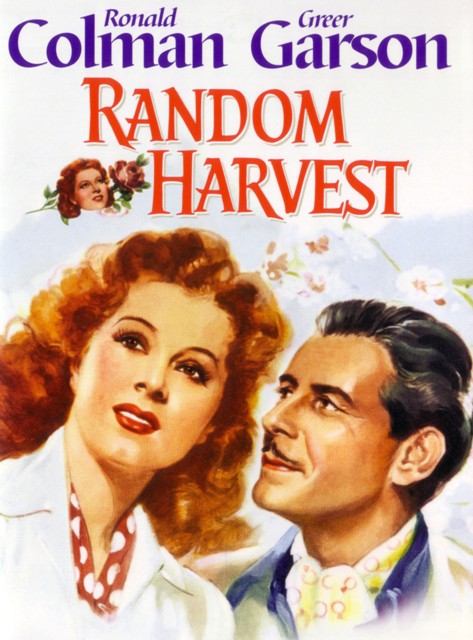
An Appreciation of “Random Harvest” (1942)

Today being Ronald Colman day on TCM’s Summer Under the Stars schedule, I was so pleased to see that Random Harvest had been scheduled for the primetime slot. One of the greatest screen romances and nominated for seven Academy Awards in 1942, this is one of my all-time favorite movies.

A brief speed-through of the (rather complicated) plot: The story is of Paula (Greer Garson), a chorus girl who befriends a shell-shocked army veteran (Ronald Coleman) who has lost his memory. The man calls himself “John Smith” or “Smitty,” though he knows that is not his real name. Paula and Smitty become great friends, ultimately falling in love and getting married. Smitty’s condition improves and he finds work, and after Paula gives birth to their child, a boy, he goes off to an interview. He is hit by a taxi on the way and the shock reverses him back to his old self–his life with Paula is completely erased from his memory. He returns to his original life and family, and becomes a successful businessman named Charles Rainier, taking over the family company. By this time Paula has lost her son, and having searched for Smitty for many years, she finds his picture in the newspaper as Charles Rainier. Under the name of Margaret, she goes to work as his secretary, hoping to jog his memory. He does not remember her, and she does not tell him of her true identity. She constantly drops clues about his identity, but to no avail–the memories do not come back. Eventually Charles goes into politics, and proposes to Margaret. She accepts. As they build (or rebuild) a life together and Charles’ political life flourishes, Margaret tells Charles about her life before him–not revealing that the man she lost was him. He tells Margaret of the past he doesn’t remember, and hopes that their marriage can help heal their heartbreak. Margaret finally can’t take it anymore and goes on a vacation–visiting the little cottage in Liverpool that she and Smitty inhabited when they were married. Charles is called to handle a strike in Liverpool, and when he goes to mediate, the surroundings trigger memories in him. His life as Smitty slowly comes back, and he makes his way to the cottage, he and Margaret/Paula meet–and Smitty’s memory comes back. The film ends with Smitty yelling “Paula!” and a passionate embrace.

It is a beautifully done film in all respects. Despite its intense romantic tone, the plot is pretty believable (and probably even more so to 1942 audiences, who were accustomed to hearing about shell-shock victims) and we really identify with and feel for the characters. Greer Garson is magnificent, as is Ronald Colman. I must say that there is really something about Greer Garson in black and white. We all love seeing her flaming red hair in the color movies she made, but her lovely chiseled features are better accentuated in black and white and I actually prefer her in films like Mrs. Miniver and Random Harvest rather than her color films. She is certainly a stunningly beautiful woman, and the softness of the photography in Random Harvest really serves her well. Not to mention, of course, the quality of the material shows us her tremendous skill as an actress. Both she and Ronald Colman were nominated for Academy Awards for their performances, in addition to 6 other nominations for the film:

  • Best Picture
  • Best Director (Mervyn LeRoy)
  • Best Supporting Actress (Susan Peters, for the role of Charles’ stepniece, with whom he has a love affair)
  • Best Screenplay
  • Best Music
  • Best Art Direction

This song, sung at the very beginning of the film, when Paula and Smitty first meet, I think is the highlight of the film:

I truly adore Random Harvest. If you haven’t had the chance to see it, I highly recommend it.

Lucille Ball in “Stage Door”

Lucille Ball is Backlots’ Star of the Week, and Stage Door is one of her best and most prominent early films, not to mention one of my favorites. Here is a compilation of Lucy in the movie. Enjoy!

With Katharine Hepburn and Ginger Rogers.

MOVIE REVIEW: Devotion

For the Ida Lupino blogathon over at Miss Ida Lupino, I am going to profile Devotion, a film that stars both Ida Lupino and my favorite lady Olivia de Havilland. I first saw the film last year, during TCM’s Olivia de Havilland “Summer Under the Stars” day, a day on which I had been taping every single movie that came on (I am a huge Olivia de Havilland fan). I thought it a travesty that I had never seen Devotion, so I rushed home from my summer class to see it live as it aired.

The film concerns itself with the true story of the Bronte sisters–their lives, loves, and writings. As they compete with each other over the affections of Reverend Arthur Nichols, their brother is struggling desperately with alcohol and they try to save him from its ravages. Ida Lupino plays Emily Bronte, Olivia de Havilland plays Charlotte, and Nancy Coleman plays Anne, in a film that has a magnificent subject–but somehow misses its target.

Despite a brilliant cast that I have just outlined, the film itself could not be totally saved. It runs very slowly, with a plot that doesn’t really seem to know where it’s going, and the very seasoned actors seem to be lost in the material. This is a film that could have been so amazingly done, à la Wuthering Heights, but it seems as though the heart of Warner Brothers wasn’t in this one. However, I think that Lupino and de Havilland can really do no wrong, so the film is worth watching if only to see them.

Devotion is notable in being the final film that Olivia de Havilland made at Warner Brothers before her famous 1943 challenge of the studio over her contract. The film was completed in February 1943, but its release was delayed until April 1946 due to concerns over how it would be received while de Havilland’s lawsuit was pending. She won her landmark suit against the studio in a unanimous decision by the court, allowing her to leave her contract without having to serve the six months probation she had incurred while on suspension. The case is now studied by law students in classes dealing with entertainment law, and it set a precedent in the industry, indicating the first rumblings of the eradication of the studio system.

In all, Devotion is a flawed film, but it is worth seeing because of its relevance in the business and because of the pairing of two of the screen’s most radiant stars.

STAR OF THE WEEK: Lucille Ball

MTE4MDAzNDA5OTQwMDIyNzk4

August 6 marks what would have been the 100th birthday of one of the foremost entertainers of the 20th century. A legend’s legend, her mark on the industry has been one of extraordinary importance. She came to be not only the face of the 1950’s and the icon for the emergence of television, but also a groundbreaker for women in comedy and in the business of entertainment production.

It would be too easy for me to talk about Lucille Ball’s contribution to comedy. Everybody already knows about “I Love Lucy” and the impact it has had on popular culture. Everybody knows what a comedic genius she was. I don’t need to bore you with that information–it is so embedded in our society that one can hardly turn on the TV without somehow being reminded of Lucy’s mark on the industry. What I want to focus on is her early and later work, that which is not so well-known and which deserves to be paid more attention to. Young Lucille Ball does not remind me of the dizzy Lucy Ricardo that we all know and love, but rather a smart, wisecracking dame–not unlike the characters Eve Arden played so brilliantly. She had a good bit of fame and popularity during her tenure at MGM, but of course that is all obscured now by her smashing success on “I Love Lucy.”

Lucille Desirée Ball was born in Jamestown, New York on August 6, 1911. Her father, Henry, died when she was 3, and Lucy claimed later in life that she always tried to be a clown, to fill the void that her father had left in her childhood. When her mother, Deedee, married again, it was to a man who was a member of the Freemasonry, and who at one point needed chorus girls for a show at his organization. 12-year-old Lucy auditioned and got the job. So began the career of Lucille Ball.

By the age of 16, Lucy was already on her way to being a legitimate performer. She attended the John Murray Anderson School of Dramatic Art in New York City, and subsequently became a fashion model. Her modeling work led to a job on Broadway, and despite a rocky start, she headed to Los Angeles and managed to get herself some B pictures and uncredited roles at MGM. She soon became known as “Queen of the B’s.”

A brief moment as the flower lady in “Top Hat” (1935)

By the late 1930’s, Lucy was beginning to become a name in Hollywood. She co-starred with Katharine Hepburn and Ginger Rogers in the 1937 hit Stage Door, and also began a radio career that gained her further exposure. By 1940 she was costarring with Maureen O’Hara in a film entitled Dance, Girl, Dance, which showcased not only her tremendous acting talent, but also her ability as a dancer and entertainer.

Dancing the hula in Dance, Girl, Dance.

The film led her to another milestone in her life. Maureen O’Hara writes in her book, ‘Tis Herself:

“While we were in line getting lunch, Lucille started complaining about her next movie, a musical called Too Many Girls. She was worried about it because her new leading man was a younger actor who had never been in front of a movie camera. She called him ‘That Cuban–Desi Arnaz.’….Just as I was telling her how talented and gorgeous he was, Desi walked into the commissary with his agent, Doc Bender. I whispered to Lucille ‘But don’t take my word for it. See for yourself.’ Lucille followed my eyes and I could almost hear the bells ringing in her head. The first words Lucille uttered when seeing Desi for the first time were ‘Oh my God.’ It was love at first sight for her.”

Lucy and Desi Arnaz married in 1940, and in 1948, Lucy was cast as the wacky wife in a radio series known as “My Favorite Husband.” Noting the newly emerging television medium, Lucy and Desi expressed interest in adapting the series for television. After a good deal of skepticism on the part of network executives, Lucy and Desi formed Desilu, their own production company, to launch their efforts in 1950.”I Love Lucy” finally premiered on October 15, 1951.

I read a ratings study once that said that when”I Love Lucy”was on TV, so many people were glued to their television screens that the levels on the water towers all across the country essentially didn’t move. As soon as the commercial came on, those levels suddenly plummeted. When Lucy Ricardo was scheduled to have her baby on the show, ratings for that episode outshone the ratings of the Eisenhower inauguration, scheduled at the same time. Such was the impact of “I Love Lucy.” It broke barriers in all arenas of the entertainment industry–both social and technical. Lucille Ball became the first head of a production studio, Desi Arnaz was the first on network television to utilize the “three camera method” used for innovative shooting, and, perhaps most notably, Lucy and Ricky became television’s first interracial couple. Despite dominating the ratings for 6 years, the Ball/Arnaz marriage suffered throughout the series, and tensions between them led to the show’s deterioration. “I Love Lucy” saw its last episode on May 6, 1957, and following a short series entitled “The Lucy/Desi Comedy Hour,” Lucy and Desi divorced.

Following her divorce from Desi Arnaz in 1960, Lucy embarked on a new project, “The Lucy Show,” centering around Lucy Carmichael, a character who appears to be a sort of liberated Lucy Ricardo. The show ran from 1962-1968.

Lucille Ball was known for her generosity as a performer. Here she acts with rising comedy star Carol Burnett, who plays Lucy Carmichael’s new roommate. Look how Lucy completely steps away from the spotlight, allowing Carol to take the stage and essentially take the crown as the reigning female comedic legend. Many stars have remarked on this quality, including Barbara Eden, who as a young starlet had a guest spot on “I Love Lucy.”. She writes in her book, Jeannie Out of the Bottle, that she recalls Lucy personally glamorizing the dress Eden was given to wear in the show, because she felt it wasn’t good enough for her. In all the books I’ve read, Lucy is described as being a stellar professional, always willing to put her costar first. In the years that followed “The Lucy Show” and until her death, Lucy and Carol Burnett remained very close friends.

By the 1970’s, Lucy’s health began to decline. A lifelong smoker, she developed a deep smoker’s voice that was difficult to ignore. She made a movie version of the musical Mame in 1974, but the film was panned by critics. It has now become a bit of a cult classic, and to its credit Lucy’s costar is the magnificent Bea Arthur, who had come from a Tony-winning turn in the Broadway production of Mame with Angela Lansbury.

In her last years, Lucy withdrew from public life. Her last film was a made for TV movie entitled Stone Pillow, in 1985. In 1989 she appeared at the 61st annual Academy Awards, and received a standing ovation from the members of the Academy. It was to be her last television appearance–she passed away from heart failure less than a month later.

It really is difficult to sum up exactly what Lucille Ball means to the cultural scene today. She is everywhere–from “I Love Lucy” lunchboxes to the reruns of the show in syndication, to the showings of her movies on TCM to the Lucille Ball drag queens in New York and San Francisco. She is truly woven into our culture, and I think it’s a shame that the Lucy people know is often her character Lucy Ricardo, and not the smart, wisecracking sidekick of Stage Door or Dance, Girl, Dance, or the generous performer that so many of her costars remember her to be. There was so much more to Lucy than Lucy.

I leave you with one of my all-time favorite Lucy moments, one of her three appearances on “What’s My Line.”

We’re in the CMBA!!

I just got an email informing me that Backlots has been accepted into the Classic Movie Blog Association!! I am told that it was one of only two blogs to be accepted this round. Thank you, dear readers, for your loyalty, and for your wonderful comments and contributions that make this blog what it is. I really appreciate all of you and your insight, and thanks for reading!

Woohoo!!

Many thanks,

-Lara

THE COSTUMES OF “MILDRED PIERCE” (1945)

Last night I went to see “Mildred Pierce” at the Castro Theatre with Tony, a good friend of mine and fellow classic film lover. I had seen it on the big screen when I was in Paris, but it’s always so much fun to watch it with a huge crowd–especially at the Castro! One thing that really jumps out at me when I watch it on the big screen is just how spectacular the visuals are–the cinematography, the lighting, and the costumes. My friend Tony is a true fashion aficionado, he can tell you who made what outfit, what costume designer was at which studio during what time period, and who influenced whom in the fashion world. When I remarked on the beauty of the costumes in the middle of the movie and asked him who was the designer, I was surprised to hear that it was not a known name.

By way of a quick google search, I found out that the costume designer was named Milo Anderson, a Warner Brothers resident designer who also worked on such movies as The Adventures of Robin Hood and To Have and Have Not. Clearly he deserves more credit than he receives–the costumes in all these movies are spectacular.

The first costume that caught my eye was this one–the sort of default outfit for Mildred. She wears it during her interview at the detective’s office and at the very end of her flashback sequence, so throughout the movie we associate Mildred with this outfit. This is a medium-length fur coat with a matching hat, and a dress whose color (we can’t really tell, but I’m guessing maybe brown?) is matched by her gloves. I am not a fan of fur at all, in fact I’m very much set against it, but Joan Crawford wore a lot of it in this movie and it suits her character.

Veda first appears in this beautiful white shimmering gown with a large white flower in her hair. The color white I think is meant to be a trick on the audience–we assume she can’t have anything to do with the murder that just took place, because she’s wearing these innocent, virginal colors, and wearing them very well. Though this is not my favorite Veda outfit from the movie (the huge flower always makes me think of Billie Holiday for some reason), it is nonetheless a beautiful creation. I think it actually might be the hair that makes it work. Look at those beautiful ringlets.

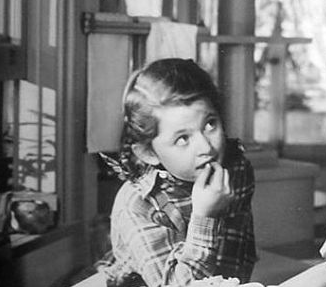
The starkest contrast in this movie is Veda’s younger sister Kay, a tomboy who is forced into ballet lessons when she would rather play football and get dirty. Her costume here really shows her character, and not only her character, but also the versatility of the designer. Among all these beautiful dresses, here he is unafraid to make the little girl look like a total hillbilly.

Here is my favorite Veda costume. Look how EVERYTHING matches color-wise, and how she’s using those accessories–I’m loving that pin, and the collar, and never even mind about that glorious hat. I basically want this outfit.

Eve Arden is one of my all-time favorite character actresses, and here she is dressed up in this bizarre Hawaiian number that seems almost anachronistic. It oddly suits her character though, and when she came on the screen wearing it, the fashion-conscious Castro crowd all started murmuring to themselves about it!

Here are some more brilliant fashion moments from the movie: