Tag Archives: tcm

TCM Programming and the Definition of “Classic Film”

As part of TCM’s tribute to chemistry and physics in film, A BEAUTIFUL MIND (2001) will play on the network tonight. The choice has sparked mixed reactions among fans of TCM on social media today.

In the past 3 years of this blog’s existence, I have spent considerable time discussing the meaning of the term “classic film.” It is a vague description, one that means different things to different people and which tends to polarize those who are loyal to their own particular definition. In this age of social media, I have seen countless debates on the subject on Twitter and Facebook, conversations that get especially heated when TCM decides to show a film that was made relatively recently.

Fans of old films have cause to be wary of TCM turning its back on this programming. The channel AMC, which is now famous for its original content (Mad Men, Breaking Bad) used to be very much like TCM, airing black and white films from the 1930s through the 1960s without commercial interruption, punctuated by its own original educational programming about film history and culture. But in 2002, AMC decided that the cable subsidies they were receiving were not enough to keep the channel going, and began to allow advertising which changed their programming focus to a general one in order to keep sponsors happy.

Though I personally do not worry about TCM shifting its focus (I direct you to the popularity of the TCM Classic Film Festival and the TCM Classic Cruise, a testament to how popular their programming is), I have noticed that they seem to be thinking outside the box with their definition of “classic film,” which is upsetting some viewers who have a very clear concept of what a classic film should look like. Tonight, they are showing A Beautiful Mind, the 2001 Best Picture winner that tells the story of mathematician John Nash and his struggle with schizophrenia. TCM’s Facebook page was alight this morning with a debate on whether or not this is a classic film, questions as to why the network was showing it and counter-attacks questioning whether TCM should even be questioned about their programming.

As I’ve stated before, my own personal definition of a classic movie when I am asked about it is a movie made more or less between the confines of 1916 (when filmmakers were really starting to “get” moviemaking in my opinion) and the fall of the production code in 1968–with several exceptions to that rule allowing for great and culturally significant movies pre-1916 (such as “A Trip To the Moon” and The Great Train Robbery) and post-1968 (such as Cabaret and Amadeus). I would also say that not every movie made between that time period can be considered a classic, but specifying a specific time period helps to get around some of the vagueness and muck that comes along with trying to make a clear-cut definition of anything.

A scene from Amadeus (1984), a movie I consider to be a classic because of the positive cultural significance and lasting influence it has enjoyed.

A Beautiful Mind is a fantastic movie, no question about it. Phillip Glass’ haunting, almost mystical score along with Oscar-winning performances by Russell Crowe and Jennifer Connelly make this movie perhaps one of the technical best of the past 15 years. Would I call it a classic? According to my own personal definition, no. It has not marinated in our culture long enough for us to see if it stands the test of time, and though it won several awards upon its release it has not proven to be culturally pervasive enough to warrant an exception to the  rule.

However, I am open to discussion on this. What is your personal definition of a classic film? Would you consider A Beautiful Mind to be a classic, and worthy of a spot in TCM’s primetime lineup? I look forward to hearing from you in the comments section, and I will also pose this question to my readers on the Backlot Commissary group on Facebook. Feel free to join the discussion here or there!

2013 at Backlots–A Year in Review

A big thank you to my readers for making 2013 a true banner year for Backlots. Here are some of the things that happened on the blog this year:

My attendance at the 2013 TCM Classic Film Festival was far and away one of the highlights of the year. A true movie lover’s paradise, the TCM Festival attracts classic film aficionados from the world over, and TCM certainly delivers the goods. It was great fun interacting in person with my fellow bloggers, whose work I know so well online, and making new classic film friends. A wonderful experience!

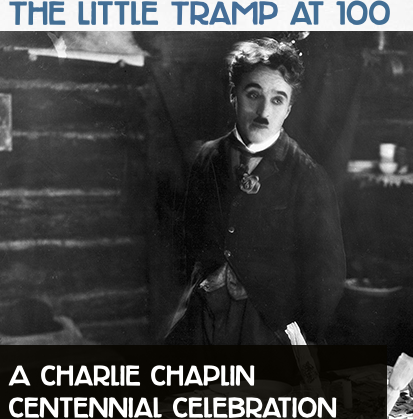
For the second year in a row, Backlots covered the San Francisco Silent Film Festival this past summer. As usual, it was a fantastic event with presentations unparalleled in their quality. Highlights for me included a screening of the hilarious Marion Davies movie The Patsy, an interactive talk with Winsor McKay expert John Canemaker,  and the breathtaking gamelan accompaniment set to the Balinese silent film Legong: Dance of the Virgins by the Sekar Jaya Gamelan Ensemble. The San Francisco Silent Film Festival never disappoints. Stay tuned next year’s festival which will be held over Memorial Day Weekend, and on January 11 for their special celebration of The Little Tramp at 100–celebrating the 100th anniversary of the first appearance of Chaplin’s The Little Tramp. I will be at both events!

Last month, I was honored to be invited to blog for the Warner Bros. 90th Anniversary Tour. We bloggers were treated to a day of exploration at the studio, led by a professional guide, and topped off with lunch at the commissary. We had special access to the costume department and several areas off limits for regular tour members, and it was indeed a special day. Again, I met so many fellow bloggers and had such a good time. Thank you, Warner Bros., for organizing this wonderful day for us!

Screen Shot 2013-12-31 at 4.45.57 PM

The classic film community was graced with several magnificent new books this year. I had the pleasure of conducting interviews with Victoria Wilson, author of A Life of Barbara Stanwyck: Steel True 1907-1940, and Kendra Bean, who is the author of Vivien Leigh: An Intimate Portrait and a personal friend of mine. Both of these works are great monuments in and of themselves. A Life of Barbara Stanwyck is a gargantuan book that features 860 full pages of text and another 200 for source notes, and has proven to be the quintessential, definitive book on the actress. My reading of this book, though it took me less than 2 days, is one of the highlights of my year. Vivien Leigh: An Intimate Portrait is so chock full of previously unseen photos of this staggering beauty that the reader simply cannot put it down. It is displayed prominently, face forward, on my shelf so as not to obscure its beauty. I am so lucky to have had the opportunity to interview these two gifted writers, and I thank them for their interviews with me. Read Victoria Wilson’s interview here, and Kendra Bean’s here.

In what was perhaps my most meaningful personal success of 2013, I had the great privilege to interview Joan Fontaine in honor of her birthday. This was her last birthday, and her last interview. Joan was frail and her health declining, so she kept her answers short. The length of her answers does not matter to me. My interview with Joan Fontaine remains the single greatest privilege Backlots has ever had. Click here to read it. Rest in peace, dear Joan.

This is the video I made in memory of Joan Fontaine. I hope you enjoy it.

Wow, readers. What a year. 2014 is already shaping up to be an equally marvelous year! Here’s to what’s to come, and to you, loyal readers, for helping to make this blog what it has become.

Tragic Beauty: The Story of Ruan Lingyu

The beautiful Ruan Lingyu, known as China’s Greta Garbo, is still revered as one of the preeminent actresses of Chinese cinema.

By Lara Gabrielle Fowler

This evening on TCM’s “Silent Sunday Nights” program, viewers on the channel will see The Goddess (1934), one of the major films featuring Ruan Lingyu, a veritable icon of Chinese cinema. Though her name may not resound to Western ears like the names of Greta Garbo and Marlene Dietrich, she is considered to this day to be one of the most talented actresses ever to appear onscreen in China. She was a massive star during her lifetime and tragically fell victim to the cruelties of the Chinese press, who drove her to suicide at the age of 24.

Ruan Lingyu was born Ruan Fenggen in Shanghai to a father who died when she was six and a housemaid mother. In order to earn money for her struggling mother, she answered a newspaper ad looking for actors, signing with the Mingxing Film Company in 1926 and appearing in her first film, A Married Couple In Name Only, the following year. Over the course of the next nine years, Ruan Lingyu (she changed her given name when she signed with Minxing Film Company) made 29 pictures–all silents–and rose to legendary status in China through picture deals with several high profile Chinese studios such as Da Zhonghua Baihe Company and Lianhua Pictures, where she filmed The Goddess in 1934. She became known as “China’s Greta Garbo,” and developed a reputation for magnificent acting talent to align with her breathtaking beauty.

Ruan Lingyu’s personal life was immensely troubled. Her marriage to Zhang Damin, the son of her mother’s employer, ended in a split due to the gambling habit that had resulted in Zhang’s being disowned by his family. Shortly after leaving Zhang Damin, Ruan began an affair with tea tycoon Tang Jishan and Zhang formally sued Ruan for damages, an event that was quickly picked up by reporters who set out to make her life a living hell for the sake of publicity.

The public pressure on Ruan began to intensify after the completion of the film New Women, which harshly criticizes the Shanghai tabloids. Based on the life of Ai Xia, another Chinese actress who had committed suicide in 1934, the film bears a very eerie resemblance to what would ultimately happen to Ruan herself just one month after the film’s release. A massive cut was required by the director Cai Chusheng to appease the press, and the tabloids took the opportunity to step up their vendetta against the young Ruan Lingyu, who was living what they considered to be a tabloid-rich life and who had just come out with a movie that spoke ill of their industry.

Adding to the tabloids’ enormous public pressure on her was Ruan’s unraveling life with Tang Jishan. Unable to see a way out of a painful life, Ruan Lingyu took an overdose of barbiturates on March 8, 1935 at the age of 24. Her famous suicide note (which may have been fabricated by Tang Jishan after her death) read “Gossip is a fearful thing.” Ruan’s funeral was attended by over 100,000 people, and several women were said to have committed suicide themselves during the procession.

The story of Ruan Lingyu is one of the saddest to come out of world cinema. And unfortunately, when one looks at tabloids today, very little has changed since Ruan Lingyu’s unfortunate demise. The tabloids today are still wreaking havoc on young stars, with little to no regard for their privacy or well-being. And in the United States, the mention of Ruan Lingyu as an example of the cruelty of the tabloids is met with a blank stare. Her name is all but forgotten here, a fate not worthy of her extreme talent and the maturity she exudes onscreen. Watching Ruan Lingyu onscreen, her portrayals of the strong and complex characters in The Goddess and New Women, it is easy to forget that she made her last film at the age of 24.

I had the pleasure of seeing a Ruan Lingyu film entitled Little Toys at the San Francisco Silent Film Festival 2 years ago, which is where I was first introduced to Ruan’s enigmatic charm. I was immediately taken by her, and was glad to hear that though her filmography is so sparsely seen in the United States, China still reveres her as one of the most legendary icons to ever come out of Chinese cinema. In China, her legacy lives on in a manner that befits her.

See you next time!

Remember How Much I Loved You–Joan and Lilian Fontaine

f03ab6d035d05bc5740be4b56b43b075

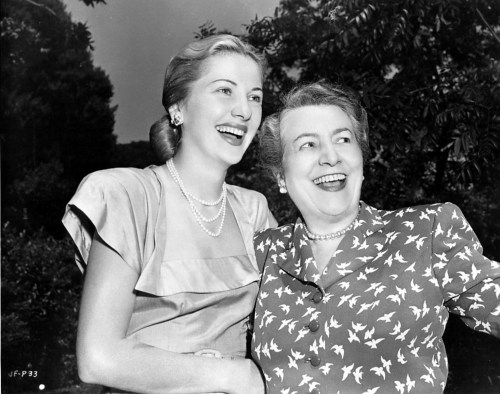
Joan Fontaine shares a laugh with her mother, Lilian.

By Lara Gabrielle Fowler

First off, thank you to Jill at Sittin’ On a Backyard Fence and Michael Nazarewycz at ScribeHard On Film for hosting this terrifically clever blogathon, focusing on one star per day via the TCM Summer Under the Stars lineup. Since many readers of this site know of my love for Joan Fontaine, I felt that instead of writing a movie review for this blogathon I would contribute something more personal, a small examination of the relationship between Joan Fontaine and her mother, who played secondary roles in several Fontaine films such as The Bigamist and Ivy.

The Lilian Fontaine Garden Theatre as it stands today.

Even today, while Joan lives a quiet life in Carmel at the age of 95, her mother is not far from her mind. Three years ago the Lilian Fontaine Garden Theatre in Saratoga, named for Lilian’s contributions to local theatre, was undergoing renovations. To everyone’s surprise, a huge 5-figure donation came through that would cover all the necessary refurbishments. It was from Joan. She declined to be interviewed, saying that this gift is for her mother, whose ashes are scattered there and who once said about the garden “”If you ever wonder about me, come to this garden, and I’ll be here… somewhere around.”

A graduate of the Royal Academy of Dramatic Art and also a trained singer, Lilian was a native of Reading–a large English city in the Berkshires. As an adult she ventured to Japan to try her luck in a performance career and ended up staying, marrying a handsome gentleman named Walter de Havilland. Their first daughter, Olivia Mary, was born in Tokyo on July 1, 1916, and Joan came along 15 months later on October 22, 1917. The de Havilland marriage was rocky, and the girls prone to illness, so on the advice of the doctor Lilian soon moved to Saratoga, California with the two girls in tow, in search of a more hospitable climate for their many ailments. Walter stayed behind.

Olivia thrived in California, but Joan remained very frail. As a young child her shyness and frequent illnesses precluded her from making school friends, and her sky-high IQ rendered it difficult for her to relate to her peers. Relations with her sister Olivia were never sunny, so having a friend at home was not an option. Isolated and often bedridden for months at a time, her mother was her sole companion and best friend.

550783_552058359264_1151502632_n[1]

Joan (child in black coat on the right), Lilian (in the black hat, holding Joan’s arm) and Olivia (far left) with family friends in Saratoga.

Lilian’s mothering skills were very much of her time and upbringing. She was determined that her daughters would grow up to be proper English ladies, and strict lessons in diction, manners, and even walking were commonplace in the house. When she remarried, to accountant and archdisciplinarian George Milan Fontaine, the lessons continued under his tutelage. Everything was expected to be “just so,” and if it wasn’t, extreme punishment could be expected. There was little affection in the house. As a teenager, Joan was severely scolded for holding hands with a boy during a concert, and her mother’s harsh words scarred her for life.

Yet through all of this, Joan retained a deep, unconditional love for her mother. When she began to earn money in movies, she sent monthly checks to her mother, supporting her completely of her own will. She offered Lilian, who had never really made it as an actress, roles in her films.

Skip to 5:45 in this clip from Ivy. Lilian is seated directly to the right of Joan, in the dark dress and hat.

When Lilian fell ill with cancer, Joan took over her care. Though Lilian was not always able to show it, Joan finally heard those words of love she so craved from her mother during their very last phone conversation. Right before they hung up, Lilian said to her tenderly “Remember how much I loved you.”

I like to think that this gave them a sense of resolution to a somewhat complex relationship, and that Joan could cope with the loss of her mother with the assurance that she reciprocated her love. It is a graceful end to a life, and a sweet goodbye from mother to daughter.

Lilian with Joan (on the floor) and Olivia (seated) shortly after their arrival to the United States.

1176545_orig-1

Last family portrait, 1975.

Thanks again to Jill and Michael!

Summer Under the Stars Blogathon: “Ball of Fire” (1941)

While browsing through the Summer Under the Stars lineup for today, I saw that Ball of Fire, a delightfully unique screwball comedy with one very catchy musical number that I find myself singing often, was on tap for this evening. I knew that I had to write an entry on it, as it is indeed a fascinating film and ahead of its time in many ways. Dealing at once with intellectualism, gangsters, burlesque, and romance, featuring a snappy script complete with endless slang terms from the era, Ball of Fire is a movie lover’s smorgasbord, with a little something to suit everyone’s taste!

The story begins as a group of aging college professors, living together in a large house, try to complete an encyclopedia that they have started. Professor Bertram Potts (Gary Cooper) is writing an entry on modern slang, and to conduct research and gather participants for his study, he ventures out into the dingier parts of the city–pool halls, bars, anywhere where lower vernacular might be used. One of these establishments is a burlesque hall, wherein he sees a young dancer sing a sensual number called “Drumboogie.”

The drummer here is making a cameo appearance. Widely known and popular for their big band sound, this is the famous Gene Krupa and his orchestra. One of my favorite parts of the whole movie is how Krupa plays the matchbox like a drum at the end of this video, as the rest of the audience whispers the song. It reminds me of something Bob Fosse might have dreamed up some 30 years later.

With this number enters the character of Sugarpuss O’Shea (Barbara Stanwyck), with whom Professor Potts is very taken for her prolific use of slang. He decides to go backstage and ask Sugarpuss if she would be willing to take part in his project, but as we soon learn, Sugarpuss is a gangster’s moll whose boyfriend, Joe Lilac, is being linked to a murder case. When she hears a man knocking on the door wanting to talk to her, she is convinced that it is in relation to Joe and talks to Professor Potts in a very suspicious way. He is entranced with her usage of slang and though she keeps telling him she is not interested (“Shove in your clutch” is a phrase Professor Potts is most taken with), he leaves his card for her in case she ever is.

Those protecting Joe Lilac are concerned that if Sugarpuss were to go back to her apartment, the police would find her and make her talk. As they try to think about where to put her for the night so the police won’t know her whereabouts, Sugarpuss pulls out Professor Potts’ card, and the decision is made for her to go there for the night. She goes under the guise of being legitimately interested in Professor Potts’ investigation, and ends up staying much longer than the initial night.

Meanwhile, Joe Lilac is poised to marry her due to the fact that she wouldn’t be forced to testify against him. The protectors show up with a huge engagement ring, and though they downplay the not having to testify bit (one of my favorite lines is “He gets more bang outta you than any girl he ever met!”), it is clear that avoiding prosecution is his primary motive. However, what complicates things is that Professor Potts is beginning to fall in love with her. Eventually, the professor proposes and Sugarpuss is officially engaged to two men.

Through a series of circumstances, Sugarpuss is driven to Joe to be married along with Professor Potts and the rest of the professors in the house, but they all, including Professor Potts, think that Sugarpuss and the professor are going to be the ones having the wedding, not Sugarpuss and Joe. Once the professor finds out, he leaves Sugarpuss in anger and she is forced toward Joe. By this point, Sugarpuss really has fallen for the professor, and how exactly she gets out of her entanglement with Joe is what takes up the last 15 minutes of the movie.

I don’t usually like to spend too much time rehashing a film’s plot, preferring to leave more room for analysis, but the way this film unravels is truly like yarn–one thing leads to another, and in order to bring the character of the film into focus, the details of the plot are important to impart. In fact, the route of this plot is very typical of the comedies of Billy Wilder, who co-wrote the screenplay. When Ball of Fire is compared to a later Billy Wilder film such as Some Like it Hot (1959), the way the story unfolds is very similar.

Though today is technically Gary Cooper day on TCM, I think this is Barbara Stanwyck’s film, through and through. The real-life Barbara Stanwyck was a tough Brooklyn gal who grew up in poverty on the streets of New York, and that common slang of Sugarpuss O’Shea was her own way of speaking. I don’t think anyone else in Hollywood at that time could have been better for the part. The way she carries herself and even the way she walks is pitch perfect for the part she plays.

Stanwyck as a young girl in Brooklyn.

The others who steal the show are the absolutely adorable professors who share the house with Bertram Potts. Played notably by S.Z. “Cuddles” Sakall, Henry Travers, and Richard Haydn, they do such things as mapping out the steps to the conga through an algorithm, and after crashing the car into a sign, explaining that by the theory of relativity that it was the sign who crashed into them. The presence of Sugarpuss in the professors’ house was supposed to be reminiscent of Snow White and the Seven Dwarves, and the professors certainly honed the sweet and slightly otherworldly quality of the dwarves.

I get a huge kick out of this movie, and truth be told I have never met one person who didn’t love it. It’s just one of those movies that is universally liked and appreciated. If you haven’t seen it, it plays on TCM fairly frequently.

Here is Sugarpuss O’Shea in a great scene teaching the professors how to dance the conga. Thanks for reading! And don’t forget to tune in later this week for my coverage of Cinecon, starting Thursday. I’ll enable live-tweeting again, as I think that was a good way to keep you informed up to the minute!

Enjoy!