Tag Archives: classic movies

Remember How Much I Loved You–Joan and Lilian Fontaine

f03ab6d035d05bc5740be4b56b43b075

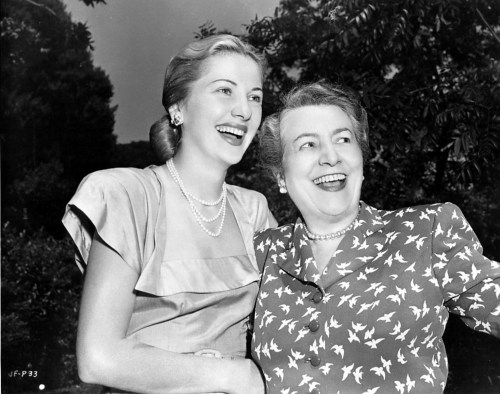
Joan Fontaine shares a laugh with her mother, Lilian.

By Lara Gabrielle Fowler

First off, thank you to Jill at Sittin’ On a Backyard Fence and Michael Nazarewycz at ScribeHard On Film for hosting this terrifically clever blogathon, focusing on one star per day via the TCM Summer Under the Stars lineup. Since many readers of this site know of my love for Joan Fontaine, I felt that instead of writing a movie review for this blogathon I would contribute something more personal, a small examination of the relationship between Joan Fontaine and her mother, who played secondary roles in several Fontaine films such as The Bigamist and Ivy.

The Lilian Fontaine Garden Theatre as it stands today.

Even today, while Joan lives a quiet life in Carmel at the age of 95, her mother is not far from her mind. Three years ago the Lilian Fontaine Garden Theatre in Saratoga, named for Lilian’s contributions to local theatre, was undergoing renovations. To everyone’s surprise, a huge 5-figure donation came through that would cover all the necessary refurbishments. It was from Joan. She declined to be interviewed, saying that this gift is for her mother, whose ashes are scattered there and who once said about the garden “”If you ever wonder about me, come to this garden, and I’ll be here… somewhere around.”

A graduate of the Royal Academy of Dramatic Art and also a trained singer, Lilian was a native of Reading–a large English city in the Berkshires. As an adult she ventured to Japan to try her luck in a performance career and ended up staying, marrying a handsome gentleman named Walter de Havilland. Their first daughter, Olivia Mary, was born in Tokyo on July 1, 1916, and Joan came along 15 months later on October 22, 1917. The de Havilland marriage was rocky, and the girls prone to illness, so on the advice of the doctor Lilian soon moved to Saratoga, California with the two girls in tow, in search of a more hospitable climate for their many ailments. Walter stayed behind.

Olivia thrived in California, but Joan remained very frail. As a young child her shyness and frequent illnesses precluded her from making school friends, and her sky-high IQ rendered it difficult for her to relate to her peers. Relations with her sister Olivia were never sunny, so having a friend at home was not an option. Isolated and often bedridden for months at a time, her mother was her sole companion and best friend.

550783_552058359264_1151502632_n[1]

Joan (child in black coat on the right), Lilian (in the black hat, holding Joan’s arm) and Olivia (far left) with family friends in Saratoga.

Lilian’s mothering skills were very much of her time and upbringing. She was determined that her daughters would grow up to be proper English ladies, and strict lessons in diction, manners, and even walking were commonplace in the house. When she remarried, to accountant and archdisciplinarian George Milan Fontaine, the lessons continued under his tutelage. Everything was expected to be “just so,” and if it wasn’t, extreme punishment could be expected. There was little affection in the house. As a teenager, Joan was severely scolded for holding hands with a boy during a concert, and her mother’s harsh words scarred her for life.

Yet through all of this, Joan retained a deep, unconditional love for her mother. When she began to earn money in movies, she sent monthly checks to her mother, supporting her completely of her own will. She offered Lilian, who had never really made it as an actress, roles in her films.

Skip to 5:45 in this clip from Ivy. Lilian is seated directly to the right of Joan, in the dark dress and hat.

When Lilian fell ill with cancer, Joan took over her care. Though Lilian was not always able to show it, Joan finally heard those words of love she so craved from her mother during their very last phone conversation. Right before they hung up, Lilian said to her tenderly “Remember how much I loved you.”

I like to think that this gave them a sense of resolution to a somewhat complex relationship, and that Joan could cope with the loss of her mother with the assurance that she reciprocated her love. It is a graceful end to a life, and a sweet goodbye from mother to daughter.

Lilian with Joan (on the floor) and Olivia (seated) shortly after their arrival to the United States.

1176545_orig-1

Last family portrait, 1975.

Thanks again to Jill and Michael!

The Double Identity of a Pop Culture Icon

Around age 14, circa 1940.

By Lara Gabrielle Fowler

On June 1, 2013, Marilyn Monroe would have turned 87 years old. It is difficult to imagine what the rest of her life would have been like, had she survived whatever took place on that mysterious night of her death at the age of 36. She was at the height of her fame professionally, but struggling with deep psychological problems that constantly threatened to derail her. At the height of her problems was an inability to reconcile two identities–the fatherless foster child Norma Jeane Baker, and the internationally famous sex symbol Marilyn Monroe. Eerily, her birthday falls under the astrological sign of Gemini, the twins. Maybe neither of these identities truly defined her. She strove desperately to improve herself as an actress, taking classes at the Actor’s Studio and earning considerable respect from Lee Strasberg, who called her one of the most naturally talented students ever to come through the studio. She fought for civil rights and was a particular champion of Ella Fitzgerald, securing her an engagement at the previously all-white Mocambo club by promising the owner that she would be there, in the front row, every night. She was a voracious reader, taking a special interest in biographies of Abraham Lincoln and was a devoted admirer of Albert Einstein. Perhaps she so passionately threw herself into these interests to cobble together her own, self-styled identity, to take the best of both worlds she had lived and put them together to create a mosaic of her own experience. I don’t often talk about Marilyn. I have too much respect for her and how she handled life to perpetuate this false myth of her as a goddess-like, immortal creature devoid of humanity. It is nearly impossible to mention her name without unconsciously perpetuating this iconic image that has landed her, tastelessly, on mugs and T-shirts and postcards and lunchboxes in every seedy tourist trap in town. But on her birthday, she deserves to be spoken of and remembered. Not as a pop culture legend, but as a woman and a real, flesh-and-blood human being. That is what I strive for when I do speak about her, and what I feel is my responsibility to her, as a person with a voice through my blog. So for her birthday, a day late, I am paying tribute to the woman as she was. These are the images that I think most represent the face of the real, natural person she strove to maintain against the current of crass commercialism. Happy birthday, Marilyn.

With her adored foster mother, “Aunt” Ana Lower, and family friends, circa 1938.

Rare video with another foster mother, Grace Goddard (also her legal guardian), who appears in the dark blue dress.

An early modeling shot.

A quiet moment with third husband Arthur Miller.

At her wedding to Miller. Monroe had converted to Judaism, and was a practicing Jew for the rest of her life.

Speaking to reporters after returning from studies at the Actor’s Studio.

Dealing With Disaster Through Cinematherapy

By Lara Gabrielle Fowler

As we struggle to make sense of the unthinkable events in Boston yesterday, we find ourselves coming together as a country and a world to participate in collective grieving, as so often happens when a tragedy of this scale occurs.

It is a time when people who need to get away from the gruesome footage and detailed descriptions often feel trapped, as all the television channels are showing the scene and all the radio stations describing it. The images are psychologically more than most of us can handle. When the events of September 11, 2001 occurred, my father instructed me not to turn on the television, as the images would scar me for life. Yesterday, I heeded my father’s advice from 12 years ago and have not turned on the television or radio. It is more than I wish to subject upon myself.

There is a movement in psychology right now called “cinematherapy,” in which those seeking comfort from grief, loss, stress, and numerous other issues, are given a list of movies to view to assist them in their journey toward recovery. I am not a psychologist, and I do not pretend to know the precise methodology behind cinematherapy. However, a good many of us involve ourselves in cinematherapy without giving it a second thought. Movies have the inherent ability to make us feel intense emotions, and in times of trial and despair, they can lift us up and make us feel better about the state of the world. They can even inspire us to change our world view, or to help those in need.

Here is a short list of movie classics that may help in our own collective journey toward healing from events that are beyond our comprehension. They are worth a look when we need an outlet for indescribable feelings.

1) SAN FRANCISCO (1936)

A love story set in the days prior to the 1906 San Francisco earthquake. The earthquake and subsequent fire occur toward the end of the movie, and the ending scene features the joy at the fire’s extinguishing cries of “We’ll build a new San Francisco!” as the cast marches confidently and valiantly down toward the city to the tune of “The Battle Hymn of the Republic.” An exquisite and inspiring ending that shows the strength of the human spirit in the face of disaster.

2) SOME LIKE IT HOT (1959)

Named the #1 funniest movie of all time by the American Film Institute, Some Like it Hot is legendary for its screwball humor. Two men witness the St. Valentine’s Day Massacre, and dress in drag to escape the mob by hiding out in an all-girls jazz band. If you’re one of those few who have not seen it, you are in for a big treat. It will make you howl with laughter, something that we all need in days like these.

3) THE THIN MAN (1934)

I know that this may seem like an odd choice for this list of movies, but aside from the fact that I personally enjoy this movie, I have a purpose for including it here. For some reason, The Thin Man seems to have strangely curative properties. I thought I was alone in my tendency to turn on The Thin Man after a long or stressful day, or when I’m feeling down. But in talking to other film fans, I learned that they have the same ritual. The Thin Man seems to be everyone’s go-to movie for comfort. Go figure, but it works.

4) MEET ME IN ST. LOUIS (1944)

Musicals were created to raise spirits during the Depression, and continued to inspire long after the Depression was over. No matter what the country was going through, our musicals helped us get through it. I would personally suggest Meet Me in St. Louis, a movie that was conceived to help wartime audiences maintain a sense of home and family in the face of terrible events overseas. The number “You and I” is particularly touching as a reminder of love and solidarity, placed in the movie as a comforting message to soldiers.

Any of these movies are worth a watch any time, but especially if one is struggling to come to terms with something saddening or distressing.

See you next time.

Announcing the 2012 Dueling Divas Blogathon!

It’s happening again! That’s right readers, it’s time for those sassy sparring ladies (or gentlemen, we’re all for gender equality here at Backlots) to get out their foils and do some serious dueling! The Dueling Divas Blogathon is back for its second year, and this time there is a twist.

The rules remain the same as last year. As a refresher, participants may blog about any of the following types of Dueling Divas:

  • Those who had a rivalry in real life, either over a particular film role or over a personality clash, ie Bette Davis and Joan Crawford
  • Those who had a rivalry on the screen, ie Mildred and Veda from Mildred Pierce
  • Any dual role played by an actor or actress in a classic film, ie Hayley Mills in The Parent Trap.

You can write about the divas themselves, compare their films, or if you are planning on covering an actor or actress in a dual role, you can compare and contrast the differences in the characters to give one example. There is really a very wide range of possibilities for this blogathon, and for those of you who haven’t participated yet it’s lots of fun!

Olivia de Havilland plays twins in “The Dark Mirror” (1946)

The Dueling Divas blogathon will be held between December 20 and 23, and you can submit any number of posts over those three days. To RSVP for the blogathon, simply comment on this post and I will add your name to the list of scheduled participants. You don’t have to tell me what you will submit and when just yet, but if you already have something in mind I would love to hear it! And don’t worry if you see someone writing about the same divas as you, as we all know there are some pairs who are massively popular and I don’t want to limit anyone’s creativity here!

Here are this year’s participants thus far:

Now for the twist.

Each blogger who submits a post will have his or her name put into a raffle. At the end of the blogathon on December 23, I will pick out a name from the raffle and the winner will have the choice between two prizes:

     A) A DVD of the classic horror film Whatever Happened to Baby Jane? starring two of our favorite dueling divas, Bette Davis and Joan Crawford.

     B) A copy of the TCM book Leading Ladies, that profiles the biographies of seemingly endless classic film stars including some real dueling divas!

The winner will receive his or her prize within a week of the blogathon’s conclusion. This is Backlots’ first competition/raffle, and I am very happy to be able to do it!

So start thinking about which divas you would like to profile, and be sure to RSVP in the comments section of this post so I can add your name to the list of participants. To add the blogathon to the events section of your site, you can use the banner at the top of this post and let your own readers know it is happening. I do want to keep it traditionally classic (before the year 1968), but if someone really wants to profile a classic clash from a more modern film, I don’t want to discourage it. As I’ve said before, the definition of “classic film” is very wide and there are no set rules about what is or what isn’t considered classic, so if you would like to profile divas from a post-1968 movie that you consider to be a classic, go for it.

Thanks for reading, and I can’t wait to see everyone’s posts in just about 6 weeks!

Live from the San Francisco Silent Film Festival, Day 3–Felix the Cat, “The Spanish Dancer,” “The Canadian,” “South,” “Pandora’s Box,” “The Overcoat.”

As is a running theme throughout the festival, today’s lineup focused on recent restorations of newly discovered or newly constructed prints. For me, the most interesting restoration story from today had to do with The Spanish Dancer, and how the film was put together like a puzzle, using pieces found all over the world individually. The pieces were spliced together, and the complete film began to emerge as a whole unit, as it had never been seen since its release in 1923. It is remarkable how resourceful archivists can be in their determination to restore and preserve–it gives me security that these films are safe in their hands, and that we will be able to keep them to show future generations.

Here are the movies we saw today:

First film: FELIX THE CAT

The day began at 10:00 with a series of Felix the Cat cartoons. As they were shown on the big screen in original 35 mm with live music, the showing of the cartoons was introduced by Leonard Maltin as a historic event–they are very rarely seen this way. Indeed, it felt like a historic event. We saw 7 cartoon shorts featuring Felix, and they came alive with the help of some great avant-garde live music. The titles of the shorts:

•    Felix Loses Out
•    Felix the Cat Trips Thru Toyland (which had some pretty intensely disturbing scenes. It surprised me that they would allow things like hangings in a kids’ cartoon.)
•    Felix the Cat Flirts with Fate (my personal favorite, in which Felix goes to Mars. In one scene, Felix begins to do the Charleston in a Mars restaurant, and a waiter says to him “Listen buddy, you can’t do the Charleston on Mars!”)
•    Felix the Cat in Blunderland
•    Felix the Cat Weathers the Weather
•    Felix the Cat in Eskimotive
•    Felix the Cat in Jungle Bungles.

Second film: THE SPANISH DANCER

This may be my favorite movie of the day. It was introduced in such a way that didn’t give me much hope for it, but it turned out to be a smart, focused plot following a clever, witty, script. I found myself really enjoying it! Starring Pola Negri and Antonio Moreno, it tells the story of a gypsy girl in love with a count, and when the count is condemned to death for breaking one of the King’s decrees, the gypsy girl goes to great lengths to try to save him. It’s a complex plot, but that’s the basic idea, and I would highly recommend that you see this film when it is released, so I don’t want to give away any major plot points. Another interesting tidbit about this film is that the young prince, whom the gypsy girl saves from falling off a horse at one point in the movie, is played by none other than a 6-year-old girl named Dawn O’Day who would later become known as the 1940’s movie actress Anne Shirley.

Third film: THE CANADIAN

This was a sweet story about love and marriage, and how a woman can make a complete turnaround in her personality when provided with satisfactory circumstances. A sort of cold fish snob by the name of Nora Marsh comes to live with her brother in a roughneck part of Alberta, Canada, and immediately makes a bad impression with her haughty manners and tendency to look down on others. She has no domestic abilities whatsoever, and constantly irritates her brother’s wife. Finally though, she somewhat suddenly proposes marriage to the houseman, and they move in together. It was not a match made in heaven, and they were unhappy for quite some time, due to various hardships they encounter. However, by the end all is mended in a quaint, sweet way that I described to my friend Marya as “very Canadian.” There just doesn’t seem to be a bad bone in this whole movie.

Fourth film: SOUTH

This was a very unusual and special screening of the documentary footage taken by cameraman Frank Hurley on the infamous Shackleton expedition through the frozen Antartctic. Breathtaking film of the landscape of Antarctica as well as profiles of the animals Shackleton encountered, make this film a really intriguing and different documentary. It looks markedly different than any other true-to-life film that I have seen from that era–instead, it resembles more something like March of the Penguins. To top off the unusualness of the film, Shackleton’s original script from when the film was screened upon its first release, was read by an actor accompanying the score.

Fifth film: PANDORA’S BOX

By this point in the evening, I was beginning to feel some exhaustion, but was eager to see this film. The movie was supposed to start at 7:00, but after the staff cleared the theater to do soundchecks after South, they didn’t re-open for Pandora’s Box at 7:00 as expected. We were told that it would be another 15 minutes or so, but it was a full 45 minutes after 7:00 that they finally re-opened the theater. The movie itself didn’t start until 8:15, and for someone who has been sitting in a theater taking notes and viewing 4 movies over the course of 8 hours, that was too late. I nearly fell asleep in the middle of Pandora’s Box due to the hour and my exhaustion, but managed to keep myself awake long enough to talk about the film in this post. It was a very interesting story of how this film came to be–there exists no original negative, all the footage they have comes from the original restoration that was done years ago, and the funding for this restoration comes from none other than Hugh Hefner, of all people. The film is an exquisite example of German expressionist filmmaking, that reached a height in Berlin in the 1920’s and was the genesis of countless other philosophic movements within filmmaking over the past 90 years. The film tells the story of a woman, Lulu, who simply allures men and enjoys them. When she accidentally/is forced to commit a murder, she is sentenced to 5 years in prison but manages to escape. The ensuing details all lead to Lulu’s further spiraling into problems and ultimately…well, I won’t give away the ending. This showing was only the second time this restoration had been seen by a North American audience, and it was the world premiere of a new score for the film, which was absolutely stunning.

I can’t say that I was wild about the restoration. It made the image too modern, too perfect. A movie from this era should be grainy, it should have a specific look to it that was lost in this restoration. It looked like it came from a DVD, or should have been a scene in The Artist. I’m glad they restored it, but it would have been more appealing to me if they had taken care not to wipe away all the grain.

Unfortunately, due to the extremely late start of Pandora’s Box, I was not able to stay for the sixth film: THE OVERCOAT, owing to my own exhaustion as well as concerns for getting home safely and in time to write this post. I was disappointed, as I had planned on reviewing every film for this blog, but I felt I needed to take care of my health first. Sometime in the future, I will get a copy of The Overcoat and review it here, to make up for missing it at the Silent FIlm Festival.

Stay tuned tomorrow!