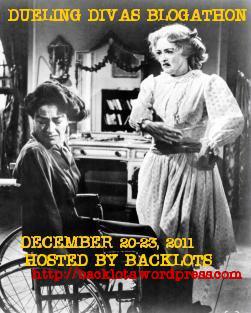
Backlots’ First Blogathon–DUELING DIVAS!

On the occasion of Backlots’ 7-month birthday tomorrow (has it already been that long??), I have decided to tackle the daunting task of a blogathon. I really hope this works.

The idea for this blogathon came from a very clever movie marathon at the Castro Theatre a number of years ago, entitled the “Dueling Divas” marathon. Each day, the theatre would show a double feature–each film starring one lady of the silver screen who had a rivalry with the lady starring in the other. For example, they had an entire week devoted to Joan Crawford and Bette Davis, where they showed double features of Possessed/The Letter, The Women/All About Eve, Johnny Guitar/In This Our Life, etc.

So drawing on that very clever idea, I am hosting the Dueling Divas Blogathon, which I have scheduled to take place between December 20-23. It’s a ways off, so as to leave enough time to plan your blogging schedules accordingly.

Participants may blog about any of the following types of Dueling Divas:

  • Those who had a rivalry in real life, either over a particular film role or over a personality clash, ie Bette Davis and Joan Crawford
  • Those who had a rivalry on the screen, ie Mildred and Veda from Mildred Pierce
  • Any dual role (see what I did there? Duel? Dual? Be proud.) played by an actor or actress in a classic film, ie Hayley Mills in The Parent Trap.
It’s totally free reign, you can write about the divas themselves, compare and contrast one of each of their films, and if you’re going to write about dual roles, you can talk about the differences in their characters or the actor’s technique in portraying them…you get the idea.
Ok, a select few rules and regulations:
1) You can write your entry whenever you want, but please do submit your entries between December 20 and 23, so I can keep track of them.
2) Drop me a comment on this post to let me know you would like to participate, and I’ll add your blog to the list of contributing blogs. I’ll be making an official post as the event gets closer, and to submit your entry, please comment with a link to your entry on the official post.
3) Write on something you love and are interested in! Make funny posts! Make overly dramatic posts! This theme can elicit lots of crazy awesome entries, and it would be so much fun to see a diverse range of posts with many different tones and topics. One of the fun things about blogathons is that we get to experience the different tones of each individual blog, so make it your own! I’m so excited to read all the entries.
Here is a list of contributing blogs thus far:
  I’m leaving a few banners for you to use. Questions? Comments? Concerns? Nagging annoyances? Friendly reminders? Emotional outbursts? Drop me a comment! I look forward to reading all your entries come December!
EDIT: Here are the entries!

BACKLOTS: I have taken a look at the 1954 Oscar feud between Grace Kelly and Judy Garland. https://backlots.wordpress.com/2011/12/20/dueling-divas-blogathon-day-1-judy-garland-vs-grace-kelly-1954/

CRÍTICA RETRO: This post is a lovely examination of that wonderful film full of dueling divas, The Women! The cast, the film, backstories and trivia. Written in Portuguese, but don’t worry–there’s a translate button on the right. http://criticaretro.blogspot.com/2011/12/as-mulheres-women-1939.html

CAROLE & CO.: Though Carole Lombard never seemed to have a feud with anyone, she certainly had some competition onscreen, with one actress in particular! Check out with whom! http://carole-and-co.livejournal.com/470760.html?view=632040#t632040

A PERSON IN THE DARK: I had so much fun reading this one! I’m a big fan of Josephine and Daphne, so I’m so glad someone chose to profile them for this blogathon. Here, they go head to head in 10 mini competitions such as Best Hair, Best Legs, and Least Conflicted About Her Gender.. http://flickchick1953.blogspot.com/2011/12/dueling-divas-handicapping-daphne-vs.html

IN THE MOOD: Susan Hayward and Paulette Goddard battle it out over forest ranger Fred MacMurray in this entertaining and well-written post about The Forest Rangers! http://theswingmood.blogspot.com/2011/12/dueling-divas-blogathon-hayward-vs.html

I STARTED LATE AND FORGOT THE DOG: Divine and witty entry comparing and contrasting two Joan Crawford and Bette Davis movies–The Great Lie and When Ladies Meet. You will love this one!! http://thebestofalexandra.wordpress.com/2011/12/20/dual-duel-or-dueling-duels-now-featuring-more-divas/

————————————————————————————————————–

DAY 2

HELIUM.COM: Joann Spears profiles many many films featuring a great many dueling divas in her comprehensive and informative post “Top Movies for a Baby Boomer Night of Chick Flicks.” http://www.helium.com/items/2179566-chick-flick

Also, see her comment below for Joann’s contribution of some of the great dueling diva scenes she talks about in her post!

MY LOVE OF OLD HOLLYWOOD: Joan Crawford and Bette Davis show their claws in a hilarious posthumous interview with Page. http://myloveofoldhollywood.blogspot.com/2011/12/dueling-divas-blogathon-just-friendly.html

FOREVER CLASSICS: A great review of In This Our Life, in which Bette Davis and Olivia de Havilland play dueling sisters. http://foreverclassics.blogspot.com/2011/12/review-in-this-our-life-1942.html

FRANKLY MY DEAR: A detailed examination of the characters played by Joan Crawford and Greer Garson in When Ladies Meet. http://franklymydear-blog.blogspot.com/2011/12/dueling-divas-greer-vs-joan-when-ladies.html

———————————————————————————————————–

DAY 3

BETTE’S CLASSIC MOVIE BLOG: Verbal spats and witty comebacks abound in The Lion in Winter! http://bettesmovieblog.blogspot.com/2011/12/lion-in-winter-1968-non-review-post-for.html

———————————————————————————————————–

DAY 4

TRUE CLASSICS: Ginger Rogers and Shirley Temple, two dancing divas of the 1930′s, square off in I’ll Be Seeing You. Right in time for the Christmas holiday! http://trueclassics.wordpress.com/2011/12/23/ginger-and-shirley-and-christmas-oh-my

VIVANDLARRY.COM: Kendra discusses Isabelle Adjani’s chilling and bizarre dual role in the movie Possessed. http://www.vivandlarry.com/film-diary/dueling-divas-blogathon-the-possession-of-isabelle-adjani/
BANNERS

New poll up!

Drawing on yesterday’s post on the Bette Davis interview, here is a new poll for readers. Feel free to vote here, or if you would like to vote later, the poll will be featured in the Polls section for the next week or so. Thanks, and have fun!

Bette Davis on the Dick Cavett Show, November 18, 1971

During its relatively short run between the years of 1968 and 1972, the Dick Cavett Show managed to procure the best in show business as guests, with the likes of Katharine Hepburn, Gloria Swanson, Pearl Bailey, Groucho Marx, and even Janis Joplin appearing on the program for interviews. Dick Cavett was a casual host, which in turn led the stars to let their hair down and be themselves on the program, sometimes revealing rather personal insights about their lives and careers.

One of the best incidences of a star really being herself on the program is the unlikely example of the 63-year-old Bette Davis, appearing toward the end of the show’s run wearing go-go boots (not kidding) and a rather short skirt. The interview revealed a side of Bette Davis that the public was not familiar with–the very funny woman who was not afraid to share secrets and drop innuendos that would make anyone else blush.

The ten-time Academy Award nominee (and twice winner) also very casually relayed her view of the importance of discipline in the medium, and her own longevity in comparison to the early demises of many of the classic Hollywood stars of the same era under the studio system. She also commented on the movies of the 1970’s and what she thought had changed and why, showing the audience a real depth of knowledge, thought, and intelligence.

It was especially interesting to me to hear her talk about the book she considers to be the most accurate portrayal of Hollywood in the classic era, What Makes Sammy Run? by Budd Schulberg. If any of my readers have read this book, I would love for you to comment with your views on it, because when I read the book, it struck me as a really gruesome portrayal of Hollywood, showing the truly ugly side of the business and the dog-eat-dog mentality of the executives in power. The fact that Bette Davis cites it as the most accurate book about Hollywood says a lot about how she, as an insider, views the system, and to me it is a sobering reminder that Hollywood was far from being all tinsel and glitter back in the days of the studio system.

It is undeniable that Bette Davis was one of the great screen actresses of the 20th century, but this interview also shows her as a smart, thoughtful, and pensive human being. The entire interview can be found on youtube, but it is in fragments titled with the subjects Davis talks about in the clip. Here are some other choice moments. As always, thanks for reading, and don’t forget to comment with your perceptions of What Makes Sammy Run? I look forward to talking with you!

Talking about her highly publicized suit against Warner Brothers.

On her allergic reaction to wasp stings.

On writers, Myra Breckenridge, and sexual repression, among other things. The latter part of this video appeared earlier in the post, but what I really wanted to share was everything from 5:16 on. Her casual demeanor is not something you would expect from such a monumentally successful movie star, but she really shines through in this clip. I think a lot of the credit also goes to the charm of Dick Cavett, who prompted her to go to that next level.

BOOK REVIEW: “Every Frenchman Has One” by Olivia de Havilland

If you have been following my blog at all, one look at the cover of this book should tell you why I felt obligated to procure a copy for myself. For those who may be new here–first off, welcome. Second, I am 1) obsessed with Olivia de Havilland, a longtime resident of Paris, and 2) obsessed with Paris itself. I studied there for 5 months, and I love everything about the city and Parisian culture. More about my time there, and my meeting Olivia de Havilland (yes, I did!) later on in this post, but first, let me give you a brief history of this book, what it is, and why it exists.

Olivia de Havilland wrote this book in 1961 as a sort of disjointed memoir about her life in Paris. It has no plot, follows no sequence of events, but rather is a series of vignettes relating to life as she has experienced it, as a foreigner abroad, and all the joys, difficulties, miscommunications and funny stories she has encountered along the way.

De Havilland moved to Paris in 1953 to start life anew after a divorce from her first husband, Marcus Goodrich. She fell in love with  Pierre Galante, the editor of the prominent French magazine Paris Match, and they soon married, planting her in the home where she still lives today, almost 60 years later.

But being a foreigner (de Havilland was born in Japan to English parents, and became a U.S. citizen in 1943) proved rather daunting at first. The title of the book, in fact, refers to the French liver–and its capacity for consuming alcohol, something she was not accustomed to. In another particularly funny chapter, she recounts her problems learning French:

“Not long after [being] intoxicated by a really brilliant showing at my lesson, I gave some quite detailed instructions to  another taxicab driver as to where I wanted him to stop. This time I made a splendid bouillabaise of “la crepe” (pancake), “le crepe” (widow’s weeds) “arret” (stop), “arete” (fishbone), and rather authoritatively asked him to put me down at the fishbone of the autobus where the lady was standing wearing the pancake. He did, too.”

She goes on to say:

“Then there was the day I shook my professor. I’d been on a household shopping excursion and had been rather dismayed at the high cost of things. Well, I don’t know if you see much difference between “matelot” and “matelas,” and I don’t know how you’d complain about the price of a mattress. But anyway I rushed in to my professor at lesson time in a state of outrage and indignantly proclaimed that I had discovered that French sailors were VERY expensive!”

This is the tone of Every Frenchman Has One. Olivia de Havilland is an immensely talented and entertaining writer, and each chapter of the book is laugh-out-loud funny. It is evident to the reader just how much de Havilland loves Paris, the French, and living abroad. It’s also interesting to read about her devotion to her children, Benjamin (12 years old at the time of the writing) and Gisele (5 years old). She mostly talks about Benjamin in this book, truly gushing about his intelligence, his fluency in French, and how much Gisele adores him. It’s really sweet.

She even briefly mentions Joan in this book, which is something I was looking for when I first read it. When talking about her religious background and how it pertained to the French way of practicing religion, she related this anecdote from her school days at the Convent of Notre Dame high school:

“When I entered the convent, I did so under a decided handicap. My sister Joan, fifteen months younger than I, had been there for six months before me, and with the really beastly shrewdness that younger sisters are wont to have, she had a VISION. Right there, during Mass, she had seen the Virgin Mary, and had immediately fainted. Of course, the nuns were in a dither of excitement about it, and Joan, who had already earned among them the gentle appellation “duckie,” departed from the convent at Christmastime with their tender blessings, leaving behind her an aura of unsurmountable prestige. Now, you just try following to a convent a younger sister who has had a Vision. Just try it.”

It’s a wonderful, funny book, and I read the 200 pages in about 24 hours. I literally couldn’t put it down. If you can find it, I highly recommend it–it’s long out of print, and it only had two printings, so you’re going to really have to search to find a copy. They go up for sale on Amazon every now and then, but they’re always ridiculously expensive. I got my copy on Amazon, for a bargain price of $60.

So if you do get a chance to read her book, please do. You’ll have a fantastic time with this great read. Next line of business–waiting for Olivia’s autobiography to come out!! It should be pretty soon now, I’ve heard through the publishing grapevine that she’s finished with it. I’m excited to read her perspective on the latter part of her life in France–her son Benjamin sadly passed away from cancer in 1991, and Gisele now lives in Los Angeles, but Olivia still lives in the lovely house on that “attractive, tranquil street” that she describes in Every Frenchman Has One. She has led a remarkable life, indeed.

Myrna Loy Picture Spam

To close this week’s Star of the Week segment, here is a picture tribute to the divine Myrna. Thanks for reading!

MOVIE REVIEW: Mr. Blandings Builds His Dream House (1948)

Continuing on in Star of the Week mode, I am offering up my review of a comedy well-known in the world of classic film, but rarely broadcast on television outside of TCM. It is the delightful Mr. Blandings Builds His Dream House, starring our Star of the Week Myrna Loy and co-starring Cary Grant, with Louise Beavers in a great supporting role as the Blandings’ maid. It was released in 1948 by RKO Radio Pictures.

The story concerns an upper-middle class liberal family, the Blandings, who are living in a small apartment in New York City where Jim Blandings has an advertising office. The family’s dream is to move away from the hustle and bustle of city life to a country house in Connecticut, where Jim could commute to work every day and come home to peace and quiet in the evenings. When they discover an old abandoned house in Connecticut for an affordable price, they consider their dream realized–though they realize the house will need some work. They set out to fix it, and…it turns out that the Blandings got more than they bargained for with this house.

With the problems increasing in number and severity as the film goes on, they begin to dominate the family’s pocketbook and infiltrate the family’s very sanity. The house also begin to threaten Jim’s work, as he is so exhausted and frustrated by the problems with the house, he is unable to meet the deadline for a slogan for his company’s client, the WHAM ham company. He eventually quits his job when he is told to come up with a slogan by midnight, only to come home to his family, including his maid, Gussy, who, incidentally, loves WHAM. When Jim’s children ask if they’re going to have WHAM for breakfast, Gussy tells them “If you ain’t eatin’ WHAM, you ain’t eatin’ ham!” The lightbulb over Jim’s head goes off, he tells his wife to give Gussy a raise, and he rethinks his idea to quit his job. From there, everything in the Blandings’ life goes uphill, thanks to Gussy, and the house problems resolve themselves.

The film is very advanced in many ways, and really does stand the test of time. I watched it recently with my sister, who is not particularly a classic film fan (though she does have respect for movies that are quality), and she LOVED this movie. She thought it was very funny and very modern, and I agree with her–it could very easily have been made within the past few years. Cary Grant and Myrna Loy have fantastic chemistry (I mean…did anyone doubt those two would be amazing together?), but I think the star of the show has to be Louise Beavers, in the role of Gussy the maid. Gussy coming up with that ridiculous catchphrase for WHAM was probably the best part of this very funny movie, and it’s a real testament to her talent that she could steal the show away from the likes of Cary Grant and Myrna Loy.

The very talented Louise Beavers.

One caveat I might give to this otherwise glowing review is that the problems the Blandings family faces sometimes get a bit too much for the audience to handle, especially since we do get so invested in these characters, and I found myself rather embarrassed to admit that I had sort of taken on their problems personally by the time the movie was over. So this may not be the correct movie to watch when you have a lot to worry about in your life–you don’t need the Blandings’ problems! But on the other hand, it might make you realize how sane your life is compared to theirs.

Check out some clips below. It’s unfortunate that there are so few clips on youtube, and it’s not usually readily available at your local video store, because it’s a real gem. Enjoy!

New Myrna Loy Biography

Checking up on TCM this evening, it came to my attention that Backlots’ Star of the Week Myrna Loy is in the news. Biographer Emily W. Leider has written the very first book about Loy’s life, entitled Myrna Loy: The Only Good Girl in Hollywood, and slated to hit the bookshelves later this month. It has already been touted by Leonard Maltin as a “highly readable, informed biography,” and promises to reveal backstories on Loy’s many friendships in Hollywood and her extraordinarily long career.

It very much surprises me that no book like this (aside from Loy’s own autobiography, Being and Becoming, published in 1987) has been written about Myrna Loy up to now. She is and was so well-loved in the classic film world, and though a private person herself, was friends with just about everyone in Hollywood and it would have been very easy to research and write 30 years ago. In fact, I believe that Emily W. Leider has done a very difficult task in WAITING to write this book, as the vast majority of those who knew and worked with Myrna Loy are now gone.

At any rate, this promises to be an immensely interesting read, and I love that this came to my attention just as Myrna Loy became Star of the Week. Here is the link to pre-order your copy at Barnes and Noble. I will post a review of this book once it comes out!

CMBA Nominations

The Classic Movie Blog Association is having its annual awards, and Backlots is nominated for Best Classic Film Blog Discussion! The nominated discussion was of the final scene of The Heiress, posted a few weeks ago.

It is truly an honor to be nominated for a blog award when I have only been a member for about a month! Thanks to the CMBA!

STAR OF THE WEEK: Myrna Loy

I’m going to need to work out my blog posting schedule in the wake of my new job, because I’m exhausted after work and feel like I haven’t posted in forever, which makes me feel really inadequate. In truth, it’s only been 2 days, but I still feel like I should be posting more. For my first star of the week for…quite some time, I took suggestions from my facebook and twitter followers, who have come back with some awesome suggestions for future posts, including a suggestion for Myrna Loy as the Star of the Week, which is something I got very excited about.

Myrna Loy is a very unique star. In real life a staunch liberal and dedicated feminist, she balked at the typical portrayal of the “woman who belonged in the home” and instead embraced such roles as Nora Charles, the independent wife, sidekick, and occasional sparring partner of detective Nick Charles in the Thin Man series–probably her most famous role and one of the best female parts of the 1930’s. The series was the first to show a married couple who could be friends, throwing friendly jabs and teases at each other while maintaining their loving relationship, and it’s hard to imagine anyone other than Myrna Loy in the role. She has a very modern air to her that allows her to play roles that may have bombed in the hands of another actress.

She was born Myrna Adele Williams in Helena, Montana on August 2, 1905, to a prominent political father and a mother who had studied at the American Conservatory of Music. Following the death of her father when Myrna was 12, the family moved to La Jolla, California, where she attended Venice High School and left at 18 to help her mother with her financial obligations, landing a job at Grauman’s Egyptian Theatre and posing for portraits that were eventually discovered by Rudolph Valentino, thus beginning her film career in silents. Her first appearance was as an extra in a film called Pretty Ladies, followed by a more lucrative role in What Price Beauty? which led audiences to notice this mysterious beauty. It followed that Loy’s silent screen roles were predominantly of ethnic femmes fatales, drawing upon her strangely exotic eyes (though her heritage was Welsh and Scottish) and dark features.

Her big break came in Manhattan Melodrama in 1934, which was followed shortly thereafter by the first Thin Man movie, securing Loy’s place as a feature player and a box office success. The second Thin Man film, After the Thin Man, came in 1936. Her stardom was quickly rising, and by 1938 she was one of the most popular and highest paid actresses in Hollywood. Another Thin Man, the third film in the series, came out in 1939, followed by Shadow of the Thin Man in 1941.

Some witty lines from The Thin Man movies.

This burst in popularity did not, however, cause Loy to abandon her principles–when the U.S. began its involvement in World War II, she left films altogether to focus on the war effort. Volunteering with the Red Cross and vehemently denouncing the policies of Hitler, she toured army bases with the group of Hollywood celebrities banding together to bring morale to the troops stationed around the country.

She returned to films in 1945 with the conclusion of the Thin Man series, The Thin Man Goes Home, followed by what she considered to be her best role, that of wife to an injured World War II veteran played by Dana Andrews in The Best Years of Our Lives in 1946. The film is a masterpiece and won countless awards, including Best Picture at the 1947 Oscars, and a place on the American Film Institute’s list of the best movies of all time (rating at #37).

Loy’s film career was then peppered with a number of mediocre films, with the exception of the delightful comedy Mr. Blandings Builds His Dream House (1948) which gave her career a slight boost. She was, surprisingly, never nominated for an Academy Award, though she did receive an honorary Oscar at the 1991 Academy Awards, shortly before her death in 1993 at the age of 88.

Myrna Loy was well-known in Hollywood and beyond for her tireless efforts toward liberal and egalitarian causes. She was a loyal and committed Democrat, and served as co-chairman of the Advisory Council of the National Committee Against Discrimination in Housing. She was also the first Hollywood celebrity to become a member of the National Commission for UNESCO, promoting equality and peace throughout the world through art. She was outspoken for the dignified treatment of black actors on film, and was quoted as saying “Why does every black person in the movies have to play a servant? How about a black person walking up the steps of a courthouse carrying a briefcase?”

As an actress and a person, Myrna Loy is deserving of a very high place in Hollywood history, and it truly is a shame that many of her movies have been forgotten or neglected. Thanks for the recommendation to have Myrna Loy as the Star of the Week!

Recommended by Jane (LouisaJanexxx) on Backlots’ twitter account.

Recent Acquisitions

Here are some of the things that have come in the mail over the past few days:

John Fricke’s newest book! As per all of John Fricke’s works, it is a wonderful source of information and beautiful photos, many of which I don’t think have ever been released. He remains the quintessential Judy biographer. A+++.

Bette Davis’ second autobiography–dealing mostly with her later, post-stroke life. One very interesting thing is her open letter to B.D. (her horrible daughter), which is a combination of anger, disappointment, and sadness. The reader can feel Davis’ sense of closure with her daughter, which is in itself both sad and comforting.

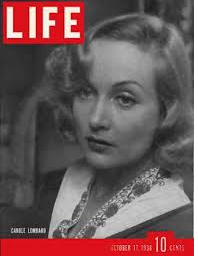
This came in the mail a few days ago, and it has become one of my favorite magazines in my collection. Chock full of interesting articles, not to mention a STUNNING cover with one of my favorite people on it, I’ve been obsessed with this magazine ever since it arrived. My only complaint is that the cover is coming off, so I have to be really careful when I handle it, especially since I am going to really treasure this one and want to handle it a lot.

My camera is broken so I can’t upload the actual picture, but I also got a coat made by the Hollywood fashion legend Don Loper. Famous for being one of the classiest fashion houses in Hollywood and also for his appearance on “I Love Lucy” (remember when Lucy gets herself into the fashion show with a sunburn? That was at Don Loper’s), I found a coat of his that was within my price range at an online vintage store. When it arrived, I discovered that it was way too big for me (that’s what I get for buying things online!), but at least I can say I have a Don Loper coat! That’s really special.

I’m still waiting on the Rosalind Russell magazine, that is taking forever to get here. I’m wondering if it went to my old address…