CLFP: “My Man Godfrey” (1936)


A magnificently crafted screenplay and powerhouse comedic performances by Carole Lombard, William Powell, and Alice Brady are the hallmarks of this beloved zany comedy that is unmatched in its blend of screwball camp and surrealist humor. It has become one of the most respected comedies to come out of Hollywood, and its appeal stands the test of time–the script is just as hysterically funny today as it was in 1936. Its unceasing barrage of witty lines and humorous situations renders the film a difficult one to keep up with, and a real challenge to examine.

Godfrey Smith (William Powell) is out of work, and makes his home at the city dump in the midst of the Great Depression. A socialite by the name of Cornelia Bullock (Gail Patrick) approaches him, explaining that she is in need of a “forgotten man” to complete a scavenger hunt for a party. She offers him $5 if he obliges. Offended, he chases her off, forcing her to trip and fall on an ash pile. Cornelia’s sister Irene (Carole Lombard) is delighted at this spectacle, and she and Godfrey strike up a discussion about the nature of scavenger hunts and the ethics of using human beings as objects in a game (“It’s kind of sordid when you think about it,” Irene says). In order to prevent Cornelia from winning the scavenger hunt, Godfrey offers to be Irene’s “forgotten man.”

The party is chaos, with participants trying to register all their finds at the same time. Amid people showing off items such as spindles, goldfish, and Chinese gongs, Godfrey and Irene emerge and Irene is declared the winner of the scavenger hunt. When Godfrey is asked to make a speech, he calls the entire party a group of “nitwits,” saying that it will be a pleasure to return to the dump. However, in appreciation for his help in her victory, Irene offers him a job as the family butler. He accepts, grateful to have a job.

When Godfrey starts work the next day, he learns the extent of the Bullock family’s eccentricity. Irene has a tendency to throw childlike temper tantrums, which the dizzy scatterbrained Mrs. Bullock (Alice Brady) treats with performances by her live-in protegé, Carlo, which invariably upset Irene even further. The long-suffering Mr. Bullock is having trouble with money, but every time the concept is mentioned, Carlo sighs dramatically and Mrs. Bullock commands the conversation to stop as it’s “upsetting Carlo.” Cornelia is set on revenge against Godfrey for taking away her scavenger hunt victory, but Mrs. Bullock ultimately protects him saying “He’s the first thing Irene has shown any affection for since her Pomeranian died last summer.” Indeed, Irene takes to Godfrey very quickly, in a way that makes Godfrey uncomfortable.

Cornelia, still set on getting Godfrey fired, hatches a scheme to accuse him of stealing her pearls. Godfrey realizes that he has been framed, and begins to hatch a scheme of his own. We learn that Godfrey is not all that he has claimed to be. Raised in a rich, aristocratic family, Godfrey chose to live in the dump to get a taste of how the other half lives. Godfrey’s scheme involved buying stock for the family by taking Cornelia’s pearls and transmuting them into gold, then into stock, then back into pearls. Cornelia got her pearls back, the family’s money troubles were over, and Cornelia had a complete change of heart in regard to Godfrey. He did take some money for himself in order to open a nightclub called “The Dump,” and there he made a name for himself again and married Irene, whose feelings he had begun to return.

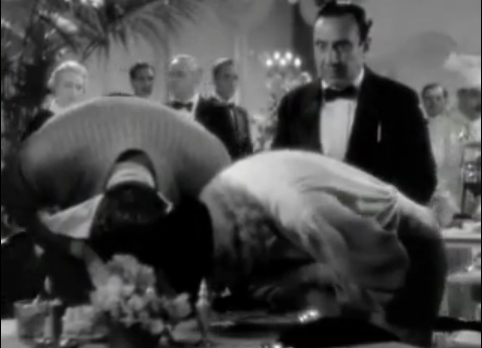
As uproariously funny as this movie is, My Man Godfrey is an incredibly difficult piece to analyze. The dialogue is so rapid fire and each line so funny that it is difficult to extract specific bits of dialogue that drive the story forward or provide important information about the characters. The nature of the film is that every bit of dialogue is important, and trying to find a quote more noteworthy than another is an exercise in futility. This is a brilliantly crafted film in every way; from the screenplay to the directing to even the cinematography, My Man Godfrey is a screwball masterpiece. Though Lombard was undoubtedly the star, Alice Brady gives a bravado performance as the nutty mother that nearly steals the show. The moment she shows up at the scavenger hunt party carrying a goat, the character of the mother is established. Speaking in a high, Billie Burke-like voice with a quirky laugh, she plays an essential role in creating the film’s zany quality.

Alice Brady as the mother.

In addition to its status as one of the great screwball comedies of all time, this movie is notable for the unique offscreen relationship of Lombard and Powell. After making Man of the World together, Lombard and Powell were married in early 1931. Their marriage didn’t last long, they were divorced after 2 years, but they remained good friends and worked together wonderfully. In fact, William Powell refused to do the film unless Carole Lombard was cast as Irene–he felt her perfect for the role. Their chemistry is evident in My Man Godfrey, and though they had divorced 3 years earlier, the friendship that they held offscreen is felt by the audience.

There exists a series of outtakes from the set of My Man Godfrey that show the fun atmosphere on the set, and also demonstrate Carole Lombard’s famous love of cursing. It was said that she loved to shock people with her ability to let out strings of 4-letter words, inconsistent with her angelic face and outwardly soft appearance. I am including these outtakes below.

See you next time!

The Artistic Appeal of “Marjorie Morningstar” (1958)

Gene Kelly and Natalie Wood in “Marjorie Morningstar” (1958).

Marjorie Morningstar marks the sole meeting of two great stars from very different worlds. Gene Kelly, the musical genius from MGM, plays older lover to former child star Natalie Wood, here in her first adult role. They seem an unlikely pair, but once the plot gets underway, it is clear that the combined magnetic talent of these two legends is enough to power any movie forward.

18-year-old Marjorie Morgenstern (Natalie Wood) is coming of age in a rather normal way, dating steadily and fantasizing about becoming an actress, much to the chagrin of her traditional Jewish parents. After rejecting a marriage proposal from her beau, she takes a job with a friend at a summer camp for little girls “across the lake from a camp with big boys,” as her friend, Marcia Zelenko, puts it. They sneak over to the other side of the lake one night, and there she meets a dapper and handsome stage director by the name of Noel Airman (Gene Kelly) who charms Marjorie immediately with his talent for all aspects of the theatre. Renaming her “Marjorie Morningstar,” he offers her a number of odd roles in the current production, and in time, Marjorie begins to fall in love with Noel. Though he claims to feel the same way it becomes clear that Noel’s past experience with girls has left him bitter and suspicious of girls with dreams of the theatre. His treatment of Marjorie borders on cruel and manipulative, but Marjorie is so taken with him that she takes no notice.

Meanwhile Wally, a young man who works in Noel Airman’s show, has fallen for Marjorie. She shuns his attention because of her devotion to Noel, but later when Noel begins to have problems with depression and drink, Marjorie learns that he has been seeing another girl and leaves him. She shows up to audition at the theater where Wally is putting on a play and gets the part. When she learns that her success is due to Wally’s love for her instead of her skill as an actress, she expresses gratitude but turns it down, with a kiss and a goodbye to Wally.

At the marriage of her old friend Marcia Zelenko, Marjorie catches a glimpse of Noel, who confides to her that he only showed up to talk to her. He and Marjorie have a passionate scene in which they reconcile, but after the failure of Noel’s next play, he disappears from Marjorie’s life. She tracks him down in London but instead of pursuing him once again, she chooses to shift her attention to Wally, who has shown up in London to meet her.

Marjorie Morningstar is classified as a melodrama, and it definitely lives up to its classification. There are scenes of intense angst, particularly the scene where Marjorie finds Noel with another woman, and this drama clearly shows the range of both main actors. Gene Kelly is especially noteworthy in these scenes, as he is very much playing against type.

Kelly was a magnificently multi-talented personality. He excelled at drama, comedy, and musicals, and felt equally at home behind or in front of the camera. His talents seemed to know no end, and whether directing, producing, choreographing, dancing, singing, or acting, Gene Kelly was the best there was. However, audiences up to this time were used to seeing him in musicals. Though there are a few songs here and there in Marjorie Morningstar (notably “A Very Precious Love,” sung by Kelly toward the beginning of the film), the film generally pushes aside his musical abilities and instead focuses on his ability to play drama. The only time we see him dance briefly in the film is during rehearsal of a number for the show–and there we get a glimpse of classic Kelly.

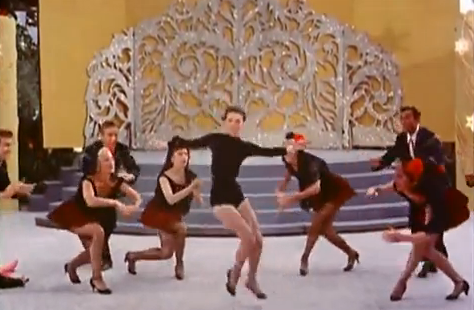
Natalie Wood, by contrast, does have an extended dance sequence. In her first role for Noel Airman, Marjorie plays a Spanish dancer who transforms her Spanish dance into a modern 1950’s number. Natalie Wood was not known for her abilities as a dancer, but she was famous in the industry for her sky-high IQ and ability to learn unusually fast. Her abilities as a dancer were likely honed on the spot, and her apparent talent is a pleasant surprise. She is nimble, confident, and a joy to watch in this number.

Natalie Wood as Marjorie in the dance sequence.

The film is shot in Eastmancolor (billed as “Warnercolor,” a form of Technicolor popular in the 1950’s), and the film is in desperate need of a restoration. Given the amount of skips, pops, and crackles that continue throughout, it seems as though the print hasn’t been touched in decades. Regardless, the color is absolutely breathtaking. I think this movie would be a wonderful candidate for restoration, because if the color is already this beautiful, I can only imagine what could happen with a little bit of work. This could become a visually stunning piece of film.

Marjorie Morningstar is, in some ways, rather groundbreaking. Uniquely touching and original in its own right, it is also notable as one of the first films to explore the life of a Jewish family without direct reference to their Judaism. Though the thematic elements of The Jazz Singer (1927) were also strongly tied to Judaism, the difference lies in the fact that The Jazz Singer defined the characters primarily by their Jewishness, while the characters in Marjorie Morningstar are defined by their personas instead of their religion. In fact, the word “Jewish,” or any of its derivatives, is not mentioned once. Instead, the family’s religion is evidenced through their activities, specifically Marjorie’s younger brother having a bar mitzvah and a very elaborate Passover dinner scene.

See you next time!

CLFP: “Love Before Breakfast” (1936)


Owing to the classy title, stellar cast, and the surprise thrill I got from Hands Across the Table, I had high hopes for this low budget comedy starring Lombard, Cesar Romero, and Preston Foster. This is a screwball yarn about a young woman pursued by two men–her fiancé who suddenly takes a job in Japan, and a wealthy businessman who takes the opportunity of her fiancé’s absence to court her vigorously. He seems to show up everywhere she does, and the young woman is disinterested to say the least. Just as the businessman begins to get the hint, the young woman finds that she has fallen in love with him and the tables are turned.

That is about as much of the plot as I can muster up. It’s definitely a vehicle solely to show the beauty of its stars, with little attention paid to the plot or the plausibility of the story. I had a difficult time watching it, as I simply could not follow the seemingly arbitrary sequence of scenes or the flimsy, poorly developed plot. It feels like an incomplete film, as though some vital scenes ended up on the cutting room floor.

The movie was inspired by a work from Faith Baldwin, the noted early 20th century novelist. She is credited at the start of the film as the author of the novel on which this story was based, but in fact no novel was ever published. Love Before Breakfast was a short story in a magazine written by Baldwin that never expanded into novel form.

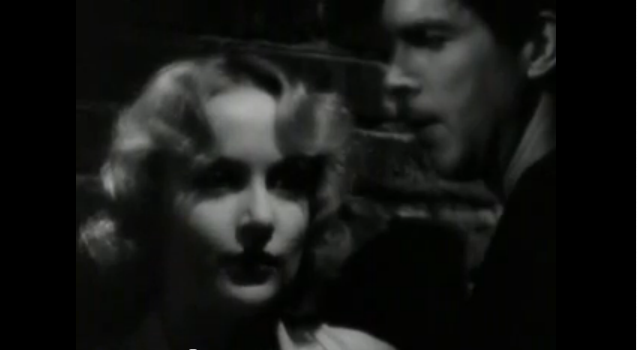
A redeeming quality of this movie is, indeed, the sheer beauty of Carole Lombard. There is one scene in which the character receives a very authentic-looking black eye. The beauty of Carole Lombard is completely unfettered, even appearing in raggedy clothes with the black eye, she displays a radiant glamor that was unmatched.

Poster art of Lombard with the black eye.

Thanks for reading, see you next time!

“Forever Natalie Wood,” Castro Theatre, San Francisco, CA, November 9-11, 2012.

The extraordinarily talented Natalie Wood, who stole our hearts at the age of 9 in Miracle on 34th Street (1947) and made the rare successful transition to meaningful roles as an adult, was tragically taken from us 31 years ago in an accident off Catalina Island. Last year, the case of her death was reopened when law enforcement gained some new information about that night, and the intense feelings surrounding Natalie’s death were reopened with it.

San Francisco impresario Marc Huestis, beloved for his lavish and creative productions dedicated to the stars of stage and screen, was uncomfortable with this new attention. A huge fan of Natalie Wood himself, he took matters into his own hands and created “Forever Natalie Wood,” a large tribute to Natalie featuring some of her best and most beloved film work to be shown over the course of 3 days at the Castro Theatre in San Francisco.

Beginning Friday night with a double feature of Rebel Without a Cause (1955) and This Property is Condemned (1966), the event continued yesterday with another double feature of Gypsy (1962) and Love with a Proper Stranger (1963). The latter is a brave powerhouse of a film, featuring probably the most powerful scene I have ever seen on film dealing with back alley abortions. Wood’s performance earned her an Oscar nomination, the third of 3 over the course of her career.

The centerpiece of the event, however, was a frank and honest discussion with Natalie Wood’s younger sister Lana, with whom she was very close. Lana, who made her own name for herself in Hollywood (notably as a Bond Girl in Diamonds are Forever (1971), wrote one of the quintessential books about Natalie Wood, and along with 2001’s Natasha by Suzanne Finstad, Natalie: A Memoir By Her Sister stands as one of the most complete and honest accounts of Natalie Wood’s life.

Preceded by 20 minutes of film clips compiled by Huestis that detailed the life and career of Natalie Wood (as well as a very entertaining performance by Matthew Martin lip syncing to a mashup of “Everything’s Coming Up Roses”), the discussion with Lana was an insightful look into the early life and career of her legendary sister as well as the details of Natalie’s later personal life. Simultaneously serving the roles of sister, friend, and confidante, Lana Wood’s words were sincere, moving, and beautiful as she spoke about what Natalie meant to her. She was quick to protect her infamously pushy stage mother, who she admitted was “difficult to deal with” but who was ultimately “full of life” and protective of her children.

Natalie Wood with Lana and their parents.

The Wood family (originally Zakharenko, later changed to Gurdin and then to Wood when Natalie began in Hollywood) was from San Francisco. The sisters’ parents were both born in Russia and emigrated to the United States later in life. Both Natalie and Lana grew up in the San Francisco Bay Area, speaking Russian and proud of their Russian heritage. Lana spoke fondly of her “very Russian” mother and her father who “played the balalaika and wished the Communists would get out of Russia.” This reverence for her Russian heritage and San Francisco background was especially moving to me, as my own nativity to the San Francisco Bay Area and my Russian heritage has always made me feel close to Natalie Wood.

During the discussion, Marc Huestis announced that there would be a surprise for Lana and the audience. He had conducted telephone interviews with Mary Badham (primarily known as “Scout” in To Kill a Mockingbird) and Ann Blyth (known for her role as “Veda” in Mildred Pierce), who had both worked with Natalie. They offered remembrances of their times with her, and expressed thanks to the audience for keeping Natalie’s memory alive. It was a lovely gesture by Huestis, and wonderful to hear such stars in their own right speaking so candidly.

Mary Badham and Natalie Wood in “This Property is Condemned.”

Speaking about Natalie’s later life, career, and relationships, Lana commented on an increasingly difficult relationship with Natalie following her second marriage to Robert Wagner, of which Lana disapproved. But they loved each other dearly despite their disagreements, and referring to of the circumstances surrounding the ongoing investigation of Natalie’s death, Lana’s voice broke as she remarked that she appreciates the investigators’ thoroughness but nothing will change. She emphasized that she does not want to bring more pain to Wagner and their two daughters. Lana concluded by thanking the audience for their devotion to Natalie. “I don’t want her to be forgotten,” she said, with a sincerity that was palpable. As with all of Huestis’ events, the crowd was warm and enthusiastic for her, and it was a true pleasure to hear her speak so freely about Natalie.

Lana Wood’s talk was followed by a screening of Splendor in the Grass (1961). I have a special affinity for this film, as it was one of the first Natalie Wood movies I ever saw and it was wonderful to see it on the big screen. One of my favorite trivia bits about this movie demonstrates just what a magnificent and dedicated actress Natalie Wood was. There is a scene in which Natalie is supposed to have a nervous breakdown in the bathtub. Due to a childhood injury on the set of The Green Promise, Natalie had a malformed wrist and due to her nearly pathological insecurity about it, she nearly always wore a bracelet on her left hand. In order to get into the right mindset for the scene (and for the reality of the scene, as she was in the bathtub), Natalie took off her bracelet. The psychological distress that she shows in this scene is not completely acting, the fact that her bracelet was off was an intense psychological impetus that helped her play the scene accurately. The film afforded her her second Oscar nomination.

The bathtub scene from Splendor in the Grass.

Today, the final day of “Forever Natalie Wood,” features a Sing-A-Long version of West Side Story (1961) at 2:00, followed by a double feature of Bob & Carol & Ted & Alice (1968) at 7:00 and Inside Daisy Clover (1965). For those in the San Francisco Bay Area, this is a great opportunity to see some of Natalie Wood’s true gems. I hope to see you there!

See you next time!

CLFP: “We’re Not Dressing” (1934)


A shipwrecked society girl tries to survive on an island with Bing Crosby, Ethel Merman, Burns and Allen, and a circus bear. Far from the feverish dream with which one might associate such a scenario, this is in fact the bizarre plot of We’re Not Dressing, a low budget Paramount comedy in which Carole Lombard stars with the personalities above, all playing parts reminiscent of their own personalities.

Based on the 1902 J.M. Barrie play, there is a nominal plot involving a sailor (Bing Crosby) trying to woo the socialite (Carole Lombard). Bing Crosby has very little actual dialogue, but a huge number of songs–it seems that Bing Crosby is constantly onscreen in this movie, and always singing. Aside from the minimal semblance of a plot, We’re Not Dressing is more like a variety show than a traditional film. George Burns and Gracie Allen often take center stage to show off their antics, while Ethel Merman and Bing Crosby sing their way through the entire movie.

George Burns and Gracie Allen in “We’re Not Dressing.”

The circus bear, Droopy, plays as prominent a role in this movie as any of his human costars. The way he is treated was obviously intended for comedic effect, but to the viewer sensitive to the treatment of animals it comes off as cruel and unnecessary. The bear is led around on a leash, tied up, and at one point, put on roller skates. Granted, the roller skate bit was done with a fake bear, but it was nonetheless a bit distressing to watch.

It is very interesting to watch the young Ethel Merman, as her character and demeanor are already much like the Mama Rose role with which we have come to associate Merman’s Broadway work. At the time of We’re Not Dressing, Merman was just beginning to make a splash on the Broadway scene, and in this movie there the brassy confidence that later became a Merman signature is already evident. The second that booming mezzo-soprano speaking voice hit my eardrums, I knew without a doubt to whom it belonged.

An Ethel Merman number that was ultimately cut from the movie.

The real highlight of this movie, though, is Burns and Allen. Their comedy is sharp, quick, and inventive, and the consistency of their comedic chemistry is what helped to make them some of the most respected names in the history of the art form. Here is an example of a classic Burns and Allen exchange in the movie:

George Martin: [watching through binoculars] Gracie, my gun! A bird!
Gracie Martin: What?
George Martin: A bird! A bird!
Gracie Martin: O, my goodness. Here.
[hands him a live duck]
George Martin: Not a duck. My gun! How can you shoot with a duck?
Gracie Martin: Well, my father used to shoot ducks. But maybe that duck wasn’t loaded, eh?
George Martin: The duck wasn’t loaded but I’d like to bet that your father was.
Gracie Martin: Well, if he wasn’t then why did the duck shoot my father because I always thought…
George Martin: Quiet! Quiet! Well, I missed him. He’s gone and that was a stratospheric duck and very rare.
Gracie Martin: Well, I am just as glad that you missed him because I don’t like rare ducks. I like my ducks well-done.
Gracie Martin: Now, take my uncle.
George Martin: *You* take your uncle.
Gracie Martin: They did.

Aside from Burns and Allen and the novelty of watching Ethel Merman at the beginning of her career, the movie is a prime example of the low-budget films to which studios would relegate their stars in retribution for declined parts. Despite ostensibly being the star, Carole Lombard’s part is rather insignificant. The film misses an opportunity to use her considerable talents to progress a flawed film, and the film suffers.

Fortunately for Lombard, the movie directly following this one more than made up for whatever setback Lombard might have otherwise experienced due to this movie. Twentieth Century was released 2 weeks after We’re Not Dressing, and continues to be one of Carole Lombard’s most highly respected and beloved films.

See you next time!

Announcing the 2012 Dueling Divas Blogathon!

It’s happening again! That’s right readers, it’s time for those sassy sparring ladies (or gentlemen, we’re all for gender equality here at Backlots) to get out their foils and do some serious dueling! The Dueling Divas Blogathon is back for its second year, and this time there is a twist.

The rules remain the same as last year. As a refresher, participants may blog about any of the following types of Dueling Divas:

  • Those who had a rivalry in real life, either over a particular film role or over a personality clash, ie Bette Davis and Joan Crawford
  • Those who had a rivalry on the screen, ie Mildred and Veda from Mildred Pierce
  • Any dual role played by an actor or actress in a classic film, ie Hayley Mills in The Parent Trap.

You can write about the divas themselves, compare their films, or if you are planning on covering an actor or actress in a dual role, you can compare and contrast the differences in the characters to give one example. There is really a very wide range of possibilities for this blogathon, and for those of you who haven’t participated yet it’s lots of fun!

Olivia de Havilland plays twins in “The Dark Mirror” (1946)

The Dueling Divas blogathon will be held between December 20 and 23, and you can submit any number of posts over those three days. To RSVP for the blogathon, simply comment on this post and I will add your name to the list of scheduled participants. You don’t have to tell me what you will submit and when just yet, but if you already have something in mind I would love to hear it! And don’t worry if you see someone writing about the same divas as you, as we all know there are some pairs who are massively popular and I don’t want to limit anyone’s creativity here!

Here are this year’s participants thus far:

Now for the twist.

Each blogger who submits a post will have his or her name put into a raffle. At the end of the blogathon on December 23, I will pick out a name from the raffle and the winner will have the choice between two prizes:

     A) A DVD of the classic horror film Whatever Happened to Baby Jane? starring two of our favorite dueling divas, Bette Davis and Joan Crawford.

     B) A copy of the TCM book Leading Ladies, that profiles the biographies of seemingly endless classic film stars including some real dueling divas!

The winner will receive his or her prize within a week of the blogathon’s conclusion. This is Backlots’ first competition/raffle, and I am very happy to be able to do it!

So start thinking about which divas you would like to profile, and be sure to RSVP in the comments section of this post so I can add your name to the list of participants. To add the blogathon to the events section of your site, you can use the banner at the top of this post and let your own readers know it is happening. I do want to keep it traditionally classic (before the year 1968), but if someone really wants to profile a classic clash from a more modern film, I don’t want to discourage it. As I’ve said before, the definition of “classic film” is very wide and there are no set rules about what is or what isn’t considered classic, so if you would like to profile divas from a post-1968 movie that you consider to be a classic, go for it.

Thanks for reading, and I can’t wait to see everyone’s posts in just about 6 weeks!

CLFP: “Hands Across the Table” (1935)


As a screwball comedy, Hands Across the Table pulls off a rather cunning deception. At first glance we see a run-of-the-mill comedy about a manicurist smitten with an affianced millionaire, and the viewer becomes complacent as she anticipates what will unfold during the following 90 minutes. After viewing a great number of B-pictures beginning with a variation on this plot, it is easy for the viewer to become so accustomed to the succession of events that she stops paying close attention.

Just as I was beginning to come to that point in Hands Across the Table, it came to my attention that what was happening onscreen was not what I had anticipated. The surprisingly sharp dialogue took me off guard, and I found the rapid-fire delivery reminiscent of the Preston Sturges comedies of which I am so fond. In the end it was a delightful movie, graced with a well-crafted and funny script in addition to the onscreen chemistry of Lombard and Fred MacMurray.

Manicurist Regi Allen (Carole Lombard) is summoned to the home of Allyn Macklyn (Ralph Bellamy), a wealthy veteran confined to a wheelchair who orders manicures to pass the time. She and Allyn are at ease together and Regi becomes his regular manicurist and ultimately his friend. Upon leaving one day Regi comes across a young man playing hopscotch in the hallway. She is puzzled at this odd behavior but shrugs it off as a quirk.

Regi (Carole Lombard) with Allen Macklyn (Ralph Bellamy).

The next day at the nail salon Regi is informed that a man by the name of Theodore Dru III (Fred MacMurray) is coming in for a manicure. “Not only rich, but young and handsome too,” in the words of the salon manager. She sets the manicure up with Regi, who is surprised to see that this Theodore Dru III was the same man she saw playing hopscotch earlier. Her nerves are so strong that she accidentally cuts his fingers. He is nonetheless charmed by her and invites her out to dinner that evening.

Their dinner at a fancy restaurant sets the tone for the rest of their relationship. Theodore is irresistibly goofy, coaching Regi on the proper way to caress the words “onion soup,” and proposing a cure for the hiccups that requiring standing up and drinking from the wrong side of the glass. Much to the horror of the restaurant staff this behavior continues into the night, and soon Regi and Theodore develop a friendship based on their mutual silliness. Learning that Theodore is engaged to Vivian Snowden, the heiress to a pineapple fortune (who thinks he is in Bermuda), destroys any ambition Regi might have had to marry him for his money.

Regi and Theodore cure the hiccups.

Amidst all of this Regi has taken Allen Macklyn as a confidant. She thoroughly enjoys their regular manicure appointments and he appreciates the friendly company. A strange sort of attraction begins to evolve with them, and it becomes clear that Allen is falling in love with her. Regi seems not to notice.

Clues begin to drop that Theodore is not quite as rich as Regi had originally assumed. She becomes suspicious when Theodore admits to not having been able to pay his bus fare and wanting to marry for money. He mentions that he lost all his money in the stock market crash, and Regi agrees to take him in as a boarder as he has nowhere to stay. Upon phoning Miss Snowden one night pretending to be in Bermuda, the heiress realizes that she has been duped. Theodore and Regis friendship turns to love, but Regi breaks it off, saying Theodore’s plan to marry into money would be thwarted if he were to marry her. At her regular appointment with Allyn Macklyn, she breaks down in tears, admitting to him what had happened with Theodore. Little did she know that Allen had planned to propose to her, but puts away his ring before she could see it.

Miss Snowden returns and Theodore decides to break their engagement in order to remain with Regi. He goes to Allen Macklyn’s apartment to find her, and when he does, he proposes marriage. They run off together and decide to flip a coin to decide what to do first–have lunch or get married. Ted says he will find a job if the coin lands on its side–and it does, falling away and landing in a manhole cover.

This quick-witted comedy features equal parts of absurdity and fun with just enough romance to cool it to perfection. It is a joy to watch. One piece of trivia to note is that Ralph Bellamy, the actor who plays Allen Macklyn, nearly always plays the role of the “other man.” If you see the name of Ralph Bellamy in a movie, it is nearly 100% certain that he will play the unlucky fellow who wants the girl but can’t have her.

Throughout the movie, a prominent scar on Carole Lombard’s left cheek is visible. In 1926, Lombard was involved in a near-fatal car crash that left the side of her face badly damaged. Extensive reconstructive surgery was conducted, but the scar remained for the rest of her life. This was the first instance of Carole Lombard’s curse with vehicles of transportation–her life ended in a massive plane crash in the Sierra Nevada mountains.

Breaking it off with Theodore.

See you next time!

“Elmer Gantry” (1960), “Inherit the Wind” (1960) and Hollywood’s Clash with Fundamentalism

Elmer Gantry preaches.

Henry Drummond challenges creationism in “Inherit the Wind.”

The year 1960 marks a significant turning point in the study of film history. With the threat of McCarthy no longer looming over the Hollywood horizon, the studio system nearly chafed into oblivion, and producers less restricted by the dying production code, we begin to see a wave of controversial and complex films emerging out of a new, more liberated Hollywood. Though one might argue that this era began in the mid-1950s (the James Dean movies, to cite three notable examples, were all controversial for their time), it was not until the 1960s that topics such as sex, drugs, and religious fanaticism became routinely discussed in American cinema. The concept of religious fanaticism is especially interesting to note, as though the production code was indeed dying, its very foundation was in religious fundamentalism and the censors took great pain to keep the questioning of religion under control.

In view of this fact, the idea that the dominance of religion over rational thought takes center stage in two seminal films of 1960–Elmer Gantry, the tale of a wandering con man turned revivalist preacher and Inherit the Wind, Stanley Kramer’s dramatization of the Scopes Monkey Trial, is a testament to the breaking of boundaries that were beginning to take precedence over a respect for the previously held rules of Hollywood filmmaking. Each film examines the impact of religion on small, rural communities, and situation that shake the very foundation of their faith.

The title character of Elmer Gantry (Burt Lancaster) is a fast-talking salesman with a charismatic personality and a penchant for liquor and women. Captivated by a revival ad featuring young female evangelist Sharon Falconer (Jean Simmons), Gantry attends the meeting in the hope of wooing her with his charm. Upon meeting the dark-haired beauty, he cons her into thinking they had known each other before, and convinces her to hire him as a member of the revivalist troupe. Despite a lack of any previous training, Gantry and Sister Sharon form a “duo” act, as Gantry preached about damnation and hellfire while Sharon preached salvation. The ministries become wildly popular, and they play to packed tents throughout the Midwest. With their increasing popularity, it became clear that neither had any popularity, and their notoriety spread due to a newspaper outing the act as a sham. One of those aware of their notoriety was prostitute Lulu Bains (Shirley Jones), who as a teenager had been kicked out of her parents’ house house for having a fling with Gantry, in which he “rammed the fear of God into me so fast I never heard my old man’s footsteps.”

Shirley Jones in the scene in which we are introduced to Lulu. Jones won an Academy Award for her raw and unabashed performance as the cunning and cutthroat prostitute.

After a raid of Lulu’s brothel in which Gantry recognizes the young prostitute, she invites him up to her room where she has secretly invited a photographer to capture Gantry seducing her. She blackmails Sharon with a threat to publicize the photos, and despite Sharon’s willingness to pay, Lulu refuses her money and gives the pictures to the newspaper out of spite. A riot erupts at the revival following the publication, and Gantry returns to the brothel to find a distraught Lulu abused by her pimp for not accepting the money. He throws the pimp out and comforts Lulu, who publicly apologizes for the frame-up.

Gantry returns to Sharon and proposes that they give up preaching and live as normal people. Sharon, unable to give up her life as a preacher, continues with the revival and turns Gantry down. As Sharon preaches at the revival that evening, a lit cigarette is tossed onto a bale of hay, and the surroundings slowly become engulfed in flames. Attendees run for their lives, but Sharon remains, screaming salvation over the flames as the building collapses around her.
In the wake of Sharon’s death, Gantry gives up preaching, citing the Bible: “When I was a child, I understood as a child and spake as a child. When I became a man, I put away childish things.” He reaches a moral awakening as the movie ends, with a chorus of the spiritual “I’m On My Way to Canaan’s Land.”

The final scene.

The symbolism of the church going up in flames is particularly disturbing to watch, and if there were any question prior to this scene as to the intentions of the filmmakers, this makes it perfectly clear. This is the destruction of fundamentalism, the collapse of a social structure that indeed “burned in its own hell,” if we are to take the irony of the scene and apply it to the teachings of the church. The burning of the church and the death of Sharon opens a door for Gantry to do his own repenting, and find his own way.

Inherit the Wind is by any standard a tighter treatment of religion, framing it in the context of the 1925 Scopes Monkey Trial. Though the names were changed in the screenplay (as in the play on which it was based by Jerome Lawrence and Robert Edwin Lee), it takes the circumstances of the actual trial and repeats them nearly exactly as they occurred. Henry Drummond (Spencer Tracy), an astute legal mind from the North, comes into a small southern town to represent a science teacher on trial for teaching evolution in a science class, contrary to state law. His adversary is Matthew Brady (Fredric March), a noted biblical scholar and staunch defendant of creationism who also happens to be an old friend. The majority of the film takes place in the courtroom, with each side defending his case with equal fervor. Eventually, Drummond resorts to putting Brady himself on the stand, in a scene that rocks the courthouse and is one of the key scenes of the film.

Inherit the Wind is known to be a parable for McCarthyism. When the play was written in 1955, McCarthy was still a very real threat. Hollywood was a favorite target of his, and outward questioning of his beliefs was almost certain career suicide for all involved with the film in question. McCarthy’s death in 1957 freed Hollywood to explore plays that had been far braver in its treatment of McCarthyism, and the equation of religious fundamentalism to McCarthy is especially indicative of the change that Hollywood was undergoing at the beginning of the 1960s.

In the wake of all of this, it must not be forgotten that the code was still alive, grasping at straws to maintain religious purity in Hollywood. A prime example of the hold that the code was desperately trying to keep on the industry is reflected in the bizarre opening message that the censors inserted into the beginning of Elmer Gantry. Note that the punctuation is all just as it appears on the screen:

“We believe that certain aspects of Revivalism can bear examination- that the conduct of some revivalists makes a mockery of the traditional beliefs and practices of organized Christianity! We believe that everyone has a right to worship according to his conscience, but- Freedom of Religion is not license to abuse the faith of the people! However, due to the highly controversial nature of this film, we strongly urge you to prevent impressionable children from seeing it!”

Until next time, readers!

CLFP: Man of the World (1931)


For my first installment of the Carole Lombard Filmography Project, I will be profiling Man of the World (1931) the first film Lombard made with good friend and future husband William Powell. The movie was produced by Universal, and released in March of 1931.

The focus of the story is on a racketeer blackmailer, Michael Trevor (formerly Jimmy Powers, played by William Powell) who makes a living off the printing of a scandal sheet in Paris, blackmailing Americans out of thousands of dollars to keep their secret Parisian rendezvous out of the tabloids. His attention at the start of the film is on a Pennsylvania coal baron by the name of Harold Taylor (Guy Kibbee) whom he is attempting to blackmail for an alleged rendezvous with a blonde. Posing as a novelist, Trevor approaches Taylor urging him to prosecute the editor of a scandal sheet that is about to print the story. Having procured the money, he meets Mary, Taylor’s niece (Carole Lombard), who is in Paris with her fiancé in whom she is disinterested. Shortly thereafter, Trevor and Mary begin to fall in love, without Mary knowing Trevor’s true identity. Their love grows, and Trevor finally proposes to Mary, promising to reform when they marry. She accepts, and they are engaged.

Trevor also has a girlfriend, Irene, who immediately flies into a jealous rage when she hears what has happened. She is convinced that he will never reform, and for Mary to be married to an ex-con would be a bad situation for all involved. To show Mary his true colors, he goes to her with a scandalous story and demands $10,000 for it. Mary slaps him, but provides him with the money.

Meanwhile, Irene has notified the police, and Trevor is asked to leave the country. The movie ends on a rather unsatisfying note–as Irene and Trevor get back together, and Mary and her unloved fiancé stay together.

The movie is playing it safe here–although the stringent rules of the Production Code of 1934 were 3 years away from enforcement, the initial Production Code of 1930 was already in place, and it seems that this movie is really trying to stay in safe territory in terms of the relationships and how they evolve. Though it makes for a very disappointing ending, it’s not hard to imagine that the producers were relegated to do this to be in compliance with the code’s mandate that adultery “must not be explicitly treated, or justified, or presented attractively (Motion Picture Production Code of 1930, Section II, Article 1),”

I had to watch this movie twice to get even the basic plot points. It moves slowly, the dialogue has little pitch or inflection, and the plot is complex. The characters are difficult to keep track of, and the fact that Michael Trevor’s original name was Jimmy Powers makes it even the more complicated, as he is called by both names throughout the movie. The chemistry between Powell and Lombard, however, is palpable–it is no surprise that they were married just a few months later.

Lombard and Powell at their wedding in 1931 shortly after the completion of “Man of the World.”

One thing that does stick out for me in this movie is the lovely fashion. In unique dresses and suits designed by Eugene Joseff, Lombard’s unique features are accentuated, and it is clear that they were trying to emulate the Parisian fashions of the day. It works very well, and I think this was the high point of the movie.

Lombard and Powell talk during a key scene in the movie, with Lombard wearing a very noticeable and fantastic hat.

The movie is available on the Carole Lombard Glamour Collection, along with several other Lombard essentials. Thanks for reading!

CAROLE LOMBARD FILMOGRAPHY PROJECT (CLFP): Biography of Carole Lombard


With the arrival of a few key films that I will need to complete this endeavor, the Carole Lombard Filmography Project (hereafter known as the CLFP) is now underway. As mentioned in a previous post, it will begin with an exploration of the life of Carole Lombard–tragically short, but full of zest and purpose.

She was born Jane Alice Peters in Fort Wayne, Indiana, the third child of Frederick Peters and Elizabeth “Bessie” Knight, on October 6, 1908. Bessie relocated herself and her three children to California after her divorce from Frederick when Jane was 8, owing to fear of Frederick’s frequent outbursts at the family. Her career began very early, with a small role in A Perfect Crime (1921) at the age of 12, and in 1925 she signed with Fox Studios (under her new name of Carol Lombard–the “e” would come in later), appearing sporadically in silent films which included a stint as one of Mack Sennett’s famous “bathing beauties” at the end of the 1920’s.

Between takes of The Swim Princess (1928).

With the coming of sound, the careers of many stars faded or disappeared. Lombard was one of the select few whose star grew increasingly bright with the advent of talkies, and she became a household name in the early days of sound. She was known for her striking, ethereal beauty, and in these early years of career mostly played dramatic parts, despite being renowned as a comedienne in the early screwball comedies of the 1930’s. As a person, she delighted her male costars with her brash and unapologetic propensity for 4-letter words, securing her acceptance as “one of the boys,” and earning her the nickname of “The Profane Angel.”

Her performance in Man of the World (1931) teamed her with William Powell, with whom she soon fell in love. The two were married in June of 1931, but the marriage was short-lived and they divorced in 1933. However, they remained close friends, and went on to star in together once more in the hilarious My Man Godfrey (1936) after their divorce.

On their wedding day and in “My Man Godfrey” (1936)

Before shooting No Man of Her Own in 1932, Lombard was introduced to her costar in the film, Clark Gable. The two had magnificent chemistry onscreen, and a few years later they became a couple, despite Gable’s still being married to Rita Langham. Gable divorced Langham in March of 1939, and he and Carole married later in the month.

The happiness in the marriage was legendary. Gable adored Lombard and vice versa. Gable was putty in her hands–in a notable instance, Lombard, an active liberal Democrat, used her charms to convince the Republican Gable to vote for Roosevelt in his reelection campaign. He was known for his willingness to do anything for her, and despite their hectic schedules, the two managed to get away often, spending time fishing and relaxing at their ranch home in Encino.

Gable and Lombard at their ranch home in Encino.

When the United States entered the war in 1941, Carole, who had just finished filming To Be or Not To Be, joined other Hollywood stars in traveling around the country to raise bonds for the war effort. On January 15, 1942, Lombard succeeded in raising a staggering $2 million in bonds in a single evening in her home state of Indiana. At the end of the evening, she told the crowd “Before I say goodbye to you all – come on – join me in a big cheer- V for victory!”

Signing autographs in Indianapolis after the bond rally.

Bessie, who accompanied Carole on the tour, proposed taking the train home, but Carole insisted on flying, as she wanted to get back to Gable as quickly as possible. Lombard, her mother, and press agent Otto Winkler boarded TWA Flight 3 in the early morning of January 16, and a few hours later landed to refuel in Las Vegas. 23 minutes after takeoff for the final leg of the trip into Los Angeles, the plane suddenly and inexplicably crashed violently into Mount Potosi. Lombard, her mother, and Winkler were killed, as were all of the other 19 passengers onboard.

At the scene, Lombard’s body was identified by a pair of ruby clips that were given to her by Gable. When Gable heard the news, the movie star who was known for being tough as nails broke down immediately, and in the following months he aged noticeably by about 10 years. Shortly after the crash, per a request of Lombard’s at the outbreak of the war, he joined the Air Force, and carried the ruby clips in a locket around his neck for the rest of his life. Despite being married twice more, he is interred next to Lombard, whom he considered the love of his life, at Forest Lawn Memorial Park.

Thus went the short but significant life of Carole Lombard. I look forward to profiling her 78 (holy moly!) films here, and the project will take as long as it takes to get them all finished. It truly is remarkable that in her 33 years, she managed to make 78 movies, more than many other stars who outlived her by decades. For more on Carole Lombard, I would highly recommend Carole & Co., a site run by my friend and fellow CMBA member Vince. It has the most complete collection of facts and photos of any other Carole Lombard site I have come across on the web, and I am hopeful that Vince may, in the coming months, be writing a guest post for the CLFP. Stay tuned!