It’s here, readers! Cinecon 49 starts today at 2:00. Please stay tuned for live tweets and frequent updates throughout the festival, in addition to nightly rundowns on the blog. Here is the schedule of the festival, taken from the Cinecon website:
HOLLYWOOD’S SILENT ECHOES with John Bengtson45 min
Click on the link above to get a copy of Mr. Bengtson’s self-guided tour of silent era Hollywood film locations. During lunch John will lead a quick walking tour from the theater to the historic 1600 block of Cahuenga nearby.
11:25
PAUL KILLIAM PROMO6 min
11:35
A TOUGH WINTER (1930) 20 min [English language version] Our Gang
Today’s star of the day on TCM is the ever-popular Shirley Jones, a talented and versatile performer who made a name for herself in movie musicals and ultimately went on to steal America’s heart as Mrs. Partridge on the 1970’s television series “The Partridge Family.” As a musical star, Jones starred on Broadway and in several Broadway-to-film adaptations, including Rodgers and Hammerstein’s Oklahoma (1955) and Carousel (1956), and later in the role of Marian Paroo in Meredith Willson’s The Music Man (1962).
Jones in Oklahoma.
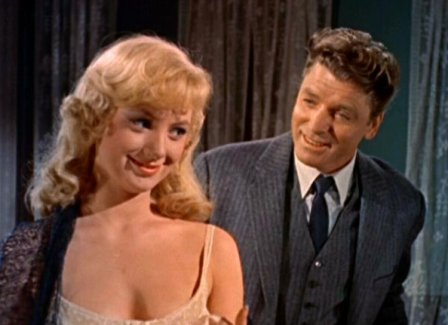
But before the public could write Shirley Jones off as the virginal singing girl next door, we got a view of just how much Shirley Jones could do. In 1960, Jones signed on to play the role of Lulu Bains, the cunning, vengeful prostitute who frames a traveling preacher and exposes him as a fraud in Elmer Gantry. In this role, we see Shirley Jones as a conniving, spiteful woman who serves Gantry exactly what he deserves, and the audience is not sure whether to love her or hate her.
Elmer Gantry tells the story of a young drifter by the same name (played by Burt Lancaster), a salesman of used household appliances who is captivated by a poster of Sister Sharon Falconer, a traveling evangelical preacher. With the ultimate intent of seducing Sharon, he tells her that he has been inspired to bring sinners back to God with his own story of moral disintegration and redemption. Sharon believes him, and they form a successful traveling evangelical ministry. When Sharon and Gantry travel to a town in the Midwest called Zenith, prostitute Lulu Bains reads about them and remembers Gantry as the man who got her kicked out of the house for “ramming the fear of God into me so fast I couldn’t hear my old man’s footsteps.” One night in Zenith Gantry leads a raid on a brothel for publicity, but recognizes Lulu as one of the arrested and orders the girls let go. Lulu invites Gantry back to her hotel room, where she has organized a scheme with her pimp to photograph Gantry in an embrace with her, exposing him as a fraud. But when she seduces him and Gantry responds to her sweetly, she turns off the light so the photograph cannot be taken. Gantry’s love for Sharon causes him to refuse her, and in her anger, she turns the light back on for the photograph to be taken.
The photographs are sent to Sharon, who offers to pay Lulu for the negatives so that the press will not see the pictures and turn the public against them. Spiteful Lulu refuses the money, and sends the pictures to the press. The city of Zenith, angered at Gantry and Sharon, shows up at the tent and a riot erupts. Lulu sees what she has done and her softer side comes through. She runs from the church and back at her hotel room, her pimp beats her for refusing Sharon’s hush money. Gantry has followed her and stops the pimp, then holds Lulu in his arms to comfort her. Lulu reports to the press that she falsified the photographs.
Though his reputation has been restored, Gantry disappears for a few days, much to Sharon’s distress. When Sharon prepares to give her biggest sermon ever, he appears at the front of the church asking Sharon to run away with him. Though she loves Gantry, she is devoted only to her mission, and refuses him. During the sermon Sharon “cures” a deaf man–and just then, the church is ignited by a fallen cigarette. The audience flees, while Sharon tries to encourage them to stay and trust God. Sharon dies in the burning church, and following her death, Gantry was asked to continue her mission. But he declines, quoting the Bible: “When I became a man, I put away childish things.”
The movie was a very daring one for 1960. The production code was still alive, and blatant denouncing of religion as well as sexual content could be censored. The loophole in this rule allowed for those situations that were necessary for keeping the otherwise acceptable story intact, and as Elmer Gantry was based on a book written in 1927, this is exactly how the movie got away with all the content offensive to the censors.
Elmer Gantry is an exceptionally introspective, intelligent film, one of the highlights of 1960 and one of my personal favorites. There are endless good things to say about this movie, but foremost among them is that Shirley Jones’ performance stands out as the highlight of this entire masterpiece of a film. Elmer Gantry was named Best Picture at the Oscars, and for her role as Lulu, Jones was awarded the Best Supporting Actress Oscar for 1960.
Shirley Jones accepting her Oscar.
As it happens, I am currently on the bus to Los Angeles. I will be covering Cinecon beginning tomorrow, and one of the special guests is…drumroll please….none other than TCM’s star of the day, Shirley Jones! I can’t wait to hear what she has to say, and I will be sure to include all of her discussions in my coverage of Cinecon, starting tomorrow.
Please be sure to watch TCM today for Elmer Gantry, showing at 3:00 EST, and the rest of the wonderful Shirley Jones movies playing today.
Hello dear readers, your author Lara here to give you an update on what Backlots is up to this month and beyond! We have a few very exciting things on the horizon, and I would like to share them with you so that you may tune in and experience them along with me!
1. CINECON
The first event is Cinecon, for which I will be traveling to Los Angeles for the second year in a row as a member of the press. Each year Cinecon presents rarely seen classic films over Labor Day weekend at the Egyptian Theatre in Hollywood, presented by Cinecon president Bob Birchard. Not only is Cinecon a wonderful place to see rare classic movies, it is also unmatched as a movie collector’s paradise. Vendors occupy several rooms at Loew’s Hollywood Hotel and sell all kinds of classic movie memorabilia, from DVDs and magazines to rare posters and autographs. It also features an elaborate banquet that many celebrities attend, and is an all-around quality event. If you are in the Los Angeles area (or if, like me, you are in the San Francisco Bay Area and need an excuse to get out of town while the bridge is closed over Labor Day!), I highly recommend that you give Cinecon a go. I had a wonderful time last year.
2. SUMMER UNDER THE STARS AND CORRESPONDING BLOGATHON
If you have been paying any attention to TCM lately, you know that the annual Summer under the Stars programming is well underway on the channel. Every year during the month of August, TCM pays tribute to a different star each day, programming a full 24 hours of the movies of a single star. Jill over at Sittin’ On a Backyard Fence and Michael at ScribeHard On Film have put together a blogathon in which bloggers write about the star of the day. I have already written about Joan Fontaine (click here to see the post), and I am signed up to blog on Shirley Jones day on August 28. My post will be about her role in Elmer Gantry–a major diversion from her previous image as a clean, virginal girl. Take a look at this clip for a preview of what’s to come on August 28.
3. HITCHCOCK HALLOWEEN
As I mentioned in my previous post, Hitchcock Halloween, Backlots’ newest blogathon is coming on October 31. Participants may blog about anything Hitchcock-related–his movies, his life, his TV show, make it your own! Let me know what you would like to contribute, and I will add you to the list of participants.
4. A SPECIAL SURPRISE
Extra! Extra! There will be a very special surprise coming to the blog in late October. Details will be forthcoming, but suffice it for now to say that this surprise is courtesy of an extremely kind and generous woman who worked as an integral part of classic Hollywood. Please stay tuned for more details as the date of the surprise approaches.
Mark your calendars folks, Backlots is going to be hosting another blogathon!
To complement the Dueling Divas blogathon that I host every December, this year I am beginning a new tradition. Avoid those birds and be watch your back in the shower folks, because Hitchcock Halloween is coming to Backlots! On October 31, submit your review or analysis of a spooky Hitchcock film to celebrate the arrival of the holiday.
I did something similar to this last year, but instead of collaborating with my fellow bloggers, I simply did it myself. This year I thought it would be fun if we all participated!
Here are some guidelines:
You can write about Hitchcock–his career, his life, etc.–profile one of his films, talk about his TV show, whatever you feel moved to do. Don’t feel like you have to be confined to movies for this one, because Hitchcock was a personality above all, and he deserves to be honored with a holistic approach.
Though I expect that most of the entries will end up being about Hitchcock’s horror films anyway, feel free to write about something like North by Northwest if that’s your favorite Hitchcock movie and that’s what you want to contribute. Heck, write about Mr. and Mrs. Smith if you want! Again, holistic approach.
During Dueling Divas, I really love when people write freely about whatever they feel the topic means to them. However, try not to stray too far. In the past I’ve felt like perhaps I gave a little too much free rein, and people got a bit tangential. Write about what you want, but don’t forget that this is about Hitchcock!
Submit your interest and topics to me when you’re ready, and I will add you to the list of participants. So far we have:
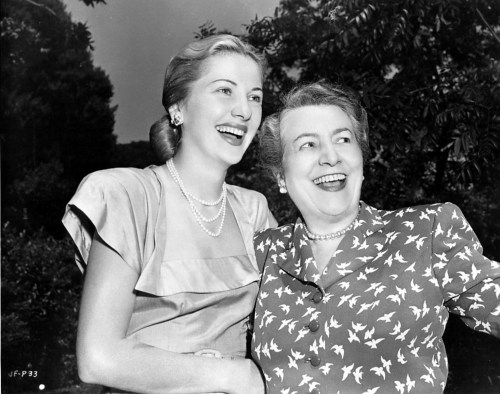
Joan Fontaine shares a laugh with her mother, Lilian.
By Lara Gabrielle Fowler
First off, thank you to Jill at Sittin’ On a Backyard Fence and Michael Nazarewycz at ScribeHard On Film for hosting this terrifically clever blogathon, focusing on one star per day via the TCM Summer Under the Stars lineup. Since many readers of this site know of my love for Joan Fontaine, I felt that instead of writing a movie review for this blogathon I would contribute something more personal, a small examination of the relationship between Joan Fontaine and her mother, who played secondary roles in several Fontaine films such as The Bigamist and Ivy.
The Lilian Fontaine Garden Theatre as it stands today.
Even today, while Joan lives a quiet life in Carmel at the age of 95, her mother is not far from her mind. Three years ago the Lilian Fontaine Garden Theatre in Saratoga, named for Lilian’s contributions to local theatre, was undergoing renovations. To everyone’s surprise, a huge 5-figure donation came through that would cover all the necessary refurbishments. It was from Joan. She declined to be interviewed, saying that this gift is for her mother, whose ashes are scattered there and who once said about the garden “”If you ever wonder about me, come to this garden, and I’ll be here… somewhere around.”
A graduate of the Royal Academy of Dramatic Art and also a trained singer, Lilian was a native of Reading–a large English city in the Berkshires. As an adult she ventured to Japan to try her luck in a performance career and ended up staying, marrying a handsome gentleman named Walter de Havilland. Their first daughter, Olivia Mary, was born in Tokyo on July 1, 1916, and Joan came along 15 months later on October 22, 1917. The de Havilland marriage was rocky, and the girls prone to illness, so on the advice of the doctor Lilian soon moved to Saratoga, California with the two girls in tow, in search of a more hospitable climate for their many ailments. Walter stayed behind.
Olivia thrived in California, but Joan remained very frail. As a young child her shyness and frequent illnesses precluded her from making school friends, and her sky-high IQ rendered it difficult for her to relate to her peers. Relations with her sister Olivia were never sunny, so having a friend at home was not an option. Isolated and often bedridden for months at a time, her mother was her sole companion and best friend.
Joan (child in black coat on the right), Lilian (in the black hat, holding Joan’s arm) and Olivia (far left) with family friends in Saratoga.
Lilian’s mothering skills were very much of her time and upbringing. She was determined that her daughters would grow up to be proper English ladies, and strict lessons in diction, manners, and even walking were commonplace in the house. When she remarried, to accountant and archdisciplinarian George Milan Fontaine, the lessons continued under his tutelage. Everything was expected to be “just so,” and if it wasn’t, extreme punishment could be expected. There was little affection in the house. As a teenager, Joan was severely scolded for holding hands with a boy during a concert, and her mother’s harsh words scarred her for life.
Yet through all of this, Joan retained a deep, unconditional love for her mother. When she began to earn money in movies, she sent monthly checks to her mother, supporting her completely of her own will. She offered Lilian, who had never really made it as an actress, roles in her films.
Skip to 5:45 in this clip from Ivy. Lilian is seated directly to the right of Joan, in the dark dress and hat.
When Lilian fell ill with cancer, Joan took over her care. Though Lilian was not always able to show it, Joan finally heard those words of love she so craved from her mother during their very last phone conversation. Right before they hung up, Lilian said to her tenderly “Remember how much I loved you.”
I like to think that this gave them a sense of resolution to a somewhat complex relationship, and that Joan could cope with the loss of her mother with the assurance that she reciprocated her love. It is a graceful end to a life, and a sweet goodbye from mother to daughter.
Lilian with Joan (on the floor) and Olivia (seated) shortly after their arrival to the United States.
A draft of one of Marilyn Monroe’s poems, in her own hand.
By Lara Gabrielle Fowler
August 5, 2013 marks 51 years since the death of Marilyn Monroe. Though I try to keep Marilyn to a minimum on this blog because of her overwhelming overexposure in the media, the fact remains that Marilyn may well be the most fascinating personality to come out of classic film. The appeal that she holds for the public is evident–it is difficult to walk into any gift shop without seeing her face plastered on posters, shirts, lunchboxes, wallets, purses, and mugs. She has become a sex icon for the ages, and more than any other star, she sells. But amid all the financial gain she brings to businesses Marilyn Monroe continues to be exploited, just as she was in life, robbed of her essence and dignity as a human being for the sake of profits. That is precisely what she was trying to get away from, and thus whenever I see Marilyn memorabilia in a gift store, I feel a twinge of sadness.
Whenever I do mention Marilyn on this blog (which is usually on her birthday and the anniversary of her death), I try to make it count. She was a fascinating human being, the complete antithesis to how the public perceived her. An introspective, observant, intelligent woman who read voraciously and was unusually articulate about herself and her craft, the blonde bombshell image crafted for her only served to exacerbate her inner conflicts and demons.
A talented writer and frequent poet, Marilyn often turned to writing as therapy in a life that overwhelmed her. Today, on the anniversary of her death, I will not pay tribute with the pictures and videos that defined her public life, but instead what defined HER, the woman who deserved so much more than what the cards dealt her.
I have selected what I consider to be some of her most expressive poetry, and I give it to you now in hopes that you will get an inner glimpse of the woman behind the face. Interspersed are drawings that Marilyn sketched during a stay on Fire Island in 1955.
Thanks for reading.
Life – I am of both your directions Existing more with the cold frost Strong as a cobweb in the wind Hanging downward the most Somehow remaining Those beaded rays have the colors I’ve seen in paintings – ah life they have cheated you… thinner than a cobweb’s thread sheerer than any but it did attach itself and held fast in strong winds and singed by leaping hot fires life – of which at singular times I am of both your directions – somehow I remain hanging downward the most as both of your directions pull me.
Entitled “Life is wonderful, so what the hell.”
I I left my home of green rough wood, A blue velvet couch. I dream till now A shiny dark bush Just left of the door. Down the walk Clickity clack As my doll in her carriage Went over the cracks- “We’ll go far away.” II Don’t cry my doll Don’t cry I hold you and rock you to sleep Hush hush I’m pretending now I’m not your mother who died. III Help Help Help I feel life coming closer When all I want is to die – Marilyn Monroe –
Entitled “Lonely.”
O, Time Be kind. Help this weary being To forget what is sad to remember. Loose my loneliness, Ease my mind, While you eat my flesh. – Marilyn Monroe –
————————————————————————————– To the weeping Willow I stood beneath your limbs and you flowered and finally clung to me and when the wind struck with … the earth and sand- you clung to me. – Marilyn Monroe –
A supremely gifted comedienne and talented impressionist, Marion Davies’ name should be indelibly ranked among the top screen comics. Displaying a comedy that seemed to be an early precursor to screwball (in many ways her presence and comedic timing is not unlike that of Carole Lombard), she had the potential to be a great comedic star. And yet even among devoted classic film fans, the name Marion Davies does not come up often in conversation. If she is mentioned at all, it is normally in the context of her ostensible inspiration for the character of Susan Alexander Kane in the immortal Citizen Kane, or for her 32-year relationship with William Randolph Hearst. She claimed to have wanted to maintain a relatively low profile, and for the most part that’s what happened until she ultimately left Hollywood in 1937 to devote her time to Hearst and events at his San Simeon ranch. Davies seemed to have little interest in Hollywood, and believing that she never really had any talent, often wondered how she ended up in the business. Davies could not have been more wrong in her perception about her acting abilities–a very bright talent, she was particularly known for her spot-on impressions, whether adopting a heavy French accent in Marianne or donning impromptu movie star ensembles in The Patsy.
Marion Davies imitating popular stars in The Patsy (1928).
She is one actress who, had she had more interest in being one, could have been an unusually bright star in the Hollywood firmament. As fate would have it, however, she became known instead as the hostess to international luminaries at Hearst Castle in San Simeon, and for her relationship with publishing magnate William Randolph Hearst, who was still legally married. They remained together until Hearst’s death in 1951.
As a teenager.
Born Marion Cecelia Douras in Brooklyn on January 3, 1897, she moved with her family to Gramercy Park and grew up in Manhattan, the youngest of 5 siblings. When Marion was a child, the family changed their last name to Davies after seeing a real estate sign sporting the British name, which was considered more advantageous than the curiously foreign “Douras.” Thus the Douras family became the Davies family.
Marion’s schooling was haphazard, as the stutter that marked her speech excluded her from any Manhattan school, and according to Marion she was eventually relegated to go abroad to a convent school in France which she hated. Biographer Fred Lawrence Guiles disputes this, saying there is no evidence that Marion went abroad, but in any event we know that Marion’s schooling was broken up due to the effects of her stutter. School proved to be dull for Marion anyway (she had a very keen mind, and was often bored) and she soon quit school to begin a career as a Ziegfeld girl.
The same year she was signed with Ziegfeld, she made her screen debut in a fashion newsreel followed by her first feature, Runaway Romany, the following year. By 1918 she had already become a bona fide star, and people were starting to notice her–including newspaper tycoon William Randolph Hearst. Hearst was so taken with her onscreen that he began to assume personal responsibility for continuing her career, and in the same year founded Cosmopolitan Pictures as a sole effort to promote Marion Davies. During this time, they also began a real-life romance. Hearst built for Davies an elaborate house on the Santa Monica Beach (that now exists as the Annenberg Beach House), but before long Davies was living full time with Hearst at his San Simeon castle. Davies’ relationship with the already-married William Randolph Hearst was called “the worst kept secret in Hollywood,” and as Hearst’s Catholic wife refused to get a divorce, that’s the way it stayed.
Davies wanted to continue honing her talents as a comedienne with United Artists, but by now Hearst was so tied up in Davies’ career that he was essentially the sole proprietor of her talent. Disapproving of her comedic roles, he promoted her above all in costume dramas, but still allowed her a bit of room to make the comedies she so longed to do coming in the form of The Patsy and Show People. Her career in the 1920s was almost completely dictated by Hearst, but another large influence came in the form of King Vidor, who directed Davies in both of the above films and saw Davies’ natural gift for comedy. He had attended many parties with Marion and incorporated her ebullient, vivacious offscreen personality into his direction of her. Due to Vidor’s help, she was able to realize in a small way her desire to be a comedienne.
The coming of sound proved to be a nerve-wracking time for Marion. She later said “I couldn’t act, but the idea of silent pictures appealed to me because I couldn’t talk either.” In silent movies, her offscreen stutter was a non-issue. A sound film, however, had the potential to ruin her career. Out of necessity, she dove into the world of sound and learned, to her surprise, that her stutter miraculously disappeared when she was onscreen. Her career survived and she made several successful sound films in the early 1930s, including Polly of the Circus (1932) and Peg O’ My Heart (1933), which was later turned into a Lux Radio Theater production in which Marion starred.
Polly of the Circus.
She made her last film, Ever Since Eve, in 1937 and from that day forward, she devoted herself exclusively to Hearst and played hostess at all the lavish parties Hearst threw at San Simeon. During these years Marion, who was always known as a considerate and caring individual and of whom Tennessee Williams once said “Marion Davies makes up for the rest of Hollywood,” developed a reputation for extreme generosity. Financing the complete education of a friend’s daughter, giving away jewelry, expensive gifts and often slipping such gifts surreptitiously into friends’ pockets at parties, Marion was generous to a fault. Even those who disapproved of Marion’s relations with Hearst (such as established Catholics Irene Dunne and Loretta Young), called her “one helluva dame.” When Hearst’s finances began to slip in the 1930s, Marion began to support him with her own money, continuing to do so until the day he died. After 35 years with Hearst, Marion decided not to attend the funeral out of respect for his family.
Eleven weeks after Hearst’s death, Marion married for the first time, to a man named Horace Brown. It was not a happy marriage, and Marion twice tried to file for divorce, but legally it lasted until Marion’s death in 1961 from stomach cancer. Though trapped in an unhappy marriage, the generosity that was so evident in her years with Hearst continued on–in 1952 she donated nearly $2 million to found a children’s clinic at UCLA, one that is now called the Mattel Clinic. She was also active in the prevention of childhood diseases and in recognition of her efforts, part of the UCLA Medical Center is now called the Marion Davies Clinic.
After Hearst’s death, Marion recorded audio tapes in preparation for a memoir. The tapes were turned into The Times We Had, a rather stream-of-consciousness tribute to Marion’s years with Hearst. It is a lovely read. Though it cannot be considered a memoir per se, it is clearly a labor of love and I would highly recommend it.
Though Davies never recognized her own talent, I consider her to be one of the brightest stars whose light was barely visible. Had she wanted it more, and had she had the freedom to choose her own way, she could have been one of the screen’s greatest and most legendary comediennes.
The San Francisco Silent Film Festival came to a close last night, in a veritable smorgesbord of a day in which audiences were treated to a wide variety of films representing everything from tragic drama to side-splitting comedy.
The day began with a series of shorts from some artists considered to be the silent kings of comedy, including Charlie Chaplin, Buster Keaton, and even Felix the Cat! Felix’s adventures yesterday consisted of an expectedly disastrous trip out west, and Leo McCarey gave us a short called “Mighty Like a Moose” in which a man and his wife, both possessing undesirable traits (the man has buck teeth and the wife has an unusually large nose), decide to have their traits fixed without telling the other. What ensues is a hilarious incidence of mistaken identity, where both spouses start having affairs, not knowing that they are actually having an affair with each other! The premise was later made into a Joe McDoakes comedy in the 1950’s, and as I had seen that comedy at Cinecon last year, I was excited to recognize this extremely clever plot. Also included were two marvelous pieces from Buster Keaton and Charlie Chaplin–Keaton’s “The Love Nest” tells the story of Buster’s foray onto the Seven Seas, getting mixed up with a cruel whaling boat captain and nearly getting himself thrown overboard. The twist at the end just puts the cherry on top of a very funny short!
Our Charlie Chaplin treat was “The Immigrant,” where the Tramp gets into his usual trouble on an immigrant ship headed to New York. Once in New York, he tries to have a meal in a restaurant, and his antics get in the way once again when he finds himself unable to pay.
It goes without saying that Charlie Chaplin was a comedic genius. Everybody knows this, and it seems silly to even mention it here. Chaplin is such a cultural mainstay, that people seem to think that he is the ONLY silent star worth seeing. Chaplin’s short was not the last on the program today, but I saw nearly half the audience leave after “The Immigrant.” This, I believe, is an area in which we as classic film scholars and (dare I say it) educators need to put in some work. Chaplin holds his own, but other equally talented classic stars are not getting the attention they deserve just as much. I commend the San Francisco Silent Film Festival for doing their part to build up the other silent stars, and keep Chaplin to a minimum. Charlie Chaplin will never die–the others will if we don’t keep them alive ourselves.
The Outlaw and His Wife.
Next was a complete change of tone with The Outlaw and His Wife, a melodramatic Swedish tragedy about an outlaw who falls in love with a village woman and together with her escapes to the mountains to live an outlaw’s life, constantly pursued by the law. A line that was often used in the movie is “Love was their only law,” and that seems to drive the story. The film is careful to paint the outlaw as an upstanding person, driven to crime out of duty and obligation to his starving family and not a natural criminal nature. The final hour of the movie is rife with tragedy that leaves the viewer pondering the meaning of existence. Though I am aware of the cliché nature of that statement, it is quite true in the case of The Outlaw and His Wife. The final few lines of the movie deal with a philosophical pondering on how long is too long to live, and the final consensus affects their fate. It is certainly not a movie for the faint of heart, but it is a powerful social commentary and a must-see for anyone versed in Swedish cinema.
A return to lighthearted fare was next on the schedule with a local crowd-pleaser, The Last Edition, making its debut after an old print in the Netherlands was found and restored.
The McDonalds are an average San Francisco family–their daughter works as a telephone operator and their son is an up-and-coming lawyer, while the father works at the Chronicle printing press. Their life is turned upside down when the lawyer son is framed for accepting bribes from a local bootlegger. The father sees the story on the presses before the paper is distributed, and when his superiors refuse to stop the presses, he attempts to do it himself. With the help of the daughter’s skilled call-connecting action at work, the family all pitches in to get the son’s name cleared before the paper goes to the street. It is a movie that keeps the viewer on the edge of his seat, and wraps up in a wonderful, tight bow. The action takes place in and around the San Francisco Chronicle building, making this movie especially pleasing to San Francisco audiences and filling the theater to the brim with excited local patrons. A backward reel around the middle half of the film did little to diminish the excitement that pervaded in the theater, and the audience cheerily clapped along with the piano music that entertained while the problem was being fixed in the projection booth.
Back to starvation and destitution with the next offering, The Weavers, a true masterpiece of a film based on a Silesian weavers’ uprising in 1844. It was released in 1917 in the wake of the deposition of Czar Nicholas II of Russia, and the filmmakers make no effort to veil the similarities. Above all, this is another powerful social commentary on the position of the poor at the command of the rich, and though the ending of the film officially leaves its position neutral, it is clear and obvious that the movie’s sympathies are with the poor revolutionaries. Gunter Buchwald, who provided the piano score, thrilled the audience with a vocal rendition of the workers’ song during the movie, which provided an extra dimension of intensity and proved to solidify the movie’s message. A fantastic screening of a powerful masterpiece.
The festival closed with a bang, with a screening of the Haroly Lloyd classic Safety Last!in which Harold Lloyd performs the famous stunt of hanging from a clock after scaling a tall building. Much to the shock of my blogger friends next to me, I had never seen this movie before. Suffice it to say that it was a wild ride! Though the general plot is of a young man trying to impress his girlfriend by making her think that he is the manager of a department store, nearly half the movie consists of Lloyd scaling the building. As a person with an intense fear of heights, this affected me greatly. It is a delightful movie, and Lloyd an agile stuntman. I am ashamed of never having seen this before, but I can now count myself among those whose cinematic experience has been enhanced by this historical piece.
Harold Lloyd in the famous scene from Safety Last!
And that was it, folks! I hope you’ve enjoyed this coverage, and I look forward to next year!
Yesterday’s programming was perhaps the most phenomenal of the entire festival thus far, and consisted of some of the best offerings I have ever seen here. With an Academy Award-winning animator and a full Balinese gamelan ensemble highlighting the day, this was one of the most unique and memorable days in the entirety of my experience at the San Francisco Silent Film Festival.
One of the things I love about the San Francisco Silent Film Festival is its commitment to diversity. It is monumentally easy to fill a program with solely American films with American directors and casts, and that seems to be the modus operandi of many American for-profit festivals around the country. But the San Francisco Silent Film Festival, a non-profit company, has much greater freedom and a wide open mind, preferring to provide the viewer with a holistic view of silent film, ranging from American crowd-pleasers to obscure international titles unseen for decades. Much of yesterday’s program represented the diversity that is so important to the San Francisco Silent Film Festival, with 4 foreign titles from Bali, France, Russia, and Germany.
But the first presentation of the day was the sheer definition of a crowd-pleaser. Academy Award-winning animator John Canemaker (“The Sun and the Moon”), who is now the head of animation at NYU, painted a complex and elaborate portrait of animation pioneer Winsor McKay, considered to be one of the fathers of modern animation. From his early cartoon drawings to his political work for the Hearst newspapers, Canemaker delivered a heartfelt tribute complete with rousing audience participation. When he discussed McKay’s creation of Gertie the Dinosaur and his incorporation of the moving cartoon into his vaudeville act, he asked the audience to do what McKay’s audiences did–talk to the dinosaur and give her instructions. The crowd went wild with enthusiasm.
Gertie the Dinosaur, animated by Winsor McKay.
This presentation on Winsor McKay was likely the very best presentation I have ever seen at the San Francisco Silent Film Festival. Informative, funny, and engaging, Canemaker piqued my interest in a subject on which I am often lukewarm (animation has never been a primary interest of mine). His book about Winsor McKay, for sale at the festival, sold out within minutes of the end of his presentation, and I made the point to go up to him while he was signing books to tell him how blown away I was. San Francisco Silent Film Festival take note–have John Canemaker back every year!
Next on the program was one of the major events of the festival–the world premiere screening of Fairbanks’ The Half Breed, restored by the San Francisco Silent Film Festival, the Cinémathèque française and the Library of Cogress. Based on the presentation given Friday morning, I was very excited for this movie. A tragic tale commenting on the rampant racism of 1849 California, The Half Breed is a film ahead of its time.Fairbanks plays a man with a Native American mother and a white father, dealing with the prejudices of white society. The most interesting part of the film for me was watching it as it passed through the projector for the first time, having seen the presentation on its restoration on Friday morning. Given that the film is nearly 100 years old, the restoration was beautiful. Some parts were so badly damaged that they could not be repaired, and taking them out would ruin the continuity. Thus, certain scenes were a bit hard on the eyes, but all in all it was a smashing success. From here, the film will take its place in the Library of Congress as the first title in the newly created San Francisco Silent Film Festival Collection.
Douglas Fairbanks in The Half Breed.
Next was an experience I will have trouble describing accurately. Quite simply, it was one of the most breathtaking cinematic experiences I have ever had. The movie was Legong: Dance of the Virgins, a production of Bennett Picture Corporation run by actress Constance Bennett and her husband Henri de Falaise. Shot entirely on the island of Bali with a native cast, it tels the story of teenage love, betrayal and tragedy between Balinese ritual dances. Accompanying the film was the San Francisco-based Sekar Jaya gamelan ensemble, taking over the Castro stage with a full assortment of Balinese gamelan instruments. Along with them was the Clubfoot Orchestra, a small group of Western instruments, and together the two ensembles played a spectacular Balinese score accompanying the action and sacred dances onscreen. Just recalling it makes me tear up from the beauty of it all. This kind of experience is what makes the San Francisco Silent Film Festival so unique, and why I feel so honored to blog for them every year. I am hard-pressed to think of anything remotely like it, and I am so appreciative to have been a part of this once-in-a-lifetime experience.
The same program from 1999.
Next came a smaller offering, a sweet yarn called Gribiche about a young lower-class boy who is adopted by a well-intentioned wealthy woman so he might have an education. The boy is grateful, but misses his mother so much he begins to act out. Eventually it becomes such a problem that everyone in the house either leaves or is fired due to his behavior. Gribiche runs back to his old home and is reunited with his mother, and together they decide to go thank the woman for her kindness but keep Gribiche at home. The two families become good friends, and the movie ends happily. It is a lovely tale that runs way too long, but the movie has such a nice message that the length is somewhat forgiven. I enjoyed it very much.
The House on Trubnaya Square, a Soviet movie about the adventures of a country housekeeper in Moscow, was a fun one for me, as I have spent a significant amount of time in Russia and am familiar with Russian comedic history and tradition. Many of the antics in this movie reminded me of some of the characters from popular Russian shows of the 1960s, and it was good fun for me. Some of the people around me were a bit put off by the screwball nature of the comedy, but being familiar with the style, I had a wonderful time watching it.
The House on Trubnaya Square.
The Joyless Street, made in 1925 and one of the programs to which I was most looking forward due to the appearance of Greta Garbo, proved to be a very long, very dark movie with some magnificent acting. Asta Nielsen, playing a desperate teenager in contemporary Vienna trying to make ends meet for her family, gives some of the finest silent acting performances I have seen. During one scene in which she is describing a traumatic experience, she appears almost possessed. Garbo is always good, and her eyes entrance the viewer. In all, the movie was very dark and rather monochromatic in tone (all 3 hours were extremely depressing), but it is worth it to see Garbo and Nielsen and to experience what Vienna was like immediately after World War I. The movie was banned by Nazi Germany and subsequently mercilessly edited, so little of the original film survives and the Filmuseum Munchen, who restored the film, had to do painstaking research to piece the restoration together. This may account for the difficulty in the storyline, but in all the Filmuseum did a beautiful job with the restoration.
The Joyless Street.
Today marks the last day, and highlights include The Last Edition and Kings of Silent Comedy! See you tomorrow!
The first full day of the San Francisco Silent Film Festival was full indeed, consisting of four feature-length silent movies and a fascinating behind-the-scenes presentation on the restoration of The Half Breed, premiering this afternoon. Beginning at 11:00 in the morning and continuing on straight to the stroke of midnight, day 2 of the festival proved to be a monumental marathon of a day.
The first event of the day was a program entitled Amazing Tales from the Archives, which is a programming staple of the festival each year. This year, Board President Rob Byrne discussed the restoration of Douglas Fairbanks’ The Half Breed, which was made possible only by digging very deep into the archives of film centers around the world. By using source material from the original Tri-Stone script, the Library of Congress, The Cinémathèque française and an incredible discovery in the Yukon (hundreds of film canisters were discovered buried under the ground in an abandoned swimming pool), the San Francisco Silent Film Festival was able to restore The Half Breed to its original 1916 splendor, or as close as possible given the 100 years that have passed since its
initial release. It premieres today at 2:00–and it will be the first time this restoration will have passed through a projector. After this showing, the film will be sent to the Library of Congress, where it will become the first title in the new San Francisco Silent Film Festival Collection at the Library.
One of the highlights of the San Francisco Silent Film Festival is the programming of consistently excellent scholars and speakers from around the world. Next on the program was an example of this, a representative from the Cinémathèque française by the name of Céline Ruivo, who talked about the wonderful Phono-Cinema-Théatre. Created in 1900 and starring some of the most prolific stars of the Belle-Époque, Phono-Cinéma-Théatre was one of the very first attempts to put sound on film. Though Edison first experimented with sound in the mid-1890s and his footage of a man playing a violin is considered to be the first “sound” film, Phono-Cinéma-Théatre took it a step further. It presented a true performance to the viewer, and provided him with the very new novelty of sound on film. Ms. Ruivo showed us how they restored this art form at the Cinémathèque française, and projected a short video called “La Poupée” that they recently found and restored. It was mindblowing to think that this art form existed in 1900, less than 5 years after Edison’s first foray into sound.
A poster for Phono-Cinema-Théatre.
Following a short break, the feature-length films began with The First Born, a British film starring Madeleine Carroll about a woman who goes to desperate lengths to keep her sleazy politician husband from leaving her. Knowing that he wants a child, she adopts a baby while her husband is away and passes him off as their biological child upon his return. After a conniving mistress tells the husband to ask his wife who the baby’s father REALLY is, he becomes angry and decides to leave his wife for his mistress. But after a row, the mistress throws something at him while he is waiting for an elevator and he falls down the elevator shaft. What happens next is a marvelous and shocking twist that I was not expecting, and the entire audience gasped. I will not reveal the ending, as I implore you to see this film if you can find it. At first I was rather put off by the misogyny that I perceived (even by 1920s standards I found it to be that way), but by the end, everything turns around. It leaves the viewer with a very positive feeling.
The sleazy husband in The First Born.
Next up was Tokyo Chorus, a 1931 film by Yasujiro Ozu who was an extremely prolific Japanese director in the 1920s and 1930s. Ozu continued to make silents long after it was popular, and Tokyo Chorus is a very relevant and relatable piece. It tells the story of a middle-class family in Tokyo that lives comfortably until the husband suddenly loses his job. It follows their journey of trying to make ends meet, their struggle paying hospital bills after their daughter gets sick, and the embarrassment the father feels when he is unable to buy his son the bicycle he longs for. It is a sweet, pensive drama, and ultimately ends on a very uplifting note. It continues to be relevant today, as many families are going through this exact dilemma around the world. Ozu created a really timeless piece that examines and comments on universal family dynamics.
Tokyo Chorus.
The uproariously funny comedy The Patsywas next, starring the supremely gifted Marion Davies as the screwball-esque lead. Indeed, I would say that this film influenced what eventually became screwball comedy. A quirky, somewhat dizzy family doesn’t understand their bouncy, energetic daughter Patricia (called “Pat”), and hence they make her the butt of many of their jokes and negative remarks. This is much to the chagrin of her father, the rock of the family. Pat tolerates it, but through a series of circumstances Pat pretends to be insane in order to win a boyfriend. The tone of the film reminds me a bit of My Man Godfrey, and Davies’ antics are quite a bit like Carole Lombard’s later screwball roles. I thoroughly enjoyed the film, and the theater seemed to be constantly roaring with laughter.
Marion Davies in one of the funniest scenes in the movie.
I had to leave early in order to catch the last train home, but I was lucky enough to stay and see Eddie Muller, known as the “Czar of Noir,” introduce the Danish The GoldenClown. He described it as “clown noir,” and the initial happy nature of the film belies a very dark second half. I very much regret not being able to stay and see all of it, but what I saw was quite interesting. It takes place in a circus, and I regrettably had to leave before its tone got sinister. Muller mentioned that the “tower of clowns” scene was particularly terrifying.
The Golden Clown.
Today’s lineup is probably the most noteworthy of the entire festival–a presentation on Windsor McKay, followed by The Half Breed, Legong: Dance of the Virgins, Gribiche, The House on Trubaya Square, and The Joyless Street.
See you tomorrow with another blog post! And don’t forget to check Twitter, as I will be tweeting throughout the festival.
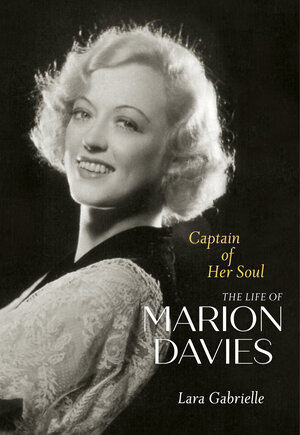
Captain of Her Soul: The Life of Marion Davies is now available at your favorite bookseller! Click hereto order it, and visit mariondaviesbook.com for all the latest.
Backlots is devoted to honoring and celebrating all aspects of classic film and is written by Lara Gabrielle, a California-based classic film writer and historian. Lara is the author of CAPTAIN OF HER SOUL: The Life of Marion Davies (UC Press, 2022).
Here you will find pieces on frequently seen classics and some lesser-known gems, as well as book reviews, festival coverage, and pieces on the history, theory and culture of film as it relates to the study of classic cinema.
Enjoy the site, and thanks for reading!
AFFILIATIONS & AWARDS
2019 CMBA Award for Best Profile of Classic Movie Performer or Filmmaker--"The Activism of Myrna Loy"
Winner of the 2018 CiMBA Award for Best Classic Movie Series, BACKLOTS AT THE COURTHOUSE: OLIVIA DE HAVILLAND VS. FX
Winner of the 2014 CiMBA Award for Best Profile of a Classic Movie Performer or Filmmaker: A Q&A WITH JOAN FONTAINE IN HONOR OF HER 96TH BIRTHDAY
Winner of the 2011 CiMBA Award for Best Classic Movie Discussion, THE FINAL SCENE OF THE HEIRESS
I am honored to be a judge of the Animal Film Festival in Grass Valley, CA.
EVENTS
BACKLOTS ON THE WEB
Join us at the Backlot Commissary, the place for Backlots' readers to share content and discuss movies!
Walter Pidgeon and Greer Garson in "Mrs. Miniver."






![550783_552058359264_1151502632_n[1]](https://backlots.net/wp-content/uploads/2013/08/550783_552058359264_1151502632_n1.jpg)























_03.jpg)

 Backlots