Kay Thompson is a name with which most people outside of the classic film world are unfamiliar. If she is known at all, it is often through the lens of Eloise, the immortal children’s book character she created in the 1950s. In classic film, she is primarily remembered by the legions of Audrey Hepburn fans, who know Kay Thompson for her work with Audrey Hepburn in Funny Face. Most people I’ve come across fail to realize that the the author of Eloise and the woman in Funny Face were the same person. While Kay Thompson was indeed a wonderful author and brilliant in Funny Face, these endeavors showcased only the tip of the iceberg when it came to the extraordinarily widespread talents of this gifted woman.
I am entirely confident in saying that Kay Thompson may have been the single most versatile personality ever to come out of classic Hollywood. Actress, singer, dancer, vocal coach, vocal arranger, cabaret performer and author, Kay Thompson ranked among the very best in every medium of the entertainment world she tackled. Associated with MGM for many years, she worked on some of the most celebrated films of the era, and served as vocal coach to the likes of Judy Garland, Lena Horne, and June Allyson. She became especially close to Judy Garland, developing a devoted relationship of best friend and confidante. She is the godmother of Judy’s daughter Liza Minnelli.
Judy Garland and Kay Thompson.
Born Catherine Louise Fink in St. Louis, MO, she signed a contract with MGM in 1943 after a stint as a singer and chorus director in radio. Her position as the head of the vocal unit, which included responsibilities such as arranging and directing the vocals in productions under Arthur Freed, enabled her to work on such films as Ziegfeld Follies of 1946 and Good News (1947) and helped hone her distinctive style of vocal arrangement.
Judy Garland in a segment of Ziegfeld Follies of 1946, which Kay Thompson co-wrote with Roger Edens.
“The Varsity Drag” from Good News.
In 1948 Thompson left MGM to pursue a nightclub act at Ciro’s, in a group she called “Kay Thompson and the Williams Brothers,” an act which included the young Andy Williams in one of his first appearances. The act was a smash hit, with Kay Thompson writing all the songs for the group’s nightly productions.
When her goddaughter Liza Minnelli was born in 1946, Thompson immediately took to her. The two became very close and their friendship lasted until the day she died. Thompson witnessed all of Liza’s mischievous antics, and in 1955, while living in New York, decided to write a book about a young, mischievous girl who lived at the Plaza Hotel. It is said that this character was based on Liza herself.
The book was Eloise, a book that remains popular today and that heralded several subsequent books by Thompson. Eloise is a character that has proven to be a timeless symbol of childhood, and in 2006 prompted a cartoon series for children on Starz.
Thompson made the first of only two movie appearances in 1957, in the Audrey Hepburn/Fred Astaire vehicle Funny Face. Though the part was essentially a secondary role to Astaire and Hepburn, it is Kay Thompson who steals the show with several show-stopping numbers that prove her abilities as a dancer as well as a singer. Despite Audrey Hepburn’s obvious charm, it is Kay Thompson who is the larger-than-life character in the movie, and hence it is her character that makes an impression and whom you remember after the movie is over. In addition, in this number in particular, her influence on Judy Garland’s performance style in her later career is very visible.
“Clap Yo Hands” from Funny Face.
Judy Garland in her last film, I Could Go On Singing, 1963.
Kay Thompson only made one more movie appearance in her life, and that was with Liza Minnelli in Tell Me That You Love Me, Junie Moon in 1970. She moved back to New York from Hollywood in 1969, and in 1974 directed a fashion show at the Palace of Versailles. She moved in with Liza in the late 1980s, and lived there until she died, at the age of 88, in 1998.
Liza created a tribute show to Kay Thompson in 2008, based upon Thompson’s nightclub act at Ciro’s. The show was called Liza’s At the Palace, and it won several Tony Awards in 2009. During her Tony acceptance speech, Liza thanked her parents for “the greatest gift they ever gave me, Kay Thompson.”
I think the reason Kay Thompson is not widely acknowledged today may be the fact that she was so talented and did so many things so well. The fact that she nurtured all of her talents, without focusing on one specific area, spread her too thin. Had she been able to concentrate her energy on one of her many talents, I think she would have been one of the biggest stars of her day. Yet if she had done that, we may not have had Eloise, we may not have had the magnificent vocal arrangements we have come to associate with MGM, and we may not have seen the talents of so many stars she nurtured. Kay Thompson was indeed an integral part of the entertainment world, and her influence lives on through her work.
Yesterday afternoon I received a copy of this beautiful book in the mail, and I haven’t been able to put it down since.
With a release slated for next week, George Hurrell’s Hollywood: Glamour Portraits 1925-1992 is a gigantic book packed full of magnificent photos from this legendary photographer and, in between photos, details from Hurrell’s fascinating life. It is proving to be a must-read.
Stay tuned for a review as the release date approaches. In the meantime, if you would like to pre-order the book, you may do so by clicking here.
If you are not yet familiar with Hurrell’s photography, here are some of his breathtaking photographs:
The beautiful Ruan Lingyu, known as China’s Greta Garbo, is still revered as one of the preeminent actresses of Chinese cinema.
By Lara Gabrielle Fowler
This evening on TCM’s “Silent Sunday Nights” program, viewers on the channel will see The Goddess (1934), one of the major films featuring Ruan Lingyu, a veritable icon of Chinese cinema. Though her name may not resound to Western ears like the names of Greta Garbo and Marlene Dietrich, she is considered to this day to be one of the most talented actresses ever to appear onscreen in China. She was a massive star during her lifetime and tragically fell victim to the cruelties of the Chinese press, who drove her to suicide at the age of 24.
Ruan Lingyu was born Ruan Fenggen in Shanghai to a father who died when she was six and a housemaid mother. In order to earn money for her struggling mother, she answered a newspaper ad looking for actors, signing with the Mingxing Film Company in 1926 and appearing in her first film, A Married Couple In Name Only, the following year. Over the course of the next nine years, Ruan Lingyu (she changed her given name when she signed with Minxing Film Company) made 29 pictures–all silents–and rose to legendary status in China through picture deals with several high profile Chinese studios such as Da Zhonghua Baihe Company and Lianhua Pictures, where she filmed The Goddess in 1934. She became known as “China’s Greta Garbo,” and developed a reputation for magnificent acting talent to align with her breathtaking beauty.
Ruan Lingyu’s personal life was immensely troubled. Her marriage to Zhang Damin, the son of her mother’s employer, ended in a split due to the gambling habit that had resulted in Zhang’s being disowned by his family. Shortly after leaving Zhang Damin, Ruan began an affair with tea tycoon Tang Jishan and Zhang formally sued Ruan for damages, an event that was quickly picked up by reporters who set out to make her life a living hell for the sake of publicity.
The public pressure on Ruan began to intensify after the completion of the film New Women, which harshly criticizes the Shanghai tabloids. Based on the life of Ai Xia, another Chinese actress who had committed suicide in 1934, the film bears a very eerie resemblance to what would ultimately happen to Ruan herself just one month after the film’s release. A massive cut was required by the director Cai Chusheng to appease the press, and the tabloids took the opportunity to step up their vendetta against the young Ruan Lingyu, who was living what they considered to be a tabloid-rich life and who had just come out with a movie that spoke ill of their industry.
Adding to the tabloids’ enormous public pressure on her was Ruan’s unraveling life with Tang Jishan. Unable to see a way out of a painful life, Ruan Lingyu took an overdose of barbiturates on March 8, 1935 at the age of 24. Her famous suicide note (which may have been fabricated by Tang Jishan after her death) read “Gossip is a fearful thing.” Ruan’s funeral was attended by over 100,000 people, and several women were said to have committed suicide themselves during the procession.
The story of Ruan Lingyu is one of the saddest to come out of world cinema. And unfortunately, when one looks at tabloids today, very little has changed since Ruan Lingyu’s unfortunate demise. The tabloids today are still wreaking havoc on young stars, with little to no regard for their privacy or well-being. And in the United States, the mention of Ruan Lingyu as an example of the cruelty of the tabloids is met with a blank stare. Her name is all but forgotten here, a fate not worthy of her extreme talent and the maturity she exudes onscreen. Watching Ruan Lingyu onscreen, her portrayals of the strong and complex characters in The Goddess and New Women, it is easy to forget that she made her last film at the age of 24.
I had the pleasure of seeing a Ruan Lingyu film entitled Little Toys at the San Francisco Silent Film Festival 2 years ago, which is where I was first introduced to Ruan’s enigmatic charm. I was immediately taken by her, and was glad to hear that though her filmography is so sparsely seen in the United States, China still reveres her as one of the most legendary icons to ever come out of Chinese cinema. In China, her legacy lives on in a manner that befits her.
Hello there readers, Lara here to thank you for all your fantastic submissions yesterday for Hitchcock Halloween. It was a really fun event and I think Hitch would have been proud! I hope you will join us next Halloween for another installment of what proved to be a very popular tribute to Alfred Hitchcock!
This post also closes out the month of October, which was a very fruitful one for Backlots. As a refresher, here are the things that happened this past month on the blog:
Backlots interviewed Joan Fontaine in honor of her 96th birthday.
Backlots interviewed Victoria Wilson, author of A LIFE OF BARBARA STANWYCK: STEEL-TRUE 1907-1940.
Backlots interviewed Kendra Bean, author of VIVIEN LEIGH: AN INTIMATE PORTRAIT.
The Hitchcock Halloween Blogathon.
Thank you to all my readers for making this such a memorable month at Backlots, and here’s to many more equally memorable months to come!
In about 2 weeks, Backlots will go down to Burbank to blog for the Warner Brothers’ 90th Anniversary VIP Tour, so stay tuned on November 13 for some very special coverage. More details to come!
Today is the day, folks! It’s a spooky Halloween morning, and I have already received several entries for Backlots’ Hitchcock Halloween blogathon! The entries will appear here as I receive them. To those of you with entries to submit, please either send them to my email address or comment under this post (or the original announcement post, as you prefer).
So without further ado, here are the entries for Backlots’ first annual Hitchcock Halloween blogathon!
75 years ago today, Orson Welles’ radio theater program Mercury Theater On the Air produced a radio drama that shocked a country, changing forever broadcasting as we know it. That program was “War of the Worlds,” an adaptation of H.G. Wells’ novel of the same name, billed as the Halloween episode of the series and presenting like a news report of a martian invasion of New Jersey.
The lasting legacy of the program is the effect it had on listeners, especially those listeners in the New Jersey area. Due to “War of the Worlds'” presentation as a legitimate news program, the story goes that the general public erupted into a frenzy, believing that an alien invasion had indeed landed in New Jersey.
The broadcast of “War of the Worlds” began with what appeared to be a weather report, followed by a musical program like any other one might hear on the radio during this era. The musical program is interrupted several times by a news bulletin on explosions witnessed in the sky over Chicago, which become increasingly in-depth as the program goes on. Orson Welles plays an astronomy professor who discusses the possibility of a martian invasion, noting disturbances in the planet Mars of late. The program switches back and forth between the broadcast of cheery, popular music and increasingly grave, disturbing, and serious reports–ultimately from a farm town called Grover’s Mill, NJ where a reporter reports on aliens who have landed in that town. For me, the scariest part of the broadcast occurs about 17 minutes in–when the increasingly panicked voice of the reporter, the screams and shouts and sirens in Grover’s Mill suddenly cut off and the program is completely silent. The announcer says that there is a problem with the field transmission, and when it returns, the announcer reports that several deaths have occurred.
According to reports, as the program was broadcast, people in the New Jersey area panicked, fainted, ran into the streets, and suffered from hallucinations of the things they had heard about on Welles’ program. The next day’s Daily News headline screamed “FAKE RADIO ‘WAR’ STIRS TERROR THROUGH U.S.” The New York Times added “Radio Listeners in Panic, Taking War Drama as Fact.” The news media worked itself up into a frenzy, with calls for Welles to make a formal apology to those he had frightened and for Washington to look into what had happened. Welles did make a formal apology, but insisted upon his innocent intentions and bewilderment regarding the public response.
Nothing like this had ever been seen or heard before. To audiences in 1938, the radio and the newspaper were the two most trustworthy things in life, and the concept of satire or parody in this context was completely foreign. This was also a particularly worried and aware America–the threat of war in Europe was looming large in 1938 (it would break out 11 months later with Hitler’s invasion of Poland) and broadcast media was relied on and trusted to give completely accurate information to this tense nation and world. Orson Welles, already a bona fide genius who had not yet reached his 24th birthday, was still wet behind the ears. It is unlikely that he fully understood the effect that his symbolic, metaphorical work of drama could have on a world waiting on baited breath on the brink of war.
The New York Times headline that illustrates the panic in context with world events, to the right.
The backlash against Welles and “War of the Worlds” was so great, that it gave rise to serious debate within the Federal Communications Commission about the possibility of radio censorship in order to protect the public interest (a prior FCC regulation reserved the right to revoke the licenses of stations deemed unfit to serve the public’s interest, but never was there an issue of censorship–the FCC had only looked into the holistic practices of a station when determining whether or not to renew their licenses). Ultimately, no direct regulation came out of the “War of the Worlds” hysteria, but the FCC has kept the event in its mind. Several subsequent policy statements from the FCC have made it clear that intentional deception on the air is not something to be tolerated, and have established a bit of a de facto ruling that a station may not broadcast knowingly false information to the general public.
Given the infamy of the event and the massive uprising against Welles and the program, it is easy to take our collective memory as truth. There have, however, been several scholarly reports to come out lately about the exact level of hysteria and how it matches up with our memory. One thing that is often overlooked is that “War of the Worlds” was competing opposite one of the most popular radio shows of the time–The Edgar Bergen and Charlie McCarthy Show. According to Broadcasting, only 2% of polled audience members said they were listening to “a radio play” or “The Orson Welles program.” None said they were listening to a “news program,” which would be what those who believed Welles’ program as truth would say. It seems that our perception of “War of the Worlds” may have been skewed by the media–and if so, aren’t we the real victims of a hoax? If the newspapers fabricated the story of the hysteria, it truly was a case of media overreach–but not from the direction they claimed. It seems that these trusted news sources may really have been the ones to blame…not 23-year-old Orson Welles.
Something to think about.
Here is the complete broadcast of Orson Welles’ “War of the Worlds,” celebrating its 75th anniversary tonight.
Thanks for reading, and thanks for tuning in for this countdown to Hitchcock Halloween! Don’t forget to submit your blogathon posts tomorrow, I will be making a post first thing in the morning.
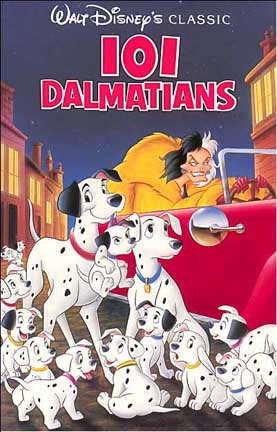
Cruella de Vil in the 1961 animated feature 101 DALMATIANS.
For my second installment in Countdown to Hitchcock Halloween, in which I am profiling several scary characters from classic film, our focus is on that sociopath socialite who lives for puppy furs (boo! Hiss!), the insufferable Cruella de Vil, who made her appearance in 1961’s 101 Dalmatians and has a bit of a secondary connection to classic film as well.
Cruella de Vil is a rich socialite with a sizable collection of fur coats, and when she hears that her friend Anita’s dog is having puppies, her interest is piqued in a coat made of dalmatian puppy fur. She drops by to see the puppies but is told that the puppies will not be born for another 3 weeks, so on a stormy night 3 weeks later, she returns for the puppies. She is enraged when she finds out that the puppies are not for sale, so she sends a pair of thieves to steal them. The movie chronicles the puppies’ life with Cruella and the ordeal of their owners to try to get them back. It is perhaps one of the most harrowing Disney movies ever released, due in large part to Cruella’s evil nature.
The movie poster.
Cruella was voiced by little-known character actress Betty Lou Gerson, whose Tennessee upbringing and formal voice training created the voice we all know so well as that of Cruella de Vil. Gerson was born in Chattanooga, TN, and began to work in Chicago-area radio in the 1930s after relocating there after high school. Gerson moved to Hollywood in 1949, soon hearing her uncredited voice prominently featured as the narrator in Cinderella (1950). She continued to act in small roles on television throughout the 1960s on such series as Bachelor Father, Perry Mason, and Hazel, before retiring from the business after the death of her husband. She passed away in 1999.
Betty Lou Gerson.
In the novel The Hundred and One Dalmatians, written in 1956 by Dodie Smith, Cruella is a tempestuous character who has little regard for anything but her own vanity. She is a glamorous and spoiled London heiress who lives for furs and jewels. When Walt Disney got a hold on the property and came calling for the role of Cruella, he knew exactly where to look for a basis. Dodie Smith had even written Cruella with a certain Hollywood star in mind.
Like Betty Gerson, Tallulah Bankhead was born and bred in the South. Hailing from Huntsville, AL, Bankhead was known for her glamorous, indulgent lifestyle and for her bon vivant personality that dominated every room she entered. Dodie Smith stated that she intended Cruella de Vil to be an evil parody of Tallulah Bankhead, and that intention is well reflected in the movie. From Gerson’s voice to the animations of Cruella’s movements, it could easily be Tallulah playing that part.
It must be noted, though, that there was one way in which Tallulah Bankhead was unlike the character she inspired–Tallulah was a passionate animal lover!
Tallulah Bankhead and Winston Churchill, the lion cub she adopted.
See you tomorrow for another installment of Countdown to Hitchcock Halloween!
Margaret Hamilton as The Wicked Witch of the West.
By Lara Gabrielle Fowler
In the days leading up to Halloween and to Backlots’ Hitchcock Halloween Blogathon, I will be profiling several spooky characters from classic film to get my readers in the mood for Halloween! The profiles will culminate in Hitchcock Halloween, a celebration of all things related to the Master of Suspense, appearing on the blog on October 31.
My first installment in Countdown to Hitchcock Halloween is a profile of one of the most recognizable spooky visages in classic film, that character we all love to hate, The Wicked Witch of the West from The Wizard of Oz (1939). The role was played by Margaret Hamilton with great skill–so great, in fact, that she has succeeded in frightening generations of young children and nearly cost The Wizard of Oz its legion of young fans right from the outset.
The Wizard of Oz was officially released on August 15, 1939, and like all films made under the strict Production Code, it had to undergo rigorous examination to make sure that there was nothing in the film that violated the principles laid out so strictly in the Code. The movie passed, but with qualifications that “care should be taken to avoid an effect which is too frightening to children.” The British censor board had a similar edict–it was given an adult permit due to the frightening nature of the witch, the “grotesque moving trees, and various hideous figures [that] would undoubtedly frighten children.” Scenes were also deleted upon the movie’s release in Sweden and Denmark.
The image of the witch’s face in the crystal ball was deleted in Sweden.
Margaret Hamilton herself was concerned about the effect the Wicked Witch of the West might have on children. A former kindergarten teacher who was extremely fond of children, Hamilton was concerned about the role’s frightening nature and how her image might be colored in the eyes of the children she so adored. Decades after the film’s release, she recalled how children came up to her and asked why she had been so mean to Dorothy. In response to this, she appeared on the children’s television program “Mister Rogers’ Neighborhood,” showing children how she put on her makeup as The Wicked Witch of the West.
The Wicked Witch of the West has also become something of a cultural icon. In addition to her several famous catchphrases, her trademark green makeup is how many of us perceive to be the way a witch “should” look. This is entirely due to the effects of the movie–the green skin tone of the witch is not present in the original novel by L. Frank Baum and was created by the studio as one way to show off the new Technicolor advancement that was all the rage in 1939.
Later in life, Margaret Hamilton was able to shed a bit of her public persona and appear in an entirely different milieu–as Cora, the coffee house woman who only serves Maxwell House in a series of commercials for the instant coffee brand.
See you tomorrow for another installment of Countdown to Hitchcock Halloween!
Mysterious, ethereal, and tremendously charming, Vivien Leigh is about as captivating as it comes. It is easy to simply marvel at her beauty, the likes of which the entertainment industry had never seen before and, in my opinion, has never seen since. Her stunning looks would be enough to secure Vivien’s place as one of the most compelling performers ever onscreen. But when one digs deeper into the life and career of the woman who was Scarlett O’Hara, a new person emerges–a sensitive, intelligent woman who fought intense demons in her personal life while maintaining a powerful inner core strength that came through in her life and her work.
It has been 25 years since the last major Vivien Leigh biography, and earlier this month classic film fans were treated to a unique and very special portrait of the star. Kendra Bean, the owner of vivandlarry.com and resident Vivien Leigh expert in the online classic film community, has written Vivien Leigh: An Intimate Portrait, a work that can be described as a labor of love, a glorious posthumous gift to Vivien Leigh. There have been several high profile biographies of the actress, the books by Alexander Walker and Hugo Vickers have left Kendra with some massive shoes to fill. But fill them she does, and with literally thousands of photographs and personal documents, Vivien Leigh: An Intimate Portrait gives readers an angle on Vivien’s life that has not been seen in previous books. In addition, Kendra is the first biographer to conduct research in the Laurence Olivier Archives, allowing this book to cover aspects of Vivien Leigh’s marriage to Laurence Olivier that have been previously unknown.
Vivien Leigh with husband Laurence Olivier.
I first met Kendra several years ago, before Backlots existed. I remember her preparation for her move from California to London, where she now resides, and I was lucky enough to be able to attend A Weekend With the Oliviers, Kendra’s 2011 tour of London through the eyes of the Oliviers. I also feel a special personal connection to this book, as I have witnessed its growth from just a seed planted straight through to its triumphant release in early October. Needless to say, I am very proud of Kendra for what has proven to be a work as beautiful as Vivien herself.
Here is a recent interview I conducted with Kendra. You can purchase your copies of the book by clicking here!
AN INTERVIEW WITH KENDRA BEAN
Without a doubt, you are the most passionate and knowledgeable Vivien Leigh aficionado I know. When did you first discover your love for Vivien, and what was it that most attracted you to her?
Haha, thanks! I discovered Vivien during my first viewing of Gone With the Wind when I was 18. I was so taken by the film that I started reading anything I could that would tell me more about it, which included several Vivien biographies. She had what the playwright John Osborne described as a “magic alchemy;” a mixture of great beauty, an interesting life, and an intriguing personality. I’ve said this in another interview, but it’s so true, so I’ll say it again: sometimes when I read biographies of famous people, I feel like my curiosity has been satisfied. But I read all the Vivien books and still wanted to know more! I find her to be mysterious, magnetic, variously admirable and sympathetic, and on some level relatable.
You have the distinction of being the first Vivien Leigh biographer to delve into the Laurence Olivier archives, giving you access to such extremely sensitive documents as her medical records and files. The book quotes several letters and private conversations, especially in regard to Vivien’s manic depression. Are these things you found in the Olivier archives?
Most of these letters and documents were found in the Olivier Archive, and some of them were in the Jack Merivale papers at the BFI. The medical-related documents didn’t cover her entire medical history, but they were enough to get some real insight into her bipolar disorder and how it was treated over the years. Of particular interest were the documents relating to the infamous Elephant Walk incident in 1953, and its aftermath (discussed in chapter 6 of the book). I felt like this was such a crucial point in Vivien’s life, but it always seemed to be such a grey area, full of speculation and rumor.
What was the most surprising thing you learned about Vivien while working on this book?
I’m not sure that I found anything really that surprising about Vivien because her qualities as a person and as a performer (both positive and negative) have been discussed and written about often over the years. Most of the material I looked at reinforced those qualities. There weren’t any huge revelations as to who she was or anything like that. What emerged instead were interesting details that I felt helped me better understand her career and personal life. Also, because these particular archives belonged to other people and Vivien was included as part of a broader context, there was a lot of material pertaining to how other people (both fans and those close to her) felt about her. I thought that was really great because it created a broader perspective. It wasn’t just how she felt about things happening in her life; it was also about the impact she left on others, and I hadn’t read a lot of it before.
You are also an expert on Vivien Leigh’s marriage to Laurence Olivier. In your research, what new insights did you gain into their marriage? Did your perception about them and their relationship go through any changes as you researched the book?
My perceptions didn’t change, per-se, I just got a more intimate understanding of some of the ins and outs of their marriage. Today it seems fashionable to talk about things like Laurence Olivier’s negative personality traits, and how he was horrible to her, but actually it became obvious going through all of that stuff that they were really close, that he cared a lot about her. I was surprised by how much concern Olivier expressed for Vivien in letters to other people, how often he told people he was proud of her performances, how much effort he put into making sure she was taken care of when she was going through really bad times with her mental troubles during their marriage, and how much he kept tabs on her after their divorce – that part really surprised me.
Before beginning this book, what adjectives would you have used to describe Vivien? Now that your book is finished, have those adjectives changed?
Mercurial; headstrong; passionate; vulnerable; significant. I wouldn’t change any of these.
The life of Barbara Stanwyck has fascinated film lovers for decades. Her particular combination of sex appeal, toughness, and grit makes for an intriguing character and was doubtless informed by a private life about which she was extremely reticent. This, along with innate intelligence and a seemingly natural instinct for acting, has made her one of the most enigmatic personalities of classic Hollywood.
Though it seems impossible to fathom, there has never been a major biography of Barbara Stanwyck.
Until now.
On November 12, Simon & Schuster will publish A Life of Barbara Stanwyck: Steel-True (1907-1940), volume 1 of the long-awaited first complete biography of Barbara Stanwyck. 15 years in the making and running a whopping 1,056 pages in length, author Victoria Wilson has created a colossal piece of literature covering the first 33 years of Barbara Stanwyck’s life. Comprised of tireless research and interviews with the star’s family, friends, and acquaintances, the work promises to become one of the most complete and enduring biographies ever written about a motion picture star.
I conducted an interview with Victoria Wilson a few weeks ago, and her answers appear here.Thank you to Vicky Wilson for this interview, and please be sure to pre-order your copy of the book by clicking here.
AN INTERVIEW WITH VICTORIA WILSON
Q This is a biography that has been in the works for 15 years, and has been very highly anticipated in the classic film community for a long time. What was your research process like in writing a book of this caliber and magnitude?
A The answer to the question of research is a huge one . . .to begin with it was definitely a process of starting on the outside and working one’s way deeper and deeper into a subject, a world, and then worlds within worlds. I began with making lists – of films, directors she worked with, living people to interview, archives. . .gathering information and creating a detailed chronology and constantly filling it in (it is now almost 400 pages long); collecting fan magazines. The earlier the fan magazine, the more authentic the interview, the information in the articles; there were no funnels, no press agents, no studio filters; fewer inventions of facts; less distortions. There was the process of interviewing people, once, twice, three times, sometimes over months, sometimes over years (as with Barbara’s friends, family, her son, etc). There was the process of collecting materials – press books, articles, objects, photographs, letters, scrapbooks, reading them, taking the information I needed, thinking about it, having it lead me to other people, ideas, and so on. I went through every file of every picture she made, or almost made. I read the novels of pictures she made, or almost made. I wrote about the novelists whose novels she read; the playwrights whose plays she acted in, or almost acted in; the directors with whom she worked. I hired researchers to go through and copy scrapbooks of her friends; to go through court records; to go through Variety from 1927 onwards and copy every article on Stanwyck, Frank Fay, Robert Taylor, etc. Each was put in chronological order in large 3-ring notebooks I amassed. I could go on and write a book about the research for the book; of the stories of finding people; of being lead to others, of leads that appeared one day and didn’t make sense or were answered until months or years later . . .And this only begins to give you an idea of what was involved.
A 1932 fan magazine with Stanwyck on the cover.
How did your interest in Barbara Stanwyck as a subject come to be?
I had always been aware of Barbara Stanwyck as an interesting actress. Someone slightly odd, compelling, not beautiful but sexy, intelligent, sometimes off-putting in her off-centeredness – but always interesting on screen.
It was really John Kobal, who I published and who became a great friend, who would tell me stories about the actors he had interviewed over the years (eventually we put together the interviews in a book called PEOPLE WILL TALK and I had John write up the stories he’d told me about them as introductory pieces to each interview) who talked to me several times about Stanwyck that made me see her in a new way, a way that stayed with me.
Years passed. I published as an editor at Knopf many biographies. I enjoyed the process of working with biographers as they did their research; helping them to think about their subject and what they were discovering about him or her and I decided one day to think of writing one myself.
I made a list of various subjects and Barbara’s name was on the list. I didn’t know much about her and did some preliminary research and realized that there hadn’t been a serious book on her; that her career spanned the history of Hollywood in its second stage and onward through television; that she’d worked with almost every major director; that she as an actress who could do almost anything onscreen; and there was the question of what she projected on the screen and where did that come from and what did it come out of . . .
On the set of LADIES OF LEISURE (1930), her breakout role and her first film with director Frank Capra.
Barbara Stanwyck had a reputation for being an intensely private person, refusing to talk about her difficult childhood or go into detail about her romantic relationships. How did you go about uncovering some of the aspects of Barbara Stanwyck’s life about which she was so reticent?
Hardcore research, pulling together bits and pieces . . .I went to Lanesville, Mass where her family came from and figured out just how – and why – her father became a mason . . .I went to Chelsea, Mass and found in the records where her family moved and moved again and again, up in stature and closer to the center of town away from the rough edges of the city on the river. I pieced together her upbringing in Brooklyn, bit by bit. But it is what one brings to the bits and pieces that makes the narrative and makes it make sense. That’s instinct, and grasp and understanding of character and human beings and coming to know one’s subject through the choices she made; the things she said; her desires and dreams and ambitions etc. Stanwyck was private but she did talk about her childhood. If anything, she played up what was difficult about it and glossed over what was normal about it. Why? Because the experience of it to her was so lonely and tough and relentless and wouldn’t it be for all of us if by the time we were four we were without a mommy and daddy and had a brother who was two years older and just as lost as we were and had three much older sisters who did the best they could to take care of us but were essentially making their way in their own lives and new families.
Stanwyck was born Ruby Catherine Stevens in Brooklyn, and was orphaned at the age of 4 when her mother was killed and her father abandoned the family.
One of the most fascinating things about Barbara Stanwyck, to me, is how much her rocky childhood influenced who she became as an actress and a person, yet she still refused to let that childhood define her. What was the most important aspect of Barbara Stanwyck’s childhood that you uncovered for this book, in terms of how it helped shape her character?
Her childhood totally made who she was, just as our childhoods make or have made who we are. Her childhood was about taking care of herself and getting through and being on her own – and apart. Her childhood of being taken to New York from Brooklyn by her sister who was a dancer and actress and being able to watch the performances in the wings and feeling close to her sister, all of which became a family to her, home to her. It gave her the sense of belonging which is what work did for her and did for her throughout her life. . .but that particular childhood also prepared her to make her way in Hollywood. She never was part of any studio family; was under contract to more than one studio when that was unheard of beginning in the early 1930’s whereas Robert Taylor, who grew up in a real family of loving parents who adored him, stayed within his Metro family for decades, longer than any other contract actor at MGM. Finally, all of the hurt and abandonment and anger and terror that she experienced as a child, and the will to survive and make something of herself, and also the love of her own sisters and brother and nephews informed the complex range of feeling and intelligence and humor and spirit and sense of fun that comes through on the screen. It was all of a piece and came right out of her childhood.
Circa 1924. Stanwyck’s sister Mildred was a chorus girl, and she soon followed suit.
Stanwyck’s two marriages, first to vaudevillian Frank Fay and next to MGM superstar Robert Taylor, both ended in divorce. Rumors circulated for years and persist today about her marriage to Robert Taylor, and that it may have been manufactured as something as a “lavender marriage” by the studio system to quell talk about the sexualities of both Stanwyck and Taylor. Clearly, it would be very difficult to say for certain whether or not this was the case, especially as so many years have passed. In addition, Stanwyck seemed to be very much in love with Taylor, never remarried, and took his 1969 death extremely hard. In your research, was there anything you found that would lead you to believe that these persistent rumors about their marriage had any truth to them?
I had one ambition for my biography of Barbara Stanwyck, and that was to write a book that reflected the truth about my subject and her world, regardless of what it was. I have written quite detailed portraits of Stanwyck’s two marriages; the first to Frank Fay; the second to Robert Taylor. Each marriage was complex and came about because of complex reasons – and stayed in tact because of equally complicated reasons; neither marriage came about because of homosexuality. I asked many people who would have a somewhat informed inkling about Robert Taylor’s sexuality, people who knew him at the time, or would have heard about the (then, of necessity) underground truth of his sexuality and nowhere did I come across any hint of his being gay, including interviewing Harry Hay, founder in 1950 of the Mattachine Society. If anyone would have known, or heard about the truth of Taylor’s sexuality over the years, it would have been Harry Hay. . .
Stanwyck and Taylor came together at opposite points in their careers, which most people don’t know. She may have been successful and by that time been around Hollywood for six or so years, but her career was in trouble when she met Taylor. He was the big big star, just exploding into real fame and overwhelmed by it all. If anything, she needed him, for lots of reasons, which I write about in the book. And he needed her – just not as his beard.
The last thing Metro wanted was for Robert Taylor to be married, until they did, and it was not as a cover up for his sexuality. When people read the book they will see in detail how Stanwyck and Taylor came together, and what it did for both people; how it helped both and changed both. Volume Two portrays the shape of the marriage and how and why it ultimately fell apart, which, as in real life, happened over time and grew out of a set of subtle and complicated circumstances – and out of two people changing and changing out of different needs at different stages of their life, and their work.
Stanwyck and Robert Taylor married in 1939 and divorced in 1951.
I was very saddened to learn of the 2006 death of Barbara Stanwyck’s only son, Dion Anthony Fay. Were you able to speak with him about this book, and what insights was he able to provide about his childhood and his intensely complex relationship with his mother?
I was able to find Tony Fay, long before the internet, through a man who was in charge of security for the Pope on his New York visits. That is a funny story – but he did find Tony and I interviewed him during the course of many years. He was extremely helpful during the writing of the book and we became quite close. Tony talked to me in great detail of his years growing up, of his nurses, his years with Fay in the house, and then after, being sent away, first to schools, then to camps, of his loneliness, of his fears of his mother, and bewilderment towards her,and his defiance; of his mother’s marriage to Bob Taylor; of the years Tony lived at home during the war when Bob was in the Navy as a training officer; of his relationship with Uncle Buck*; his years after, going to various schools; of living in Beverly Hills and much much more. I was extremely fond of Tony. Despite being put up for adoption once and then cast out by his adopted mother, Tony Fay was a loving man who managed to triumph over difficult, dark years.
Barbara Stanwyck with her son Dion Anthony Fay (called “Tony”), whom she adopted with husband Frank Fay in 1932.
Barbara Stanwyck is often described as “the best actress who never won an Oscar,” and indeed, her versatility is staggering. Her ability to play drama, film noir, and comedy with equal flair is almost unmatched. To what do you attribute her extraordinary talent?
Deep intelligence; a dark childhood; iron determination; will; large emotions – fear; anger; loss; a driving discipline; uncanny talent.
Barbara Stanwyck in “The Thorn Birds,” a TV miniseries she made in 1983 and which also won her the 1983 Emmy and Golden Globe.
How would you like Barbara Stanwyck to be remembered today?
You’d have to ask that of Stanwyck herself. And chances are her answer would be not at all, that she was here for a time, did an honest day’s work for an honest day’s pay, and when it was over, it was over.
REFERENCE:
*Uncle Buck was the boyfriend of Stanwyck’s sister Millie, who was one of Stanwyck’s closest friends and biggest supporters. He ran her house for years and for a time, he looked after her son, Tony.
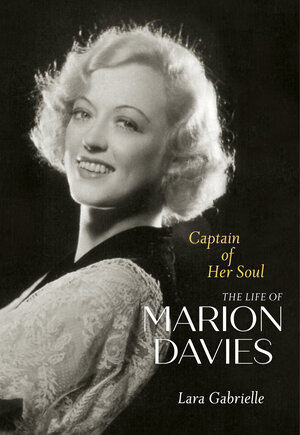
Captain of Her Soul: The Life of Marion Davies is now available at your favorite bookseller! Click hereto order it, and visit mariondaviesbook.com for all the latest.
Backlots is devoted to honoring and celebrating all aspects of classic film and is written by Lara Gabrielle, a California-based classic film writer and historian. Lara is the author of CAPTAIN OF HER SOUL: The Life of Marion Davies (UC Press, 2022).
Here you will find pieces on frequently seen classics and some lesser-known gems, as well as book reviews, festival coverage, and pieces on the history, theory and culture of film as it relates to the study of classic cinema.
Enjoy the site, and thanks for reading!
AFFILIATIONS & AWARDS
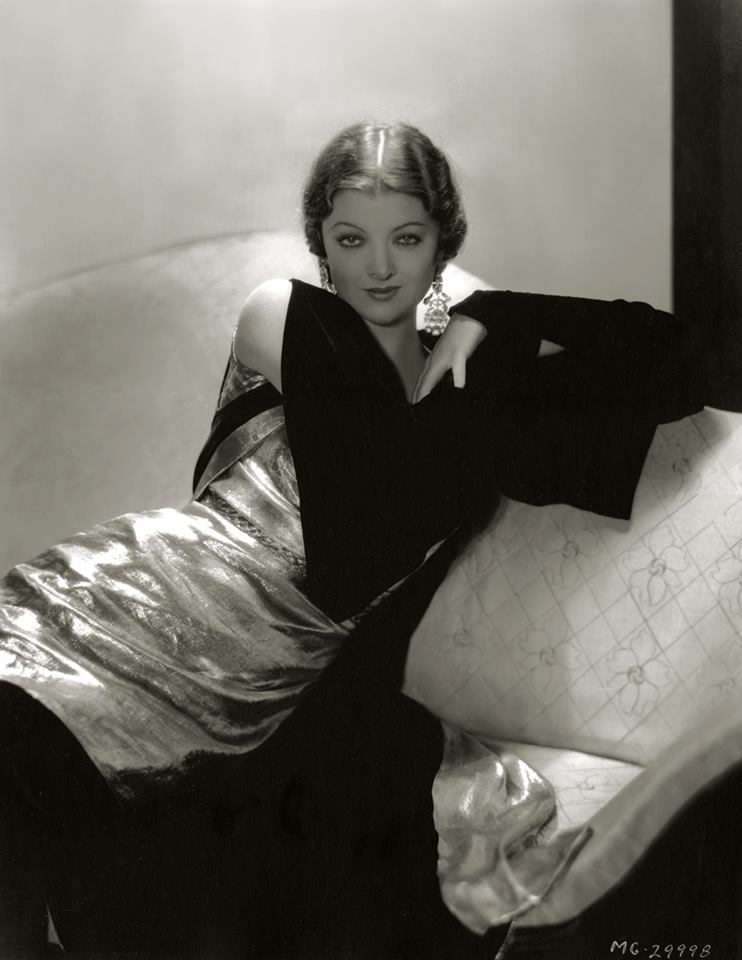
2019 CMBA Award for Best Profile of Classic Movie Performer or Filmmaker--"The Activism of Myrna Loy"
Winner of the 2018 CiMBA Award for Best Classic Movie Series, BACKLOTS AT THE COURTHOUSE: OLIVIA DE HAVILLAND VS. FX
Winner of the 2014 CiMBA Award for Best Profile of a Classic Movie Performer or Filmmaker: A Q&A WITH JOAN FONTAINE IN HONOR OF HER 96TH BIRTHDAY
Winner of the 2011 CiMBA Award for Best Classic Movie Discussion, THE FINAL SCENE OF THE HEIRESS
I am honored to be a judge of the Animal Film Festival in Grass Valley, CA.
EVENTS
BACKLOTS ON THE WEB
Join us at the Backlot Commissary, the place for Backlots' readers to share content and discuss movies!
Walter Pidgeon and Greer Garson in "Mrs. Miniver."





















_03.jpg)

 Backlots