The Fight of Marsha Hunt and MARSHA HUNT’S SWEET ADVERSITY: A Forthcoming Documentary

Marsha Hunt during her years as a Hollywood star.

Marsha Hunt today.

Two years ago, while attending the Cinecon festival in Hollywood, I had the great opportunity to speak with classic Hollywood star and tireless civil rights advocate Marsha Hunt. She was attending a screening of Gentle Julia, a movie she made with Jane Withers who was also in attendance. Following the screening, I noticed that most of the audience members flocked to Jane Withers, a frequent Cinecon guest well-known to the audiences who attend the festival yearly.

But I wanted to talk to Marsha Hunt.

There was something about her that was so lovely, gentle, and serene–at 94 years old, she was still dazzlingly beautiful and had no problem standing at her introduction. There was real sweetness in her eyes, and I felt the need to go over and talk to her. So I did, and we had the loveliest discussion about her years with Paramount Pictures, her career, and what she was doing now. Talking to this shy, softspoken elderly woman, one would never suspect that this was one of the fiercest, most outspoken critics of the Hollywood blacklist, who preferred to have her name besmirched and her career ruined than give up what she considered to be important political ideals.

Marsha Hunt stands with the Committee for the First Amendment, formed to protect the Hollywood Ten.

In the late 1940s with the rise of Senator Joseph McCarthy in Wisconsin and anti-Communist sentiment running rampant throughout the United States, many Hollywood figures with liberal inclinations were targeted as Communists and were unable to find work. Among those were those that became known as the “Hollywood Ten,” writers Dalton Trumbo, Adrian Scott, Samuel Ornitz, Albert Maltz, John Howard Lawson, Ring Lardner Jr., Edward Dmytryk, Lester Cole, Herbert Biberman, and Alvah Bessie. In support of them, several prominent Hollywood stars and directors formed the Committee for the First Amendment, dedicated to protecting these and other figures in Hollywood from persecution. One of the most dedicated members was Marsha Hunt, who shortly thereafter found herself on the blacklist due to this and other political activities within Hollywood. She was asked to give up her ideology–and she refused. Her career suffered greatly because of it, but she never sacrificed her principles for the sake of a role. She became active in the issues of the United Nations and has become an unofficial spokesperson for the issues of global pollution, hunger, homelessness, and world peace. She has taken to calling herself a “planet patriot.”

Marsha Hunt speaks on the radio on behalf of the United Nations.

Today, Marsha Hunt is 96 years old and still fighting. This time, her efforts are documented in a forthcoming documentary entitled Marsha Hunt’s Sweet Adversity–the film is in post-production and getting quite a bit of attention on social media. Hunt, also a talented composer, wrote a song about marriage equality that has gone viral:

Marsha Hunt’s Sweet Adversity will tell the life story of Marsha Hunt through interviews, archival footage, talks with fellow actors and co-workers in the United Nations, and friends from her early days as a schoolgirl in New York. The producers are all Emmy winners, and this is sure to be a documentary worth checking out due to the life and nature of this remarkable woman.

The documentary is a small but passionate effort and is looking to enter film festivals, deadlines of which are coming up soon. Entering a film festival can often be quite expensive, so the filmmakers have set up an Indiegogo page where you can  make a contribution toward this film’s completion.

Even if you are not able to make a contribution, you can still still support Marsha and the filmmakers by keeping up to date on the progress of Marsha Hunt’s Sweet Adversity. Visit the Facebook page, accessed here, which will give you updates on when the documentary is to be released and how Marsha is doing. You may also visit the IMDB page here.

I have been following this documentary closely, and I am very much looking forward to its release.

Thanks for reading this update, and I’ll see you next time!

FASCINATING PEOPLE: Professor Alan Greenberg

A portion of an interview with Claudette Colbert, conducted by Professor Alan Greenberg.

Having had the enviable privilege of getting to know some of the biggest stars of classic Hollywood and possessing hundreds of hours of interviews that he conducted with such luminaries as Barbara Stanwyck, Claudette Colbert, Jack Lemmon, Lillian Gish, and Greer Garson, Professor Alan Greenberg is perhaps one of the greatest sources of classic film information around. During his time as leader of a community service program in San Diego focusing on teaching foreign students about American culture, Professor Greenberg was able to conduct lengthy interviews with the legendary stars and directors of classic Hollywood, recording on tape these rare and intimate glimpses into their lives and careers.

Gregory Peck on Alfred Hitchcock.

Professor Greenberg has a very interesting background. Upon a move to La Quinta, CA that would ultimately prove to be quite fortuitous, he found himself living in the same city as the legendary director Frank Capra who had recently published an autobiography. Always interested in the films of the 1930s and 1940s, Greenberg took it upon himself to write Capra a letter to ask if they might be able to meet. He agreed, and this was the beginning of a long friendship that also gave Greenberg the opportunity to meet some of Capra’s friends who, of course, were often giant figures in classic Hollywood. This ultimately led to a huge network of prominent friends who were always glad to help out when Greenberg’s students at Orco Development, the community service program he established in the 1980s, had a research need. In the following Q&A, Greenberg discusses Orco Development more in detail and gives you more information on what it is all about.

I became acquainted with Professor Greenberg a few weeks ago and found his story so fascinating that I asked if he would like to do a Q&A on the blog so that my readers could become introduced to him and his work. I was thrilled when he agreed. So please enjoy this Q&A that I conducted with Professor Alan Greenberg, friend to the stars!

You have had the great privilege to interview some of the most well-known, best-loved, and highly respected people in classic Hollywood. Tell our readers a bit about your background, and how you came to befriend so many of these veritable Hollywood legends.

A couple things in my background prepared me for interviewing and sharing adventures with some of the great legends from the Golden Age of Hollywood. I was always attracted to programs like Edward R. Murrow’s Person To Person and other interview shows where Murrow would talk to Frank Sinatra, Marilyn Monroe, Humphrey Bogart, etc. about their backgrounds and careers while being taken on a tour of their homes. This fascinated me, the ability to go to their house and talk to them about their work and lives. Secondly, I was bullied a great deal in high school due to a bad case of acne. Looking for a solution, I noticed an ad in the paper talking about boxing lessons at a gym in downtown Manhattan. Of all things, the instructor that day was the 5 time former middleweight champion Sugar Ray Robinson. He was having financial difficulties at the time, and wanted to make some money while helping young people. He became a friend and mentor to me over time and this experience taught me how to become comfortable talking to my heroes from an early age. Also, many people I interviewed over the years were fans of boxing including Bob Hope, Frank Sinatra, and the actress/director Ida Lupino. Ms. Lupino was a boxing enthusiast and you can see a picture of her, Sugar Ray Robinson, and myself taken during dinner in the gallery of my website.

I also had become friends with the late director Frank Capra after moving to California in the 1970’s. He was retired at the time and was impressed with my knowledge of his career. At one point he told me “You know more about me than I do”. One day we were having lunch at a restaurant, when a group of Japanese students asked if he was in fact the director Frank Capra. He said yes and we all had a friendly conversation about American film and American history. After the conversation was over, Capra and I realized the student’s knowledge of American film and history was lacking. This bothered Capra in particular because he had directed a series of documentaries called Why We Fight which explained America’s involvement in WWII. He and I eventually came up with the idea of creating a Community Service Program called Orco Development, the purpose of which was educating foreign-born students about American film, politics, and the military. I suggested it would be more engaging for the students if we spoke to the people involved in what we were studying. Capra used his vast connections in Hollywood to get subjects who I would then interview and eventually get to know on a personal level. So it was really Capra’s reputation and mentoring that allowed me to befriend all these Hollywood legends, there was nothing special about me that attracted them to the course, other than the depth of knowledge I had about their work.

Professor Greenberg with his friend, director Frank Capra.

Professor Greenberg with his friend, director Frank Capra.

Who was your first interviewee, and how did that experience prepare you for the many dozens more of these interviews you would go on to complete?

Although I met a number of famous people before getting to know Frank Capra, I would say he probably is the first formal interview I did. Fortunately when I contacted him and he wrote me back, he gave me 3 weeks time before we could actually meet. I had a copy of his autobiography The Name Above The Title which I read it in total and made numerous notes on index cards preparing for it. I then sat down and began to memorize my questions. When I arrived at his home in La Quinta I just had one index card with a keyword from each topic. He was so impressed with this breadth of knowledge on his life and career that it initiated this friendship. I think it also flattered him that someone so young would be interested in someone 50 years older.

I learned that one way to impress these people and get to know them personally was to do this kind of thing. Also I learned about eye contact, the worst thing you can do is sit there with your subject and have your eyes dart back and forth between them and your notes, studying the questions. It says you didn’t prepare. This experience taught me to be overly prepared and in some cases it can really impress people. Afterward Capra and I began speaking every weekend for 2 years and he basically schooled me in classic movies. He was one of the top 5 directors of all time and he was my mentor. So that was quite an experience.

Your prior knowledge coming into these interviews is vast. I recall one interview in which you provide your subject with the name of Melvyn Douglas’ wife with barely a pause. Were you a classic film fan before your association with these figures?

I would say I was a classic film fan but on a very superficial level. My good friend and fraternity brother Philip Wuntch, who was the former film critic for the Dallas Morning News and author of Marty Jurow Seein’ Stars, had a much deeper appreciation for classic films than I did before I was mentored by Mr. Capra. So I did enjoy the movies before, but it was the interaction with these people, getting to know them, that made me enjoy classic films on a new level.

Of all the Hollywood people you came to know, who left the biggest impression on you, and why?
I think the person who left the biggest impression on me was Burt Lancaster. He was exactly as energetic and charismatic in real life as he was on film. But that’s not what impressed me the most about him. One day he called me up and asked me if I knew anything about Cesar Chavez and the work he was doing with the farm workers. I said I only knew about it from reading stories in the newspaper. He then invited me up for the day to check out Chavez’s operation and see the kind of struggles they were going through. Burt’s personality was as big as they come, but when we went up to see Chavez and the farm workers he was as respectful, polite, and attentive as anyone I’d ever seen. He completely put his ego aside to listen to everyone he came into contact with. Not that Burt had ever been dismissive with people before, but most of the time his personality could really take over the room. Not in this case. That showed me how much he really cared about the issues that were important to him. There were no camera crews, no reporters, just two guys trying to understand the lives of people that were fighting for their rights.
What was the most memorable moment to come out of the interviews you conducted with the Hollywood stars?
When you’ve done literally hundreds of interviews, many moments stay with you over the years. I think one your readers might enjoy hearing is the interview I did with Myrna Loy. For those who don’t know, Myrna Loy was one of the most popular stars of the 1930’s with movies like The Thin Man , Manhattan Melodrama, and The Best Years Of Our Lives which incidentally, Capra once told me was the perfect movie in his opinion. She had starred with just about every leading man in Hollywood, and could do comedy as well as drama. I think on a list of the most popular classic film actresses, she could definitely make the top 10 along with Hepburn, Stanwyck, Davis, etc. With that in mind, she proceeded to tell me that she had made it as an actress, “in a very small way” and when I responded to her that she was in fact one of the most popular screen actresses of all time she said, “Good God I don’t believe that, but then that’s alright. I was just a little punk girl trying to be a movie star, there were a lot of us around”. When I asked her if she got a lot of fan mail she replied, “Oh I got hardly any at all, they didn’t even know who I was”. She absolutely refused to see herself as a big star, and she had this attitude every time we spoke, it wasn’t false modesty. She felt she was a good actress, but when it came to stardom, she not only wouldn’t acknowledge it, she honestly didn’t believe she was popular at all. I was very surprised given all the incredible films I had seen her in.
myrna-loy
You have had a truly fascinating career, and possess hundreds of hours of audio recordings from some of the most popular figures in the Golden Age of Hollywood, something unique indeed. Do you have any plans to write a book or put together a project related to your experiences interviewing these stars and directors?

I was very encouraged by the response I’ve been receiving from my website. For example we recently put a portion of my interview with Barbara Stanwyck on YouTube, and I think within a few days we had almost 500 people listen to it and many of them left comments, begging to hear the whole interview.

A portion of an interview that Professor Greenberg conducted with Barbara Stanwyck, in which she discusses her directors and her love of her older sister.

So I’d like to begin some speaking engagements, talking about these unique experiences because there is clearly an interest. Turner Classic Movies has millions of viewers and whenever Robert Osborne gives the background to a picture before they play it, I’ve been told it’s enthusiastically received. One thing that I think sets my interviews apart from the usual Hollywood interviews is these stars were much more candid with me, knowing I had no intention to gossip about them or pass the info on to the media, or take their words out of context. We had an understanding between us and I was sincere in my curiosity about them.

As far as a book is concerned, I’ve been approached by publishers in the past, but to be frank, they asked me if these famous people had revealed any personal sexual details about their lives. I was disheartened by this and the publishers told me the book wouldn’t sell well without these details. That certainly wasn’t the path I wanted to go down so I politely refused and put the idea of a book behind me.

Where can readers learn more about you, and follow any project you may be working on?

People can find out more about me and the program utilizing our website: www.orcodevelopment.org and also keep an eye out for my lectures where I reminisce, tell anecdotes, play interviews and show pictures of my friends Jack Lemmon, Burt Lancaster, Claudette Colbert, Katharine Hepburn, James Cagney, Barbara Stanwyck, Jimmy Stewart and more. You can find most of them in the gallery section of our website with me during the 25 or so years I taught this course. I have some personal and never before heard stories about my friendship with these venerated actors. If any colleges, senior centers, organizations, etc. would like to contact me. They can do so through phone or email and I’ll be happy to reply.

————————————————

Thank you so much to Professor Greenberg for this marvelous Q&A. See you next time!

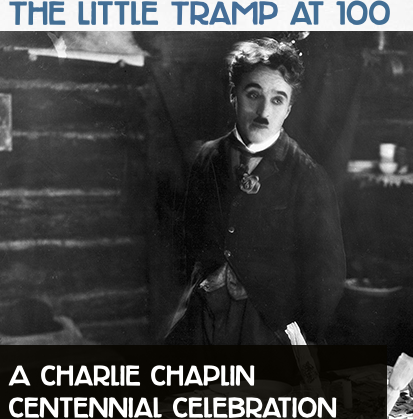
THE LITTLE TRAMP AT 100

Screen Shot 2013-12-29 at 5.18.58 PM

An enthusiastic crowd packed the Castro Theatre solid yesterday, for the San Francisco Silent Film Festival’s celebration of the 100th anniversary of Chaplin’s “little tramp” character. Featuring a beautiful lineup of films all played with live accompaniment  (a piano accompanied the shorts, and the feature-length films were accompanied by 15 musicians from the San Francisco Chamber Orchestra), the San Francisco Silent Film Festival once again provided us with a world-class event, a moving portrait of love for a cinematic legend.

Often I find that even those people who have never seen a silent film know and are interested in Charlie Chaplin. There is something about Chaplin that we identify with, that speaks to the commonality of our experiences as humans. The honesty, sweetness, almost childlike quality of his iconic “little tramp” character is something intangible, representing a sort of universal goodness that we all strive for. To those who know his life story, his leftist politics and his fight for social justice having banned him from working in the United States for the latter portion of his life due to the Hollywood blacklist, this aspect of his character is simply a branch of who he was in real life.

“The Little Tramp” made his first appearance onscreen in a hilarious short called “Kid Auto Races at Venice,” in which he plays a spectator who, unwittingly or otherwise, keeps getting in the way of the camera filming an auto race event. It was filmed on January 11, 1914–100 years ago yesterday. It was the first offering at yesterday’s event, and the crowd went wild. Chaplin’s character in this is decidedly a bit more irate and cranky than what we are used to, as the character evolved over several years to become the character so widely loved today.

“Kid Auto Races at Venice” (1914)

We were then treated to 3 shorts that Chaplin made during his time at Mutual studios–“The Vagabond,” “Easy Street,” and “The Cure,” all very solid shorts that show the evolution of the character and Chaplin’s comedic trademarks. In “The Cure,” Chaplin plays an alcoholic spa-goer who gets himself and everyone else into a lot of trouble when his liquor is accidentally tossed into the curative waters. It is a very funny bit, and features prominently Chaplin’s gift for physical comedy–he teases the audience with nearly falling into the water several times, and we wonder when and if he will actually fall!

Next was a feature film, one of Chaplin’s most monumental hits and the first of his films to receive universally rave reviews. The Kid, released in 1921, was presented to us with Chaplin’s original score played by members of the San Francisco Chamber Orchestra. Charlie Chaplin, a gifted composer, wrote many of his own scores and they are all magnificent. Festival artistic director Anita Monga told us that in order to procure the rights from the Chaplin family to show the film, the San Francisco Silent Film Festival had to agree to play it with the original score. Usually, the family requires that the score be played with the original instrumentation as well, but due to budget constraints the festival was able to talk them into allowing the chamber score to be played. So we heard 15 members from the San Francisco Chamber Orchestra playing Chaplin’s beautiful score to The Kid.

The Kid is a masterwork of simplicity and understatement. The plot is simple–a poor young man (the tramp) finds a baby and raises him as his own, becoming his surrogate father. When the child gets sick and he calls a doctor, the doctor finds out the situation and tries to send the boy away to an orphanage. The tramp loves the little boy so much he does everything to get him back.

Chaplin conceived this movie in the wake of the death of his own infant son, which makes the end product that much more significant. The little boy, 4-year-old Jackie Coogan, gives a startlingly beautiful performance and it’s difficult to fathom that this adorable child would grow up to play Uncle Fester on The Addams Family.

Last on the program was The Gold Rush, the film Charlie Chaplin said he would “most like to be remembered by.” After the success of The Kid, Chaplin set out to make an epic that would top it. Costing over $900,000, The Gold Rush was the most expensive comedy picture ever made up to that time and also the longest comedy, at 95 minutes in length in 1925.  Also featuring some of Chaplin’s best-remembered sequences (including one where he eats a boot, goofs around making dinner rolls dance on forks, and battles a cabin about to fall off a cliff), this is one of Chaplin’s greatest achievements of his career.

The Gold Rush has an unusual history–originally released in 1925, Chaplin later composed a score for it, added narration, and re-released it in 1942. Thus, though it was a silent film, it interestingly received an Oscar nomination for Best Sound at the 1943 Academy Awards. At the festival last night, we watched the original version that is in the process of restoration by Photoplay Productions. So we saw the film without narration, as close to the way Chaplin had originally filmed it as possible given the restoration work being done.

Chaplin eats his shoe in one of the famous sequences. Note the narration that was added upon the film’s re-release.

As always, the San Francisco Silent Film Festival delivers. The full official San Francisco Silent Film Festival will take place over Memorial Day weekend this year, between May 29 and June 1. Please mark your calendars, because this is something that you will not want to miss. Thank you to Anita Monga, film historian Jeffrey Vance who gave informative talks before the screenings, and everyone at the San Francisco Silent Film Festival for making The Little Tramp at 100 an event to remember.

THE LITTLE TRAMP AT 100 Celebration–January 11 at the Castro Theatre


By Lara Gabrielle Fowler

Tomorrow, locals of the San Francisco Bay Area will be treated to a very special event at the Castro Theatre. In celebration of the 100th anniversary of the Little Tramp’s first appearance onscreen, the San Francisco Silent Film Festival is putting together a program honoring Chaplin’s iconic character, featuring two landmark Chaplin films as well as several shorts from his time at the Mack Sennett studios.

I will be in attendance to keep you up to date on what is happening throughout the day, through live tweets and posts on the official Facebook page and the Backlot Commissary. As with all festivals, I will make a post at the end of the day talking about the event and what it was like. Stay tuned!

From THE KID, one of the films to be screened on Saturday.

If you are in the San Francisco Bay Area, it would be wonderful to see you there. For more information on the program, check out the Little Tramp at 100 site, as well as Mick LaSalle’s wonderful article for the San Francisco Chronicle last week.

For those of you who are not able to make it, I look forward to talking with you on social media or through the comments section of this post. For those who are coming, I will see you there!

TCM Programming and the Definition of “Classic Film”

As part of TCM’s tribute to chemistry and physics in film, A BEAUTIFUL MIND (2001) will play on the network tonight. The choice has sparked mixed reactions among fans of TCM on social media today.

In the past 3 years of this blog’s existence, I have spent considerable time discussing the meaning of the term “classic film.” It is a vague description, one that means different things to different people and which tends to polarize those who are loyal to their own particular definition. In this age of social media, I have seen countless debates on the subject on Twitter and Facebook, conversations that get especially heated when TCM decides to show a film that was made relatively recently.

Fans of old films have cause to be wary of TCM turning its back on this programming. The channel AMC, which is now famous for its original content (Mad Men, Breaking Bad) used to be very much like TCM, airing black and white films from the 1930s through the 1960s without commercial interruption, punctuated by its own original educational programming about film history and culture. But in 2002, AMC decided that the cable subsidies they were receiving were not enough to keep the channel going, and began to allow advertising which changed their programming focus to a general one in order to keep sponsors happy.

Though I personally do not worry about TCM shifting its focus (I direct you to the popularity of the TCM Classic Film Festival and the TCM Classic Cruise, a testament to how popular their programming is), I have noticed that they seem to be thinking outside the box with their definition of “classic film,” which is upsetting some viewers who have a very clear concept of what a classic film should look like. Tonight, they are showing A Beautiful Mind, the 2001 Best Picture winner that tells the story of mathematician John Nash and his struggle with schizophrenia. TCM’s Facebook page was alight this morning with a debate on whether or not this is a classic film, questions as to why the network was showing it and counter-attacks questioning whether TCM should even be questioned about their programming.

As I’ve stated before, my own personal definition of a classic movie when I am asked about it is a movie made more or less between the confines of 1916 (when filmmakers were really starting to “get” moviemaking in my opinion) and the fall of the production code in 1968–with several exceptions to that rule allowing for great and culturally significant movies pre-1916 (such as “A Trip To the Moon” and The Great Train Robbery) and post-1968 (such as Cabaret and Amadeus). I would also say that not every movie made between that time period can be considered a classic, but specifying a specific time period helps to get around some of the vagueness and muck that comes along with trying to make a clear-cut definition of anything.

A scene from Amadeus (1984), a movie I consider to be a classic because of the positive cultural significance and lasting influence it has enjoyed.

A Beautiful Mind is a fantastic movie, no question about it. Phillip Glass’ haunting, almost mystical score along with Oscar-winning performances by Russell Crowe and Jennifer Connelly make this movie perhaps one of the technical best of the past 15 years. Would I call it a classic? According to my own personal definition, no. It has not marinated in our culture long enough for us to see if it stands the test of time, and though it won several awards upon its release it has not proven to be culturally pervasive enough to warrant an exception to the  rule.

However, I am open to discussion on this. What is your personal definition of a classic film? Would you consider A Beautiful Mind to be a classic, and worthy of a spot in TCM’s primetime lineup? I look forward to hearing from you in the comments section, and I will also pose this question to my readers on the Backlot Commissary group on Facebook. Feel free to join the discussion here or there!

2013 at Backlots–A Year in Review

A big thank you to my readers for making 2013 a true banner year for Backlots. Here are some of the things that happened on the blog this year:

My attendance at the 2013 TCM Classic Film Festival was far and away one of the highlights of the year. A true movie lover’s paradise, the TCM Festival attracts classic film aficionados from the world over, and TCM certainly delivers the goods. It was great fun interacting in person with my fellow bloggers, whose work I know so well online, and making new classic film friends. A wonderful experience!

For the second year in a row, Backlots covered the San Francisco Silent Film Festival this past summer. As usual, it was a fantastic event with presentations unparalleled in their quality. Highlights for me included a screening of the hilarious Marion Davies movie The Patsy, an interactive talk with Winsor McKay expert John Canemaker,  and the breathtaking gamelan accompaniment set to the Balinese silent film Legong: Dance of the Virgins by the Sekar Jaya Gamelan Ensemble. The San Francisco Silent Film Festival never disappoints. Stay tuned next year’s festival which will be held over Memorial Day Weekend, and on January 11 for their special celebration of The Little Tramp at 100–celebrating the 100th anniversary of the first appearance of Chaplin’s The Little Tramp. I will be at both events!

Last month, I was honored to be invited to blog for the Warner Bros. 90th Anniversary Tour. We bloggers were treated to a day of exploration at the studio, led by a professional guide, and topped off with lunch at the commissary. We had special access to the costume department and several areas off limits for regular tour members, and it was indeed a special day. Again, I met so many fellow bloggers and had such a good time. Thank you, Warner Bros., for organizing this wonderful day for us!

Screen Shot 2013-12-31 at 4.45.57 PM

The classic film community was graced with several magnificent new books this year. I had the pleasure of conducting interviews with Victoria Wilson, author of A Life of Barbara Stanwyck: Steel True 1907-1940, and Kendra Bean, who is the author of Vivien Leigh: An Intimate Portrait and a personal friend of mine. Both of these works are great monuments in and of themselves. A Life of Barbara Stanwyck is a gargantuan book that features 860 full pages of text and another 200 for source notes, and has proven to be the quintessential, definitive book on the actress. My reading of this book, though it took me less than 2 days, is one of the highlights of my year. Vivien Leigh: An Intimate Portrait is so chock full of previously unseen photos of this staggering beauty that the reader simply cannot put it down. It is displayed prominently, face forward, on my shelf so as not to obscure its beauty. I am so lucky to have had the opportunity to interview these two gifted writers, and I thank them for their interviews with me. Read Victoria Wilson’s interview here, and Kendra Bean’s here.

In what was perhaps my most meaningful personal success of 2013, I had the great privilege to interview Joan Fontaine in honor of her birthday. This was her last birthday, and her last interview. Joan was frail and her health declining, so she kept her answers short. The length of her answers does not matter to me. My interview with Joan Fontaine remains the single greatest privilege Backlots has ever had. Click here to read it. Rest in peace, dear Joan.

This is the video I made in memory of Joan Fontaine. I hope you enjoy it.

Wow, readers. What a year. 2014 is already shaping up to be an equally marvelous year! Here’s to what’s to come, and to you, loyal readers, for helping to make this blog what it has become.

Backlots Forays Further Into Facebook–Introducing the Backlot Commissary!

meet-john-doe

In this age of social media rule, a pervasive online presence is a requirement for the survival of a blog. As Backlots grows in its readership and prominence online, I have realized the need to expand its reach on the various social media platforms on which the blog has a presence.

Backlots’ Facebook page has proven to be a spot where I can post content for my readers, but I have found it to be limiting in terms of interaction. So hear ye, hear ye–in addition to Backlots’ Facebook page, I am hereby introducing the Backlot Commissary! The Commissary is a Facebook group in which readers can have interactive discussions with each other, post content, and communicate with other classic film fans. I hope that it will be a nice place for classic film socializing, and that we can have some great and meaningful discussions there.

Clark Gable eats at the MGM Commissary.

To join, simply click the link above and find “Request to Join Group” on the page. It is an open group, so as long as you have a a Facebook account, you shouldn’t have trouble joining. If you do, please let me know in the comments to this post and I will get back to you.

Thanks for reading, and I look forward to talking with you at the Backlot Commissary!


Merry Christmas from Backlots!

To all those who celebrate it, I wish my readers a very merry Christmas with lots of quality time with friends and family!

The holiday of Christmas has heralded some of the most beloved movies of all time. In celebration of the season, I am profiling a few of my favorites here. Have a wonderful holiday, and if you have a free moment, check out some of these movies!

CHRISTMAS IN CONNECTICUT (1945)

Starring Barbara Stanwyck and Dennis Morgan, it tells the story of a “perfect housewife” columnist who doesn’t exactly have the life her column suggests…and when her boss requires her to host a war veteran at her home for Christmas (and insists upon coming along himself), she has some arranging to do! A sweet situation comedy that is defined by Barbara Stanwyck’s delightful performance and that of the adorable S.Z. “Cuddles” Sakall as the character of Uncle Felix.

MIRACLE ON 34TH STREET (1947)

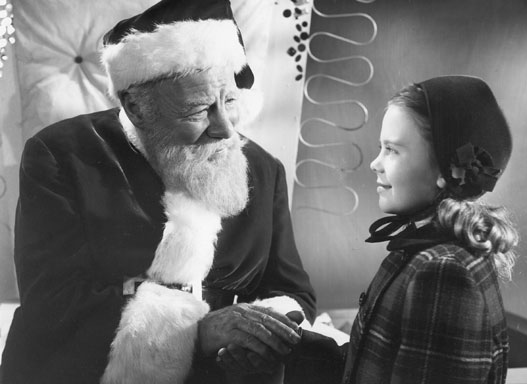
This one is a true classic, and often I find myself disillusioned with the fact that with its great popularity has come a colorization that has now taken over AMC every year at Christmas as well as a 1994 remake, that has become more prevalent than the original on the other more commercial channels. But this, I believe, is the one and only one to see. Natalie Wood stars as a little girl skeptical of Santa Claus, until a Macy’s Santa Claus played by Edmund Gwenn makes her think twice. It is a fantastic children’s movie and also holds up extremely well for adults–if you haven’t seen it since your childhood, now is a wonderful time to revisit it!

HOLIDAY AFFAIR

This is a lesser-known gem with which I first became acquainted last year at Noir City X-Mas. It is a sweet, low-key comedy that stars Janet Leigh as an engaged war widow who falls in love with a department store clerk while undercover on her job as a comparative shopper. Though she already has a fiancé, her young son takes to the department store clerk (played by Robert Mitchum) and there begins to be some tension due to her son’s clear preference for Mitchum’s character. The movie is light fare, but good fun. One of the best performances in the movie comes from the little boy, played by Gordon Gebert. His acting career never took off but he found a second talent in adulthood–after studying architecture at UCLA, USC, and MIT, Gebert is now a very prominent professor at New York City’s College School of Architecture.

The Dueling Divas Thank You For a Great Blogathon!

Well readers, another year of Dueling Divas has come to an end! But don’t worry, the divas will return next year for another round–so stay tuned for the announcement of the 4th Annual Dueling Divas blogathon, to take place in December 2014!

While I’m at it, I thought I would tell you about a special program I will be covering next month. On January 11, I will be heading back to the Castro Theatre to celebrate the 100th anniversary of the first appearance of Charlie Chaplin’s legendary “The Little Tramp.” Organized by the San Francisco Silent Film Festival, the day will feature the following screenings:

  • KID AUTO RACES AT VENICE (1914, featuring the first appearance of The Little Tramp)
  • THE VAGABOND (1916, short film)
  • THE CURE (1917, short film)
  • EASY STREET (1917, short film)
  • THE KID (1921)
  • THE GOLD RUSH

If you are in town, please stop by. Tickets are $22 for each of the the feature-length films, $15 for the shorts, and $54 if you want to see the whole program. It promises to be a fun and informative day, and the San Francisco Silent Film Festival always puts on very quality programs. I look forward to seeing you there!

Thanks again for a great blogathon, and see you next time!

DUELING DIVAS BLOGATHON: Margo Channing vs. Eve Harrington

imageedit_3_7970005247

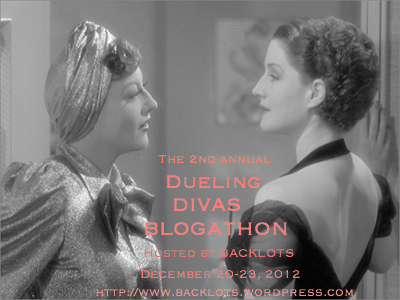
The banner for this year’s Dueling Divas blogathon is an appropriate one, as this year I am contributing with an examination of two of the fiercest divas ever to appear on the silver screen–the two main characters in Joseph L. Mankiewicz’s 1950 masterpiece All About Eve.

All About Eve is the definition of a team effort. Everything in the movie runs like a well-oiled machine, and the movie wouldn’t be what it is had a single character been left out. But at the head of the machine are Bette Davis and Anne Baxter playing Margo Channing and Eve Harrington–an aging stage star grappling with the realities of fewer parts and a young fan who has her eye on more than just the adoration of her stage idol. Through these two characters, we are told a raw and brutal story of what it means to be in the theatrical profession.

Eve looks on at Margo and her director boyfriend, Bill Sampson.

MARGO

Margo Channing is a star. A bona-fide, veteran star of the stage whose plays consistently sell out and who has received legendary status in a profession which often eats its own. According to columnist Addison DeWitt (George Sanders), she has been a star ever since she entered the stage quite by accident as a toddler during A Midsummer Night’s Dream, stark naked. She is selfish, egotistical, and driven, but underneath her rough exterior lies a loyal woman who treasures her friends and harbors many insecurities and an almost vulnerable naivete.

When Margo meets Eve Harrington, a stage-struck kid who had seen every performance of Margo Channing’s new play, she is drawn to her and develops a protective feeling toward her. She soon comes to live at Margo’s house, acting as a secretary and assistant. Bertie (Thelma Ritter), Margo’s maid, instinctively senses something off about Eve. She observes that Eve seems to be “studying” Margo, “like a blueprint.” When Eve takes the initiative to call Bill (Gary Merrill), Margo’s director boyfriend, on his birthday, Margo begins to suspect her herself. Things come to a head at Margo’s welcome home birthday party for Bill when she approaches Bill about Eve and they have an argument. At the end of the party and after many drinks, Margo verbally attacks Eve telling her to “stop behaving as if I were the Queen Mother.” Everyone around her defends Eve against Margo, and Margo goes to bed drunk and angry.

Bill and Margo argue about Eve.

When Margo arrives at the theater, she runs into Addison DeWitt who tells her that Eve has been made her understudy without her knowledge. Margo enters the theater and, in her panic, begins a fight with Bill, Lloyd, and producer Max Fabian over Eve’s casting as her understudy. Bill sees through her act to the vulnerability and insecurity that is driving it, and calms her. But he decides to leave for a while, to have a break from Margo. As he leaves, Margo asks if he is going to see Eve. It is now clear that Eve has intruded on Margo’s psyche and she is almost obsessed with her.

On the evening of the performance, Lloyd, and Karen drive Margo to the train station after a weekend in the country so she can get back to New York in time to perform for the play. The car mysteriously runs out of gas, and when Lloyd goes out to find gas, Karen and Margo sit in the car and talk. Margo expresses regret at the way she’s treated Eve, confides her jealousy at Eve’s youth and vibrancy. She admits to not feeling like a woman in her relationship with Bill, something on which she feels Eve holds an advantage. She moves Karen to tears, and Karen apologizes profusely for the car breaking down. Margo tells her it is not her fault, “after all, you didn’t personally train the gasoline tank yourself.” Karen slumps down in her seat, hinting to the audience that she did, in fact, drain the gasoline tank herself in order to give Eve the chance to perform.

Margo was incensed and massively hurt at Addison DeWitt’s column the next morning, in which Eve slammed Margo’s persistence in playing “younger” roles. Plans are underway for Lloyd Richards’ new production entitled Footsteps on the Ceiling, in which Margo wants to play “Cora,” the young lead. Lloyd is thinking of giving the part to Eve, but Karen essentially forbids him due to that morning’s column. Bill, Karen, and Lloyd take Margo out for drinks, and at the restaurant Karen and Lloyd learn that Bill and Margo are going to be married. They also run into Eve and Addison, who are out together at the same restaurant. In the midst of their merriment, a note arrives for Karen. It is from Eve, who implores her to meet her in the ladies’ room. When she returns, Karen is oddly silent. At this point, Margo says unexpectedly that she does not want to play Cora after all, now that she is going to be married. Karen looks shocked, and then suddenly breaks out in laughter. When questioned as to what she’s laughing about, she replies “Everything! Everything is so funny!”

Lloyd ignores Karen and casts Eve as Cora. She gives the performance of her life and wins the Sarah Siddons Award.

EVE

Eve Harrington is a devoted fan who has come to every performance of Margo Channing’s Broadway play, Aged in Wood. When Karen Richards sees her there standing at the stage door, she feels she has to bring her in to see Margo. Eve tells her story of having a husband who died in the war, and seeing plays as a means of escape. She told of seeing Margo Channing come to San Francisco in a play called Remembrance, and at the conclusion of her story reduces all in Margo’s dressing room to tears. She makes a good impression, and when Margo invites her to be her secretary, she continues to do so. Eve becomes close with Karen Richards, and Karen in turn becomes Eve’s advocate against the often difficult Margo.

Celeste Holm as Karen Richards.

At Bill’s welcome home birthday party, Eve is seen conversing with him downstairs, which prompts Margo to start an argument with Bill out of Eve’s earshot. Once the party begins, Eve approaches Karen upstairs. She asks Karen if, since she knows the part so well, she might be able to arrange it for her to play Margo’s understudy in Aged in Wood. Karen is excited at the possibility, and promises Eve that she won’t forget to ask producer Max Fabian.

Eve procures the role of understudy, much to the chagrin of Margo, who is already upset thinking that Eve is stealing Bill from her. Karen, ever Eve’s champion, drains the gasoline from the car on the way back to the train station from the country in order to give Eve a chance to play Cora. While Karen, Lloyd and Margo are stuck in the country with no gasoline in their car, Eve gives a standout performance and is visited backstage by Addison DeWitt. Addison sees her in her dressing room, seducing Margo’s boyfriend Bill. Bill rejects her, telling her that he is in love with Margo. Eve is upset, and Bill tells her not to worry, just to “score it as an incomplete forward pass.” When Bill leaves, we see another side of Eve…angry and vicious, as she tries to rip the wig of her costume in her rage. She stops immediately when Addison DeWitt, who has seen everything, comes in. Suspecting her lack of authenticity, he questions her about the story she told when she first met Margo. Eve answers vaguely, then gets out of answering when she goes into the shower.

Eve is rejected by Bill.

Addison’s column the next morning was the excuse for Eve to ask Karen to see her in the ladies’ room when they were all out at the same restaurant. In the ladies’ room, Eve cried and made Karen’s heart slowly melt for her. When Karen was finally back on Eve’s side, she asked if there was anything she could do. Eve replied “There is something…”

EVE: Something most important you can do.

KAREN: You want to play Cora. You want me to tell Lloyd I think you should play it.

EVE: If you told him so, he’d give me the part. He said he would.

KAREN: After all you’ve said…don’t you know that part was written for Margo?

EVE: It might have been 15 years ago, it’s my part now.

KAREN: You talk just as Addison said you did.

EVE: Cora is MY PART. You’ve got to tell Lloyd it’s for me.

KAREN: I don’t think anything in the world would make me say that.

EVE: Addison wants me to play it.

KAREN: Over my dead body.

EVE: That won’t be necessary. Addison knows how Margo “happened” to miss that performance, and how I happened to know that she’d miss it in time to notify every paper in town. It’s quite a story. Addison could make quite a thing of it. Imagine how snide and vicious he could get and still tell nothing but the truth. I had a time persuading you….If I play Cora, Addison will never tell what happened, in or out of print. a simple exchange of favors. I’m so happy I can do something for you at long last.

Karen then returns to the table. When Margo says she no longer wanted to play Cora, Karen begins to laugh. Eve always gets what she wants.

Toasting Bill and Margo’s marriage.

That evening, as Karen lay mulling in bed, the phone rang. It was a roommate of Eve’s saying how sick and nervous she was about the upcoming tour of the play in New Haven, and she was asking for Lloyd. Lloyd instructed the roommate to tell her not to worry, that he would be right over. As the roommate hangs up the phone, we see Eve linking hands with her, her plot a success.

The next day, Eve is walking with Addison in New Haven. They discuss her future career and when they get back to her hotel room, she tells him that Lloyd is leaving Karen, that she is going to marry him. She dreams of the plays he would write for her and how far they could go together. She told of him banging on her door, saying that he was leaving Karen and couldn’t stop thinking about her.

Addison sees through this. He tells Eve that Lloyd may leave Karen, but he will not leave Karen for her. And he won’t do so because he, Addison, will not permit it. He proceeds to tell Eve everything he knows about her. The questionings that night after her performance in Aged in Wood confirmed his suspicions that she was a liar and a fake. Her real name is Gertrude Slozhinsky, and she has never been to San Francisco. She has no deceased husband, and everything about her story is false. She had an affair with her boss at the brewery at which she worked, and she was paid $500 to get out of town, money with which she ran straight to New York. Addison uses this information to show Eve that she cannot do anything without his approval now–because if she does, he will release this information to the public, ruining her career. It is a checkmate against her, and Eve realizes it. Addison makes her realize how much she “belongs” to him and Eve, hysterical and crying, mentions how she couldn’t go onstage in this state. “Couldn’t go on?” Addison retorts, “You’ll give the performance of your life.”

Addison confronts Eve.

The statement about Addison “owning” Eve is very much a reflection and acknowledgment of the power of the press in the rise and fall of a theatrical or cinematic career. Addison can be seen as a sort of Louella Parsons or Dorothy Kilgallen, who literally held the power to make or break a career. If any of the columnists had something against a certain star, they could destroy that star with one swipe. This is very elegantly and astutely alluded to in the character of Addison DeWitt, and in 1950 everyone in Hollywood and beyond would have understood the significance of this character.

Eve does go on to give the performance of her life, which takes us back to the beginning of the movie, the Sarah Siddons Award ceremony. Eve thanks everybody who has made this possible (however, she noticeably leaves out Addison DeWitt) and mentions how although she is going to Hollywood to make a film, her heart will always be in the theatre. After the ceremony, Karen, Lloyd, Bill, and Margo offer her halfhearted congratulations, with Margo remarking “I wouldn’t worry about your heart, Eve. You can always put that award where your heart ought to be.” Eve decides to skip the party in her honor, and instead go home.

When she gets home, she notices a girl in the mirror, sleeping on her chair. The girl awakens and says she is the president of the Eve Harrington fan club at Erasmus Hall High School and had sneaked in to do research for a project. She and Eve talk a little, and when the doorbell rings the girl goes to answer it. It is Addison, holding the award Eve had left in the cab. The girl introduces herself as “Phoebe” and takes the award, not telling Eve that it was Addison who had brought it. She took it back to the back room, drapes Eve’s cape around her shoulders and, standing in front of an infinitely reflecting mirror, pretends to be a star as she bows…and the movie ends.

BETTE DAVIS VS. ANNE BAXTER: THE 23RD ANNUAL ACADEMY AWARDS

All About Eve was a smash hit. Universally acclaimed, the film went on to be nominated for 14 Oscars which beat Gone With the Wind’s previous record of 13. Among the 14 Oscars were double nominees in the Best Actress category–with Bette Davis and Anne Baxter nominated together in the same category.

The Best Actress nominees that year were:

  • Judy Holliday, Born Yesterday
  • Anne Baxter, All About Eve
  • Bette Davis, All About Eve
  • Eleanor Parker, Caged
  • Gloria Swanson, Sunset Boulevard

There are several theories about what happened in the Best Actress category in 1951, but it can be confidently stated that this was one of the most quality years for actresses in all of film history. Had each of these actresses been nominated in any other year without such stiff competition, each of them could have won, and could have won deservedly. However, in a year when films like All About Eve and Sunset Boulevard were contenders, it came as a shock that the winner that year was Judy Holliday in Born Yesterday. Here is one of the theories about what happened.

Bette Davis’ role as Margo Channing clearly belonged in the Best Actress category, but Anne Baxter could have been nominated in either the Best Actress or the Best Supporting Actress category. She decided to go with Best Actress, which set her up squarely against Bette Davis, who was the odds-on favorite for the award. When the Academy voted, they were given two great performances in All About Eve to choose from, and they were torn between which All About Eve actress to vote for. Hence, the votes were split between Davis and Baxter which ultimately cost Bette Davis the award.

The strange part of this theory is that the second Academy favorite that year was not, after all, Judy Holliday–it was Gloria Swanson for Sunset Boulevard. It might be said that Anne Baxter’s inclusion in the Best Actress category took votes away from Gloria Swanson as well, leaving Judy Holliday squeaking by with enough votes after the split to take home the award. It is impossible to know for sure, but we can be fairly confident that Anne Baxter’s nomination in the Best Actress category affected the awards in one way or another.

Gloria Swanson awaits the envelope at the Academy Awards in 1951.

This is an entry for the Dueling Divas Blogathon, which I host every year in December. Check out the other entries here! See you next time!