This evening’s kickoff for the 19th annual San Francisco Silent Film Festival was an event of epic proportions. In honor of the anniversary of World War I, the festival opened with the monumental Rex Ingram/Rudolph Valentino collaboration The Four Horsemen of the Apocalypse (1921), a movie that features “quite literally, a cast of thousands,” in the words of festival president Rob Byrne. The movie is so long that it requires an intermission, and packs a punch with its grim imagery and deep metaphors. This is all aside from the fact that for the majority of the movie, the timeless suave beauty of Rudolph Valentino lights up the screen, creating an impression on the mind that is difficult to forget.
The plot is quite vague, but when Valentino is on the screen, a plot is rendered unnecessary. The crux of the movie is that Valentino plays the grandson of a wealthy Argentinian who finds himself fighting in World War I on the side of the French, opposite his half-German cousins. The movie takes a staunch anti-war attitude, and the title relates the biblical description of the four horsemen of the apocalypse to the ravages of war. It is a complex and highly philosophical movie, with symbolism interweaving and juxtaposing war and religion.
In addition, if the audience member is familiar with the history of World War I, it is fascinating to look at the realities of what World War I wrought on the world and the biblical description of the four horsemen of the apocalypse. Watching the part of the movie seen above, I was reminded of just how much the concepts of conquest, war, famine and death drove World War I from its beginning to its end. The idea to tie those two things together in a movie is sheer brilliance.
I was immensely impressed with this movie. It was a film ahead of its time, complete with advanced special effects and hand-painted color on the film in addition to its complex inferences. A raw and touching tribute to those who have experienced the pain of war.
The Four Horsemen of the Apocalypse was accompanied by the wonderful Mont Alto Motion Picture Orchestra, celebrating its 20th anniversary this year. Mont Alto is a mainstay at this festival, and as one of the few motion picture orchestras in existence, does very well traveling to film festivals around the country. It is a truly remarkable group, and this evening they played their own original score to The Four Horsemen of the Apocalypse, receiving a standing ovation at the end.
After the movie, we headed down to the Opening Night Party at the McRoskey Mattress Company, where we were treated to wonderful live music and great food. It was a chance to mingle with other festival attendees, who often have similar niche interests, and I had a wonderful time chatting with several people who share mine. We finally headed home around midnight, exhausted from a very full and rewarding evening.
Tomorrow’s schedule starts at 10:00 AM, so be sure to tune in on the live tweets!
It’s here, readers! Backlots’ annual coverage of the San Francisco Silent Film Festival starts tonight. As usual, I will be enabling live tweets on the blog, and posting every evening about the day’s adventures.
For more information about what is going on this weekend, please visit the San Francisco Silent Film Festival website at http://www.silentfilm.org. There, you can buy tickets, find the full schedule, and get the lowdown on what the Silent Film Festival does year-round. It is a wonderful organization dedicated to the preservation of our silent film heritage, and it partners in many restorations and rare screenings of silent classics. Check them out!
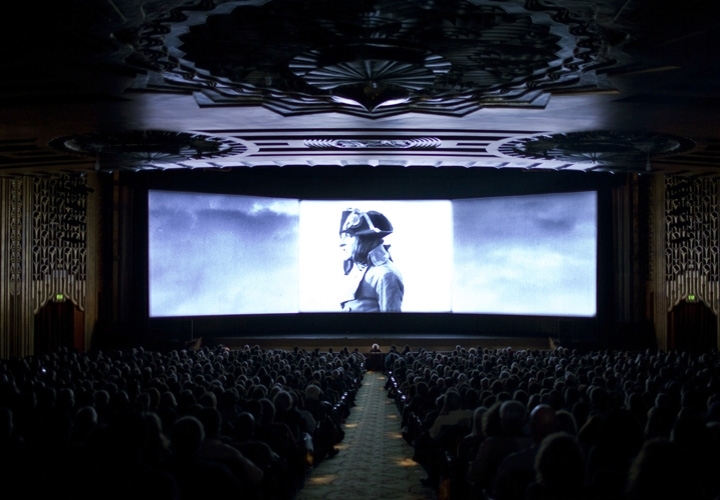
In 2012, the San Francisco Silent Film Festival screened Kevin Brownlow’s masterpiece restoration of Abel Gance’s NAPOLEON at the Paramount Theatre in Oakland. Over the course of 4 days, 10,000 people packed the theater.
If you are in the Bay Area, I encourage you come to at least one screening. You won’t regret it. My mother, who previously knew little to nothing about silent film, came with me several years ago to the festival’s screening of Wings with live foley accompaniment. She was blown away, and couldn’t stop talking about it. Since then, she has come with me to multiple screenings at the festival every year, and has become a bona fide silent film fan. This is what the Silent Film Festival strives to do–to create new interest in silent film and delight longtime devotees–and it succeeds beautifully.
So if you’re in the Bay Area, I hope to see you there. If you are not, follow along on the blog and on Twitter. It will be a great time!
Hello again readers, it is a rare occasion when I make two posts in a single day, but in addition to being Memorial Day (necessitating my post about the Hollywood Canteen this morning), today is the last day of the CMBA Fabulous Films of the 50s Blogathon and I am signed up to cover one of my favorite films of all time. Far be it for me to pass up a chance to talk about Auntie Mame, so I am writing my second post of the day and I can’t wait.
Auntie Mame is a unique piece of art. More than just a film, it is a beautiful character study, a celebration of eccentricity and love of life. Mame Dennis is a true bon vivant, a woman who is so in love with life that it sometimes causes her trouble. She is also sublimely affectionate, maternal, and caring, traits that are seemingly the antithesis of what Mame Dennis stands for, but ones that strangely fit her character. Though Mame does get married, romantic love does not drive the plot. Instead, it centers around loving life, celebrating all that it has to offer.
The original novel of Auntie Mame was written by Patrick Dennis in 1955, and was based on the eccentricities of his much beloved aunt, Marion Tanner. Tanner was known around New York for her red brick house at 72 Bank Street, which often served as a haven for radicals, struggling artists, and other Bohemian personalities. Much like Auntie Mame and her home at 3 Beekman Place, Marion Tanner welcomed strangers into her home for parties and a safe haven, a practice that very much worried her nephew. When he wrote Auntie Mame, she delighted in the comparison, and often brought it up in conversation with guests at her endless parties.
Rosalind Russell, the stage and film star who would ultimately become Auntie Mame’s first and most highly respected interpreter, had her own connection to the character. Shortly before its publication, Russell was sent a copy of the book by the author. When she picked it up to read, she could hardly believe what she was reading. “It’s the Duchess,” she said to her husband, “Someone has written the Duchess.” “The Duchess” was the name that the Russell family had given to Rosalind’s older sister Clara. A stylish, larger-than-life character who knew and loved everyone of importance, Clara gave off an air of royalty that spurred the nickname. For Russell, this character was simply a fictionalized version of the sister she knew and loved so well. The book took on a further significance for Russell in that Clara had died too young of a stroke not long before, and the story brought back a flood of memories that were hard to shake. After the book was published and she was asked to do Auntie Mame on Broadway, she immediately agreed, basing her interpretation on the character traits of her sister.
Rosalind Russell as a child (bottom right) with her siblings. Clara is at the top with the large bow.
The show ran for 639 performances from October 31, 1956 to June 28, 1958. Rosalind Russell and Peggy Cass were nominated for Tony Awards, and Peggy Cass won for her portrayal of frumpy assistant Agnes Gooch. Warner Bros. latched onto the idea of a film, with Russell and Cass reprising their roles, and the film was released in December of 1958. Several other cast members of the original Broadway show appeared in the film, including Jan Handzlik, the boy who played Patrick.
The plot of the movie is not particularly important–it is a character-driven narrative that puts emphasis on celebrating individuality. A young boy, Patrick, is sent to live with his eccentric aunt after his father dies, leaving him an orphan. He arrives at the door of 3 Beekman Place, to find his Auntie Mame giving a wild party–having forgotten that her nephew was supposed to arrive that day. But she welcomes him with open arms, and immediately takes him under her wing as her surrogate son. Complicating matters is Mr. Babcock, the representative from the Knickerbocker Bank that Patrick’s father assigned to make sure “that crazy sister of mine doesn’t do anything too goddamned eccentric.” Mame and Mr. Babcock don’t agree on how to raise Patrick, but ultimately Mr. Babcock has the upper hand and sends Patrick to elite, snobbish private schools, turning him into one of the snobs that Mame detests. At school he falls in love with Gloria Upson, an empty-headed, vapid, country club girl that he intends on marrying. Mame objects to Patrick marrying a girl with “braces on her brains,” but instead of telling him that outright, she hosts a family dinner for the girl’s conservative parents in which she lets her eccentricity out in full force. The girl and her parents are deeply offended, and leave in a huff. Patrick sees that they are unwilling to accept how he was raised, and he reverts back to being the loving nephew of his loving Auntie Mame.
The movie is quite long, covering the period from the 1920s through the end of the Depression as well as Mame’s marriage to her husband Mr. Burnside and her eventual widowhood, but the charming and delightful characters make the time rush by. Rosalind Russell is undoubtedly the star of the show, but there are great performances by many members of the supporting cast. Peggy Cass repeats her Tony-winning performance and gives a hilarious interpretation of Agnes Gooch, the assistant who ends up pregnant out of wedlock (or is she?), and the actors who play Gloria’s conservative parents are fantastic. Adding to the show-stealing performances is the marvelous Joanna Barnes, who has a gift for playing rather unlikable characters to perfection. Here is one of my favorite scenes from the movie.
Director Morton Da Costa was known for being a master of the “in” shot, a method of focusing in on the character at the end of a scene by spotlighting the face while fading the rest of the scenery to black. The technique undoubtedly comes from Da Costa’s years in the theatre scene, as the effect is very theatrical and unusual for film. This was used very nicely in many scenes in Auntie Mame, as well as in another Da Costa triumph, The Music Man, four years later.
Shirley Jones in The Music Man (1962). At the end of the video, watch for Da Costa’s signature “in” shot.
Auntie Mame received wide critical acclaim upon its release. Rosalind Russell and Peggy Cass were both nominated for Oscars, and Rosalind Russell won a Golden Globe for her performance. The film was additionally nominated for Best Picture, Best Art Direction, Best Cinematography, and Best Film Editing at the Oscars.
The film’s opening theme.
As for Marion Tanner, the basis for Auntie Mame, she saw the film’s release and lived a very long and full life for a long time afterward. Sadly, she and her nephew had a falling out due to worries about her carefree lifestyle, and they spoke rarely in her later years. She died in 1985 at the age of 94, and never lost her enthusiasm for life. “I do believe in people, you know,” she liked to say.
Servicemen gather outside the Hollywood Canteen at 1451 Cahuenga blvd. in Hollywood.
On this Memorial Day, I would like to pay tribute to an integral part of Hollywood history that relates to the holiday. On October 3, 1942, the Hollywood Canteen opened its doors at 1451 Cahuenga blvd. in Hollywood, with a purpose to provide music, entertainment and food to active service members, completely free of charge. Staffed by volunteer Hollywood celebrities and open to all serving members of the Allied forces–men and women, black and white, from all the allied countries–it was a venture to preserve Allied morale and a method for members of the entertainment industry to contribute to the war effort in a meaningful way.
The idea for the canteen came from actor John Garfield, who was inspired to recreate the successful Stage Door Canteen in New York for service members on the West Coast. Unable to serve in the army himself because of a heart problem, he wanted to do something to aid the efforts overseas and sought partnership with fellow actor Bette Davis, who helped set the wheels in motion. Working long hours to get the canteen up and running, Garfield and Davis managed to get the canteen built in less than 1 month, complete with elaborate chandeliers and a giant dance floor.
Bette Davis installs a chandelier.
Per the rules of the “Hollywood Victory Committee,” established after Pearl Harbor in order to allow actors to volunteer for the war effort without having trouble with the Screen Actors Guild, Davis and Garfield were able to procure volunteers who not only would keep the canteen running smoothly, but would also provide unmatched amusement and entertainment for the patrons of the canteen. Among the frequent volunteers were Rita Hayworth, Deanna Durbin, Barbara Stanwyck, Joan Crawford, Jeanette MacDonald, and countless other Hollywood luminaries. Upon the visit of the millionth service member in 1943, the lucky sergeant Carl Bell was brought into the canteen by Marlene Dietrich where he received a kiss from Betty Grable. It was unlike anything most of these servicemen and women had ever seen.
Though the Hollywood Canteen seemed to be a fantasy land in which soldiers could escape from the harsh realities of wartime, its walls were not immune to the difficult social problems of the time. Upon seeing that tables were not segregated at the canteen, many white soldiers opted to leave in lieu of sitting and chatting with fellow service members of African-American descent. Bette Davis, known for her refusal to entertain for segregated audiences, took to the microphone when this happened to explain the policy of the Hollywood Canteen. “The blacks got the same bullets as the whites did, and should have the same treatment,” she said.
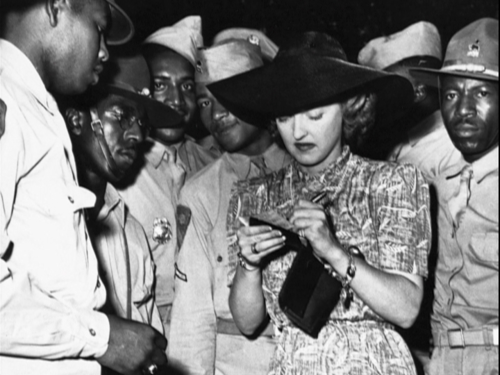
Bette Davis signs autographs outside the Hollywood Canteen.
In addition, it was at the Hollywood Canteen that a pregnant Gene Tierney was signing autographs when she was approached by a fan who had recently been quarantined for German measles. Tierney contracted the disease, and her daughter was born with severe problems including blindness, deafness, and intellectual disability. Tierney suffered from serious mental anguish and guilt for the rest of her life because of her decision to go to the Hollywood Canteen that night.
In 1944, the canteen was such a famous institution that Warner Bros. decided to make a movie about it. Based loosely on the experiences of Sgt. Bell, it tells the story of two servicemen on leave who spend several nights at the Hollywood Canteen–one of whom becomes the millionth G.I. served and wins a date with Joan Leslie. The movie features so many stars that, according to Variety, “There isn’t a marquee big enough to hold all the names in this one, so how can it miss?” The movie was a smash success, and received 3 Academy Award nominations. 40% of ticket sales went to the real Hollywood Canteen.
The Andrews Sisters in Hollywood Canteen (1944)
The canteen continued even after the war was over, finally closing for good on Thanksgiving Day, 1945. Today, in keeping with corporate lack of appreciation for history, the building has become a parking garage for the building next door. But the legend of the Hollywood Canteen lives on, a true testament to the power of Hollywood to maintain morale and keep spirits up in the most difficult times.
Many of these photos were found over on Karen Noske’s wonderful blog Movie Star Makeover. Go visit it if you have the chance, K is a friend of mine and does a magnificent job with her site.
Earlier this evening, I received confirmation that Backlots will be at the San Francisco Silent Film Festival as an official member of the press. This will be my third year at the festival, and it stands as one of my favorite festivals to cover. Held at San Francisco’s beautiful Castro Theatre, I find the ambiance to be perfect, and the programming and festival speakers to be of the highest quality of any film festival I have attended. I feel immensely privileged to be able to have this experience year after year.
THE FOUR HORSEMEN OF THE APOCALYPSE (1921).
This year’s lineup features some real treasures, including a presentation of the Rudolph Valentino classic The Four Horsemen of theApocalypse as the opening night movie. Painstakingly restored by Kevin Brownlow and David Gill, the print comes directly from Brownlow’s Photoplay Productions and the screening promises to be quite an event. It is followed by an opening night party at the McRoskey Mattress Company down the street, which is an opportunity to mingle with other like-minded silent film fans in the glamorous upstairs room of McRoskey’s overlooking Market Street.
One of the things I love about the San Francisco Silent Film Festival is its attention to world cinema–it gives the audience a true smorgasbord of movies, a holistic and full approach to what the tradition of silent film means on a grand scale. Throughout the festival there will be movies from Sweden, the former U.S.S.R., China, and the UK, as well as ample opportunity to see American favorites and crowd-pleasers. The festival is presenting a newly found print of Ramona, and we will see the world premiere of a new restoration of Douglas Fairbanks’ The Good BadMan, made possibleby a collaboration between the San Francisco Silent Film Festival, the Cinematheque Francaise, and the Film Preservation Society.
Douglas Fairbanks in THE GOOD BAD MAN (1916).
If you are in the San Francisco Bay Area, this festival is not to be missed. Please visit their website at http://www.silentfilm.org for tickets and more information. On my end, I will be live-tweeting during the festival and blogging every night, so be sure to tune in for live updates as they happen, beginning on May 29.
Upon glancing at TCM’s schedule for this month, I was thrilled to see that the network is paying tribute to the wonderful June Allyson as their featured Star of the Month. In addition to her status as one of the most charming and charismatic stars at MGM, I have a special connection to June Allyson that makes me especially happy to see her honored this month. I will talk about that later in this post.
Known for her sweet, girl-next-door image, June Allyson reigned as one of the top stars of MGM in the 1940s and 1950s. In contrast to her wholesome, suburban persona onscreen, the girl who was born Ella Geisman grew up in poverty, raised by various relatives in the New York City projects. Despite a childhood accident that rendered her unable to walk for several years without a steel brace, she became a seasoned dancer and eventually began to land gigs in nightclubs and acting roles in musical short subjects with Vitaphone Pictures. In 1938, at the age of 21, she got her first Broadway role in Sing Out the News, and her first starring role came 3 years later in George Abbott’s production of Best Foot Forward.
Due to her performance in the Broadway show, MGM asked Allyson to appear in the film version that was in pre-production in Hollywood. She agreed, and made the trip west. Upon her arrival, she found that Best Foot Forward was going slower than expected, and she was cast in a tiny role in Girl Crazy (1943) to keep her occupied. This is June Allyson’s first appearance in a feature film.
Best Foot Forward came to fruition later the same year, and when Arthur Freed saw her screen test, he demanded that she be put under a long-term contract immediately. Allyson thrived at MGM, using her cherubic face, wide smile, and arrestingly husky voice to her advantage in such films as Two Girls and a Sailor (1944), Good News (1947) and Little Women (1949).
With Peter Lawford in Good News (1947)
The trailer for Little Women (1949)
In 1945, June Allyson married heartthrob Dick Powell, much to the chagrin of Louis B. Mayer who thought Powell was bad for her studio image. She was placed on suspension, but she and Powell remained married until Powell’s death in 1963 and the couple adopted 2 children together. After Powell’s death, Allyson was invited to appear alongside old MGM rival Judy Garland on “The Judy Garland Show,” marking one of the most delightful episodes of the series.
Acting on a lifelong interest in medicine, in later life June Allyson committed herself to educating the public about gynecological and urological diseases in seniors, eventually founding the June Allyson Foundation for Public Awareness and Medical Research. She continued with this work until she died in 2006, at the age of 88.
Now for my connection to June Allyson. I was lucky enough to have met this wonderful woman in the summer of 1998, when I was 12 years old. My very obliging mother had taken me halfway across the country to attend the Judy Garland Festival in Grand Rapids, MN, and June Allyson was the guest of honor that year. I remember her so vividly. Her spirit filled the room, her voice was warm, her character gentle and sweet. She loved children, so my sister and I were subject to great affection. I remember several big bear hugs, and she interacted with me with great tenderness and love. I felt that we were dear friends. I’ve carried that beautiful memory of June Allyson with me always, and I miss her dearly.
Don’t forget to tune in to TCM tonight for an evening with June Allyson! Showing tonight: Two Girls and a Sailor at 8:00 EST, Best Foot Forward at 10:15, and Good News at midnight.
As regular readers of this blog know, the level of devotion I possess for Barbara Stanwyck is very high. I consider her to be one of the greatest, most versatile actresses ever on the screen, and will take any and every opportunity to watch one of her movies and, according to a recent calculation, I have seen 63 of them. So you can imagine my joy when I discovered a Barbara Stanwyck movie in the Warner Archive that I had not previously seen, and naturally I took the opportunity to request it for the blog. The movie is Woman in Red, a drama made for Warner Bros. in 1935 costarring Gene Raymond and John Eldridge as Stanwyck’s love interests.
1935 was a relatively quiet year for Barbara Stanwyck. The previous year had seen the enforcement of the strict Production Code, to which several steamy Barbara Stanwyck pictures had contributed (notably Illicit, Forbidden, and the pre-Code masterpiece Baby Face), and in 1935 the public had to get used to a new type of Barbara Stanwyck. She delivered, but the movies she made in 1935 were extremely benign by comparison. The Woman in Red is no exception, and in this film we see a much tighter, more constrained character in Stanwyck’s portrayal of Shelby Barret than we have seen in a Stanwyck movie before.
Shelby Barret is a professional equestrienne who rides for a woman named Mrs. Nicholas, a wealthy society lady. She falls in love with Johnny Wyatt, a polo player for Mrs. Nicholas, but Mrs. Nicholas is also in love with Johnny and she fires Shelby. Meanwhile, another wealthy gentleman by the name of Gene Fairchild is in love with Shelby, and after Shelby and Johnny marry, she elicits Gene’s financial help (without telling Johnny) in the budding horse-handling venture that she and Johnny are undertaking.
She accepts an invitation to party with Gene Fairchild on his yacht, when Gene and his companion Olga show up drunk and Olga falls off the boat to her death. Fairchild is implicated as her murderer, and witnesses testify that he was seen with a mysterious “woman in red” (Shelby was wearing red that evening). Her snobby in-laws, the Wyatts, start talking about the case and Shelby confesses that she is the woman in red. In court, the Wyatt family defends her, and she defends Fairchild, risking her marriage. Ultimately, Johnny comes around and forgives her, and they are reconciled at the end.
It is a rather hurried ending, and the movie feels rushed in general. The plot is difficult to follow because the characters aren’t terribly well developed, but there are a few wonderful angry Barbara Stanwyck scenes which are always a delight to watch.
It is also great to see Barbara Stanwyck acting with horses at this point in her career. Stanwyck had a great love for horses, despite several serious falls during stunt sequences early in her career, and her rapport with them is palpable. In 1936, she and the Zeppo Marx family founded Marwyck, a ranch designed for the training, breeding, and respite of thoroughbred racehorses. It remained active until 1943, and Barbara Stanwyck was an integral part of the upkeep and maintenance of the ranch and the horses. In this film, Stanwyck is so natural with the horses that they almost seem a part of her, and the effect is lovely.
Barbara Stanwyck tends to a horse at Marwyck.
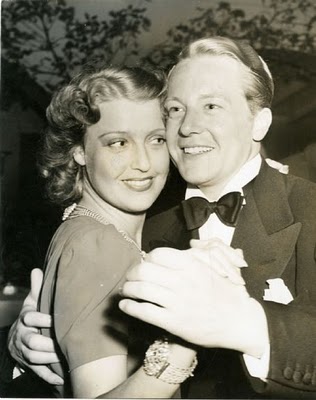
Gene Raymond, who plays Johnny, was an extremely versatile personality in Hollywood. Though he was at various times a composer, director, producer, and an airline pilot, the role for which he is perhaps best known is for being the husband of MGM singing star Jeanette MacDonald. They were married for 28 years until MacDonald’s death in 1965.
Jeanette MacDonald and Gene Raymond.
If you would like to see The Woman in Red, click here to order it from the Warner Archive.
Upon my return from Los Angeles early this morning, I was thrilled to find my Warner Archive titles waiting for me in the mail, thus allowing me to begin my new collaboration with the Warner Archive sooner than I had anticipated. I had initially projected that “Treasures From the Warner Archive” would begin in June, but I don’t see any reason for waiting any longer than necessary. So without further ado, this is the first installment in this series. Ladies and gentlemen, I give you a delightful pre-Code, featuring a young Clark Gable and Marion Davies in one of her best roles–it’s a balancing act of love, passion and virtue in Polly of the Circus.
The film begins with a debate about a circus billboard in a small, conservative town as Polly (Marion Davies), the featured act in the circus, is pictured on a billboard wearing only her leotard. This offends the local townspeople and the police insist on her legs being covered, which leads to elaborate drapings over her legs on every billboard in town. Polly objects to this, and takes up her objections with the minister (Clark Gable), who ignores her and the drapings remain. At the opening night of the circus, Polly is heckled by an audience member about the billboards, which causes her to lose her focus and fall 50 feet from the trapeze.
She is gravely injured, and the minister, Mr. Hartley, takes her in to heal her. During her convalescence, Polly and Mr. Hartley fall deeply in love and eventually marry. His uncle, also a minister, objects to her marrying a circus girl, as does the church, and Mr. Hartley is stuck between the woman he loves and the ministry he has spent his whole life training for. He is left with limited options, as divorcing Polly would be a sure way to be excommunicated from the church. Polly, seeing his pain, does the only thing she thinks she can–she leaves him and rejoins the circus. Severely depressed, facing the stunt that left her injured before, she says to her friend “If I’m supposed to make it, I’ll make it.” Just then, Mr. Hartley appears below her, calling to her excitedly. He has chosen to live openly with her. She smiles broadly. “I’ll make it!” she cries, as she pulls off the stunt with perfection. She joins Mr. Hartley at the bottom of the trapeze, as the movie ends.
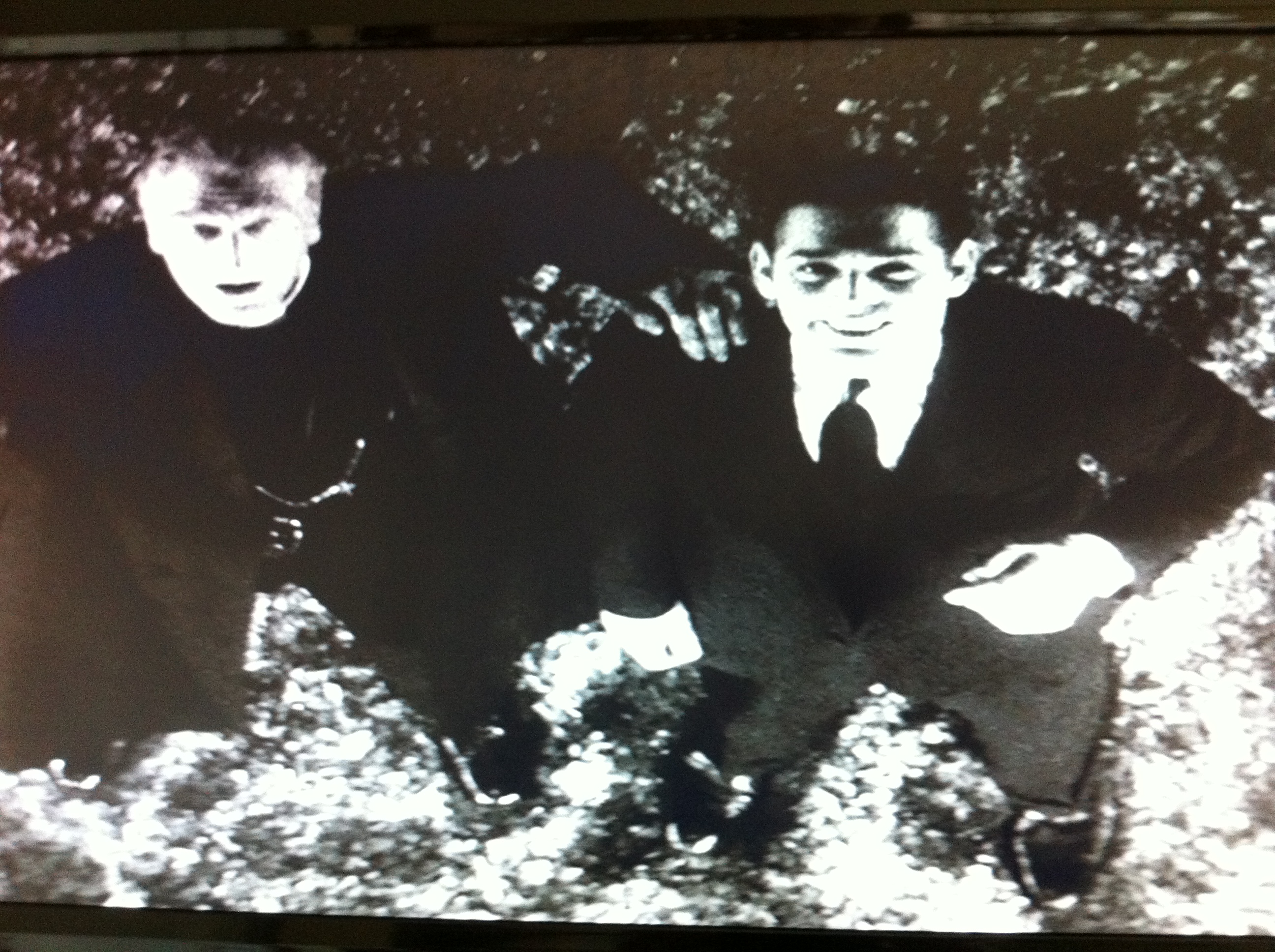
Looking up at Polly from the base of the trapeze.
I have seen a great many Marion Davies movies, and Polly of the Circus stands as one of my personal favorites. Not only is it a close examination on the timeless issue of it means to be torn between two serious life choices, but it is also a deft and clever pre-Code, with delightfully suggestive dialogue and witty double-entendres. One of my favorite lines of the movie is one in which Mr. Hartley and Polly are getting to know each other, discussing what it means for Mr. Hartley to be a minister. Polly says “Well I suppose even a minister has his moments. But of course your wife would have to sleep in the woodshed…during Lent.”
Mr. Hartley laughs heartily at this, showing the audience that we all know exactly what she means. It is a movie that doesn’t overpower the audience, but one that leaves a rich aftertaste when the movie is finished.
Polly of the Circus is the first of two movies that Marion Davies did with Clark Gable, and this one is considered the better of the two. In 1934, Cosmopolitan Pictures (the production company with which Marion was affiliated) moved from MGM to Warner Bros., and Marion made 4 movies there before she retired in 1937. Her second-to-last film at Warner Bros. was one entitled Cain and Mabel, one for which Cosmopolitan boss William Randolph Hearst had high hopes. It was a multi-million dollar production, and again teamed Marion Davies and Clark Gable (on loan from MGM), two stars that were almost guaranteed to bring the studio a profit. However, Hearst overestimated the potential of the production, and Cain and Mabel failed to make a profit. It was a terrible blow to the studio, and its failure at the box office is tragic because, in retrospect, it is indeed a fun movie to watch. The Warner Archive has also made Cain and Mabel available on demand, and that is one that I will be reviewing in the future. Stay tuned!
But as much as I love Cain and Mabel, it is Polly of the Circus that is closer to my heart. A beautiful love story set against the backdrop of a circus is a winning combination, and the movie delivers. I am so glad that the Warner Archive has made it available, and that I could talk about it here.
If you would like to order Polly of the Circus, here is the link to its page on the Warner Archive. Thank you for reading, and stay tuned for the next installment in this series, when I will talk about Barbara Stanwyck in The Woman in Red.
Today marks what would have been the 107th birthday of an incomparable legend. Katharine Hepburn, a persona so beloved and respected to have reduced hardened prop men to putty in her hands during her appearance on Dick Cavett in 1973, was a force to be reckoned with and everybody knew it. When Katharine Hepburn walked in the room, there was no question as to who was in charge. This was an individual who fought for what she wanted, demanded what she needed, and in the process singlehandedly redefined what it means to be a woman in Hollywood.
Katharine Hepburn at the rehearsal for her appearance on Dick Cavett in 1973.
Hepburn famously said on an interview with Barbara Walters “I have not lived as a woman. I have lived as a man. I’ve just done what I damn well wanted to, and I’ve made enough money to support myself, and ain’t afraid of being alone.” Katharine Hepburn broke many molds during her lifetime, and defied societal expectations in a generation in which women were still expected to be subservient to men. And she didn’t do it alone.
Katharine Martha Houghton Hepburn, the mother of Katharine Hepburn and a pioneer of women’s rights in Connecticut.
From her earliest childhood, Katharine Hepburn was taught to live the way she wanted to, and not give credence to what others might think. This attitude was instilled in her by her mother, the passionate suffragette and famed leader of Connecticut women’s rights groups Katharine Martha Houghton Hepburn. Houghton Hepburn served as the president of the Connecticut Women’s Suffrage Association and, after the 19th Amendment was passed in 1920, founded the American Birth Control League with fellow activist Margaret Sanger, the organization that later became Planned Parenthood.
In later life, the younger Katharine would remember her mother taking her along to suffrage rallies as a toddler, teaching her that the women there were doing all they could to fight for her future. Due to her mother’s work, the Hepburn family endured intense hostility from the neighbors–neighborhood children were often not allowed to play with the Hepburn children, and bricks were thrown through their windows on several occasions. But through it all, Mrs. Hepburn persevered, and passed on to her daughter the attitude that rights must be fought for and earned.
Katharine Hepburn with her mother and siblings.
Young Katharine never let go of the lessons of her childhood, and throughout her life fought many personal and professional battles, fighting hard and not backing down until she won. In her desire to be comfortable, she insisted on wearing pants almost exclusively, a practice seldom exercised in her generation. In her stalwart determination to not be restricted by what other people thought, she is widely credited with popularizing pants for women. In 1947, at the height of the Red Scare and the Hollywood blacklist, Katharine Hepburn was one of the founding members of the Committee for the First Amendment, formed to protect and support the blacklisted Hollywood Ten. Evoking her mother, and the women who fought for equal rights for women when she was a child, she delivered a speech written by blacklisted screenwriter Dalton Trumbo at the Hollywood Legion Stadium during a Progressive Party rally. Her own risk of being targeted by the Hollywood blacklist not holding her back, Katharine Hepburn once again stood up for what she believed in.
Backlots will be watching and reviewing titles from the Warner Archive Collection as part of a regular feature on the site.
Readers, I am proud to announce some good news regarding the site. Beginning next month, I will be adding a new and exciting feature to Backlots, one that I hope will prove informative, entertaining, and that will keep Backlots firmly rooted on the pulse of what is new and exciting in classic cinema.
As part of a new collaboration with the Warner Archive, I will be watching and reviewing several titles from the collection each month for a feature entitled “Treasures From the Warner Archive.” I will provide backstories on the films, explore trivia bits, and perhaps host a few quizzes, polls, and competitions related to the Warner Archive titles over at the Backlot Commissary. I do hope that you, the reader, will participate in discussions in the comments section or at the Commissary, because I would love to hear from you! I will also be taking requests as to which films my readers would like to see reviewed, so please be sure to stay in touch if you have a specific Warner Archive title you would like to see reviewed.
The first two films are on their way, and I am pleased to announce that the first entry in this feature will be analysis of Polly of the Circus (1932), starring Marion Davies and Clark Gable, followed shortly thereafter by a post on The Woman in Red (1935), an oft-cited but rarely seen Barbara Stanwyck film.
Polly of the Circus.
The trailer for The Woman in Red.
The Warner Archive Collection is a real treasure for classic film fans. Established in 2009, it aims to manufacture classic titles on demand for consumers, focusing on films that have never before had a DVD release. Its library has been growing exponentially as it acquires the rights to release films from other collections, and its Netflix-type streaming system, Warner Archive Instant, is bringing classic films to a demographic that is accustomed to watching movies on the computer. It is a true honor to collaborate with such an innovative and forward-thinking company.
Keep your eyes peeled for the first installment of Treasures From the Warner Archive!
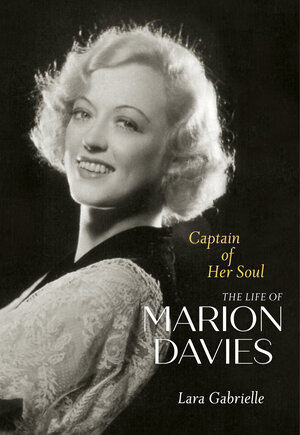
Captain of Her Soul: The Life of Marion Davies is now available at your favorite bookseller! Click hereto order it, and visit mariondaviesbook.com for all the latest.
Backlots is devoted to honoring and celebrating all aspects of classic film and is written by Lara Gabrielle, a California-based classic film writer and historian. Lara is the author of CAPTAIN OF HER SOUL: The Life of Marion Davies (UC Press, 2022).
Here you will find pieces on frequently seen classics and some lesser-known gems, as well as book reviews, festival coverage, and pieces on the history, theory and culture of film as it relates to the study of classic cinema.
Enjoy the site, and thanks for reading!
AFFILIATIONS & AWARDS
2019 CMBA Award for Best Profile of Classic Movie Performer or Filmmaker--"The Activism of Myrna Loy"
Winner of the 2018 CiMBA Award for Best Classic Movie Series, BACKLOTS AT THE COURTHOUSE: OLIVIA DE HAVILLAND VS. FX
Winner of the 2014 CiMBA Award for Best Profile of a Classic Movie Performer or Filmmaker: A Q&A WITH JOAN FONTAINE IN HONOR OF HER 96TH BIRTHDAY
Winner of the 2011 CiMBA Award for Best Classic Movie Discussion, THE FINAL SCENE OF THE HEIRESS
I am honored to be a judge of the Animal Film Festival in Grass Valley, CA.
EVENTS
BACKLOTS ON THE WEB
Join us at the Backlot Commissary, the place for Backlots' readers to share content and discuss movies!
Walter Pidgeon and Greer Garson in "Mrs. Miniver."































_03.jpg)

 Backlots