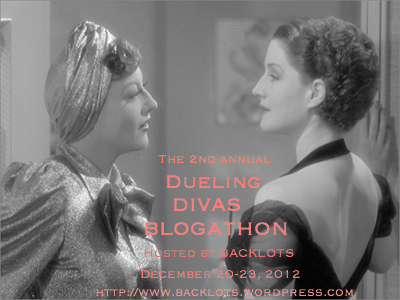
Thank you for making Backlots’ first year as productive and wonderful as it has been! This blog’s first anniversary is on March 17, and its first 9 months have yielded things I never expected for my first year as a blogger–Backlots was accepted into the CMBA and participated in some fantastic blogathons. We hosted the Dueling Divas Blogathon which was great fun, and were honored to receive a CMBA Award for a discussion of The Heiress. The success this blog has achieved is largely due to you, the readers. If I didn’t see that this blog was loved and read every day, I would never have the motivation to keep up the work this blog takes. So I sincerely thank you for your readership, you make Backlots what it is! I look forward to a marvelous 2012, and wish all of my readers the same.
Even though Judy seems to prefer my readers in Laos, I’m pretty sure 2012 has already arrived in southeast Asia, so I’ll take the lead and wish EVERYONE a happy new year! Have a great one!
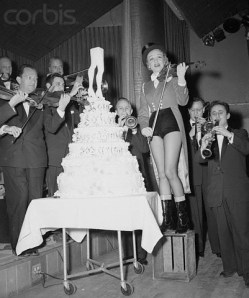
Today would have been the 110th birthday of our Star of the Month, Marlene Dietrich! Here is a birthday tribute to this incomparable legend. Happy birthday Marlene!
The Dueling Divas blogathon has come to an end, and it was so much fun!! I’m so happy that my first blogathon was such a smashing success. Please be sure to check out all the magnificent entries here! Thanks to all who participated, and all who took the time to read. It couldn’t have turned out better.
Stay tuned the rest of this month while we celebrate Marlene Dietrich, whose birthday is coming up on the 27th!
The first day has arrived! It is currently 1:15 in the morning, but I am busy collecting the entries that have arrived already. This list will be updated as more posts come in.
CRÍTICA RETRO: This post is a lovely examination of that wonderful film full of dueling divas, The Women! The cast, the film, backstories and trivia. Written in Portuguese, but don’t worry–there’s a translate button on the right. http://criticaretro.blogspot.com/2011/12/as-mulheres-women-1939.html
A PERSON IN THE DARK: I had so much fun reading this one! I’m a big fan of Josephine and Daphne, so I’m so glad someone chose to profile them for this blogathon. Here, they go head to head in 10 mini competitions such as Best Hair, Best Legs, and Least Conflicted About Her Gender.. http://flickchick1953.blogspot.com/2011/12/dueling-divas-handicapping-daphne-vs.html
HELIUM.COM: Joann Spears profiles many many films featuring a great many dueling divas in her comprehensive and informative post “Top Movies for a Baby Boomer Night of Chick Flicks.” http://www.helium.com/items/2179566-chick-flick
Also, see her comment below for Joann’s contribution of some of the great dueling diva scenes she talks about in her post!
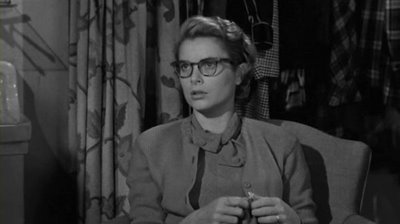
For my first day of dueling divas, I am devoting my attention to that well-publicized “scandal” at the 1954 Oscars between Judy Garland and Grace Kelly. Now I must admit that I am a bit biased on the subject–as readers of my blog know, I am a HUGE Judy Garland fan, and have been since very early childhood. For years I had a chip on my shoulder about Grace Kelly, refusing to see The Country Girl (the film for which she was nominated) in protest of the outcome of the 1954 Oscars.
Why all this hullabaloo, you ask? Well, let’s start at the beginning.
In order to understand the significance of the 1954 Oscars for Judy Garland, we must revisit Judy’s career at MGM. She was signed to a contract in 1935, and shortly thereafter she was put into a virtual treadmill of productions that wore her young body out. She was given pills to sleep, pills to stay awake, and pills to make her lose weight, which in addition to the stress of her life at MGM, contributed to psychological problems and a severe addiction that culminated in the late 1940’s. Following a particularly difficult time on the set of Annie Get Your Gun (from which she was ultimately fired and replaced by Betty Hutton) and failure to appear on the set of Royal Wedding (in which she was replaced by Jane Powell), MGM suspended her contract and Judy Garland was a movie has-been at 28.
Almost immediately, however, she bounced back with an absolutely stellar concert career, playing some of the best houses in the world and breaking records at the Palace Theatre with her 19-week one-woman show. In the early 1950’s, Judy Garland was on top of the world, free from MGM and able to spread her wings to tackle anything. It is often said that the producer of the Palace show, Sid Luft, was almost solely responsible for her career revival, and the two married in 1952. Two years later, he was producing A Star is Born, heralded as Judy’s magnificent comeback to movies, and one that brought Judy her first Academy Award nomination as Best Actress.
All of Hollywood was abuzz about her performance, and everyone was convinced that it would bring her an Oscar–if not for her performance alone, then for the audience’s love and affection for her as a person and an entertainer. So convinced was everyone that she would win, that when she was unable to attend the Oscars ceremony due to having just given birth to her 3rd child, cameras were set up in her hospital room to televise her acceptance speech.
Judy was understandably very upset. The media had led her to believe that there was no way anybody else would win. Judy accused Grace of winning simply because she made herself dowdy in The Country Girl, for her role as the long-suffering wife of an alcoholic. Judy is quoted as lashing out for Grace “taking off her fucking makeup and grabbing MY Oscar!” The telegrams that came in were very sympathetic, the cleverest one being from Groucho Marx: “This is the greatest robbery since Brink’s.” Many years later, upon being interviewed for the A&E Biography on Judy Garland’s life, MGM coworker June Allyson said “I really hated the Academy that year. Judy SHOULD have won that Oscar. She really should have.”
Per Judy’s self-deprecating sense of humor, the incident was relived many times, notably in a story from the “Born in a Trunk” segment of her TV show in 1963:
Poor Grace Kelly. Due to the legions of Judy fans across the world, she has developed a bit of a bad name, through no fault of her own. I am the first to admit that until about 7th grade, I held a major grudge against Grace Kelly. It wasn’t until I forced myself to read a biography and watch a few of her movies that I came around to her, and developed a great respect for her as a dignified human being (one of my favorite anecdotes is that when Josephine Baker was refused service in the Stork Club while Grace was dining there, she grabbed Josephine by the arm, stormed out, and vowed never to eat there again. She never did, the two embarked upon a lifelong friendship). Her performance in The Country Girl, as much as some Judy fans may hate me for this, is brilliant.
But I still think Judy should have won!
This post is an entry in the Dueling Divas blogathon!
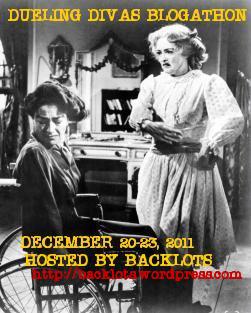
I’m so excited for the Dueling Divas Blogathon, taking place between December 20 and 23, 2011!!
So again, a recap of the rules. You can post about:
Those who had a rivalry in real life, either over a particular film role or over a personality clash, ie Bette Davis and Joan Crawford
Those who had a rivalry on the screen, ie Mildred and Veda from Mildred Pierce
Any dual role (see what I did there? Duel? Dual? Be proud.) played by an actor or actress in a classic film, ie Hayley Mills in The Parent Trap.
This opens the door for LOTS of possibilities, and I’m proud to say I have already got one stellar entry from Crítica Retro! Please link your posts to this page, and I will update this post with the links as the entries come in, beginning on the 20th.
Among Marlene Dietrich’s many friends in the industry was Judy Garland. The personas of the two couldn’t have been more different, yet they remained longtime friends and once shared an apartment building in the 1960’s. Marlene, the epitome of otherworldly glamor and chic, sharply contrasted with Judy’s humanity and humorous outlook on life, never taking herself too seriously and having a glorious time teasing those who did.
So as you might imagine, Judy had a field day with her good friend Marlene. Always a wicked impersonator with a real knack for mimicry, Judy could “do” Marlene to a t, and employed her talent both privately and publicly.
Here she is fooling around at a rehearsal, making fun of Marlene’s low voice.
In an appearance on the Jack Paar Show in 1964, Judy recounted a story about a strange record that Marlene put on at a party.
When the two shared an apartment building, Marlene was the frequent target of pranks at Judy’s hand, as Judy thought it was great fun to mess with someone who took herself so very seriously. Nonetheless, the two remained good friends until Judy’s death in 1969.
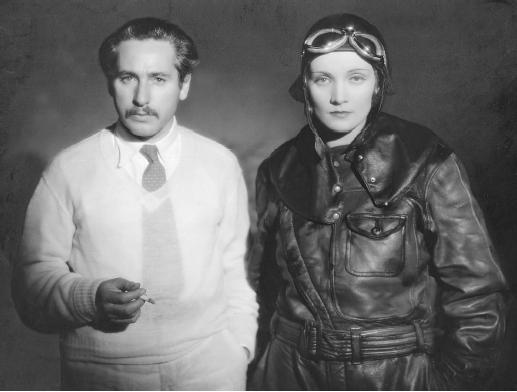
1930 was an incredibly important year in Marlene Dietrich’s career. Not only did it see two immortal collaborations with director Josef von Sternberg, but also saw her immigration to the United States and her transition from German film to American film, with which she would make her greatest mark. The two collaborations with von Sternberg produced some of her most memorable scenes, and the uniqueness of her persona in both films secured her in the public eye.
Their first film together was Der blaue Engel (The Blue Angel), which gave Dietrich the number that would become the most iconic song of her entire career.
Dietrich singing the song again in 1963.
Two versions of The Blue Angel were filmed simultaneously, one in English and one in German, and it is the English language version that is best known, due to the famous English lyrics of “Falling in Love Again.” Ironically, it is also the English language version that was considered lost, until it surfaced in a German film archive and had its U.S. premiere at the German film festival at the Castro Theater in San Francisco. I had the great honor of attending.
Here is a version of the song in German:
Dietrich was on a ship bound for the United States on the evening of the opening of The Blue Angel, and upon the success of the film, von Sternberg advised her to stay in Hollywood. She signed a contract with Paramount Pictures to further her career, and as von Sternberg was already established there, he went on to direct her in 6 American films between 1930 and 1935, the first of which was Morocco.
The production code was not yet born, and thus von Sternberg had much more leeway and freedom to make Morocco everything he wanted to be–and that included a number that touched upon Dietrich’s success with the cabaret feel of The Blue Angel. But this time with a twist:
Dietrich was bisexual, and though her private life remained strictly guarded, she was never ashamed to let her sexuality be known through film. In fact, it was Dietrich’s idea to add the scene we see at 2:16 to the script, saving it from being cut by the censors by cleverly throwing the flower she takes from the woman to Gary Cooper, thus making the scene confusing and disjointed if the kissing scene were removed.
The uniqueness of Marlene Dietrich was evident from the beginning, and as we can see, she always pushed the envelope. She continued to do so for her entire career, both on and offscreen.
Stay tuned for more Marlene, all this month, as we pay tribute to her as Star of the Month!
Before we get into the meat and potatoes of this month, my fellow blogger Dorian at Tales of the Easily Distracted has just begun a wonderfully fun game where we try to connect two classic Hollywood stars through 6 degrees of separation. The current challenge is Myrna Loy and Danny Kaye.
Here goes:
1. Danny Kaye starred in White Christmas with Bing Crosby
2. Bing Crosby starred in High Society with Grace Kelly
3. Grace Kelly starred in To Catch a Thief with Cary Grant
4. Cary Grant starred in Mr. Blandings Builds His Dream House with Myrna Loy.
EDIT: Well, looks like I screwed up the rules of the game. We’re not supposed to solve the Six Degrees ourselves, but instead just pass one degree on to someone else. So since I awkwardly solved the entire round, it’s now up to me to pick two new stars and pass them on to someone else to try to solve.
Ok, so in keeping with my personal classic film obsessions, here are my two new stars:
Caftan Woman, try your luck with Judy Garland and Olivia de Havilland.
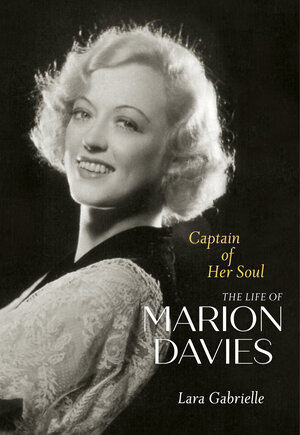
Captain of Her Soul: The Life of Marion Davies is now available at your favorite bookseller! Click hereto order it, and visit mariondaviesbook.com for all the latest.
Backlots is devoted to honoring and celebrating all aspects of classic film and is written by Lara Gabrielle, a California-based classic film writer and historian. Lara is the author of CAPTAIN OF HER SOUL: The Life of Marion Davies (UC Press, 2022).
Here you will find pieces on frequently seen classics and some lesser-known gems, as well as book reviews, festival coverage, and pieces on the history, theory and culture of film as it relates to the study of classic cinema.
Enjoy the site, and thanks for reading!
AFFILIATIONS & AWARDS
2019 CMBA Award for Best Profile of Classic Movie Performer or Filmmaker--"The Activism of Myrna Loy"
Winner of the 2018 CiMBA Award for Best Classic Movie Series, BACKLOTS AT THE COURTHOUSE: OLIVIA DE HAVILLAND VS. FX
Winner of the 2014 CiMBA Award for Best Profile of a Classic Movie Performer or Filmmaker: A Q&A WITH JOAN FONTAINE IN HONOR OF HER 96TH BIRTHDAY
Winner of the 2011 CiMBA Award for Best Classic Movie Discussion, THE FINAL SCENE OF THE HEIRESS
I am honored to be a judge of the Animal Film Festival in Grass Valley, CA.
EVENTS
BACKLOTS ON THE WEB
Join us at the Backlot Commissary, the place for Backlots' readers to share content and discuss movies!
Walter Pidgeon and Greer Garson in "Mrs. Miniver."

























_03.jpg)

 Backlots