Tag Archives: tcm classic film festival

2016 TCM Classic Film Festival Schedule FRIDAY

2692

Analysis of the TCM Festival schedule continues here at Backlots. Friday morning starts off as well as any Friday morning could start, but it is also a perfect example of the joyous difficulty TCM’s schedule poses for the attendee.

THE CHOICES
Screen Shot 2016-04-18 at 9.59.41 AM

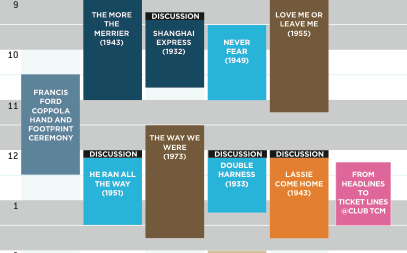
As happy as many of us are that Shanghai Express, The More the Merrier, and Love Me or Leave Me are all playing at the festival this year–we are faced with the dilemma that they are all playing at the same time, and we can’t be in three places at once.

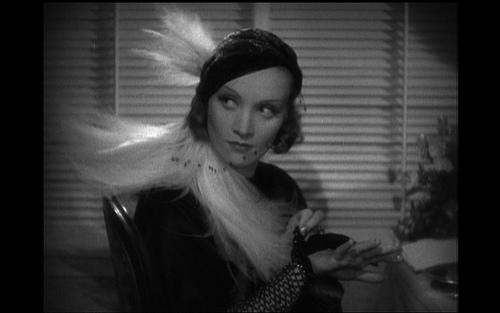
Shanghai Express, the 1932 pre-Code starring Marlene Dietrich, Clive Brook, and Anna May Wong, is exactly the kind of film that attracts a significant part of TCM’s demographic. TCM viewers and festival attendees seem to have a real fondness for pre-Codes–two years ago, Bruce Goldstein’s presentation on pre-Code Hollywood was packed to the gills with enthusiastic fans of the steamy, sensuous world of Hollywood between 1929 and 1934. Shanghai Express is a textbook pre-Code. Telling the story of Shanghai Lily, a sexually liberated woman (“It took more than one man to change my name to Shanghai Lily”) who meets a former lover on a train during the Chinese civil war, it is sure to draw a large crowd at the festival.
6082429140_fbece2e6f9

Love Me or Leave Me, the classic Doris Day musical, is another delightful choice for this time slot. An increasing number of people seem to be drawn to Doris Day in recent years, and the love is much-deserved. There is more to Doris Day movies than may meet the eye at first glance–this movie, for example, was nominated for 8 Academy Awards and won for Best Writing.

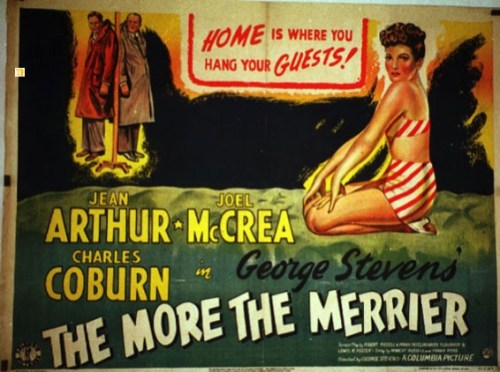
But both of these are playing opposite The More the Merrier, a movie that many of us have been trying to get to the festival for many years. Starring Jean Arthur, Joel McCrea, and Charles Coburn, The More the Merrier is a farce about the housing crisis during World War II, disguised as a hysterically funny screwball comedy. Coburn’s character finagles his way into sharing a room with Jean Arthur and then rents half of his room to Joel McCrea, creating a situation in which Coburn begins to act as a matchmaker for the two younger characters.

Additionally, The More the Merrier will be introduced by Cari Beauchamp, a major draw for festivalgoers herself. In addition to her regular presentations at prior TCM Festivals, she won over viewers of the channel this past year with her appearances on TCM’s “Trailblazing Women” series.

The fact that we have been trying to get The More the Merrier for several years, along with the delightfulness of the movie and Beauchamp’s introduction, makes this a must-see.

MY CHOICE: The More the Merrier

MY MIND MIGHT BE CHANGED BY: Nothing, although if it were in any other time slot, I would see Shanghai Express.
1c07681b49136748db6b3b57565eae54d8d39f8a1ee90d8722f3c973

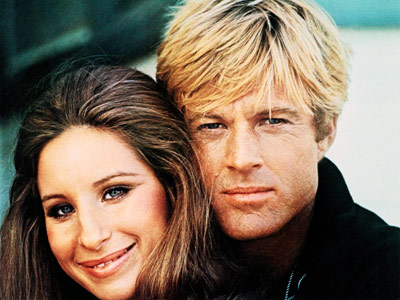
The next time slot at 11:30 is quite a lot easier on the decision-making front. I love The Way We Were, and once again, Cari Beauchamp is introducing. With her long history in politics and in the feminist movements of the 1970s, there is no one better to introduce this movie.

Nothing else in this time slot particularly grabs me. Lassie Come Home is sweet, but I don’t feel the need to see it on the big screen. The Way We Were it is.

MY CHOICE: The Way We Were

MY MIND MIGHT BE CHANGED BY: Nothing.
Screen Shot 2016-04-18 at 11.03.42 AM

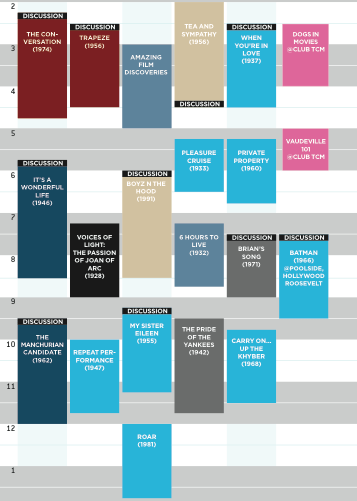
The Friday afternoon and evening slots provide a buffet of great choices once again. At 3:00 at Chinese Multiplex 1, Serge Bromberg will present a look at some of the newest discoveries and restorations in silent film, including new footage from Buster Keaton’s The Blacksmith and a previously lost Laurel and Hardy film, The Battle of the Century. Meanwhile, down the hall at the Multiplex 4, there will be a screening of the Deborah Kerr classic Tea and Sympathy, and for Coppola fans, a screening of The Conversation with Coppola present. For me, I’m torn between Tea and Sympathy and Serge Bromberg’s presentation. I’m not sure which will win out this time–my never-ending love for silent film, or my love for Deborah Kerr. Darryl Hickman, who plays Al in the film, will be a special guest, which is a plus. This one is a toss-up, but silent film may easily win out despite the pros to Tea and Sympathy.

MY CHOICE: Amazing Film Discoveries

MY MIND MAY BE CHANGED BY: Tea and Sympathy.

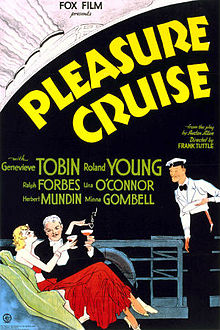
The evening hours commence with a choice between another pre-Code, an oft-screened uber-classic, a modern movie, a silent, and a Club TCM presentation about vaudeville. The pre-Code is Pleasure Cruise, a not terribly well-known movie and one that would be my first new-to-me pick of the festival. It’s difficult to go wrong with a pre-Code, and the new-to-me factor is a bonus.

MY CHOICE: Pleasure Cruise

MY MIND MAY BE CHANGED BY: Vaudeville 101
220px-Pleasure_Cruise_poster

The late evening is no contest. Despite the stellar lineup of movies in this time slot, including Pride of the Yankees and My Sister Eileen, Angela Lansbury is going to be at The Manchurian Candidate. That sells it for me.

MY CHOICE: The Manchurian Candidate

MY MIND MIGHT BE CHANGED BY: Nothing, unless Angela Lansbury can’t be there for some reason.

I’ll be back tomorrow with Saturday’s picks!

2016 TCM Classic Film Festival Schedule: THURSDAY

guesswhoscomingtodinner1_610_407shar_s_c1

Ever since the schedule for the 2016 TCM Classic Film Festival went live a few days ago, festival attendees have been meticulously planning their schedules and making the difficult moviegoing decisions that define each year at the TCM Fest. With less than 2 weeks until the festival, the schedule was slightly late in coming out and the choices are difficult. Over the course of the next several days, I would like to analyze each time slot to illustrate the difficulties in choosing which movie to attend at the festival, which one I ultimately chose, and which movies might force me to make a last minute switch.

Since there are 4 packed days to cover, I am going to focus on one day per post. Here is the first installment of Backlots’ 4-part series about the TCM Classic Film Festival schedule!

THURSDAY, 4/28

THE EVENING CHOICES

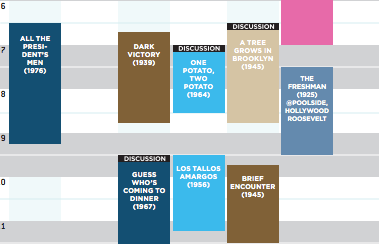
Screen Shot 2016-04-17 at 9.46.16 PM

The festival kicks off at 6:30 in the evening with a gala screening of All the President’s Men. This event is only open only to holders of the higher pass levels, and Backlots’ media pass is not one of those, so I am now free to consider the other options. Upon inspection of the other movies in that time slot, I see that there are several options. Dark Victory is one of my all-time favorites. The story is a five-kleenex one, about a vibrant young woman who is diagnosed with a fatal brain tumor that will make her go blind before she dies. Jam-packed with stars (including Humphrey Bogart trying to speak in an Irish accent, worth the price of admission in itself) and a well-known tearjerker, it is a great opening night pick.

A frequent dilemma at the TCM Classic Film Festival is whether to attend old favorites, or new-to-you movies. Sometimes the choices are easy, sometimes they’re extraordinarily difficult. In this particular time slot, the only thing getting in my way of attending Dark Victory is the screening of Harold Lloyd’s The Freshman at the Roosevelt Hotel pool, at which there will be an interesting new approach to silent film accompaniment–a new score played by a modern DJ. Curiosity may get the better of me, and my plans to see Dark Victory may be foiled by a modern novelty.

MY CHOICE: Dark Victory

MY MIND MIGHT BE CHANGED BY: The Freshman

https://www.youtube.com/watch?v=0ZeIpxAyaxs

The next time slot begins at 9:30. Guess Who’s Coming To Dinner, the quiet but strong 1967 piece about interracial marriage has been a favorite since I was 10 years old. As Spencer Tracy’s final film and one of Katharine Hepburn’s most nuanced performances, it stands as a cinematic monument not only for the commentary it makes on civil rights-era America, but also to the brilliance of two of Hollywood’s finest actors. In attendance will be Katharine Houghton, Katharine Hepburn’s real-life niece who plays her daughter in the movie.

Brief Encounter is considered by many to be “the best movie you’ve never heard of.” It tells the story of two strangers who meet in a train station, and begin a quick and torrid love affair. The screenplay was based on a play by Noel Coward, and the action is directed by David Lean. When it was announced in the schedule, the internet went abuzz with excitement, as the movie rarely gets the attention it deserves. For that reason, I think I will attend the screening of Brief Encounter in this time slot.

MY CHOICE: Brief Encounter

MY MIND MIGHT BE CHANGED BY: Guess Who’s Coming To Dinner.

Be sure to tune in tomorrow for Friday’s picks!

Backlots at the TCM Classic Film Festival 2016

TCMFF2016Art1

Earlier this week, I received confirmation that Backlots will once again be covering the TCM Classic Film Festival in late April. This will be my 4th year at the festival, and I couldn’t be happier and more honored to be taking part in this special event.

The TCM Classic Film Festival is now in its 7th year, and has grown to become perhaps the biggest film festival in the world that focuses solely on classics. Classic film fans the world over flock to Hollywood during the week of the festival (generally in mid- to late April), to see their favorite films on the big screen, preview state-of-the-art restorations, and attend discussions and interviews with leading figures of the film world.

25064_001_4557_CC1

Sophia Loren at the 2015 TCM Classic Film Festival, interviewed by her son, Edoardo Ponti.

Holders of the highest pass level are given the red carpet treatment, quite literally, as they walk the red carpet alongside the stars, filmmakers, and other Hollywood celebrities into the highly coveted opening night movie. In previous years, the opening night movie has been a Technicolor musical, usually celebrating a significant anniversary in the festival year, shown with members of the cast in attendance. This year marks the 60th anniversary of the release of The King and I, a movie that fits all the criteria for TCM’s opening night traditions, and early talk among film fans online was that this would likely open the festival, possibly with Rita Moreno in attendance.

However, TCM issued a surprise announcement a few weeks ago, shaking up our expectations for the opening night movie, and announced that All the President’s Men (1976) would open the festival. This being an election year, it is a meaningful choice and we now have new criteria by which to predict future opening night movies.

As for The King and I, that movie will be shown during the festival proper, along with such draws as The Song of Bernadette (1943), A Tree Grows in Brooklyn (1945), Charlie Chaplin’s The Kid (1921) and a special presentation of the silent masterpiece The Passion of Joan of Arc (1928), among many others.

The_Passion_of_Joan_of_Arc_(1928)_English_Poster

One of the highlights of the TCM Festival for fans is the appearances made by classic Hollywood legends. Every year, a major classic film star makes an appearance and has an interview, often with Robert Osborne. Last year, the guest was Sophia Loren, and this year the festival continues with the Italian theme with the appearance of Gina Lollobrigida, who will present two of her films, her Golden Globe-nominated Buona Sera, Mrs. Campbell (1968) and Trapeze (1956).

Another event that draws a crowd is the yearly footprint ceremony at Grauman’s Chinese Theatre  (now officially TCL Chinese Theatre–but always Grauman’s to classic film fans). In 2016, the honors will go to Francis Ford Coppola, who will place his hand and footprints in the famed forecourt of Grauman’s Chinese Theatre in front of a mass of fans and press. This is often the highlight of the festival, and festivalgoers often start lining up early in the morning just to secure a spot.

It promises to be a fun year. If you would like to attend the festival, there are still limited passes available. Go to http://www.tcm.com/festival and I hope to see you there!
TCM Classic Film Festival Day 3: WHY BE GOOD? 42nd STREET, EARTHQUAKE!

Day 3 was one filled with favorites and laughs. I started off the day with Why Be Good? (1929), a movie I had seen a few months ago when a new restoration was screened at the Los Angeles County Museum of Art. This same restoration was shown here, and I loved the movie so much the first time that I had to see it again.


The plot of the movie centers around a young girl who falls in love with a wealthy banker’s son, but has to prove that she’s a “good girl” before his father will allow him to date her. The premise sounds contrived, but in reality the film is unique and refreshingly feminist in many spots, with lines that resonate with much of feminist thought today. Colleen Moore is as cute as can be, with big, expressive eyes and movements that radiate the jazz age. It was great fun to see it screened at the festival, and I’m happy that this sweet film is getting the attention it deserves.

Next up was 42nd Street (1933), a personal favorite. Featuring much of the same cast as the seminal Golddiggers of 1933, what this movie lacks in originality it makes up for tenfold with a spectacular cast and Busby Berkeley’s creative musical numbers. Ruby Keeler is a delight as always, and the title number is one of the first real ballet sequences within a film that tells its own story within the film. The famous ballet sequences in An American in Paris and Singin’ In the Rain followed 42nd Street‘s lead in creating a veritable “show within a show,” but 42nd Street takes it one step further–the title number is indeed a story within a story within a story. Take a look:

42nd Street and Golddiggers of 1933 are hallmarks of the pre-Code era, and are extremely popular with the TCM Festival crowd, yet pre-Codes are often put in the smaller theaters and easily sell out. My dream is to one day see a pre-Code programmed at Grauman’s Chinese Theater, where it will not only look beautiful but also bring a lot of excitement to the festival-going crowd. I would have loved to have seen Ruby Keeler on that giant screen!

I had a large break in my schedule on Day 3, during which I relaxed with friends and got ready for the evening screening, Earthquake!, poolside at the Roosevelt Hotel. A Q&A with Richard Roundtree preceded the film, and then we were treated to one of the most fabulously low-budget movies I have ever seen. The inspiration for future disaster films such as the Airport movies and the spoof Airplane!Earthquake! stars Charlton Heston and Ava Gardner (who hilariously insisted on doing her own stunts) and focuses on a disastrous earthquake in Los Angeles, ultimately destroying the city. Its low-budget special effects left the audience in stitches, and satisfied my frequent craving for camp film. I left with a pain in my stomach from laughing so hard. Thanks, Earthquake!

Day 4 tomorrow. See you then!

TCM Classic Film Festival Day 2: The Dawn of Technicolor, STEAMBOAT BILL JR., REBECCA, BOOM!

Dear readers, I’m usually so good about posting right after festival events, but after several late nights, I needed some sleep. The festival is now over, and I’m getting back into the swing of things. I apologize for the delay!

Day 2 was a jam-packed one at the TCM Classic Film Festival, the first day of the festival with a full docket of programming. I started off the day with a beautiful presentation called The Dawn of Technicolor, based on the new book by David Pierce and James Layton. Pierce and Layton were there discussing the facets of early Technicolor, and the differences between the two-strip Technicolor process and the much better-known three-strip process, as seen in movies like The Wizard of Oz. It was a fascinating discussion, touching on such concepts as lighting techniques for early Technicolor and difficulties in getting certain colors to register (blue was especially difficult), and Pierce and Layton showed the audience clips of very early Technicolor musicals that were a delight.

Since many of the early Technicolor clips that the audience saw yesterday are extremely rare, I will instead post here two clips that demonstrate the two-strip process and the three-strip process, respectively.

This is the “Tell Me, Pretty Maiden” number from The Florodora Girl. Pierce and Layton noted that, in addition to the difficulty in photographing blue tints, yellow tints were next to non-existent in the two-strip Technicolor process. The focus was on reds and greens, which came out in beautiful shades and this lends itself to the signature look of two-strip Technicolor.

You can see the difference between two-strip and three-strip Technicolor by looking at this beautiful clip, in which all the colors of the rainbow are represented as Dorothy goes over it. By 1939, three-strip Technicolor had all but replaced two-strip as the color standard in film, though color wouldn’t become industry standard until several decades later.

A wonderful and informative presentation, that I would recommend to anyone interested in film!

Next I went to Club TCM to hear legendary film historian Jeanine Basinger speak about portrayals of history in the movies. Professor Basinger is the head of the film department at Wesleyan University, and founder of the renowned film library there, as well as one of the most respected figures in the world of film studies. She discussed the way history has been portrayed in Hollywood and what devices filmmakers use when trying to depict events for which we may not have all the information, or when trying to make history interesting and screen-worthy. One thing she talked about was what she calls the “letters of transit” device, referring to the plot of Casablanca that hinges on Victor Laszlo getting letters of transit out of Morocco when letters of transit did not exist in reality. The filmmakers used this device to add spice to the story, and it worked brilliantly. No one seems to care that letters of transit did not exist in reality, they existed in Casablanca and that seems to be enough. It was a great discussion, and hearing Professor Basinger speak is something that all students and scholars of film should be able to do.

A scene about “letters of transit” in Casablanca (1942).

Next up was the Buster Keaton classic Steamboat Bill, Jr., complete with a new score by silent composer Carl Davis, who also conducted the orchestra. It was a brilliant score and great fun to watch. Buster Keaton is typically hilarious and, naturally, gets into some real shenanigans. This is the movie with what is probably Buster Keaton’s most famous scene:

Steamboat Bill, Jr. was made in 1928, when Buster Keaton was at the peak of his career. Unfortunately, it was also right before his downfall, with contract switches and the coming of sound essentially putting a halt to what was one of the most glorious careers of the silent era. It was interesting to watch it in this context, as one of the great silent comedians was at the top of the world…only to fall off shortly thereafter.

A personal favorite, Rebecca, came next. I have written about this movie many times before, but it’s such a masterpiece of lighting, cinematography, and acting that I see something new every time. This time, I noticed that director Alfred Hitchcock uses very long lines in his camerawork, perhaps to emphasize the tallness of the estate Manderley. Nearly all the doorways and windows are structured to draw the eyes upward, and even the furniture and shadows are designed to guide the eyes up. Take a look at this scene, and notice the narrow, vertical light on the wall from the window, as well as the narrow structure of the window itself:

It is said that nothing in Hitchcock is accidental. If that adage holds true, this is a genius work of subtlety on his part.

The festival this year features an unusually high number of films that one can read through a queer lens–and Rebecca is certainly one of them. The relationship between the evil Mrs. Danvers and the late Rebecca de Winter can be inferred very clearly in this movie, as evidenced by this scene. Though filmmakers were kept from stating the relationship explicitly, the eerie scenes with Mrs. Danvers in Rebecca’s room do more for a queer reading of the film than anything that could have been stated explicitly.

The next movie, Boom!, is one that I have seen before on the big screen and it is a movie so bad that it’s a lot of fun to watch. I can barely tell you the plot, except that it takes place on a Greek island and Elizabeth Taylor is a drug addict who is visited by death, played by Richard Burton. It features monstrously terrible and nonsensical dialogue, and my friends and I were laughing the whole time. It’s the perfect midnight screening.

I’ll update about Day 3 tomorrow!

TCM CLASSIC FILM FESTIVAL DAY 1: Meet TCM, So You Think You Know Movies?, QUEEN CHRISTINA, My Man Godfrey

Exhausted but beyond excited, I arrived in Los Angeles last night for the kickoff of the 2015 TCM Classic Film Festival, taking place in Hollywood this weekend for its sixth year. The theme this year is “History According to the Movies,” which leaves plenty of room for interpretation…and controversial programming. When the full schedule of the TCM Classic Film Festival was announced several weeks ago, the internet started buzzing. Bloggers and film fans began asking questions–why were there so many modern movies scheduled?  Is TCM changing direction? Today at the annual Meet TCM panel prior to the official start of the festival, a film fan brought the question to the attention of Charlie Tabesh, head of programming at the channel. Tabesh answered that the modern programming of this year’s festival fits into the theme of “History According to the Movies,” and TCM has always operated according to themes. If the channel were paying tribute to the career of Katharine Hepburn, Tabesh continued, they would show not only Hepburn’s admired early work, but also her last film, Love Affair, made in the 1990s and generally acknowledged to be far from great.

MORNING GLORY (top), which won Katharine Hepburn her first Oscar, would get equal attention with LOVE AFFAIR (bottom) on TCM in a tribute to Hepburn’s career.

Much of the discussion centered around the fact that the festival is screening Out of Sight, a film from 1998 edited by Anne V. Coates. Having edited Lawrence of Arabia, Murder on the Orient Express, and several other noteworthy titles that firmly establish her in the landscape of classic Hollywood, Coates is a deserved honoree at the festival this year for her achievements in editing and, Tabesh said, she requested that the festival screen Out of Sight for a look into what editing looks like today. A look into editing from a woman in the business for over 50 years is a remarkable gift to festival goers. As there is no set definition of “classic,” TCM is obligated to identify and adhere to what they as a channel and a brand consider to be classic cinema, and for Tabesh, classic film has no expiration date. This is clear in TCM’s choice of programming on the channel as well as at the festival–for an in-depth discussion of TCM’s programming choices and what makes a classic, see my article TCM Programming and the Definition of Classic Film. After a short break for lunch, which I spent with my friend Spencer and fellow blogger Kristen at Journeys in Classic Film, festivalgoers convened again at Club TCM for an exciting round of So You Think You Know Movies?, TCM’s difficult and rapid-fire trivia competition. So You Think You Know Movies? is designed for the trivia master, with extremely obscure questions about film history and culture. Trivia is my strong suit, and our team did well, but ultimately a team of 8 called The Flickers won the grand prize, and deservedly so. When quizzed on the spot after the game, they knew almost all the answers to the supplementary questions, which were just as difficult as in the regular game.

As those with high-level passes got ready for the big opening night screening of The Sound of Music, I had a few hours to relax wherein I caught up on some preliminary blogging until 5:30, when I decided it was time to get in line for Queen Christina. A word about lines at the festival–passholders must line up in order to gain entrance to a movie, and entrance is first come, first served. Needless to say, lines queue up quickly. As I deduced that Queen Christina, a hugely popular movie with two hugely popular stars (Greta Garbo and John Gilbert), I gave myself an hour to play it safe in case it sold out. The movie began at 6:30, and the audience was treated to two wonderful things–first, an introduction by noted film historian Cari Beauchamp, and then a rare lighting test that showed Greta Garbo acting in a casual manner.  Cari Beauchamp’s talk included details about Greta Garbo’s personal life (“Ernst Lubitsch said that Greta Garbo was the most uninhibited people he knew,” she related), and about her acting in general, in this film and beyond. It was a great introduction to a fascinating film. Queen Christina is one of the last great hurrahs of the days before the full implementation of the Production Code. It tells the true story of Sweden’s queen Christina, who lived in the mid-1600s and who many historians now believe was either transgender or intersex. The film hints gingerly at these subjects, though even in the days before the Production Code, the industry was bound by what it thought the public would accept, so a full examination of a transgender person was out of the question. However, in scenes like these, director Rouben Mamoulian gives the audience an idea of what it is he’s trying to get across.

For a full analysis of the LGBT implications of Queen Christina, feel free to check out my post on the subject for the Queer Film Blogathon in 2011.

Next up was one of my favorites, a showing of the screwball classic My Man Godfrey in a theater that was packed to the gills with enthusiastic fans. This is one that I have seen on the big screen several times, but always seem to come back for more whenever it is showing. One of the zaniest screwball comedies of all time, it is a masterpiece of ensemble acting and director Gregory La Cava directs Carole Lombard and William Powell to perfection. Alice Brady, playing the eccentric and off-the-wall mother, was robbed of an Oscar  in 1936, though the film itself received 6 Oscar nominations including Alice Brady for Best Supporting Actress, and remains one of the best-loved screwballs among devotees of classic cinema. We have a big day tomorrow, so I’d better get to bed. See you tomorrow night!

TCM CLASSIC FILM FESTIVAL UPDATE: Get well soon, Robert Osborne!

The TCM Classic Film Festival, going on its sixth consecutive year later this month, is known for its devoted following and a large, dedicated staff that keeps a monumental event running seamlessly from start to finish. Classic Hollywood guests, behind-the-scenes film programmers and prominent on-air talent bring life to the festival, giving it the vitality that has come to define this event over these past six years. This year, a major component of past festivals will be missing. The legendary Robert Osborne, the face of TCM and a tour-de-force within the film industry, is undergoing surgery the week of the festival and will be unable to appear at the event.

Osborne, approaching his 83rd birthday, still plays an essential and active role in turning the wheels that keep TCM operating. Though he has increasingly delegated hosting duties to Ben Mankiewicz in recent months, he remains a veritable powerhouse on the channel and has achieved the status of a near-deity within the community of classic film aficionados. He will be greatly missed at the festival this year, and Backlots certainly wishes him a speedy recovery.

I have met Robert Osborne a number of times, but I must say that my favorite moment with him was when he asked about my favorite film at the festival. This was a year when they had shown Cover Girl, a movie that I knew was a mutual favorite. We discussed Cover Girl and Rita Hayworth for several minutes, and I walked away thinking “I just talked to Robert Osborne about Rita Hayworth. What a story I have!” So Robert, here’s to your successful surgery–and make way for tomorrow!

The TCM Festival Schedule is Here!

A few days ago TCM released the final schedule of the TCM Classic Film Festival, and there has been a lot of chatter about it already. Much of the discussion has centered around an idea that I have often brought up on this blog, a point of contention among classic film fans–the definition of “classic film” and what constitutes a classic.

This year’s festival features an unusually large number of films from the 1970s and beyond, and for some die-hard TCM fans this has proven a bitter pill to swallow. Many are devoted to films made in the “classical Hollywood era” (an academic designation for films made between 1927 and 1963) and purport that a classic film festival should prioritize films made between the birth of sound on film and the final waning years of the Production Code in order to truly be considered a “classic film festival.”

As I have mentioned before, there is no singular definition for what makes a classic. The term “classic film” is as diverse as the movies themselves, and the vast majority of film fans would not be able to give you a clear-cut definition of what the term means to them–“I know a classic when I see one” is commonly heard among film devotees, perpetuating the enigma of the concept. For me, though I am unabashedly a devotee of the classical Hollywood era, I am familiar with the difficulty of programming a classic film festival that is unbiased and fair to people with varied definitions of “classic,” and trying to make as many attendees happy as possible.

On my part, I have grown to truly love the TCM Festival schedule this year and have already mapped out my timetable. Go to filmfestival.tcm.com for the full schedule, but here is what you may expect from Backlots this year:

THURSDAY:

QUEEN CHRISTINA

MY MAN GODFREY

Friday:

INHERIT THE WIND

THE PROUD REBEL/THE PURPLE ROSE OF CAIRO (I’m loyal to my Olivia, but man, Purple Rose of Cairo…and on the big screen…I’m torn on this one.)

LIMELIGHT

STEAMBOAT BILL, JR.

REBECCA

BOOM! (I’ll have to leave Rebecca early, but there is no freaking way I’m missing the camp factor that is Boom!)

Saturday:

WHY BE GOOD? (I saw this a few months ago and it is so fantastic. Viva Colleen Moore!)

42nd STREET

THE MIRACLE WORKER

Hollywood Home Movies

ADAM’S RIB

Sunday:

THE HUNCHBACK OF NOTRE DAME

GUNGA DIN/THE DIARY OF ANNE FRANK (I’ll probably decide the day of)

THE PHILADELPHIA STORY/THE CHILDREN’S HOUR/JUDGMENT AT NUREMBERG

KISS ME, KATE

Backlots at the 2015 TCM Classic Film Festival

A few days ago, I received confirmation that Backlots will be covering the TCM Classic Film Festival in Hollywood, as a member of the press for the third year in a row.

Over the past 6 years of its existence, the TCM Classic Film Festival has become synonymous with class and sophistication, and has provided a haven and meeting place for classic film lovers from all over the world. Featuring a plethora of classic film related events to augment the film showings, and world-class guests from all areas of the entertainment world, the TCM Classic Film Festival is truly not to be missed.

Though the full schedule for this year is yet to be released, the theme of “History According to Hollywood” has yielded such exciting programming choices as Gunga Din, Dr. Zhivago, The Hunchback of Notre Dame, and 1776.

Stay tuned, as I will be posting exciting updates to the schedule in these weeks leading up to the festival. In the meantime, if you are in the Los Angeles area, be sure to go to http://www.tcm.com/festival to learn more about the pass options and how to attend. I look forward to seeing you there!

Live From the TCM Classic Film Festival Day 4: 5TH AVE GIRL (1939), EMPLOYEES’ ENTRANCE (1933), THE LADY FROM SHANGHAI (1947), Closing Night Party

The final day of the TCM Classic Film Festival was by far the lightest in terms of screenings, but I also found it to be among the most enjoyable. One of the wonderful things about this festival, speaking for those of us who write about classic film, is that there is never any shortage of community here. The classic film writers’ world is quite a tight-knit one, and I found myself constantly surrounded with fellow bloggers and friends comparing schedules and trying to coordinate screenings, chatting in line about Barbara Stanwyck and Irene Dunne, and updating each other on what’s new on our blogs. The TCM Classic Film Festival is known for valuing bloggers, so many of us in the online classic film community received credentials this year and it was nice to put faces to names, and reunite with those I saw last year.

The first showing today was a repeat, a movie that had sold out in a previous time slot and they scheduled it in another to get more people in. It was a Ginger Rogers movie called 5th Ave Girl, directed by Gregory La Cava (of My Man Godfrey fame) and co-starring Walter Connolly, telling a story about a young woman who is hired by a lonely man to live in his house with his wife and children, and make his life a little less boring. It was not, in my opinion, a hugely successful effort, but it is a feel-good movie and it showcases Ginger’s ability to do some pretty top-notch deadpan comedy.

Interestingly, it was made in 1939, the year known as “the best year for movies,” alongside Gone With the Wind, The Wizard of Oz, Mr. Smith Goes to Washington, and Stagecoach. But in those days, studios were an essential factory line for movies, and it’s sobering to think that even in a year like 1939, the sheer amount of movies coming out of Hollywood ensures some troublesome ones. Though it was not a bad movie, it was rather slow with a bit of a loose plot that I found tedious. It is one of the few films I’ve seen at festival that I haven’t particularly liked.

Loretta Young and Walter William in EMPLOYEES’ ENTRANCE.

Next up was Employees’ Entrance, a 1933 film about a corrupt and evil boss that uses people and then throws them out. It stars Warren William as the evil boss and a young Loretta Young as the wife of his next-in-command. The boss is such a tyrant that he won’t let his employees get married, so the two have to keep their marriage secret, and the movie is about their lives and those of everybody else who is privy to the antics of this deranged person.

One of the highlights of the Employees’ Entrance screening was an informative and entertaining lecture about the pre-Code era from the president of the Film Forum in New York City, Bruce Goldstein. Goldstein gave a witty and fun overview on what the pre-Code era meant for Hollywood, and referenced several strong pre-Code films and the strong women characters that are indicative of that era.

As my readers know, I have a real fascination with the pre-Code era and I have just learned that TCM will soon be having a tribute to the women of pre-Code Hollywood, who make up some of the most exciting characters ever to be seen onscreen. Stay tuned for more details as they become available, as I will be doing a series on Backlots related to this.

Rita Hayworth and Orson Welles in THE LADY FROM SHANGHAI (1947).

My final screening of the festival was a movie that I have had the privilege of seeing before on the big screen, but this was a world premiere presentation of a new digital restoration that I was anxious to see. It was The Lady From Shanghai, a movie that presenter Eddie Muller called “noir poetry,” directed by Orson Welles and starring his recently separated wife Rita Hayworth opposite himself. The movie is notable for the brilliant “hall of mirrors” scene, and for the surprise of seeing the beautiful Rita Hayworth with short blonde hair–as well as the magnificent directing of Welles and his innovations in cinematic technique. The plot is a bit muddy, but in this case it doesn’t much matter because the focus is primarily on the visuals and Welles’ beautiful manipulation of the camera.

The restoration was gorgeous. There are some mixed feelings within the classic film community about digital restorations, and in my opinion it’s possible for a film to be “over-restored.” A few years ago I had the privilege of seeing a new digitally restored print of Pabst’s Pandora’s Box, one that was hailed as being such a superb restoration that it was near flawless. And it was a flawless restoration. To my mind, too much so. It looked computerized in how perfect it was, and it didn’t look like it came from film stock. It turned me off a little. But this one was simply a pristine clean-up–it was still clear that this was a movie that had been shot on film, and it was just the restoration that was done digitally. I enjoyed it quite a lot.

And that was the end of the TCM Classic Film Festival. I spent the rest of the evening at the closing night party, talking to friends and preparing to miss them until next year. But the good news is that we all know each other online, so it’s only goodbye to faces–not goodbye to people. Thank goodness for the internet, keeping us all connected though miles away.

A huge thank you to TCM for allowing me to attend this festival, to Chelsea Barredo for all her help with the red carpet credential, and to all the wonderful people I met and reconnected with this year. Here’s to the next one!