And so starts Annie Hall, Woody Allen’s classic examination of love in the modern world.
I consider this to be his masterpiece–a very funny, smart, and often poignant look at modern relationships, from the perspective of a neurotic New Yorker. This movie has been a part of my life for a very long time, lines from it have been appropriated by my family and I know just about every scene by heart. Coming from a rather neurotic Jewish family myself, the main character is essentially a composite of every person in my family. And as such it is very much beloved.
The story concerns itself with Alvie Singer, a comedian who insists that he grew up in Brooklyn underneath the roller coaster, though his analyst says he exaggerates his childhood memories. He recalls being neurotic as a child about the universe expanding:
All this serves to strengthen Alvie’s character for the duration of the movie. Despite his neuroses (or perhaps because of them), Alvie is a VERY strong and well-developed character. In fact, I believe that the character development in this movie, of all the characters, is perhaps one of the best in the history of film. Even the minor characters that only appear in one scene (Annie’s grandmother, for example, who Alvie refers to as a “classic Jew-hater”) have a real biography and history behind them. The scenes with Alvie’s other relationship partners are also wonderful examples of this:
Carol Kane as “Allison Porchnik”
Shelley Duvall as “Pam”
The character of Annie Hall herself is established very skillfully right away, partly due to Allen’s brilliant writing, partly to the masterful direction and I think the majority is due to Diane Keaton’s completely natural ability in the character of Annie. It is said that Annie Hall was based on Keaton herself–she had dated Woody Allen in the early 1970’s, and if one is aware that her original last name was Hall and she was called “Annie” as a child, it certainly seems more than likely.
The story is told in a series of flashbacks, and the flashback sequence where Alvie meets Annie for the first time is a true testament to Keaton’s brilliance in capturing the character:
From this scene, we begin to see the relationship between Annie and Alvie develop, through a series of revelatory scenes that connect the two characters psychologically and develop their characters as they relate to each other. Their relationship is more one of “opposites attract” than a true kinship, and their status as an “unlikely couple” gives the film much of its quirky charm.
Another recurring theme in this movie is intellectualism, with an almost incessant dropping of names and references to major figures in literature, popular culture, and psychology. In a classic scene, at the very beginning of the film, we really see what intellect means to Alvie, for better or for worse:
Alvie, as we are reminded multiple times throughout the film, has been in therapy for 15 years and wants Annie to go, too. He pays for her sessions, and this concept of their both being in therapy paves the way for lots of intellectual discussions about the nature of psychology. Alvie seems very concerned about Annie and her lack of depth, as he perceives it, and he tries to get Annie to expand her intellectual horizons by going to adult education courses. When she does, and begins to crush on her professor, Alvie ridicules intellectualism in general because it interferes with his own intentions with Annie.
The whole film is really a game, playing with the audience in regard to the characters, their insecurities, and their general humanity. It lacks a traditional ending, with Allen preferring, I think, to keep the movie entirely real and more like an examination of characters rather than just a piece of entertainment. It certainly succeeds, and it won Best Actress (Diane Keaton), Best Director, Best Screenplay, and Best Picture at the 1977 Oscars.
Here is Diane Keaton giving her Oscar speech:
Annie Hall is a favorite of film fans and is widely available. You might have a tougher time finding it at the huge movie outlets, as it’s still considered an offbeat movie appealing only to certain audiences (because it’s so intellectual), but Netflix has it, and most independent movie outlets have it, and you generally shouldn’t have too much trouble finding it at all. It’s VERY funny, very quirky, the writing is impeccable and it is a truly joyful movie experience.
Well, no one saw this coming, did they? Those of you who know me know that The Wizard of Oz (or, more accurately, Judy Garland) is very special to me. When I learned there was to be a 1939 blogathon through YAM, I actually got a bit concerned because I didn’t know if my computer battery would last for an entire Wizard of Oz post and I thought of profiling other movies. But it would be sacrilege for me not to, so I am attempting it now.
The Wizard of Oz has been a part of my life since the age of 2. I watched it, wide-eyed, with my parents and apparently (though I don’t remember) wasn’t scared of anything and was more interested in watching the pretty colors and hearing “Over the Rainbow.” Two years later, when my grandmother showed me “Meet Me In St. Louis,” I became a full-fledged Judy Garland fan and have never turned back. I regularly attend the Judy Garland Festival in Grand Rapids, MN (about 3 hours plane ride from my home), and at the age of 13 I won a trivia contest there and was interviewed for NPR. Yeah. It’s pretty serious. Knowing that background, you can understand how The Wizard of Oz might be very important to me. Judy Garland’s signature film (though we’ll go into that later), and one that stayed with her right up until her very last concert, it has a place in the hearts and minds of everyone, whether they like it or not. It has had a place in our collective consciousness for 3 generations, and it showing no signs of stopping for the next, especially with the multi-annual showings on TBS that make it even more accessible for the younger generation. Its themes are timeless, and it has something for everyone, at every age.
In the interest of space and readability, I am going to refrain from doing too much analysis of the movie here. I will focus on biographical aspects of the actors, and some trivia–I could write for hours on end about this movie (and I have–I once wrote a paper on the themes of transference from child to adult in The Wizard of Oz and it was about 25 pages long), but for the purposes of this blog and this blogathon, I’m keeping myself back a bit in the interest of space and readability.
I’ll start with the casting and general information about the actors and their roles in this movie: The Wicked Witch of the West was played by Margaret Hamilton, who in my opinion deserved to win Best Actress (or at least Best Supporting Actress) for this movie. A former housewife turned movie actress to support her family, she was well-loved and a sweet person by all accounts. To demonstrate the kind of person she was, it is sufficient to say that throughout her life, both before and after her acting career, she taught Sunday School and kindergarten. After Oz, Hamilton continued her career in radio and television, before retiring in the late 1970s. She died in 1985.
Hamilton is often remembered for her commercials for Maxwell House coffee:
Another reason I think she should have gotten some kind of award for this role is the scene where she disappears after the famous line “I’ll get you, my pretty, and your little dog too!” For this scene, Hamilton was to step onto a hidden elevator, and be carried down under the scenery. During a rehearsal, when she stepped on the elevator door, there was an electrical malfunction and since Hamilton’s makeup was copper-toned, she ended up with horrendous burns on her face and had to be taken out of the picture for a number of weeks. If that doesn’t put you in the running for an Oscar, I don’t know what does.
The lovely Jack Haley was not the first choice for the Tin Man. The original choice was actually Ray Bolger, who ended up playing the Scarecrow. Bolger expressed his preference for the Scarecrow due to his idol, Fred Stone, having played the role on the stage, and an actor by the name of Buddy Ebsen (Beverly Hillbillies, anyone?), who was originally slated to play the Scarecrow, was switched to the Tin Man. He was all set to do the picture until the aluminum powder in his makeup got into his lungs and lay him up in the hospital, putting him out of the picture.
Are you sensing a theme? Forget “Poltergeist,” I swear this film had a curse.
They brought in Jack Haley, a vaudeville actor who had done a number of musical pictures in the early 1930’s, to replace Ebsen, and the brilliant men in the makeup department decided to change aluminum powder to aluminum paste, thereby rendering Haley presumably safe. Phew. But then he got an eye infection. See what I mean? Haley’s work in Oz was his true masterpiece, and though he continued to act in pictures and in television and radio, he never quite matched what he did with Oz. He died in 1979.
Ray Bolger’s preference for the Scarecrow, as I mentioned in the previous paragraph, was due to his idol, Fred Stone, having played the role on the stage. A brilliant dancer, he had been on Broadway in the early 1930’s, and signed with MGM in 1936. Prior to making The Wizard of Oz, and he had portrayed himself in The Great Ziegfeld, and in 1946 Bolger went on to do another film with Judy Garland, “The Harvey Girls,” and also made an appearance on Judy’s television series in 1963. He was the last surviving main cast member of Oz, until his death in 1987.
Bert Lahr was a successful actor in vaudeville and on the stage, who had worked with the great British comedienne Beatrice Lillie in The Show is On. He was chosen for this role early on in the film’s planning stages, likely due to his lion-like looks and charm. His costume was composed of real lion fur and was said to weigh upwards of 50 pounds, prompting him to complain outwardly of the heat under the hot MGM lights. He continued to act on the stage through the 1960’s, participating notably a rather disastrous run of Waiting for Godot in 1956, and passed away due to cancer in 1967.
A trivia bit about the scene with the Cowardly Lion: during rehearsals, Judy, then 16, was known for bursting into adolescent giggles. At one particular one, when the lion makes his first entrance and Judy slaps him on the nose, she couldn’t get a take without laughing. Apparently, Victor Fleming came down and, in an event that could never happen today without Fleming getting indicted for child abuse, slapped Judy across the face to get her to stop laughing. During the next take, Judy did not outwardly laugh, but you can see that Fleming had not completely won–Judy pushes Toto in front of her face to cover a visible smile. Watch for it.
Billie Burke, who had been married to Florenz Ziegfeld until his death in 1932, seemed the perfect choice for the gentle, slightly dotty Glinda, the Good Witch of the North. After a wonderful career on Broadway, she had played very successfully opposite Jean Harlow in 1933’s “Dinner at Eight,” and had made “Everybody Sing” with Judy Garland in 1938 (which, by the way, is one of my favorites). Typically playing dizzy, slightly neurotic women, she was nominated for an Oscar in 1938 for Merrily We Live. She made a number of other MGM films and acted on the stage until her retirement in 1960. She died in 1970.
The Munchkins are credited in the film as “The Singer Midgets.” A good portion of the munchkins were indeed performers with Leo Singer, a showman from Vienna who had a troupe of little people working in entertainment there. However, as Singer’s troupe only comprised about 30 little people, MGM hired him to find more to put in the film. There are a grand total of 124 munchkins in the film, along with a few children. 4 of the original little people are still living today, and received a star on the Walk of Fame in 2007.
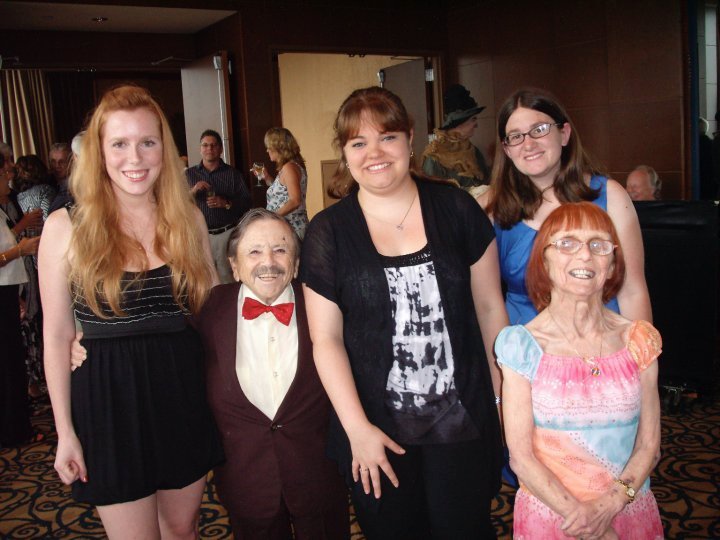
Some friends of mine and me at the Judy Garland Festival, with Jerry Maren (the Lollipop Kid munchkin) and his wife Elizabeth.
And last but not least…
Judy Garland came from a vaudeville family, making her stage debut at the age of 2 and a half, singing “Jingle Bells” at her father’s theater in Grand Rapids, MN. She continued acting with her sisters in their vaudeville routine until 1935, when she was signed to MGM at the age of 13. She began her MGM career with a number of small films, and then began to take off with a succession of films with Mickey Rooney, namely Thoroughbreds Don’t Cry in 1937 and Love Finds Andy Hardy in 1938. The Wizard of Oz was her 16th film with MGM.
True to Wizard of Oz fashion, Judy was also not the first choice for Dorothy. It’s rather well-known that they originally wanted Shirley Temple, who was quite a bit younger, but 1) Fox wouldn’t let her out of her contract, and 2) she couldn’t sing. The musical arranger at MGM, Roger Edens, had been working with Judy since her arrival at MGM 3 years before, and they had grown quite close. He was overwhelmed by her talent, and he supported her being cast in the role of Dorothy when Shirley Temple was unavailable and unfitting. The Wizard of Oz, and specifically “Over the Rainbow,” stayed with her until her death. It seemed to be an anthem for her, in a life that was often difficult, this song, with its themes of flying over the rainbow to a land “where troubles melt like lemondrops” seems fitting. Here are some other notable clips of her singing “Over the Rainbow throughout her career:
Command Performance for the troops, 1943
Ford Star Jubilee, 1955.
Performing with daughter Liza at the London Palladium, 1964.
And Judy’s very last performance of “Over the Rainbow,” on March 25, 1969 in Copenhagen. She died less than 2 months later.
Shortly after the filming of The Wizard of Oz, MGM began supplying Judy with a cocktail of pills, to put her to sleep, wake her up, and make her lose weight. She soon became addicted, and her addiction to pills is now what many people think of when they think of Judy’s private life. Due to her addiction and growing difficulty with the side effects in her private life, Judy began to become unreliable on the set and was fired from MGM in 1950. She began a very successful concert career, and made a comeback to films with A Star is Born in 1954, which garnered her an Oscar nomination.
Now, people say that The Wizard of Oz is Judy’s signature film. Though I think for most audiences it is, I don’t believe it’s her best. That honor, in my book, would have to go to “A Star is Born,” her comeback in 1954. But “Over the Rainbow” saved her. I don’t think she would have lived as long had she not lived for this song. She died of an accidental Seconal overdose at her home in London, on June 22, 1969, aged 47.
The Wizard of Oz is literally available everywhere. But I would venture to say that there is not one person reading this who has not seen it, multiple times. It is a true institution in this country and the world, and it holds a very important place in the history of film.
Thank you to YAM for hosting this 1939 blogathon, and happy watching!
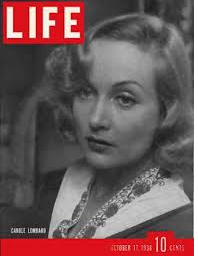
A zany comedy with a script that is so absurd it’s almost surreal, “My Man Godfrey” is one of the films that I think deserves more credit outside the classic film community than it gets. A showcase of the very different comic styles of both Carole Lombard and William Powell, it is, I think, one of the more advanced comedies to come out of the 1930’s.
The story deals with a high society girl, Irene, who plucks a homeless man out of the ash pile to bring to a “scavenger hunt” at a high society party. See what I mean about absurd? The scavenger hunt had as its last requirement the finding of a “forgotten man,” and bringing him to the party, so this girl went down to the ash pile next to the Brooklyn Bridge and found a homeless man.
She wins the prize, much to the chagrin of her sister, who had tried to coerce the homeless man into coming with her first. Irene feels grateful to the homeless man, whose name we have learned is Godfrey, for helping her win the coveted prize, and as thanks, she offers him the position of butler in their house. Neither the sister nor the mother (who is truly nutty, and who had, by the way, had found a goat the scavenger hunt…) approves. He is hired nonetheless by Irene, and begins his work the next morning.
We learn straight away that this family is even more nutty than it seems. The mother has a protégé by the name of Carlo who eats too much and is a drama queen, the mother herself has a tendency to see pixies when she is hungover (which is often), Irene is prone to fake fainting spells when she doesn’t get her way (which Carlo attempts to quell by acting like a gorilla to make her laugh), the older sister is a spoiled brat and the father is on the brink of bankruptcy and bitter about how insane his family is. Godfrey is the only butler who has stayed more than a short period of time, and the father wonders why he decides to stay. His ability to stay with the family makes him suspicious of his actual identity. Irene, naturally, falls in love with him, and this only complicates things for Godfrey.
In fact, we learn that Godfrey is not a homeless man by necessity, but rather by choice. He came from a prominent Boston family, and embittered by society life, he admired the men who lived on nothing and decided to become one of them. The family does not know this, and he does not tell them. That is, until the end, after a series of mishaps ensue (namely the disappearance of the brat sister’s pearl necklace) and…well, I won’t tell you the end.
Carole Lombard is perfect in the role of Irene, with her sweet, eccentric humor, and William Powell plays the straight man very well with most of his humor being in his physical presence. There is one scene where he is simply walking up the stairs, and it is funny as can be. The mother, played by Alice Brady, however, may steal the show away from both of them. Her nuttiness is pretty much the comic center of the movie. Although Alice Brady is perfect, if I were to recast the film with other actors fitting the roles perfectly, I would cast Billie Burke as the mother.
“My Man Godfrey” is brilliantly well-written, on a number of levels. On one level, it is full of zingers and one-liners, many of which are delivered so quickly that it takes a moment to realize what was just said. One of my favorites, between Godfrey and the maid:
GODFREY: May I be frank?
MAID: Is that your name?
GODFREY: I’m Godfrey.
MAID: Oh. Be Frank.
As I mentioned earlier, another aspect of the script is its complete and unapologetic absurdity. When Irene has one of her fake fainting spells, Godfrey puts her in the shower and turns the cold water on to teach her a lesson, and Irene takes this to mean that Godfrey is in love with her. The mother says nothing but things that don’t make any sense, and her reactions to anything negative have to do with how they’re affecting Carlo. Toward the end of the movie, the father finally has enough of Carlo and throws him out the window. If this movie has a fault, it’s that it may be TOO absurd for many people. My personal taste says that nothing is too absurd, but it’s just way over the top and surreal.
The film also ends in a very strange way, leaving the viewer almost feeling like something was intended to be there but never made the final cut. When the film ended the first time I watched it I was very confused–is it really over? It leaves one expecting something more.
My Man Godfrey is not VERY widely available, but you should be able to find it on Netflix. They recently colorized it, and don’t get that version if you can avoid it. The original black and white is always the best option.
Since it was Katharine Hepburn’s birthday on Thursday, May 12, Backlots is acknowledging the occasion with a short biography of the legend, and a celebration of some of her great films and roles.
Born in Hartford, Connecticut on May 12, 1907, Katharine Houghton Hepburn was the second of 6 children born to Thomas Norval Hepburn and Katharine Houghton (yes, she was indeed named after her mother), a progressive couple well-regarded in the Hartford community. A generally happy childhood (marred, however, by the suicide of her older brother Tom, which had a tremendous effect on her throughout her life–she consistently listed her birthday as November 7, which was Tom’s) was followed by attendance at Bryn Mawr college, where she began her theatrical career in university productions. At the age of 25, she made her first onscreen appearance opposite John Barrymore in A Bill of Divorcement (1932), which was followed the next year by Morning Glory (1933) which garnered her the first of her 4 Academy Awards (the other three for Guess Who’s Coming to Dinner (1967) The Lion in Winter (1968, for which she tied with Barbra Streisand in “Funny Girl”) and On Golden Pond (1982). Her career spanned 6 decades, she influenced women’s fashion by popularizing pants, and was a true independent spirit. Her final film was made in 1994, and she remained active well into her final days. Reports say that she continued to ride a bicycle until a hip problem in her late 80’s precluded it, and she was sharp and witty right up until her death in 2003 at the age of 96.
Hepburn was an immensely versatile actress, capable of playing comedy and tragedy with equal skill, as evidenced in part by the screwball comedy Bringing Up Baby (1938) and the royal tragedy Mary of Scotland (1936), along with the hilarious The Philadelphia Story (1940) and the dramatic The Lion in Winter. She is widely considered to be the best actress of all time, and given her track record, Backlots does not dispute it.
Here are some of her best roles. I will start with her Oscar-winning performances:
Morning Glory (1933)
Guess Who’s Coming to Dinner (1967). The young girl at 0:38 is Hepburn’s niece, Katharine Houghton. She plays the main character in this film (although truthfully the movie is centered more on the older generation than the younger, in a commentary about changing times), and though she’s not a great actress, it’s interesting to watch her.
The Lion In Winter (1968). Hepburn plays Eleanor of Aquitaine, opposite Peter O’Toole. Katharine Hepburn was known for not attending the Oscars, and this fact was made clear when she shared the Oscar with Barbra Streisand in 1968, who was all too happy to give her speech while Hepburn did not attend.
On Golden Pond, 1982, opposite Henry Fonda. A lovely performance, also featuring Fonda’s daughter, Jane.
Some other greats:
Bringing Up Baby, 1938. One of my personal favorites. It’s the perfect screwball comedy, and Cary Grant is hilarious as well. Interestingly, shortly after this movie was made, Katharine Hepburn was voted “box office poison,” due to her string of flops, but “Bringing Up Baby”was loved by the critics.
The Philadelphia Story, 1940. Considered to be one of the best Hepburn films, I think she deserved the Oscar that year, though she was up against some tough competition (Joan Fontaine in “Rebecca,” and Ginger Rogers in “Kitty Foyle,” who won). It’s a very dignified comedy, and boasts great performances all around.
Holiday, 1938. Another one of my personal favorites. The story of a young spirited girl stifled by her society family, Hepburn is completely at ease in the role and it’s great fun to watch. Highly recommended.
In addition to the films I’ve profiled here, I would also recommend:
Little Women (1933)
Alice Adams (1935)
Woman of the Year (1942)
Adam’s Rib (1949)
The African Queen (1951)
Suddenly, Last Summer (1959)
Truthfully, I think you can’t go very wrong with Katharine Hepburn. With the exception of Spitfire (1934) and Dragon Seed (1942, where she plays a Chinese person. No, really), I don’t think she really made a completely bad film, even the “string of flops” that earned her the “box office poison” label in the late 1930’s are not so bad.
To close, I leave you with an interview clip that truly shows how much respect she had in the industry. She was known for being assertive and for being a powerful woman, and it shows here. Watch the tech guys as they cave to her every demand. They are just putty in her hands. Katharine Hepburn was more than a legend, she is immortal. Happy birthday, Kate!
My good friend Caroline over at GARBO LAUGHS had the brilliant idea of putting together a blogathon, in which various film blogs are invited to participate in celebrating LGBT presence in films. As a longtime proponent of all things both film and gay, I have decided to have Backlots participate in this blogathon, and the film I have chosen to profile is that always classic, always relevant winner of 1972’s Best Picture, Best Actress, and Best Supporting Actor Oscars (along with 5 more for cinematography, editing, art direction, song, and sound)–the immortal “Cabaret.”
If I could talk about “Cabaret” every week, I would. It is one of my favorite musicals (though as I will discuss later, I call into question its status as a legitimate musical), and it’s really no wonder why. Not only is it a brilliantly constructed film on every level–scenery, costumes, sound, visual effects, acting, singing, dancing, the list goes on and on–but it has the added bonus of having Liza Minnelli (gay icon, reason #1 for my choosing this movie), at the peak of her career, bringing the house down with her powerhouse vocals and dancing ability. Now, I am a big Liza fan. I have seen her in concert 4 times, seen all her movies, and just generally adore her, so when one is a big Liza fan, it generally follows that one is also a big “Cabaret” fan. This movie IS Liza. In fact, at the last concert of hers that I went to, there was a little girl, no more than 6, who was dressed as Sally Bowles from Cabaret. Liza pulled her out of the audience, stood her onstage, and had her take a bow. And everyone knew exactly who she was supposed to be.
The second reason I chose this film for the blogathon is that the male lead (Michael York) is gay. Or, more accurately, “doesn’t sleep with girls.” We become aware of this fact early on in the film, during a scene in which Sally has been trying unsuccessfully to come onto him. She mutters “Maybe you just don’t sleep with girls…” and noting his silence, she changes her tone and says “Oh….you don’t…!” We come to learn that he has slept with three girls, and all 3 times were disastrous, prompting him to forget all about them and switch to men. His sexuality is regarded as simply a fact, and throughout the film it is not called into question too often. There is, however, a very strong chemistry between him and one of the other male characters. It’s misleading (so to speak) to call this second man a lead, because he doesn’t have too much of a role other than as the sometime boy toy of Michael York. As the film progresses, Sally manages to bring him around to women, or more precisely, HER, until she realizes that they both have been sleeping with the same man, this second lead character.
A bit about the history of homosexuality onscreen, as it relates to this movie and its visibility: in the wake of the breakdown of the Hays Code in the late 1960’s, the liberation movement, and the Stonewall Riots, which occurred 3 years before the release of “Cabaret,” gay characters and situations were becoming more and more prominent onscreen. Under the code, the only way for a filmmaker to incorporate a gay character or scene into their film would be to resort to subtle innuendo–films like “Rebecca” (1940, my second choice for this blogathon) succeeded in showing a character’s sexuality by way of very strong innuendo, which proved effective in skillful hands. But more often than not, any sexual content would be nixed by the censorship board and the film would end up on the cutting room floor. Fortunately, the Hays Code broke down in 1968 in favor of the Motion Picture Association of America, which devised the current ratings system. Due to its themes, “Cabaret” is rated R, and my mother wouldn’t let me see it until I was 13. The themes were not so much the problem in my family, but instead the issue was scenes like this:
As the opening credits tell us, the story begins in Berlin in 1931. The Nazis were just coming into power, and the cabaret was the place where people retreated when “life was disappointing.” In the first scene, we are introduced to the character not named in the film, but who is known as “The MC.” Playing him is the brilliant Joel Grey, who came to the film from the Broadway production (interestingly, Grey is one of only three performers to have won a Tony and an Oscar for the same role, along with Rex Harrison and Yul Brynner).
Sally Bowles, an American chorus girl at the cabaret, meets Brian, a young English teacher newly arrived in Berlin, and offers him the spare room in the boarding house where she lives. They promptly become great friends and she attends an English lesson of Brian’s, only to make snarky remarks and teach the two students how to say naughty words. One of the students at the lesson is a young Jewish girl, Natasha, from a prominent Berlin family, and it is obvious that the other student, Fritz, is very taken with her. He ultimately falls in love with her, which proves problematic as the Jews face more and more persecution as the Nazis gain more power. Fritz also has a dark secret of his own, which complicates his feelings even further.
Sally and Brian remain friends, despite Sally’s attempts to make him fall for her, and when Sally meets a new friend named Maximillian, Brian feels left out. Ultimately, however, Brian and Maximillian begin sleeping together, Brian not knowing that Sally was doing the same.
A love triangle emerges, resulting in Sally’s pregnancy. Brian urges her to keep the baby, but Sally decides otherwise and terminates the pregnancy. This ruptures their relationship and the film ends as Sally leaves Brian at the train station, before going back to the cabaret to sing the final song, the triumphant “Cabaret.”
All the action takes place against the backdrop of the Nazis’ ascent to power, juxtaposed with the seemingly oppositional scenes at the cabaret. Interestingly, all the songs in this movie are incidental, performed either at the cabaret or in other appropriate places. The closest we get to an actual impromptu musical sequence is the chilling “Tomorrow Belongs to Me,” performed at a Nazi rally in a park. Here we see Brian and Maximillian courting as the Nazis have a rally in the background.
This is why I hesitate to classify “Cabaret” as a traditional musical. There is no “breaking out into song,” only music in places where it would exist in real life. This is similar to the masterpiece of Liza’s mother, Judy Garland (we’re going to discuss Judy later, because I can’t rein myself in when talking about her), “A Star Is Born,” which prompts similar questions about its status as a musical.
The character of the MC is eerie from the start, and through various songs he performs at the cabaret, we can deduce that he has some questionable leanings.
My general analysis of this film is that the MC represents Nazism itself, permeating all aspects of life and contaminating everything it touches.
After Liza’s triumph in “Cabaret,” the film abruptly ends, with the MC singing “Auf wiedersehn…a bientot…”, bowing, and exiting. The camera then rolls across the audience in a mirror, freezing on a Nazi soldier. The credits roll.
Chilling, right?
Cabaret is available just about everywhere, in movie stores, on Netflix, on TV, it’s very accessible. You won’t have any trouble finding it at all. And please do find it, it’s officially one of the best movies ever made, as the AFI regularly lists it in the top 100 films ever made.
To close, here is a clip of Liza accepting the Oscar for Best Actress of 1972:
Thank you, Caroline, for allowing me the opportunity to write for the Queer film blogathon! Everyone go check out http://garbolaughs.wordpress.com, she is absolutely marvelous.
By the grace of horrendous internet problems in my apartment and having to resort to the free wifi at Parc Monceau (and thus the limited power of my computer battery), I haven’t posted in a long time. This is especially awkward because of all the classic film news that has since happened–in no particular order:
Elizabeth Taylor died.
A tragic moment for the entire industry, and it seems almost futile to try to do a tribute to her because she was SUCH a legend, that it’s impossible to put her into words.
I will, thus, simply compile some of my favorite Elizabeth Taylor moments here. As Elizabeth lived her life with vivacity and endless humor, I celebrate her here with clips that demonstrate how she lived her life. RIP Liz, you were really something.
National Velvet, 1944. This is literally the only clip from National Velvet that I could find on youtube that wasn’t altered in some way. I ADORE this movie, and truthfully this is how I will always remember her. Now that she’s gone, I tear up when I watch it.
Lassie Come Home, 1943. This was the beginning of Elizabeth’s career at MGM, and she costars with Roddy McDowell, who would become her lifelong friend.
Elizabeth’s classic, hilarious performance on “What’s My Line?” in 1954.
Suddenly Last Summer, 1959. One of Elizabeth’s best, very well-known within the classic film community, but I’m not sure how well outside of it. It’s a wonderfully done, brave film for its time, and with marvelous performances by Katharine Hepburn and Montgomery Clift (another lifelong friend of Elizabeth’s), and it’s worth a viewing. TCM shows it from time to time.
The magnificent Cleopatra, 1963, in which she costars with her two-time husband, Richard Burton, and becomes the highest paid actress of her time, garnering a staggering (for the era) 1 million dollars for the role.
Boom!, 1968. PLEASE SEE THIS FILM. It is so rarely seen these days, and it is so campy that it’s absolutely brilliant. Favorite moments: When Elizabeth screams “SHIT on your MOTHER!!!” and does martial arts on the veranda wearing a veritable porcupine chandelier thing on her head. I can’t even. Just see it.
Jumping forward a few years, this is “These Old Broads” (2001) my ALL-TIME FAVORITE made-for-TV movie. Simply put, Elizabeth plays a housebound drunken agent, who represents 3 old movie stars trying to make a comeback. In this clip, Elizabeth’s character talks with Debbie Reynolds’ character about a shared ex-husband, called “Freddie Hunter.” In real life (for those of you living under a classic film rock), after Elizabeth’s husband, Mike Todd, died in a plane crash, Debbie’s husband, Eddie Fisher, left Debbie for Elizabeth. One of the many, many reasons I love this movie. Please, please see it.
Golden Globe Awards, 2000. I don’t think Elizabeth was drunk here, I really think this was just HER. This is one of the great Elizabeth moments out there.
And last, but certainly not least…
RIP Elizabeth. The world is a far less exciting place without you.
As it was raining very hard last night and there was really nothing to do but go to a movie, I decided to go to the classic movie theater and watch the film Leave Her to Heaven, starring Gene Tierney, one of the most spectacularly beautiful actresses ever onscreen who does not get the credit she deserves. I’ve seen the film a number of times before, but never on the big screen, so this was a treat.
Upon entering the theater, I ran into a woman with whom I had befriended at a screening of “His Girl Friday,” the both of us sharing an undying love with Rosalind Russell, and I almost expected to see her here at this showing of Leave Her to Heaven because at our last meeting she expressed a similar admiration for Gene Tierney. I was not disappointed. There she was, and we spent the time before the film discussing the merits of aforementioned actress, with my using the French phrase “super belle” to describe her beauty. She insisted that her beauty was not everything, there was a fire and life to her that superseded her immense looks, and I must say that I agree. Her life was not to be envied–her marriage to designer Oleg Cassini produced a daughter born blind and mentally retarded, due to Gene’s acquisition of German measles while pregnant. She developed bipolar disorder, and spent much of her mid-adult life in and out of mental institutions. She wrote about the experience in her autobiography, “Self Portrait,” a very brave thing to do in that day. My friend and I discussed all that, until the movie started we were both enamored with it.
Ellen Berendt a woman who marries a man she meets on a train, proceeds to become so jealous of everything that comes between them that she will stop at nothing to destroy those things. In a famous scene, she encourages her husband’s teenage, disabled brother to go for a swim in a lake near their house, and *SPOILER ALERT*watches remorselessly as he tires and ultimately drowns. She makes herself fall down a flight of stairs while pregnant so that the unborn child will not come between her and her husband. The film wraps up with an incredible, mind-bending conclusion that you would never expect, so prepare to be surprised.
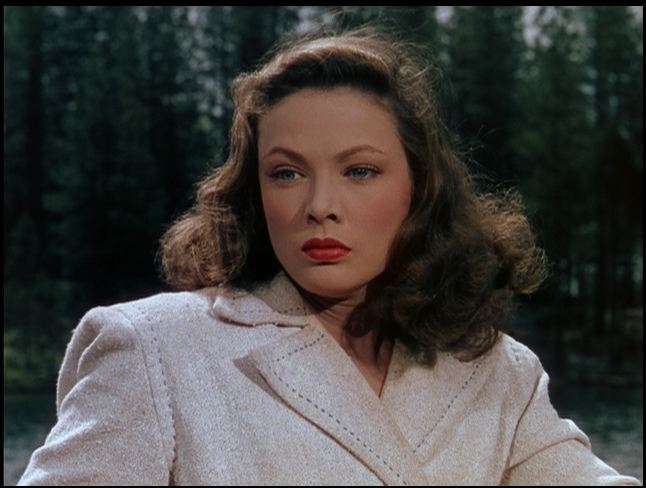
One of the interesting things about this film is that it is shot in a beautiful Technicolor. In a film that deals with murder, treachery, and revenge, the use of color is something very rare indeed during this time period, with the vast majority of these films being in black and white, as clear representatives of the film noir genre. The film itself is very much a part of the genre in its treatment of its subjects, and it is in fact largely classified as a noir film, despite its unusual use of color photography. For a film such as this, whose plot could be considered part of film noir, the use of such tranquil, almost pastel colors has an unusual effect. It sets a scene of calm and serenity, in the place of the traditional stark black and white photography of the genre, which almost makes you feel like something is bound to happen at any moment. Indeed, many of the horrid things that Ellen does in this movie are approached gradually, with a sense of calm and reserve. The scene with the boy in the lake is played with no background music, just the sounds of the water coupled with Tierney’s heartless gaze through her sunglasses. The fact that she wears sunglasses, too, is something quite remarkable to me. It masks any emotion that may be happening behind her eyes, and instead allows the viewer to imagine exactly what she is feeling behind those glasses.
The scene on the lake.
As the scene ends, she suddenly yanks off her glasses, revealing her bright blue eyes in a piercing gaze.
After the fact.
The film also stars the lovely and talented Jeanne Crain, who does quite a good job in the thankless role of younger sister Ruth, with not much action to speak of. Chill Wills has a supporting role, but his character does not advance to plot much at all, nor does the character of Ellen’s mother. Ellen’s father, who is never seen in the film (according to the plot, he died shortly before the main action took place), has more of an impact on the story than any of the other supporting characters, and it seems like much of what happens in terms of the supporting characters is simply filler. Many of them could have been cut out, but then again the more characters there are, the more action happens, no matter how tiny, the more evidence we have to think Ellen is a monster. I must say that one of the benefits of this movie is that it is VERY nice to look at–Cornel Wilde plays the husband, Gene Tierney the main character, and Jeanne Crain the supporting role. In all, this is a movie well-worth seeing. There is a recurring theme of eyes speaking emotions rather than words–in addition to the lake scene, there is one scene toward the end that Cornel Wilde plays completely with his eyes, absolutely brilliantly. He says not a word throughout the entire scene, but his eyes speak it all, which I say is a mark of a great actor.
If you would like to see Leave Her to Heaven, it is readily available on Netflix and in movie stores. It also happens to be shown often on public television.
As promised, I am diving straight into Star of the Week mode. This segment is one where I will be focusing on one of the classic greats, showing you important clips and pictures from their work over the span of a week. This week’s honors go to a 2-time Oscar winner and living Hollywood legend, one of the last great ladies from the Golden Age of Hollywood, Olivia de Havilland.
Olivia de Havilland as Melanie Hamilton, in "Gone With the Wind."
The star of such great films as The Snake Pit (for which she was nominated for an Academy Award) and The Heiress (for which she won), her greatest success and fame was achieved through the epic 1939 masterpiece Gone With the Wind, in which she played the second lead, the demure Melanie Hamilton. She is also known for leading a high profile lawsuit against Warner Brothers in 1943, securing a release from her contract and defining what is currently known as The de Havilland Decision, a ruling that is found in law books today and is studied by those pursuing entertainment law. 5 times nominated for the Academy Award, and twice a winner, Miss de Havilland is truly one of Hollywood’s great leading ladies.
Olivia de Havilland was born in Tokyo, Japan, to British parents Walter and Lilian de Havilland, on July 1, 1916. The following year saw the birth of her sister Joan, later known to Hollywood as the actress Joan Fontaine (whom we may get to on another Star of the Week segment as she is a very fine actress in her own right), and due to the ill health of both toddlers, the family decided to uproot and resettle in the United States. The town that they found was a quaint little village by the name of Saratoga, 45 minutes south of San Francisco, and that is where they stayed. Walter soon returned to Tokyo and his practice as a patent attorney, and by 1925, Walter and Lilian were separated.
The de Havilland family in Tokyo, Japan, with some housemaids. When this picture was taken, her mother was pregnant with Olivia's sister, Joan.
Olivia and Joan were raised by their mother and a very overbearing stepfather by the name of George Fontaine, who ensured that the girls were brought up in a rigid, military fashion. This had a marked effect on both of them, and when Olivia was discovered participating in a play without permission, her stepfather gave her an ultimatum–leave the play, or leave the house. Olivia decided to leave. She was 16.
This did, however, give her the freedom to be in as many plays as she wanted, and soon became the star of such local productions as “Alice in Wonderland” and “A Midsummer Night’s Dream,” receiving accolades from The San Francisco Chronicle for her performance as Alice. She was soon discovered by Max Reinhardt, and declined a scholarship to Mills College to accept the role of Hermia in Reinhardt’s production of “A Midsummer Night’s Dream” at the Hollywood Bowl.
As Alice in Wonderland, 1932.
From there, her career took off. She reprised her role in Reinhardt’s film version of the play, and soon signed a contract to Warner Brothers studios, where she acted in a number of small-budget films before gaining status and acting alongside Bette Davis in It’s Love I’m After and Errol Flynn in The Adventures of Robin Hood, who would become her most frequent co-star and love interest. She describes her first meeting with Errol Flynn, in this adorable interview with the Academy of Achievement in 2006.
It was shortly thereafter that Olivia secured the role as Melanie Hamilton in Gone With the Wind. After convincing Jack Warner to lend her to Selznick Studios for the film, she gave a performance that secured her a nomination for Best Supporting Actress at the 1940 Academy Awards, losing, however, to Hattie McDaniel in the same film. The loss hurt Olivia at the time, but she soon came to realize what an important win that was–McDaniel was the first black actor to win an Academy Award.
Olivia and Hattie McDaniel in a scene from "Gone With the Wind."
Olivia continued to make films for Warner Brothers, notably with Errol Flynn, until 1943, when her contract expired. She was prepared to leave, until Warner Brothers told her that she had to stay on for time spent on suspension. Olivia, unsatisfied with that response and feeling an instinct that something was wrong, began researching law books and came upon an obscure California law stating that an employer may not hold an employee for a period longer than 7 years. She brought this law into court, and after a long, drawn-out battle between her and the studio, Olivia won the case, as she learned while in the South Pacific visiting wounded soldiers. She describes the experience in this interview from the Academy of Achievement:
The win was a monumental victory not only for her, but for the entire entertainment industry. Citing the de Havilland Decision, no actor may be held for more than 7 years by an employer.
In the years after the de Havilland Decision, she began to garner meatier roles,and began to establish a reputation as a raw, emotional actress. She earned her first Academy Award for To Each His Own in 1946, having been nominated twice previously (her 2nd nomination had been in 1941 for Hold Back the Dawn, for which the award ironically went to her sister, Joan Fontaine, for Suspicion), and followed that with another nomination for The Snake Pit in 1948 and a second Academy Award for The Heiress in 1949. With her husband, Marcus Goodrich (whom she had married in 1946), she had a son, Benjamin, but the marriage didn’t last, due to Goodrich’s controlling behavior toward her and their son. Shortly after their divorce, Olivia made a voyage to Paris with Benjamin, and met a charming Frenchman by the name of Pierre Galante, who would become her second husband. The family settled in the city, and Paris has been Olivia’s home for the past 50 years.
Working relatively infrequently due to her move to Paris, Olivia focused on her family, caring for Benjamin and her daughter Gisèle, born in 1956. She made some notable films in the 1960’s, including Hush…Hush, Sweet Charlotte with Bette Davis and The Light in the Piazza with Rossano Brazzi, but her life had shifted to France, where she served as the president of the Cannes Film Festival jury and was a presenter at the César Awards, France’s version of the Academy Awards. It is in Paris that she continues to live, a vibrant and active 94-year-old who is the recent recipient of the Legion d’Honneur, France’s highest accolade. She also received a standing ovation at this year’s César Awards when she was mentioned as being in the audience.
Olivia’s acknowledgment and standing ovation occur at 1:18. Sorry for those who don’t speak French, Jodie Foster’s speech is all in French. But the ovation is universal.
There is another, less happy aspect to Olivia’s life story–and that is her lifelong “feud” (though I hate that word) with her sister, Joan Fontaine. It is said that the two of them have argued since childhood, and the final blow came when Joan published her memoirs in 1978, saying not so nice things about Olivia. I don’t like to talk about the feud between them because it is SO talked about in articles about the sisters, but it is worth mentioning in a bio of her life. Both sisters refuse to comment on their relationship, which seems to be a series of miscommunications and missed opportunities between them. As I say when discussing them, it seems to be no one’s fault, simply a sad circumstance. However, it has no bearing on Olivia’s work, which is comprises a truly incredible group of films.
WHAT TO WATCH
The Snake Pit. This is my favorite Olivia performance. She plays a mentally ill patient in a mental hospital, and gives a number of absolutely chilling scenes as a woman who clearly does not know where she is or how she got there. A difficult role pulled off with tremendous skill. The full movie is available on youtube. Also available on Netflix and in the classic films sections of most movie stores.
The Heiress. Olivia’s most revered and respected performance. She plays Catherine Sloper, a naive heiress to her doctor father’s fortune, who is seduced by a man who may or not be courting her for her money. The character makes an absolutely chilling turnaround at the end, with one of the most intense final scenes in the history of film. Available on youtube and Netflix, but not usually available in movie stores.
The Adventures of Robin Hood. The most important of Olivia’s 8 films with Errol Flynn, and the most famous of the Robin Hood movies. Olivia plays Maid Marion, in a role typical of her early Warner Brothers days, and the movie is a great thrill to watch. Available in most movie stores.
Dark Mirror. Olivia plays a dual role, as twins accused of a murder. Something truly notable about this film is that the characters of the twins, though played by the same person, have completely different personalities as created by Olivia. Something very, very difficult. Also, it marks one of the early uses of split screen technology. A relatively rare film, it is not yet available on DVD, but can be found on VHS on Amazon.com and eBay. As I am hard-pressed to even come up with a clip on youtube, I give you the radio version as performed by Olivia in 1950.
I must add, too, that my choice of Olivia as this week’s Star of the Week is not entirely random. She is my favorite living actress, and I have seen just about all of her films, minus one or two that I haven’t been able to find anywhere. I also happen to be living currently in Paris, studying abroad for my university. By chance, this coming week, Olivia is introducing a new film she has narrated by the name of “I Remember Better When I Paint,” at the American Library in Paris. My friends (other Olivia de Havilland fans coming from all over Europe to see this event) and I are attending, and we are so incredibly excited about it that we can hardly stop talking about it. Of course, after this event is over, I will be reporting back with a post dedicated to our experience.
As I am writing to you on St. Patrick’s Day, I thought I would give you my own little pot o’ gold, an introduction and critique of that traditionally hard-to-find gem (though getting easier, it is now available on youtube and was just released on DVD!), everybody’s favorite little-known Judy Garland film, “Little Nellie Kelly!”
Released in 1940, it is the first of 2 films to team Judy Garland and George Murphy (actor and ahem…sometime governor of California), and one of a number, 3 I think, to team Judy and Charles Winninger, who really should be more well-known than he is because he is hilarious and adorable. In this movie he has a number of little motifs as Nellie’s father/grandfather (don’t worry, we’ll get to that in a minute!)–1) whenever he is angry at something, he drops his clay pipe, which promptly breaks, and 2) whenever something happens against his will, he pretends to have trouble with his heart, which is immediately cured with a swig of “medicine” (held in a very suspect flask). The film also stars the ill-fated Douglas McPhail, who looks a bit like a bonobo but we’ll forgive him because he had a hard time in life. In his day, McPhail was quite a good opera singer but never really made much out of it. He, of course, plays Nellie’s love interest. Hmmm. We know Judy’s taste in men was not the best, but MGM could have done a little better to help her out on this one.
The film begins in Ireland, at a time period we’re assuming to be sometime around 1920. A crotchety old man in a bar is yelling about work and how it is the curse of civilization. The other barflies agree with him and tell him how wise he is, and the scene makes very little sense. It does, however, introduce us to the character of Mr. Noonan, Nellie’s father (I know. Don’t worry.). He is a stubborn old Irishman who has never worked a day in his life, and is quite proud of it, much to the chagrin of his daughter, who is played by Judy doing a very unconvincing Irish accent. When he returns home he is lectured by his daughter’s bad Irish accent on the merits of working, and over the next few minutes it becomes clear that she has intended to marry a man by the name of Jerry Kelly (George Murphy). And, get ready–the man is looking for a job. OH THE HORROR. As her father refuses to have anything to do with someone looking for a job, especially when aforementioned job is in America, he tells Nellie that he cannot support this union and goes off to the bar for some more drinks.
A fine, upstanding member of society.
Of course, Nellie and Jerry DO get married, and the story begins. They move to America, as everyone seems to do if they are foreign in any movie before about 1960, and Nellie’s father ends up coming along too, even though he was insistent that he wanted to stay in Ireland, and still hates his son-in-law. They become American citizens, Jerry promptly gets a job as a policeman (after a very patriotic and somewhat awkward training scene), and Nellie promptly gets pregnant.
Ok now here is where things get interesting. Remember how I said I would explain everything with the Nellies and the fathers and the grandfathers? Here it comes. Nellie gets pregnant, has a child, and *SPOILER ALERT* (though not really because the story can’t really progress without this eventuality), dies in childbirth.
Now, people say that this film was really Judy’s beginning as a dramatic actress. Judy was only 18 when she filmed this scene, and it is incredibly powerful. She plays it as though she had the acting experience of someone twice her age–which is a recurring theme in Judy’s career, specifically in regards to her singing voice. Many people were dazzled and baffled as to how someone so young could have so much artistic power, and I think that almost dehumanizing of her led to some of her major problems in life. It is truly remarkable to see these dramatic scenes of hers so early in her career, and to remember that she was still a teenager.
Anyway, back to the movie. the daughter that Nellie has is also named Nellie (voilà). And if that weren’t confusing enough, when Nellie grows up, we can see that this is the movie in which Judy plays a dual role–she plays both Nellie AND Nellie. Good job, MGM, keep your viewers on their toes.
Nellie grows up and falls in love with a young man named Dennis Fogarty, with whom she sings the now-famous St. Patrick’s Day song, “It’s A Great Day For the Irish,” the movie version of which for some reason is not available on youtube, so I’m just going to post the version I found, from later on in Judy’s career:
The same basic story continues with Nellie as it had with Nellie (is your head spinning yet?)–yet this time little Nellie has the support of her father, who is so sweet and loving that he counteracts the temperamental grandfather. Eventually the grandfather is brought around and even gets a job! Cue musical happy ending.
The interesting thing about this movie is that it is indeed a musical, but there are a number of songs that are incidental. One of the more lovely songs in the movie is a simple lullaby, sung by the grandfather to baby Nellie, without any accompaniment. The token “Look at Judy, she can sing!” number that happens in every movie Judy did at MGM, this time occurs with a powerhouse rendition of “Singin’ In the Rain” performed as entertainment during a party. It is not by any means on the level of “A Star Is Born,” whose songs are pretty much entirely incidental (and thus may be disqualified from classification as a musical altogether), but “Little Nellie Kelly” does challenge a number of tenants of the traditional style. First off, there is rarely ever a tragic death scene in an MGM musical, and this one happens within the first 15 minutes. Also the tone is decidedly more somber than your average musical, which is accentuated by the black and white format. It is tempting to say that the black and white itself is not particularly a musical format, however I may remind myself and my readers that MGM churned out a lot of musicals in the early 1940s, and the vast majority of them were black and white because Louis B. Mayer was obsessed with saving money. However, it’s not unwise to notice that the colors on the screen do contribute to the overall tone of the film, and make it markedly more ethereal than your average MGM musical.
Then there is Judy in this movie. In my humble status as lifelong fan, I would say that this was Judy’s first stepping-stone toward real adult dramatic roles, and veritably the first film in which she actually played an adult. Many people cite “For Me And My Gal” (1942) and “Presenting Lily Mars” (1943) as her first grown-up roles, but this film tends to be overlooked by those who focus more on her second role, that which she plays for the majority of the film, of the young Nellie. Her dramatic intensity in the death scene packs a punch, especially for those used to her roles in the Andy Hardy movies and other light comedies of the 1930s. This little-known film paved the way for her work as a dramatic actress, an endeavor she achieved, notably, in “The Clock” in 1945 and the magnificent “Judgment at Nuremberg” in 1961.
If you would like to watch “Little Nellie Kelly,” it has just been released on DVD, but is not yet available through Netflix. The entire film, though of poor quality, can be found on youtube, and VHS versions are regularly for sale (averaging about $1 each!) on Amazon.com and eBay.
This is Backlots, my answer to the repeated cries of “Have you ever thought of making a film blog??” that have been ringing in my ears for some time now. I can now say to those parties that yes, I have thought of making a film blog–indeed, it has been created! This is a new endeavor for me, so let me outline exactly what I hope to accomplish with this site.
-I hope to give you, the reader, my take and analysis on classic movies, both familiar and unfamiliar. I’ll probably post lots of pictures.
-I would also like to choose an actor or actress of the week, write out his or her biography (most likely with my own commentary–I enjoy commentary), and dedicate the week’s post to that person’s films.
-I am definitely going to talk a lot about my favorite people, because that’s unavoidable. Prepare to hear a lot about Bette Davis, Judy Garland, Olivia de Havilland, Rosalind Russell, and other immensely fabulous people for whom I have a particular affinity.
-I want to dedicate one day a week to a specific director, in conjunction with the actor/actress of the week. This way, we can try to give the directors the credit they deserve and seldom get.
-I am going to try to make this blog as entertaining and informative as possible.
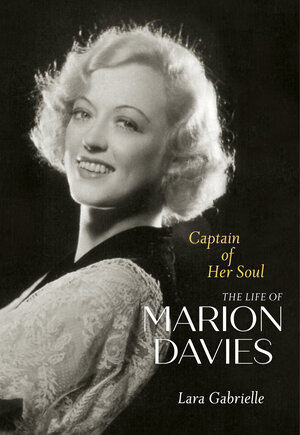
Captain of Her Soul: The Life of Marion Davies is now available at your favorite bookseller! Click hereto order it, and visit mariondaviesbook.com for all the latest.
Backlots is devoted to honoring and celebrating all aspects of classic film and is written by Lara Gabrielle, a California-based classic film writer and historian. Lara is the author of CAPTAIN OF HER SOUL: The Life of Marion Davies (UC Press, 2022).
Here you will find pieces on frequently seen classics and some lesser-known gems, as well as book reviews, festival coverage, and pieces on the history, theory and culture of film as it relates to the study of classic cinema.
Enjoy the site, and thanks for reading!
AFFILIATIONS & AWARDS
2019 CMBA Award for Best Profile of Classic Movie Performer or Filmmaker--"The Activism of Myrna Loy"
Winner of the 2018 CiMBA Award for Best Classic Movie Series, BACKLOTS AT THE COURTHOUSE: OLIVIA DE HAVILLAND VS. FX
Winner of the 2014 CiMBA Award for Best Profile of a Classic Movie Performer or Filmmaker: A Q&A WITH JOAN FONTAINE IN HONOR OF HER 96TH BIRTHDAY
Winner of the 2011 CiMBA Award for Best Classic Movie Discussion, THE FINAL SCENE OF THE HEIRESS
I am honored to be a judge of the Animal Film Festival in Grass Valley, CA.
EVENTS
BACKLOTS ON THE WEB
Join us at the Backlot Commissary, the place for Backlots' readers to share content and discuss movies!
Walter Pidgeon and Greer Garson in "Mrs. Miniver."



 Well, no one saw this coming, did they? Those of you who know me know that The Wizard of Oz (or, more accurately, Judy Garland) is very special to me. When I learned there was to be a
  The Wicked Witch of the West was played by Margaret Hamilton, who in my opinion deserved to win Best Actress (or at least Best Supporting Actress) for this movie. A former housewife turned movie actress to support her family, she was well-loved and a sweet person by all accounts. To demonstrate the kind of person she was, it is sufficient to say that throughout her life, both before and after her acting career, she taught Sunday School and kindergarten. After Oz, Hamilton continued her career in radio and television, before retiring in the late 1970s. She died in 1985.




















_03.jpg)

 Backlots