I have been friends with Caroline, the author of Garbo Laughs, since we were classmates at Mills College, a whopping 6 years ago. We started our blogs within 5 months of each other (Garbo Laughs is 5 months older!), and since then, because of our personal friendship and blogging style, Garbo Laughs and Backlots have been intertwined in many ways. Caroline is a gifted writer, and I’m certainly honored to be associated with a blog of this caliber.
For the second year in a row, Garbo Laughs is hosting its Queer Film Blogathon, a celebration of, in Caroline’s words, “lesbian, gay, bisexual, trans, or otherwise non-heterosexual, non-gender-binary depictions or personages in film.” Last year I submitted a profile of Judy Garland, because really, what would a queer blogathon be without any mention of Judy Garland? This year, I will try my luck with Queen Christina, a riveting historical account of a monarch, a fascinating study of lesbian depictions onscreen, and of what movies could get away with before the implementation of the Hays Code.
Based loosely on the life of Queen Christina of Sweden, the film takes particular care to hint subtly at the queen’s real-life sexual identity, alleged to be transgender or intersex (the queen often wore men’s clothes, had a strong, masculine voice and masculine features, never expressed an interest in marriage, and displayed a general manner that was described as being manly. The historical evidence mounted so high that in 1965 an archaeological undertaking was commissioned to explore the possibility of Queen Christina being intersex. The results were inconclusive.) It is particularly interesting that this part of the queen’s life was kept intact, while other, less controversial details of her life were fabricated or exaggerated for the movie.
Portrait of the real-life Queen Christina of Sweden.
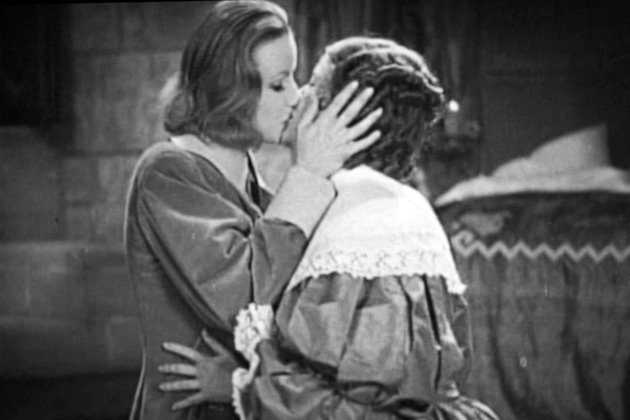
The most famous scene in Queen Christina is one in which the queen kisses a duchess firmly on the lips in a good morning greeting. Though the textual layer of the film suggests that they’re just friends, when one reads into the subtext, in this case the facial expressions and acting technique of Greta Garbo, one is enticed to question exactly what this relationship is.
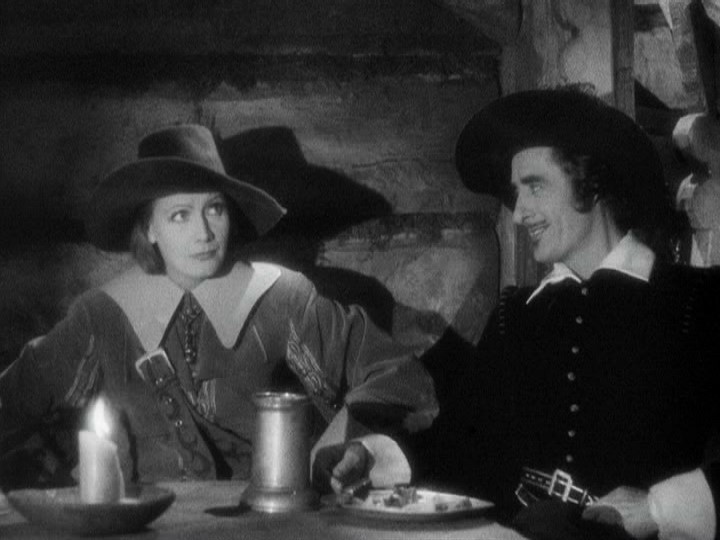
Another scene that toys with the audience’s perception and interpretation of the film is this exchange, between the Chancellor and the queen:
CHANCELLOR: But your majesty! You cannot die an old maid!
QUEEN CHRISTINA: I have no intention to, Chancellor. I shall die a bachelor!
In the days before the implementation of the revised production code in 1934, filmmakers had a much freer reign and tighter artistic control over their work, and thus many plots, scenes, and situations that we today would consider racy or controversial were frequent occurrences in the era before the Code. After the Hays Code went into effect, we began to see far less outward expression of homosexuality, as the Hays Code stipulated that “sex perversion [homosexuality] or any inference to it is forbidden.” The first known lesbian kiss onscreen occurred in 1930 in the Marlene Dietrich film Morocco:
In Queen Christina, Greta Garbo’s portrayal of the queen is striking. Her physicality in conveying the character is masterfully executed–walking with a cat-like stride, with slumped shoulders and decidedly masculine intonation in her voice, this is not the Garbo that audiences were used to. Interestingly enough, however, it seems that this was an outward expression of Garbo’s own bisexuality, which was scarcely a secret in Hollywood. She had affairs with many women over the years, notably playwright and poet Mercedes de Acosta, whose correspondence with Garbo was released in 2000. Though the Rosenbach Museum possesses love letters between them, they have not been made available to the public.
Queen Christina is a unique film with a unique place in cinema history. It is important not only as an early expression of sexuality on film, but also as a veiled hint at the sexuality of an explosive Hollywood star, and, apart from the LGBT aspect of this film, it is considered one of the best of the 1930’s and an essential classic in the Greta Garbo pantheon of films.
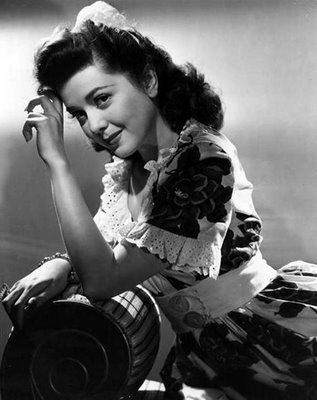
Yesterday I received news that Ann Rutherford, an established character actress in the 1940s and one of the last remaining cast members of Gone With the Wind, passed away at the age of 94. I had heard that she was ill, and apparently she had been slowly tapering down her very busy schedule of appearances for some time, due to failing health. She had an extraordinarily wonderful life, and was much beloved both by fans and her family–she regularly made appearances at Gone With the Wind events and established herself as somewhat of a Gone With the Wind ambassador, endearing herself to legions of devotees of the film. She married twice, and I understand that she remained very close to her stepdaughter from her first marriage, Debbie Dozier. Ann Rutherford will be remembered for her significant contribution to film, through Gone With the Wind and the Andy Hardy series (in which she played Andy Hardy’s long-suffering girlfriend Polly Benedict), and for her kind nature and devotion to her fans.
Here is a photo tribute to her. RIP Ann Rutherford.
Today is a big day for the Judy Garland community. Judy Garland was born on June 10, 1922, and would be turning 90 years old today. I have often expressed my love for Judy here, she has given me some of the best moments of my life, and I have my discovery and subsequent obsession with her to thank for my love of classic film in general.
I made a video tribute for her birthday last night, featuring some photos of her as a child, along with a segment from Judy’s 1960 interview with Fred Finklehoffe in which she discusses her childhood. This interview was privately conducted, in Judy’s own home, in preparation for her memoirs which she planned to title Ho-Hum. Finklehoffe was a screenwriter and a trusted friend, who had written the screenplay for Meet Me In St. Louis, For Me and My Gal, and a number of other great MGM productions, and Judy chose him to assist her with her memoirs.
Ho-Hum never came to fruition, but we are left with a beautiful group of tapes in which Judy reflects upon her life events with clarity and articulateness, and for the duration of this interview Judy seems magically free of the demons that haunted her throughout her life.
One of the things that strikes me most about the Finklehoffe interviews is the serene calm that Judy exudes as she talks about her life. To those of us who know Judy well, it is her loud, often zany sense of humor that defines her, and what made her the darling of so many parties and A-list events in Hollywood. I think that this calm she displays in the Finklehoffe interviews is a vision of what she would be like had she stayed little Frances Gumm in Grand Rapids, MN, and the sweetness of these private tapes is something that was never really replicated in any public interview. On the many appearances that she made over the years, Judy always stole the show with outlandish stories and self-deprecating humor that kept the audience in stitches. Here, I will explore that legendary wit, and the potential reasons behind this need for the public Judy Garland to always make people laugh.
There is a quote from songwriter Leonard Gershe that gives us a good idea of Judy’s humor:
“Judy had a great sense of fun. Everybody has a sense of humor, to some degree or another, some have more, some have less…not everybody has a sense of silliness. Judy could be silly. Judy had a wonderful sense of the ridiculous. And that’s what got her through so many trials and tribulations.”
Lucille Ball, who was with Judy at MGM in the 1940’s, summed up Judy’s humor like this:
“People always expect me to be funny. I was never funny; the writers were funny! Do you know who was really funny? Judy Garland. Judy Garland was naturally funny … the funniest lady in Hollywood. She made me look like a mortician.”
The trials and tribulations of Judy’s life are well-known. Her struggles with pills, illnesses, psychological problems and multiple suicide attempts are the stuff of Hollywood legend. It is often said that the most creative people are subject to the worst problems in life, and by all accounts Judy was as close to a genius as an artist can get. Her IQ was estimated to be in the 160’s or higher, and she possessed an unmatched imagination that influenced her career as an entertainer as well as her reputation in Hollywood for being one of the best storytellers in the business. I believe she often used her gift for storytelling and humor as a shield against a world that was often unkind to her, and she employed it readily and often in an effort to entertain, but also to protect herself from the painful realities of her life.
I must say here that it is, however, very important not to write Judy off as a tragic figure. She made it very clear that that is not how she wanted to be remembered, and though much of her life was indeed very painful, she was lucky to have the gift of humor to get her through things and allow her to always come back stronger than ever. Despite her problems, she was always able to pull herself back up and her audiences with her, and we have her ability to laugh at herself and others to thank for that.
Judy on Jack Paar, 1962
Her stories were often fanciful and probably untrue, but they were so entertaining that nobody took any notice. Her keen memory allowed her to repeat these outlandish stories nearly verbatim every time she told them, and come up with new zingers depending on the situation in which she was telling them.
Judy with Phil Silvers in 1963.
Never was Judy’s wit more noticeable than when she began to make regular appearances on television in the early 1960’s. With the advent of her television series in 1963, Judy finally had a format in which to express her talents on film in a way that suited her. The show was a hit, and Judy was in top form.
Here, she shows off her remarkable ability to mimic by imitating the popular Broadway stars of the day.
A major blow came to Judy in 1964 when CBS abruptly canceled her series, causing her severe distress. This was a real turning point in Judy’s life, and I believe it to be the initial cause of her final decline. She never recovered from the trauma of having her series canceled, and it sent her further down the path of drugs and self-medication, which eventually led to her demise.
However, on the last episode of her show, Judy gave the audience a dose of her incredible sense of fun, with a hilarious flubbing of her famous Born In a Trunk number. Regardless of how she was feeling personally at the time, Judy Garland always delivered.
I will end this post with one of my favorite Judy moments, laughing at herself for a flubbed take of “Swanee” in a recording studio in 1954. Happy birthday, Judy, this is how I will always remember you.
For the past week or so, TCM has been airing the trailer for The Innocents, a 1961 British thriller scheduled to be shown this evening, June 8. The film is highly acclaimed and is a major film in the career of Deborah Kerr, as well as an oft-referenced masterpiece of horror filmmaking.
The trailer for The Innocents.
As a person who is truly terrified of the supernatural (I could barely get through The Three Lives of Thomasina as a child), the trailer really took a toll on me. Anything dealing with ghosts is something I have a really hard time with, and each subsequent time that this trailer aired, I found myself looking away from the TV until it was over. However, I felt that I should at least TRY to watch this movie tonight, as it truly is a monumental piece in the genre, not to mention the fact that I love Deborah Kerr. So I settled in to watch the movie, making sure to leave all the lights on in case it got dark. If I know my post-horror film fears, I won’t be getting up in the dark at all, for fear of a ghost attacking me.
Robert Osborne picked this film to be shown during TCM’s “Creepy Old Mansions” marathon–alongside such films as The Black Cat, The Spiral Staircase, and Gaslight. Taken from the celebrated Henry James short story “The Turn of the Screw,” the plot deals with just that, a creepy old mansion, which the governess (Deborah Kerr) believes is haunted. Not only the house is haunted, she believes, but the spirits of the house have also overtaken the children’s souls. Kerr was really the only significant name in the film, though child actors Martin Stephens and Pamela Franklin later became moderately successful as well, and Michael Redgrave makes a VERY brief appearance as the children’s uncle.
The first half hour or so is very benign. We are introduced to the characters, and everybody seems very normal, until gradually strange things begin to happen in the house–we hear creaking and see strange shadows, and Deborah Kerr discovers the token creepy music box during a game of hide-and-seek with the children. You know things are going to happen when the creepy music box is discovered.
Then comes this scene, aptly described on youtube as being the scariest.
We begin to learn the identities of these apparitions–those of workers at the mansion in the past, who had close relationships with the children. The children begin to act strangely as well, with the little girl often singing the tune from the music box at the edge of a lake, with a ghostly figure watching her from the other side. The boy is by far the creepier of the two, and there are some scenes with the little boy that are among the creepiest child scenes I’ve ever come across. On that note, I will stop for fear of giving away the ending.
This film definitely belongs to Deborah Kerr. She implies everything with her eyes, and the viewer always knows when something bad is about to happen and how scared you should be–just by keeping a watch on Deborah Kerr’s eyes. She does a superb acting job, and it’s a real shame that she didn’t get any acknowledgment for it. The Innocents was nominated for two BAFTA awards (Best British Film and Best Film from Any Source), and director Jack Clayton was awarded the National Board of Review Award for Best Director.
Deborah Kerr in a particularly harrowing scene.
Despite my initial reservations about the supernatural aspect, I thoroughly enjoyed the movie, and found it to be very well-made and a marvelous thriller that really does stand the test of time. I would highly recommend it to anyone who can stomach a ghost story of this caliber.
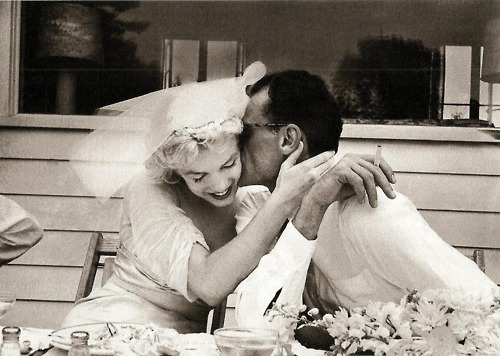
As I’ve said many times before, I find Marilyn Monroe to be one of the most vastly misunderstood, misused, and exploited actresses in Hollywood. She has become so much of a cultural icon that her status as an actress and a human being have been eradicated, and people only see is a shell of what she was, a sex symbol whose image can be seen plastered all over shirts, mugs, and posters in sorority houses. She strove so much to be taken seriously, and it pains me to think about how she would see her image if she were alive today.
Yesterday, June 1, 2012, is what would have been her 86th birthday. I will do my part toward restoring her image as someone who deserves respect and acknowledgment for who she was, not what she was perceived to be. Here are some of my favorite photos and videos of her throughout the years. Happy birthday, Marilyn.
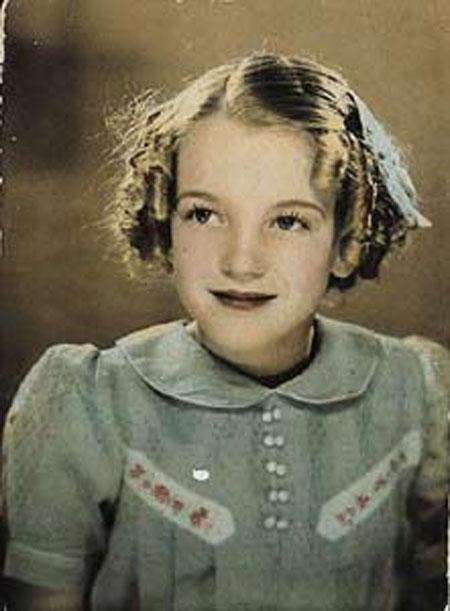
At age 8.
Having fun on the beach, circa 1939.
This photo was taken 6 weeks before her death in 1962, at the age of 36.
Following up on the success of the Dogathon a few months back, our friend Page over at My Love of Old Hollywood has set aside these few days, May 25-28, as days to blog about our favorite film horses–in the 2012 Horseathon. There is certainly no shortage of horse movies in Hollywood. From Trigger to Black Beauty, from cowboy movies to war movies, horses are some of the most prominently featured animals onscreen, likely due to their versatility of use and their prevalence in many aspects of our lives. Pick a movie at random, and there is a good chance there is a horse in it somewhere.
But there is a difference between a horse making an appearance in a movie, and a “horse movie.” That is, there are certain films that feature the horse as a central character, and the horse drives the story forward, films like Black Beauty and My Friend Flicka that exalt the horse and treat him as a noble creature deserving of respect and admiration. Perhaps the gentlest and most sincere dedication to the place horses have in so many lives–and definitely the movie with the most stellar cast–is the lovely National Velvet (1944). Central to the film’s story is Velvet’s relationship to her horse, The Pie, one that was mirrored in real life by Elizabeth Taylor’s bond with the horse that played The Pie.
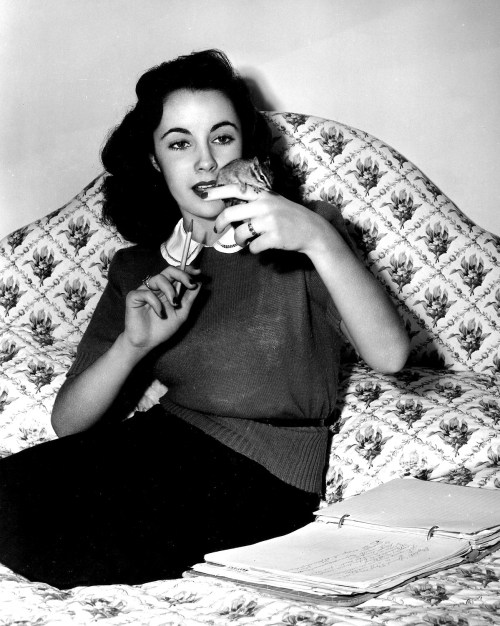
At this point in her career, Elizabeth Taylor was still a rising child starlet. Her appearance in Lassie Come Home the previous year had given her a good bit of screen time, and she had a prominent (though uncredited) scene of about 10 minutes in the Orson Welles version of Jane Eyre. But to audiences at the time of National Velvet, Elizabeth Taylor was simply a face that might look vaguely familiar, though she was already developing a name for herself on the MGM lot as a child star with a great deal of potential, and also, offscreen, as a quirky girl who seemed to always have animals around her. Elizabeth Taylor’s pet chipmunk, Nibbles, became almost as big a star on the MGM lot as his owner. Various stars who had been under contract at MGM recall Nibbles in interviews, and how young Elizabeth would not be seen without him. In 1946, while she was making The Courage of Lassie , Elizabeth found that Nibbles had been cast in a bit part in the film. Nibbles’ scene was ultimately cut, prompting Elizabeth to remark “He was too good. It didn’t look real.”
Elizabeth Taylor and Nibbles.
Other than her love for Nibbles, Elizabeth was known for her love of horses. As a toddler in England, she was so drawn to horses that she was given a small pony to keep as a pet, and recalled that the happiest moments of her life were when she was riding her horse. She always had animals throughout her life, and it was this obvious love of animals that drew the producers to cast this relative newcomer as the horse-smitten Velvet Brown in their upcoming production of National Velvet.
The Pie was a 7-year-old thoroughbred named King Charles, a descendant of famed racehorse Man O War. He was owned by a society woman at the Rivera Country Club in Los Angeles who had trained him as a show jumper, and she offered to let Elizabeth Taylor ride him while at the country club. Elizabeth immediately fell in love with the horse, and he was acquired by MGM for $800 to star in National Velvet with her. She undertook a rigorous training routine to prepare for the movie, and rode King Charles for 90 minutes every day while also feeding and bonding with him at the Rivera Country Club for the rest of the day.
From the beginning, King Charles was a difficult horse to get along with. He wouldn’t listen to commands, and he regularly bit crew members, once seriously injuring a trainer who was trying to make him play dead for a scene. The only person he would listen to was Elizabeth. The two had developed a special bond, which is very evident in the final film.
After filming wrapped, on the occasion of Elizabeth’s 13th birthday, she found that she had received King Charles as a gift. She and the horse stayed together until King Charles died, and remained wonderful and loyal companions to one another for as long as he lived.
On the set.
Thank you to My Love of Old Hollywood for sponsoring this Horseathon!
I’ve found that I rarely talk about Judy here. For those of you who know me, you know what an intense Judy Garland fan I am. She does something to me. When I was 10, I heard her voice for the first time outside of The Wizard of Oz and Meet Me In St. Louis, and it immediately drew me to her–I can’t explain it, other than to say it is inexplicable. I have been to the Judy Garland Festival 4 times, and was interviewed about my love for Judy on NPR when I was 13. But I don’t talk about her much on my classic film blog. Why is that, you ask? I think it may go back to the inexplicability of my devotion to her. When people ask me what it is about Judy that draws me to her, I tend to ramble–to try to either justify it, quantify it, or to make some sort of tangible sense of it. It makes no sense.
It may also be due to the fact that I don’t particularly think of Judy as a classic film star, per se. She certainly was one, but her reach went so far outside of her years at MGM that she essentially blew through her reputation as a film star and created her image as an ICON. After 15 years at MGM, she was fired in 1950 due to her unpredictable behavior, and set upon a concert career. Not only did she merely break into this field of the entertainment business, but she broke attendance and box-office records, won Grammys and a special Tony Award, and established an international reputation as a first-rate concert artist. Right at the outset of her experimentation with a concert career, she secured an engagement at the renowned and coveted Palace Theatre for 4 weeks. She ran for 19, breaking all previous records for the theatre, and securing her status as concert performer. She was far more than a classic film actress, she was a world-class entertainer.
A bit of backstory to the Palace engagement–Judy’s run at the Palace came on the heels of a humiliating firing from MGM in 1950, after a number of years of difficult behavior and illness–mostly due to the prescription pill addiction that became increasingly severe between 1939 and 1950. Beginning around the time of the success of The Wizard of Oz, MGM provided Judy with pills to make her sleep, pills to wake her up, and pills to make her lose weight, resulting in an unhealthy and uncontrolled regimen that had disastrous physical and mental consequences for her young body. By 1950, she was nearly paralyzed by psychological problems, and had already undergone psychiatric treatments and electroshock therapy to bring her back to work. Summer Stock with Gene Kelly was a success that year, but when these issues prevented her from working on Royal Wedding, Judy’s contract was terminated and she was a has-been at 28.
Everybody thought Judy Garland was through, but with the help of a charismatic talent agent turned film producer by the name of Michael Sidney (“Sid”) Luft, back she bounced the next year with her record-breaking 19-week engagement at the Palace Theatre, beginning on October 14, 1951.
Judy’s opening number at the Palace.
Following her success at the Palace, Judy gained a reputation as a bankable concert performer, and it looked like that’s where she would stay. That is, until 1954, when Sid Luft (whom Judy married in early 1952) decided he would stage another brilliant comeback for Judy–this time in movies. Here we have two magnificent comebacks for Judy Garland within 5 years–with some striking similarities. This post aims to highlight some of those similarities, interwoven with Judy’s offscreen life.
Part of the appeal of A Star is Born, at least where Judy is concerned, is the bubbling, charismatic energy that is exuded from the screen. While watching the film, we often feel as though we are watching a live show, as Judy Garland worked her stage magic onscreen.
In this scene, Judy is playing a young hoofer just striking it big in the theater world. She has had trouble in the past, difficulty finding her footing, and now she is singing her heart out in a show made just for her.
Playbill for Judy’s one-woman Palace show.
Judy’s show at the Palace was designed as a tribute to vaudeville–whose heyday centered on the Palace Theater as the mecca for the show business industry. As a child, Judy traveled around the country in “lousy vaudeville” as part of The Gumm Sisters, an act made up of Judy and her two older sisters Suzy and Jimmie. The girls played in various small houses with Judy (then known as Frances, or more often, “Baby”) invariably advertised as the star. She had joined the act at the age of 2 and a half, and in 1935, at the age of 13, she was signed to a contract at MGM. She made a string of unmemorable films before her huge breakout role in The Wizard of Oz, which established her as a star and legend.
Judy (far right) with her sisters Jimmie (middle) and Suzy.
Following The Wizard of Oz, Judy became a hit. She starred in 6 feature films between 1940 and 1941 alone, and developed a repertoire that would stay with her throughout her entire career. She developed a friendship with many prominent composers, lyricists and arrangers, including the legendary composers Hugh Martin and Harold Arlen.
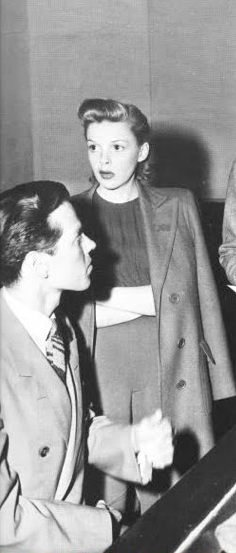
Judy Garland with Hugh Martin, 1944.
“The Man That Got Away,” by Harold Arlen.
Despite her problems, Judy Garland was renowned for her resilience and ability to be self-deprecating and to put on a happy face, no matter how rough times were. Many attribute her status as a gay icon to this aspect of her–her ability to keep coming back, stronger than ever, after each hardship. Audiences were drawn to her, and she gained a legendary following that was absolutely devoted to her.
This is a very powerful scene, and eerie to watch, as we are essentially watching Judy talk about herself. The premise of the scene is that Judy’s husband, a former film star, is in a sanitarium for alcoholism and Oliver Niles, the film head, comes to check on her. Notice her vulnerability, her emotion, and her sadness for the reality of the situation, and then her COMPLETE transformation as she goes back to the set. That isn’t a character–that’s Judy.
The audience, comprised of Judy’s devoted fans, sings Auld Lang Syne to Judy on her closing night at the Palace.
Judy Garland’s life could be a book–chock full of metaphors, symbolism, irony, and repeated themes. I came up with the idea for this post while listening to Judy’s Palace album, and thinking about the similarities between these two monumental events to each other, and to Judy’s life and career. I hope I have done those similarities some justice. I was disappointed to find that nearly all of the Palace material I wanted to use was unavailable on the internet, so I took the initiative to make most of the Palace videos you see in this post.
This blogathon, sponsored by Ferdy on Films, This Island Rod, and longtime friend of Backlots The Self-Styled Siren, exists for a very specific purpose. In the classic film community, the issue of film preservation is akin to the issue of global warming in the general public. We know that the longer we wait to start making efforts to preserve our films, the sooner the films will deteriorate and we will no longer have access to some of the movies we hold most dear in our culture. The Film Foundation reports that we have already lost half of all American films made before 1950, and 90% of films made before 1929. We cannot let this trend continue.
Thus, this blogathon is a specific effort to raise money for the National Film Preservation Foundation, a non-profit organization dedicated to preserving films that would not be saved without public support. The mission with this particular blogathon is to raise money for an online version of a recently restored copy of The White Shadow (1924), one of the earliest-known credits for Alfred Hitchcock, and to increase the visibility of those films that have been restored. Visit their website to learn more about the organization, and I urge you to donate what you can. Your donation can be as little as $10 or as much as $100,000, and any amount is greatly appreciated (if you can seriously afford $100,000, I’m dragging you to my house and making you pay my cable bill. That’s just the way it has to be.)
My contribution to this film preservation blogathon is an analysis of the classic 1925 version of The Phantom of the Opera, starring Lon Chaney and Mary Philbin. Now, we are all familiar with the story of The Phantom of the Opera, the novel by Gaston Leroux has inspired countless representations on film and onstage, the most famous of which is now, obviously, the Andrew Lloyd Webber musical that took London by storm in 1986.
However, for classic film fans, there is nothing like the 1925 film adaptation of the story from Universal Studios, which features a spectacularly well-written narrative and, for me, one of the most startling scenes in all of cinema–the unmasking of the Phantom.
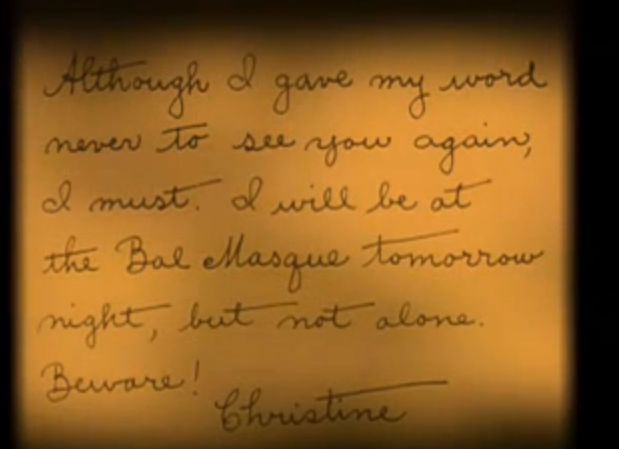
The story begins as new owners of the Paris Opera House are just sealing their purchase, and they are warned of a shadowy character that occupies Box 5, “a cloaked figure of a man who hides his face and will not speak.” It seems that the company has known about him for some time, as during the performance that evening, there are exclamations of horror that “the Phantom is up from the cellars again!” Up from the cellars he is, and with a plan–to destroy the career of the prima donna Carlotta in favor of the novice Christine Daaé, with whom he has fallen in love. By way of a series of letters to the owners, the Phantom makes it clear that if Carlotta sings that evening’s performance instead of Christine, she sings “in a house with a curse on it.”
The Phantom’s letter.
The owners pay no heed, and that evening the curtain rises with Carlotta playing the lead role. Raoul, Christine’s lover, receives a mysterious note during the performance–“I cannot explain, but you must never attempt to see me again.” Then, inexplicably, the lights begin to flicker on and off, and though Carlotta continues singing, with the Phantom’s cry of “Behold! She is singing to bring down the chandelier!” the chandelier falls upon the audience, wreaking havoc in the theater.
In the meantime, Raoul rushes back to Christine’s dressing room to catch her in the act with another man. Instead, he watches Christine almost hypnotically walk through her dressing room mirror, to the other side of the wall. When he tries to follow her, he finds that the mirror only lets her through.
The mirror leads to the Phantom’s lair, and it is here that we first see the Phantom. He is seen wearing a white mask and breathing through a nylon-esque covering on his mouth, which Christine initially shrinks from but comes to be curious about–leading her to the famous Phantom unmasking scene.
This clip has no music set to it, and I almost think it’s even more disturbing this way. Take a look:
Lon Chaney was a makeup master, and he was allowed to design his own makeup for this film as he was previously for Hunchback of Notre Dame (1923). Out of all the versions of The Phantom of the Opera that have ever been produced, this is considered to be the truest depiction of the Phantom as he was described in the original novel. Universal was prepared to milk the shock they knew Chaney’s face would bring the audience for all it was worth, so they made it a point not to release Chaney’s face as the Phantom on any of the promotional materials for the movie. Thus, the reaction from the audience would be one of genuine shock and horror, and many audience members were said to have screamed and fainted at the sight of the deformed face on the screen.
Upon seeing the Phantom’s face, Christine becomes horrified, and begs him to let her go. He does, but makes her promise never to see Raoul again. “If so, it is death to you both!”
Christine leaves, but the Phantom’s warning did not deter her from writing to Raoul.
At the Bal Masqué, while everybody is dancing and having fun, we see a figure clad in red coming down the stairs. Red, you ask? Yes. In this scene, we see one of the first sequences ever shot in Technicolor.
Christine and Raoul steal away to the Opera rooftop, so as not to be seen by the Phantom. There, Christine describes to Raoul what she has seen–describing the Phantom as a “loathsome beast” and imploring him to save her from his wretchedness. Little does she know that the Phantom is directly above her, listening from the statues on top of the Opera roof.
At the performance the next evening, the Phantom kidnaps Christine while she is onstage and brings her down to the cellars. A man named Ledoux (whom we have been seeing throughout the movie without knowing who he is) reveals to Raoul that he is a secret policeman who has been studying the Phantom for some time. He leads Raoul down to the Phantom’s hiding place, where through a series of events, the Phantom is threatened and gives Christine a choice–turn a scorpion knob to marry him and spare Raoul, or turn a grasshopper knob to blow the Opera House to bits. Christine opts to spare Raoul, but in reality it was a trick, and the intent with the scorpion knob was to drown Raoul and Ledoux in the lake. When Christine learns this, she begs the Phantom to spare them, and promises to do anything he wants. At this, the Phantom opens a trap door and lets them out. He can’t stand the sight of Christine kissing Raoul, so he kidnaps Christine again and steals a carriage outside the Opera to carry her away. His carriage breaks down and the Phantom is pursued by a mob, that allegedly kills him and throws him in the Seine. This is one of the most interesting movie endings I can think of because….there are still bubbles coming out of the water when the camera fades out.
Could the Phantom still be alive? Could he make his way back to the Opera House to find another protégée? I have scoured my available resources for those people who have noticed this subtlety in the ending, and I can’t find another examination on it. From the first time I saw the movie the ending struck me as being a cliffhanger, and when I couldn’t find others’ takes on it, it surprised me. Take a look and see what you think:
You may notice in the title of this video clip that the given year is not 1925, as was the year the movie was originally released, but 1929. This is due to an important re-editing of the film that was done in 1929 after the introduction of talking pictures. The producer, Carl Laemmle, recorded an audio track and score for the movie that were released with a newly edited version of the film on February 16, 1930, and this clip was taken from the newer version. Re-editing the film now seems in vain, however, as all of the sound footage that Laemmle re-shot is currently lost and the re-edited version of The Phantom of the Opera is now considered a lost film.
Which brings me back to my original point–by making film preservation a priority, we can prevent further films from getting lost or damaged. Imagine what it would be like to be able to see the re-edited 1929 Phantom of the Opera with the sound footage that Laemmle shot, and compare it to the original 1925 version. If we had cared more about the future of films in 1930, we might have been able to do just that today.
If you would like to learn more about film preservation and the process by which people go about repairing damaged films and preserving those in danger of being damaged, here are some links. Thanks for reading!
The Selznick School of Film Preservation trains individuals in the art of film archiving and curating. The Selznick School has restored films going back to 1902, and has the distinction of having restored many of the original tests for Gone With the Wind.
The National Film Preservation Foundation, the organization that we are helping to support with this blogathon, was established by Congress in recognition of the need to retain our motion picture heritage. They offer a clear, straightforward explanation on how a film decays and how to stop it. To view that section of their website, click here.
The Sundance Institute joined the UCLA Film and Television Archive in 1997 to create a solid force committed to film preservation. Dealing mostly with independent films, their mission is not strictly related to the classics, but instead demonstrates an all-inclusiveness that recognizes that all vulnerable films need to be protected for the future.
Katharine Hepburn as a small child in Connecticut.
Though she often preferred November 7, in honor of her late brother Tom, May 12 marks the birthday of the most legendary actress ever to perform onscreen. It sounds like a ridiculous superlative to say “the most…” anything subjective, but in this case, it is justified, as I think we can all agree that Katharine Hepburn is unequaled in her star power. The quality of her work can be debated, the extent of her talent can be questioned, but at the end of the day, nobody ever disrespects Katharine Hepburn.
In October of 1973, Hepburn appeared in a rare interview session with Dick Cavett. She decided, during the tech rehearsal, that she didn’t like the set, and proceeded to essentially direct the workers in their jobs. She critiqued everything from the carpet to the table, and started to move furniture around to suit her preferences. She was doing things that were unorthodox, controlling, and straight-out against union rules–yet nobody stopped her. Every person on the set gives her the utmost respect, they are putty in her hands. They knew that they were dealing with a legend of the highest caliber. Take a look:
How does one achieve this kind of power? What are the factors involved in making a legend? So many tried and failed to earn this kind of respect, to have such an illustrious career that others literally grovel at your feet. So many of that era lost themselves in drugs or alcohol, and met a premature demise. What did Katharine Hepburn do? How is she different?
Bette Davis, in an interview about her own longevity without the problems ailing so much of Hollywood, probably summed it up best:
It takes great discipline…and I think I was very fortunate in my upbringing. I think my New England background, for the work I went into, was an extraordinary stabilizer….I was also an extremely healthy person…I was enthusiastic, loved my work, and in that area I had no problems. No reason to escape into dope or pills.”
Katharine Hepburn was intensely proud of her New England heritage, and often cited it as a defining force in her life and identity. Bred from pure Connecticut Yankee stock, Hepburn was raised to be self-assured, assertive, and confident in herself and her abilities.
Hepburn was born May 12, 1907, the second child of parents Thomas Norval Hepburn, a prominent urologist, and Katharine Martha Houghton Hepburn, who advocated for women’s rights and was one of the founders of Planned Parenthood. Her family’s progressive views both empowered and alienated her–dinner table discussions were often focused on controversial issues of the day, abortions, venereal disease, or her father’s work in the field of urology. Neighbor children were often asked not to play with the Hepburns, for fear of unwanted influence, yet these discussions set the basis for Kate’s lifelong reputation for outspokenness, and spurred a political activism in her earned enormous respect from the Democratic contingent of Hollywood. She actively campaigned for Roosevelt and remained a supporter throughout his run as president, and spoke out vehemently against the anti-Communist witch hunts that occurred under McCarthy in the 1950’s. Her political efforts directly reflected her mother’s, who was herself an impassioned speaker at many women’s rights rallies and would often take Kate, as a toddler, to listen to the speeches given at conventions and protests.
Katharine Martha Houghton Hepburn, who shared a passion for politics as well as an uncanny physical resemblance with her daughter.
The Hepburns had 6 children–Tom, Kate, Marion, Dick, Bob, and Peg. They were raised strictly despite their parents’ liberal views, and yet were all-around happy children. Kate shared a special bond with her older brother Tom, who was a doting and loving caretaker to his sister. Kate’s world was turned upside down when she found Tom hanging in the attic of a friend’s house while they were visiting, and she never fully recovered from the shock. She said that after Tom’s death, she began to feel “ingrown, sort of like a toenail can get when the shoe is too small.”
I pledged to Tom and myself that he would live in my heart and mind as long as I lived. I decided I had to live my life for two… The real date of his death would not be until the day I died.
According to biographer Charlotte Chandler, following the death of her brother, Hepburn began taking on boyish clothes and cut her hair short. The death of her brother, in combination with her family’s progressive attitude toward women, most likely solidified Hepburn’s legendary fashion sense and influence on the clothes of her day. She singlehandedly popularized pants for women, and her lithe, tomboyish figure became the envy of women in lieu of the often voluptuous figures of women in 1920’s cinema.
As an actress, Hepburn brought stunning realism to her characters–be they the ditsy Susan Vance from Bringing Up Baby, or the stoic mother coming to terms with her daughter’s interracial marriage in Guess Who’s Coming to Dinner? Her versatility was legendary, and she truly played every genre, excepting the horror movie phase that so many actors succumbed to when their careers started to falter. She always preserved her dignity when it came to roles, and she made stellar career choices, ensuring her extraordinary longevity as an actress. I think we only have to lament the fact that she never played Shakespeare onscreen. Her theatre career began at Bryn Mawr college, known for producing forward-thinking, progressive women, and the alma mater of her mother. Had Hepburn’s confidence and self-assurance not already been cemented in her from a young age Bryn Mawr definitely would have done the trick. Hepburn was destined to be a leading woman both in her life and her career.
Hepburn’s success as an actress and a cultural icon is undoubtedly due to her upbringing in New England and the circumstances of her life therein. We certainly have this upbringing to thank for many of the classic films we enjoy today–because Katharine Hepburn certainly would not have been the Katharine Hepburn we know and love today without the influence of her early life.
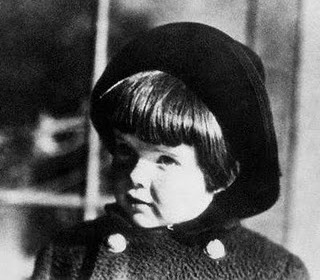
Here is a picture of Kate and her brother Tom as children. Thanks for reading!
Captain of Her Soul: The Life of Marion Davies is now available at your favorite bookseller! Click hereto order it, and visit mariondaviesbook.com for all the latest.
Backlots is devoted to honoring and celebrating all aspects of classic film and is written by Lara Gabrielle, a California-based classic film writer and historian. Lara is the author of CAPTAIN OF HER SOUL: The Life of Marion Davies (UC Press, 2022).
Here you will find pieces on frequently seen classics and some lesser-known gems, as well as book reviews, festival coverage, and pieces on the history, theory and culture of film as it relates to the study of classic cinema.
Enjoy the site, and thanks for reading!
AFFILIATIONS & AWARDS
2019 CMBA Award for Best Profile of Classic Movie Performer or Filmmaker--"The Activism of Myrna Loy"
Winner of the 2018 CiMBA Award for Best Classic Movie Series, BACKLOTS AT THE COURTHOUSE: OLIVIA DE HAVILLAND VS. FX
Winner of the 2014 CiMBA Award for Best Profile of a Classic Movie Performer or Filmmaker: A Q&A WITH JOAN FONTAINE IN HONOR OF HER 96TH BIRTHDAY
Winner of the 2011 CiMBA Award for Best Classic Movie Discussion, THE FINAL SCENE OF THE HEIRESS
I am honored to be a judge of the Animal Film Festival in Grass Valley, CA.
EVENTS
BACKLOTS ON THE WEB
Join us at the Backlot Commissary, the place for Backlots' readers to share content and discuss movies!
Walter Pidgeon and Greer Garson in "Mrs. Miniver."












 This blogathon, sponsored by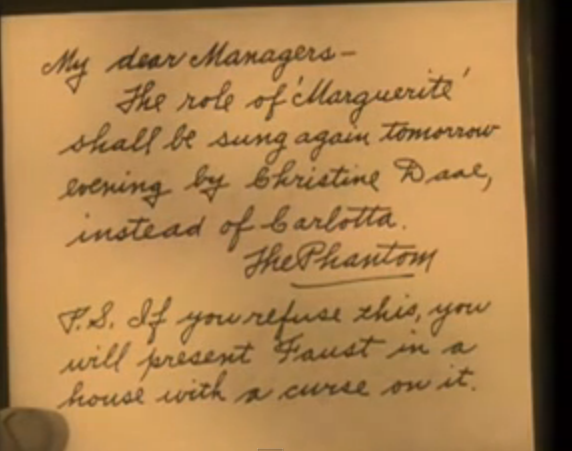



















_03.jpg)

 Backlots