For fans of the sophisticated screwballs that defined the majority of Carole Lombard’s career, it is often difficult to fathom that Carole started off as a dramatic actress. From the late silent era until 1934 when Twentieth Century changed her career, Carole Lombard (or, as she was often billed in her early films, “Carol Lombard”) was cast as in roles that highlighted her striking, angelic and ethereal beauty instead of capturing her bubbly and sociable offscreen personality. High Voltage is one of the movies that introduced Carole to the dramatic speaking roles of the early 1930s–her first full-length “talkie,” after a few significant roles in silent films notably as one of Mack Sennett’s “Bathing Beauties.” High Voltage is a rather straightforward film, nothing particularly interesting to speak of, but it is a wonderful look into early sound production that was still imperfect.
A busload of passengers is stranded in a snowstorm, and upon encountering an abandoned church, huddles together there until their rescue. Two of the passengers begin to fall in love, but there is a complication–regarding the man’s status with the law.
The plot of the movie is very basic, but is filled with lots of ornate dialogue that is oddly anachronistic. The movie is a bit difficult to understand, but this is more due to the scratchy print than anything else–it would greatly benefit from a restoration that would perhaps make the movie slightly more interesting to watch.
I might also add that this movie was made in 1929, the year sound film began to come into widespread use. Filmmakers were still experimenting with how to use dialogue, how to direct speaking actors, and how to seamlessly morph a highly successful silent medium into a speaking one without losing the character. It is fascinating to watch Carole in this film, because she is still very much a silent actress in her movements and expressions. During a scene where the group hears a rescue plane, Carole gets up dramatically and runs to the window, flailing and pointing energetically outside. It looks exactly like a scene that should occur in a silent movie, so much so that I instinctively half expected intertitles to show up on the screen. Her makeup is also reminiscent of traditional silent film–specifically the eyeliner she wears under her eyes, used to accentuate features and aid physical expressionism.
Despite its status as Carole’s first talkie, this is a rather minor Lombard film, one that doesn’t showcase her talent particularly well, but the filming is a prime example of cinematic technique in early sound films and this may be of interest to film historians.
Well, readers, it sure has been a while since my last entry in the Carole Lombard Filmography Project. I watched this film quite some time ago in anticipation of this post, and somehow time slipped out of my hands. Here I am, a shameful number of weeks later, finally giving Carole and this film the attention they deserve. From now on, I will try my hardest to keep Carole current!
Our film today is an important one in the career of Carole Lombard. By 1934, Carole’s star was quickly rising. She had made a number of high caliber dramatic films in the early 1930’s, including Virtue (1932), No Man of Her Own (1932) and Supernatural (1933), but at this point in her career Carole’s tremendous comedic talent was virtually untapped. A semi-comedic role for Carole in We’re Not Dressing earlier in 1934 was a rather pithy introduction to the world of comedy, but Twentieth Century was the film that marked Carole’s first real foray into the comedic roles worthy of her gifts.
Carole plays Mildred Plotka, a lingerie girl plucked from obscurity to star in a play by Oscar Jaffe (played by John Barrymore), a Broadway producer who is convinced she has acting talent. He has renamed her Lily Garland, and is determined to groom her to stardom. Jaffe is a bit of a tyrant as a director, and at one point jabs Lily in the behind with a safety pin in order to get the scream he wants out of her character during a particular scene. Eventually Lily does become a star, and she and Jaffe collaborate on many successful productions, becoming a veritable theatrical duo. In addition, they begin to fall in love.
Jaffe’s tyrannical nature is evident in their personal as well as professional life, and after 3 years Lily has had enough. She tries to break it off with him, but he promises to be better and she stays. However, Jaffe’s obsession with control is too strong and instead of backing off, he has her phone tapped. This is the last straw for Lily, and she leaves for Hollywood to become a movie star.
Without Lily, Jaffe’s plays flop. He begins to sink into financial ruin, and in order to avoid being jailed by his creditors, he dons a disguise and gets on the Twentieth Century train to escape them. Unbeknownst to Jaffe, Lily gets on the train with her new boyfriend at a later stop. When Jaffe finds this out, he schemes a way to get her to sign a contract for a new play, thereby solving his financial problems. A series of misadventures occur aboard the train while Jaffe schemes, and ultimately he cons Lily into an agreement by pretending to be dying.
Along with It Happened One Night (1934), Twentieth Century is considered by many to be the prototype for what would become screwball comedy. The elements are all present–a dotty woman, somewhat bumbling man, and a plot that twists and turns at every corner. The movie is directed by Howard Hawks, who would go on to direct such masterful screwball comedies as Bringing Up Baby (1938) and His Girl Friday (1940) and become one of the genre’s foremost masters. The performances in Twentieth Century are brilliant all around, Carole Lombard shows all the comedic flair that was the hallmark of her later performances, and John Barrymore essentially steals the show with his outwardly controlling yet ultimately rather silly Jaffe. Barrymore’s loose and zany body language is really something to watch in this movie. He, much like Carole Lombard, also had a flair for comedy, but unfortunately this talent of his was never realized the way Carole’s was, as his career suffered a steep decline a mere 3 years later.
Carole was known for being a very easy and pleasant actress to work with, and she kindled a lovely friendship with John Barrymore during filming that lasted for the rest of their careers. When Barrymore’s career was in jeopardy due to debilitating alcoholism and a steadily decreasing ability to remember his lines (possibly a case of Alzheimer’s Disease, virtually unknown at the time), Carole personally requested that Barrymore play opposite her in True Confession (1937), giving his career a much-needed boost. Barrymore died in May of 1942, just 5 months after Carole’s death in a plane crash.
Director Howard Hawks, Carole Lombard, and John Barrymore on the set.
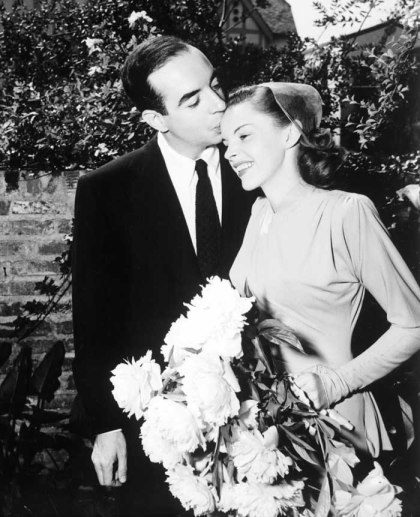
One year after Judy Garland and Vincente Minnelli fell in love on the set of Meet Me in St. Louis the contemplative wartime drama The Clock came to fruition. Up to this point in Judy Garland’s career, her roles had been limited to girl-next-door types and she always sang at least one song (with the exception of Life Begins for Andy Hardy, for which a song entitled “Easy to Love” had been written but cut from the final project). This marked Judy Garland’s first foray into the field of drama, for which her considerable talent was grossly underestimated. The Clock would be followed later in her career by a number of very successful dramatic roles including one in the epic Judgment at Nuremberg which landed her an Academy Award nomination for Best Supporting Actress. Minnelli, in his directorial genius and insight into the inner workings of Judy Garland’s enormous talent, saw in her a flair for drama, and directed her in such a way that it would be easily visible to the audience just how much she could do with the material.
Joe (Robert Walker), a soldier on leave in New York City for 48 hours, meets local girl Alice Mayberry (Garland) when she loses her heel at Penn Station. The two strike up a conversation, and immediately take to one another. He asks her to dinner, and though she is initially hesitant, she agrees to meet him under the clock at the Astor Hotel at 7:00. After going through a series of mishaps together, including a missed bus that ended in a late-night ride with a milk man, they discover that they have fallen head over heels in love. Given that Joe has only a few hours left before he must go back on active duty and knowing this may be their only chance, they decide to get married at once. They must have all paperwork completed before 5:00, closing time at the marriage officiant’s office.
Joe and Alice at the home of the milk man who gives them a ride after a missed bus.
Their process acquiring all the necessary paperwork and blood tests for the marriage is a masterful moment of suspense in the film. We see the hours tick by, and knowing all that they have to get done in that short amount of time, the audience is made to feel the same feelings of rush and urgency that Joe and Alice do. This is a testament to both Minnelli’s direction and the film’s superb editing. As they chisel away the bureaucracy of the system, Joe and Alice encounter those who are unconcerned with their plight, and others who are sympathetic, leading them to arrange everything just in time and catching the marriage officiant as he is on his way to the elevator to catch his train home.
Joe and Alice are married in a makeshift ceremony, punctuated by a loud passing train that drowned out much of the service and the officiant hurried off as soon as it was over. Disappointed in such an unsentimental ceremony, they go out to a cheap cafe for dinner. Alice breaks down over how unceremonious the event was and they depart for a local church, where they quietly recite the marriage service themselves sitting side by side in a pew. Their tranquility is starkly contrasted with the cool indifference that marked their official marriage, and it is a beautiful moment in the film nicely acted by both Garland and Walker.
Shortly after their marriage, Joe boards a train back to his camp. Joe and Alice bid each other farewell with an optimistic and confident “See you soon.” The film ends as Joe leaves, with Alice walking numbly on the train platform. Whether Joe and Alice will see each other soon, or whether they will even see each other again is uncertain. The film’s ending leaves the viewer with his own vision of Joe’s fate, representing the very real emotions prevalent in the last days of World War II.
Fine acting and fine directing make up this real gem of a film, an unusually pensive and thoughtful look at the harsh realities of wartime concerns. It may be thought of as a precursor to The Best Years of Our Lives, examining the difficulties of the active soldier in the same way The Best Years of Our Lives examined the difficulties of veterans. It is a largely underestimated film, and too often glossed over in discussions of quality wartime drama. During the filming, the romance between Garland and Minnelli intensified, and by the end of shooting, they were engaged. They married in June of 1945, one month after the release of the film.
See you next time!
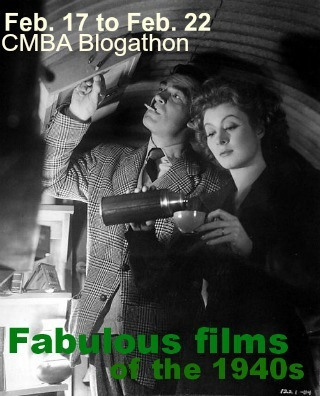
This has been an entry in the Classic Movie Blog Association’s Fabulous Films of the Forties blogathon. Thanks for hosting, CMBA!
Buster Keaton and Buster Keaton in drag in “The Playhouse,” shown this afternoon at Silent Winter 2013.
By Lara Gabrielle Fowler
The San Francisco Silent Film Festival has lived up to its stellar reputation once again. Featuring a mouth-watering lineup of silent cinema gems, Silent Winter 2013 was a lively and vibrant event, augmented by an enthusiastic and passionate audience that proves to the world, as it does every year, that silent cinema is still alive and well. Expert speakers introducing each showing allow for the individual appreciation of every film chosen, the unique backgrounds and subtle intricacies that make each film special. This is the prerogative of the San Francisco Silent Film Festival, and that passion and respect for this beautiful art form is what keeps devoted patrons coming back year after year.
The films chosen for Silent Winter this year were:
Snow White (1916)
A series of 3 Buster Keaton shorts–One Week, The Scarecrow, and The Playhouse
The Thief of Bagdad (1924)
My Best Girl (1927)
Faust (1926)
The 1916 version of Snow White is similar in many ways to the 1937 Disney version of the fairy tale. A number of gimmicks are re-used in the later Disney film (in fact, Walt Disney was inspired by the 1916 film more than the original fairy tale), including a variation on a scene in which Grumpy the dwarf is dumped into the washing tub. Though the dwarfs have different names and certain sinister elements are softened or removed in the 1937 movie (there is a rather dark subplot about the hunter being imprisoned with his children), the influence is clear, and the sequence of events is very familiar to modern audiences most familiar with the Disney story. It is a charming film, beautifully shot and nicely acted with an especially noteworthy performance by Marguerite Clark as Snow White.
The Buster Keaton shorts were an absolute joy. I have yet to come across anyone, classic film fan or otherwise, who dislikes Buster Keaton. His charm, the sweetness and complete honesty that is the basis for all his comedy is immensely likable and audiences immediately fall in love with this sweet bumbling character whose life always seems to land him in a pickle. In the first short, One Week, Buster and his new wife try to put together a build-your-own house, but mix up the boxes and end up with a very strange house indeed–parts are upside-down, backwards, and crooked, and the roof doesn’t cover the house. After a massive storm that essentially destroys the house to an even worse state, they find out that their house is on the wrong lot anyway and they will have to move. This is what happens when they try to move the house. 1:26-1:09 is my favorite gag out of the hundreds that make up this 22-minute short.
The Scarecrow deals with two roommates after the same girl. A simple plot that is an excuse for lots of Keaton gags, including a genius sequence demonstrating the small size of the men’s apartment.
The Playhouse is nothing short of a Keaton masterpiece. Utilizing camera techniques that would not come into mainstream use for decades (and even then used sparingly), the opening sequence shows Keaton at a playhouse playing all the roles in a revue, and continues with old vaudeville tricks and hilarious plot twists involving mistaken identity.
The Thief of Bagdad hardly needs an introduction. This is one of the finest films of the silent era starring the legendary swashbuckler and explosive silent star Douglas Fairbanks. Chock full of magic camera tricks and gorgeous Middle-Eastern inspired clothing, it took more than a year to complete and credit for the production goes almost solely to Fairbanks. Also making an appearance is Anna May Wong, in an early role.
One of the more flabbergasting stunts in the movie is the magic carpet that actually flies. Its execution required a crane and three platforms for the cameras.
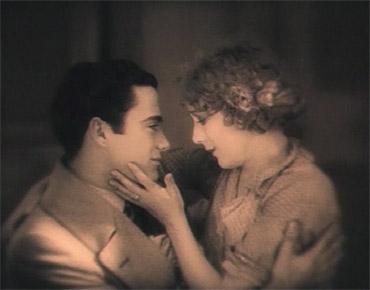
My Best Girl is a very sweet and timelessly funny movie starring Mary Pickford and Buddy Rogers, who fell in love during filming. The plot involves a young woman who unwittingly falls in love with a rich man, and then deals with the consequences. One of the most beautiful things about this movie is that you can actually see the two falling in love. After Mary Pickford’s divorce from Douglas Fairbanks in 1936, she and Rogers married, and the marriage lasted 42 years until her death.
Faust is an incredibly intense German expressionist re-telling of the Faust legend directed by F.W. Murnau, who also directed such masterpieces as Nosferatu and Sunrise. Its dramatic intensity is almost unbearable, and there are moments that are legitimately frightening and shocking, even to an audience accustomed to paralyzing horror films like The Exorcist. However, had the Oscar been awarded in 1926, it would have gone unquestionably to Emil Jannings, who gave a masterful and stunningly powerful performance as Mephisto.
This was a wonderful evening that certainly left me wanting more. I am really looking forward to the big San Francisco Silent Film Festival this summer, and I learned tonight that they will be showing all of Hitchcock’s silents in a special presentation this coming June. Thank you, San Francisco Silent Film Festival!
Douglas Fairbanks in “The Thief of Bagdad,” showing today at the San Francisco Silent Film Festival’s Silent Winter.
My dear readers, I apologize profusely that Backlots has been a little dead recently, your author has been having a VERY busy month. But I am back to tell you that Backlots will be covering Silent Winter today! A day filled with some of the great silent cinema treasures, it promises to be a busy and exciting day today! As always, I’m enabling live tweets. See you this evening for full coverage!
Noir City’s tribute to Peggy Cummins continued this afternoon with showings of 2 films she made in 1957. By this time, Peggy was primarily making films in England, and though neither Hell Drivers nor Curse of the Demon is strict film noir, they both showcase Peggy’s marvelous acting and are prime examples of postwar British cinematic technique.
Hell Drivers features a highly recognizable cast, including Sean Connery, Patrick McGoohan, and Herbert Lom in addition to Peggy Cummins. The story of an ex-con (Stanley Baker) named Tom who takes a job as a gravel truck driver, only to have a clash with the lead driver (Patrick McGoohan) and uncover a money scam, the movie has developed a bit of a cult following among British cinephiles. Though rather minimalist and slow-moving, with most scenes taking place in or around the trucks, there is some truly skilled filmmaking, and the editing is particularly noteworthy. In one scene toward the beginning, when Tom is learning to drive the truck for the first time, his brakes fail and the truck is nearly thrust into traffic. Director Cy Endfield organized a series of very quick cuts as the truck heads into the traffic, forcing the audience to feel the panic and fear of the situation. At this moment, the entire audience audibly gasped–a clear sign of an effective conveyance of emotion.
Hell Drivers was produced by the J. Arthur Rank Organisation, one of the most prolific British film companies of the postwar era. The Rank Organisation had a major hold on British filmmaking, owning most of the major studio complexes including Pinewood and Denham (bought from Alexander Korda in the late 1940s), and 650 individual movie theatres throughout Britain. The introduction to Rank films has become almost synonymous with British cinema, and has been parodied numerous times in popular culture.
In the video below, fast-forward to the 5:00 mark to see a well-known parody of the J. Arthur Rank introduction.
While Hell Drivers represents pure British cinematic technique, Curse of the Demon is an example of how postwar Britain did B-movies. A campy horror spectacle, it employs aspects of witchcraft and ancient Druid legend to a story about an American psychologist who comes to England on business and receives a demonic hex. Aside from Peggy Cummins, the other prominent member of the cast is the legendary Hollywood actor Dana Andrews, whose career by this point had taken a turn toward the B-picture business. The director, Jacques Tourneur, was a good friend of Andrews’ , and Curse of the Demon was a great help to Andrews’ faltering career. It was received well by critics, and the audience at Noir City thoroughly enjoyed it tonight. Though the special effects are clearly low-budget and the modern methods of producing fear in an audience wouldn’t be honed until almost 30 years later with The Exorcist, there is certainly no lack of startling and terrifying moments in Curse of the Demon. The audience delighted in the camp and suspense of the story, and judging by the applause, laughter, and gasps, it was a definite hit.
Peggy Cummins was in the audience again today, and again got a standing ovation. I commented to a friend yesterday that one of the things I love about San Francisco culture is that audiences are extraordinarily cultured and well-read, and when celebrities appear at events, they are truly treated as stars. They get standing ovations, enthusiastic applause, and deep respect from San Francisco audiences, and owing to that, the city sees many celebrities coming back again and again, to be greeted with the same warm and enthusiastic greeting that met them the first time. San Francisco treasures its stars, and in turn, they treasure us.
Tomorrow’s lineup is a spectacular double feature dealing with showbiz noir. Repeat Performance is at 1:00, 5:00, and 9:10, and Billy Wilder’s unparalleled classic Sunset Boulevard at 2:50 and 7:00.
The opening night of this year’s Noir City can be described, by any standard, as a resounding and spectacular success.
Upon my entrance to the theater 15 minutes before showtime, I was greeted with a house that was packed solid. The only seats available were a select few in the upper balcony and two or three in the front row, upon which my guest and I quickly descended. It was one of the most sold out crowds I have seen at any event at the Castro Theatre, and it is a testament to how much film noir is appreciated and woven into the cultural fabric of San Francisco.
Along with its credit as a frequent backdrop for many film noir plotlines, San Francisco is also the headquarters for the nationally renowned Film Noir Foundation, of which native San Franciscan film noir scholar Eddie Muller is the founder and president. Muller often makes appearances on Turner Classic Movies and is a true celebrity among cinephiles, especially those with a specific interest in the genre of film noir.
Eddie Muller, often termed the “Czar of Noir.”
This evening, Eddie Muller delivered an opening statement to the crowd, outlining some of the reasons why he thought this film was one of the most influential to come out of the genre. Without Gun Crazy, he said, there would not have been a Bonnie and Clyde as we know it today, and the direction of Joseph H. Lewis has inspired directors of various genres to replicate his creative and innovative ways of shooting a scene. Indeed, there were many very creative innovations employed on the set of Gun Crazy, including the use of a wheeled platform to carry the camera in driving scenes.
The film is a clear predecessor to Bonnie and Clyde, but with a particular emphasis on the psychology of a man obsessed with guns. The film opens when Bart (Russ Tamblyn of West Side Story fame plays him as a child, John Dall is Bart as an adult) is a teenager, convicted of robbing a gun store. We learn that Bart hates the thought of killing anything, but has had a fascination with firearms since he was very young. The judge sentences him to live at a reform school until the age of 18 to try to curb this enthusiasm for guns.
Bart comes out of the reform school with very little changed, and at a carnival with his buddies he meets and falls in love with Annie “Laurie” Starr, an English shooting prodigy who challenges him to a gun match. Bart succeeds in getting her away from her no-good boyfriend, but Laurie quickly realizes that Bart doesn’t work, and to support the lifestyle she wants, they will need to have money. Instead of looking for work, Bart and Laurie turn to a life of crime. Much of the movie centers around the elaborate schemes, fake identities, and cunning deceptions that they pull off to avoid being caught, and one particular scene, in which the pair robs a bank, is absolutely magnificent in its suspense, drama, and cinematography.
Gun Crazy was made in 1950, and this meant, of course, that wayward women ultimately had to be punished according to the production code. The way this was done was poignant, creative, and wrapped the film up very neatly. Filmmakers often struggled with this mandate, and many film endings under the code are blunt and rather unimaginative because the filmmaker was forced to punish a wayward woman somehow. Not so in Gun Crazy, it made complete sense. The work was based on a short story by MacKinley Kantor, who co-wrote the screenplay with Dalton Trumbo. Trumbo was not, however, given any screen credit due to his blacklist by the House Un-American Activities Committee (HUAC) in 1947. Full credit went to Trumbo’s “front,” Millard Kaufman, and Trumbo’s name appears nowhere in Gun Crazy. He served 11 months in prison for contempt of congress the same year Gun Crazy was released, for refusing to name names to the HUAC as part of the Hollywood Ten. Click the link to learn more about this part of Hollywood’s history.
Dalton Trumbo.
Particularly intriguing in the film is Peggy Cummins, who plays what Eddie Muller described as “the most ferocious woman ever on film.” She shoots, robs banks, and is an all-out criminal by nature. It is a juicy role, and Cummins plays it with great aplomb. We were lucky enough to have Peggy Cummins with us this evening–she flew out from her home in London, where she has lived for the past 50 years. She was clearly moved by the crowd’s ovation, and expressed multiple times her gratitude for this audience that remembers and enjoys her work. Eddie Muller engaged with her about many aspects of her life and career, and she is a great talker. Charming and funny, she is a beautiful and active 87-year-old woman who walks unassisted and has a mind as sharp as a tack. She shared memories of working on the movie with John Dall and Joseph Lewis, and recalled in particular the ending scene of the movie, in which she could literally feel the emotion of the moment. She also noted that the famed bank robbery scene was filmed in one take, which wowed the audience.
Tomorrow, Noir City’s tribute to Peggy Cummins continues with Curse of the Demon at 1:00 and 5:00,and Hell Drivers at 3:00. If you’re in the area, come join, it will be a real treat.
Backlots will be covering Noir City, beginning tonight! As always, I am enabling live tweets so you may follow the action in real time on the blog. Tonight’s screening is an especially special one–Gun Crazy with Peggy Cummins in person. Ms. Cummins has long lived in London, and her appearance at the TCM Classic Film Festival last year marked the first time she had set foot in the United States in 50 years. She returns tonight, and it will be fascinating to hear what she has to say about Gun Crazy.
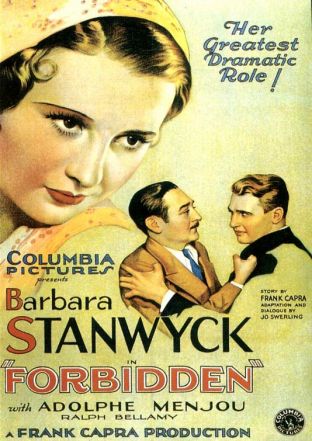
Barbara Stanwyck has an affair with married politician Adolphe Menjou, and subsequently has his baby, in “Forbidden” (1932).
From her first forays into sound film, Barbara Stanwyck was known for her portrayals of strong, gutsy, and independent women. In Illicit, she sleeps with her boyfriend without intent of marriage. In Forbidden, she carries out an affair with a married politician–then gives birth to his child. In Baby Face, she plays a fiery and motivated woman who works her way to the top of a company, entirely through sexual favors. Unapologetic about defending themselves and using guile and sensuality to their advantage, Stanwyck’s characters embodied the spirit of the pre-code era and threw the Catholic establishment into a rage.
Though studios were generally at liberty to film the content they wished (before 1934, censorship decisions were left to state boards), they were ultimately concerned about profit. The Great Depression was taking its toll on the movie business, and with budgets and salaries cut, no one could afford to take the chance of a movie bombing. Catholic groups, including the Catholic Legion of Decency, were handing out lists of films to boycott, and the films of Barbara Stanwyck often appeared at the top of the list. With everyone struggling to stay afloat, it was the moral crusaders threatening boycott who won out the vast majority of the time. When Illicit was released, some local censor boards barred any mention even of its title.
Two young lovers, happy simply living together without marriage, face the societal pressure to marry. Anne (Barbara Stanwyck) is reluctant to, as she thinks it will ruin their spark. Dick (James Rennie) is more inclined, but he respects Anne’s wishes. As the societal pressure begins to come from their own families, they finally do marry–but just as Anne had predicted, their marriage renders them dull toward each other and their marriage begins to fail.
Local censor boards in New York required a good deal of cutting to appease the powerful Catholic moral forces in the state before the release of Illicit, and some cuts were so drastic that parts of the storyline were altered. Many censor boards cut overt references to the couple’s intimacy, and required less suggestive angles to hide any implied immorality on the part of Dick and Anne. The drinking in the movie was also of concern to the censors, who wanted it taken out as it did not “progress the story.” New York was also one of the censor boards objecting to the title of the film, but ultimately the title stayed.
On the heels of Illicit, which understandably sparked a major outcry among religious conservatives and moralists, came Forbidden, potentially an even more scandalous film than its predecessor.
A young librarian, Lulu, meets and falls in love with Bob, a married politician. When she becomes pregnant with his child, she cuts contact with him so as not to burden him or ruin his rising career. But when he shows up at her house one day, her life unravels. For the sake of appearances, she and Bob devise a plan to pose the child as an orphan to be adopted by the Bob and his wife. His wife, none the wiser, gleefully adopts the baby and she is raised as her daughter. Lulu, initially posing as the governess of the child, is let go by the wife for lack of experience. The daughter grows up without ever knowing who her mother was. However, Lulu and the Bob never stopped loving each other, and due to circumstance, she ends up at his deathbed and he dies holding her hand.
Upon its release in 1932, Forbidden was hailed as a “screen masterpiece” by an Italian jury of film professionals and government officials at an international film screening in Milan. It features many of the hallmarks of Frank Capra’s later works, and is a superbly crafted melodrama. However, when Columbia asked for a re-issue in 1935, the request was denied. In “glorifying adultery,” the film was very much in violation of the code. The code further stipulated that any wayward woman was to be punished for her ways, and Forbidden did just the opposite–depicting Lulu as self-sacrificial and noble in her actions toward the politician and their daughter.
One of the last films to be made pre-code was also one of the most risqué. In fact, it is often said that Baby Face might have been the Catholic establishment’s last straw before the implementation of the Production Code, as the suggestions are so explicit that it leaves very little to the imagination.
Lily Powers is a working class girl who runs off to New York and progresses up the corporate ladder by sleeping with all the necessary men. She is involved with none of them, using them only as tools for her own success. She eventually marries a man for his money, but doesn’t realize the way she really feels about him until the end. She is portrayed as a smart, cunning, and resourceful woman, and her use of men to get what she wants is shown as a positive and almost necessary trait.
The original cut of Baby Face was deemed too inappropriate for state censorship boards in 1933, and failed to pass the New York board due to its unabashed sexual content. Changes were made to comply with the up-and-coming production code, including a modified ending with Lily losing everything and atoning for her sins, living a modest life in her hometown. But the censors could remove little without damaging the entire movie, as the sexual content is the very thing that drives the story forward.
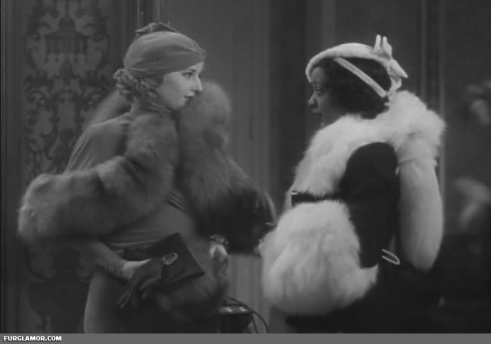
Another unique factor in this movie is the relationship between Lily and her best friend Chico, an African American woman from her hometown. The two join forces and run away to New York, and are fiercely loyal to each other throughout the movie. Interracial relationships of any kind were extremely rare in any film prior to the lifting of the production code in 1968, and this relationship between Lily and Chico is a lovely note in the film that serves to soften the hardened character of Lily into an emotional, feeling human being with a treasured best friend.
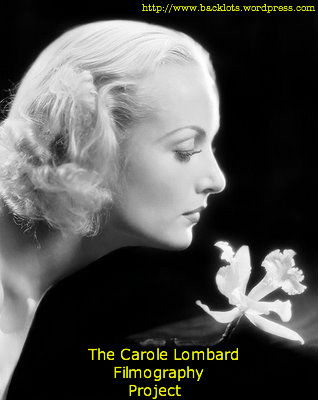
The Carole Lombard Filmography Project is back in full swing, after your humble author took it upon herself to put it on hold until the Dueling Divas Blogathon was finished. I am happy to say that Carole has come back, and the next film to be covered is one of my favorites, and a hallmark film in her career.
Much is made of Carole Lombard’s angelic and ethereal beauty. Despite her tragically short time in movies she was considered to be one of the great beauties of the 1930’s, and never was her beauty more apparent than in Nothing Sacred, the first screwball comedy shot in Technicolor and Carole Lombard’s first and only feature shot using the relatively recent invention. Nothing Sacred holds a place as one of the very first films to have made full use of Technicolor technology, and the visuals are strikingly soft, almost like a watercolor painting.
When discussing this film in film circles, it has become something of an expectation to bring up what a shame it was that Carole Lombard didn’t have a chance to make more movies in Technicolor, as color film was clearly a medium on which she could make her mark. Her gentle features are highlighted and accentuated, and it is difficult for the viewer to look at anyone else when she is onscreen.
Lombard plays Hazel Flagg, a young woman who has been told she is dying of radium poisoning. A New York newspaperman named Wally Cook (Fredric March), demoted to the obituary section as punishment for trying to pass an ordinary Harlem resident off as an African prince at a charity event, learns of her story and decides it would make a sensational news piece. However, little does Wally know that Hazel has just been told by her doctor that the diagnosis was incorrect, and she is actually in perfect health. When Wally goes to her hometown in Vermont, Hazel jumps at the chance to leave her small town in Vermont and go to New York City, not telling Wally that the diagnosis was incorrect. The name of Hazel Flagg becomes synonymous with tragedy, and no one doubts the validity of her story. But when Wally calls in a renowned expert on radium poisoning, everything begins to fall apart in hilarious ways.
Though Nothing Sacred is indeed considered a screwball comedy, it is strikingly dry in comparison to the zany and madcap My ManGodfrey, released the previous year. Nothing Sacred is a far tighter film–instead of being character-driven like My Man Godfrey, the complex satire that makes up the plot is the primary focus in this movie.
Underneath the humor, Nothing Sacred also makes a serious commentary on the influence of the news media and the nature of fame. Hazel Flagg symbolizes the ability of a single person to dupe and manipulate the media in order to achieve recognition, and Wally Cook is an example of the exceptional lengths to which a newspaperman will go to get a story. These are problems that continue to be relevant today, and in the aftermath of some recent political events the movie is all the more poignant. Through screwball humor and comedic antics, with Carole Lombard giving a magnificent comedic performance as Hazel, Nothing Sacred succeeds in touching upon a serious issue in journalism with aplomb, sharp wit, and a fair amount of irony.
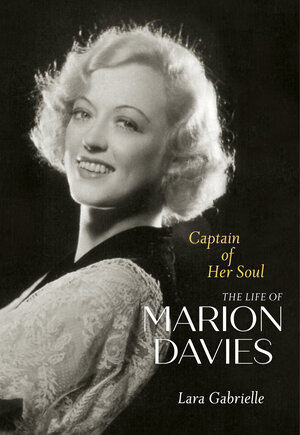
Captain of Her Soul: The Life of Marion Davies is now available at your favorite bookseller! Click hereto order it, and visit mariondaviesbook.com for all the latest.
Backlots is devoted to honoring and celebrating all aspects of classic film and is written by Lara Gabrielle, a California-based classic film writer and historian. Lara is the author of CAPTAIN OF HER SOUL: The Life of Marion Davies (UC Press, 2022).
Here you will find pieces on frequently seen classics and some lesser-known gems, as well as book reviews, festival coverage, and pieces on the history, theory and culture of film as it relates to the study of classic cinema.
Enjoy the site, and thanks for reading!
AFFILIATIONS & AWARDS
2019 CMBA Award for Best Profile of Classic Movie Performer or Filmmaker--"The Activism of Myrna Loy"
Winner of the 2018 CiMBA Award for Best Classic Movie Series, BACKLOTS AT THE COURTHOUSE: OLIVIA DE HAVILLAND VS. FX
Winner of the 2014 CiMBA Award for Best Profile of a Classic Movie Performer or Filmmaker: A Q&A WITH JOAN FONTAINE IN HONOR OF HER 96TH BIRTHDAY
Winner of the 2011 CiMBA Award for Best Classic Movie Discussion, THE FINAL SCENE OF THE HEIRESS
I am honored to be a judge of the Animal Film Festival in Grass Valley, CA.
EVENTS
BACKLOTS ON THE WEB
Join us at the Backlot Commissary, the place for Backlots' readers to share content and discuss movies!
Walter Pidgeon and Greer Garson in "Mrs. Miniver."
























_03.jpg)

 Backlots