It’s Sunday, everyone, and the divas are out in full force! I will be updating this page throughout the day as the entries come in. Here is our list of duels so far:
Christy over at Sue Sue Applegate gives us a rundown of June Allyson and Joan Collins in The Opposite Sex…and also gives us some insight into the rivalry between June Allyson and Joan Blondell over mutual hubby Dick Powell. http://suesueapplegate.wordpress.com/2013/12/22/that-darn-smack/
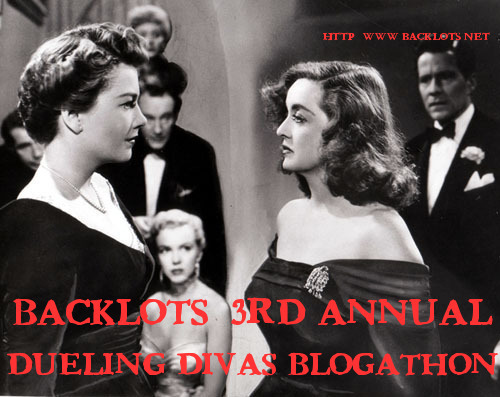
It’s almost here, folks! This Sunday, December 22, send in your posts for Backlots’ third annual Dueling Divas Blogathon and tune in to see those divas go at it! We have some great posts to look forward to this year. I will be writing on Margo Channing vs. Eve Harrington in All About Eve, with a focus also on the real life competition between the two actresses at the 1950 Academy Awards.
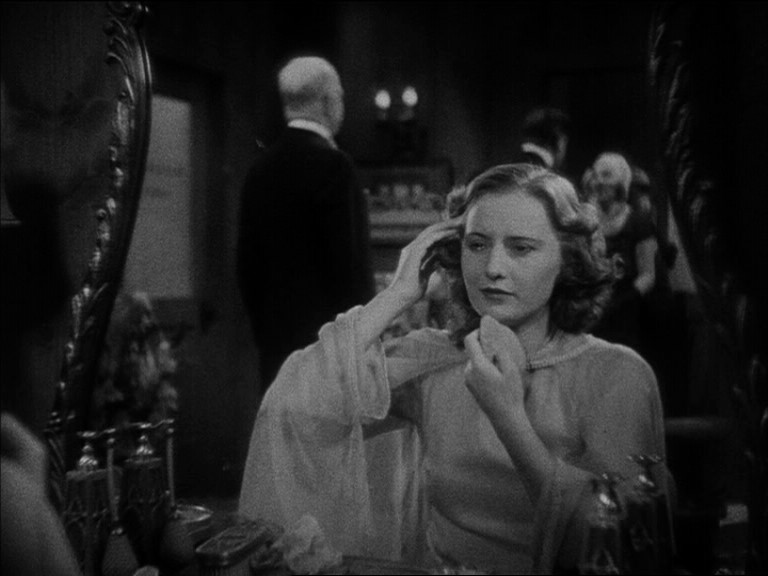
GIRLS DO FILM: Olivia de Havilland in The Dark Mirror
If you have not yet signed up to participate, it’s not too late! Send in your request and I will add you to the list. I always look forward to this blogathon, and if this year is anything like the previous two, it’s going to be a lot of fun.
To tide you over while those divas sharpen their claws for Sunday, here is a video from those dueling-est of dueling divas, the ladies from George Cukor’s 1939 classic The Women.
Yesterday was a rough day for classic movie fans. Hours after we got word that the legendary Peter O’Toole passed away, we heard that Joan Fontaine, with whom I had recently conducted an interview, also left us yesterday.
To me, Joan Fontaine was more than an actress. She was a kindred spirit. My connection with her went beyond the flickering screen–our correspondences were always warm and kind, and I felt like I had a friend in her.
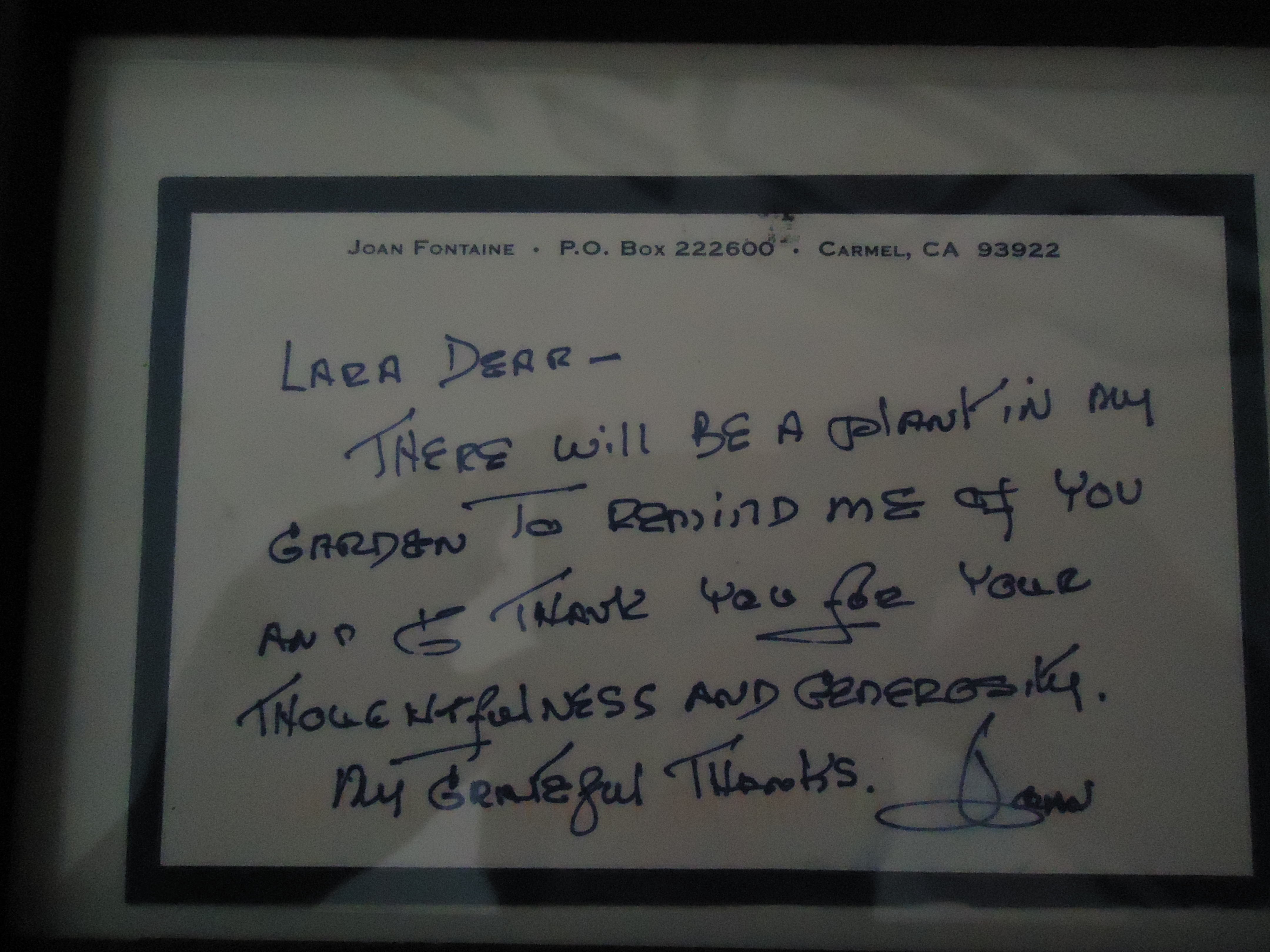
I feel that she was widely misunderstood by many, who heard of her often shy personality and mistook it for aloofness, or heard of her famous troubles with sister Olivia de Havilland and blamed her for them. Nothing could be further from the truth. I wrote Joan a few months ago with a letter about my meeting with Olivia de Havilland in Paris. She was interested to hear about my meeting Olivia and requested a letter about it, which she read eagerly. I got a response a few days later saying that she thanked me for the letter, and she enjoyed reading it.
I am reposting the interview I did with Joan in honor of her 96th birthday. It is the last interview she ever did.
It was an honor and a blessing for me to have such a connection with this remarkable woman. I loved her very much and I will miss her.
—————————————————————————————————-
A Q&A With Joan Fontaine in Honor of Her 96th Birthday
Joan Fontaine cuddles with a dog on the set of The Constant Nymph, 1943.
By Lara Gabrielle Fowler
October 22 marks the 96th birthday of Oscar-winner Joan Fontaine, an actress with the exceptional talent and intelligence to become a veritable Hollywood legend. Graced with a delicate, porcelain beauty, Joan captured Hollywood’s heart early on and with her formidable acting talent became the youngest performer ever to win a Best Actress Oscar, a record that was not broken for 44 years.
Born Joan de Beauvoir de Havilland in Tokyo in 1917, she moved to Saratoga, CA with her mother and older sister Olivia when she was 17 months old. Joan grew up in Saratoga (with a year back in Japan during her high school years) and acted in local productions before heading off to Hollywood following her high school graduation. She started in several small pictures, before her career suddenly took off and began to soar with her triumphant performance inRebecca (1940), for which she earned her first Academy Award nomination. She won the Oscar the following year for her role in Suspicion, and a third nomination came in 1943 for The Constant Nymph. She replayed many of her roles on radio and later took to the stage, notably in Tea and Sympathy and The Lion in Winter, among others, establishing herself as an extremely versatile performer.
Today, Joan lives in Carmel, CA and enjoys life at home with her 4 dogs (she is a lifelong animal lover) and a large garden. She moved to Carmel from New York City in the mid-1980s as she was just beginning to retire from a long and rewarding working life, and it was from Carmel that Miss Fontaine very kindly and generously agreed to answer some questions for Backlots. It is a great honor for me to be able to share them with you, and I hope that you will enjoy her answers as much as I greatly did.
A very happy birthday to Joan, and many more to come!
A Q&A WITH JOAN FONTAINE IN HONOR OF HER BIRTHDAY
You have a very unique name—Joan de Beauvoir de Havilland. I understand that the name de Havilland comes from Guernsey. How did your parents come to choose de Beauvoir as your middle name?
My parents paid tribute to a close family friend killed in service.
Shortly after the her arrival in California.
Your autobiography mentions that you have reaped many benefits from being born in Japan, and there have been few drawbacks. You mention the inquisitions into Japanese-born people after the bombing of Pearl Harbor as one of the drawbacks. What are some of the benefits you have had due to your Japanese birth?
Another culture. The wide world opening up.
Another question about Japan—having spent some time there as a teenager during the Depression, as well as time at home in the United States during the same period, what were your perceptions of the similarities and differences between Japan and the United States during that difficult time in history?
I was in school, so I wasn’t exposed during that time (Japan). And in the U.S., I was working, so again I wasn’t exposed to the hard times that so many were experiencing.
You began your career at a relatively young age, and acted alongside some of the most established stars of the period while you were still in your teens. Before your 25th birthday you were an internationally renowned Oscar winner. As a naturally introverted young person, were you aware of any stress or overwhelm due to all the attention that you received?
We were all actors doing a job. Everyone was professional. I respected them and they gave me respect. After the Oscar, things did change, they seemed intimidated.
Winning the Oscar for “Suspicion” at the 1942 Academy Awards ceremony.
Taking into account your international background, did you identify more as a British actress or as an American actress? I know that you officially became an American citizen in 1943. How, if at all, did that affect your identity within the industry, both within yourself and among your peers?
British. The parts I was given were for a British “lady”. I was cast because I was a young British actress. After becoming an American citizen, really nothing changed. By that time I was established.
With Alfred Hitchcock, a director with whom Fontaine was paired twice. In addition to securing Fontaine her first Academy Award nomination, the first film the two made together, “Rebecca,” was Hitchcock’s debut picture in the United States and the only Hitchcock film that has ever won Best Picture. Fontaine is also the only actress that has ever won Best Actress for a role in a Hitchcock film, for “Suspicion” the following year.
You are an extraordinarily versatile performer, appearing in films, on television, on the stage, and on radio. Which medium gave you the most pleasure, and for what reasons that you can pinpoint?
I have always enjoyed stage work. You can feel the audience reactions and are able to adjust your performance accordingly.
Like you, I am a native of the San Francisco Bay Area (born and raised in Oakland). As you are a person who grew up in the San Francisco Bay Area and moved back to the general area as an adult, I am very interested in your perspective on how things have changed. Can you tell me a bit about how the demographics, attitudes, pace of life, and landscapes were when you were growing up, as opposed to the way they are now?
This area has grown so much, it is almost unrecognizable.
The coastline along Carmel, CA, a place I consider to be among the most beautiful spots in the country.
I understand that you have a love for animals, especially dogs. If I am correct, you have 5** of them! Can you tell me a bit about your passion for animals and how it began?
Animals, all kinds, are one’s friends. As a child, Mother never allowed me to have pets. As an adult I found them to be loyal friends.
(**NOTE: I was under the impression that Joan had 5 dogs, but she crossed out 5 and wrote 4. One of her dogs unfortunately died, so she now has 4.)
At home with one of the many dogs Joan has had over the years.
You are a very multi-talented individual. In addition to your gifts for acting, you have also been an interior decorator, a licensed pilot, a cook, a balloonist, and an author. What do you consider to be your crowning achievement in life, regarding your work, your personal life, or your many hobbies?
Receiving the Oscar. Adopting a Peruvian girl.
Joan with her two daughters Martita (adopted from Peru) and Debbie, feeding the pigeons in Paris.
Well my goodness, readers. It has been a very long time since the last installment of the Carole Lombard Filmography Project, Backlots’ running series in which I attempt to see Carole Lombard’s complete filmography and blog about each film. A series of circumstances have pushed the project back by several months and that is why you haven’t seen much Carole here recently. But fear not, the CLFP is back and come hell or high water, it will be completed!
Today’s installment is a guest post from Melissa Gluck–a lawyer by day, classic film fan by night–who very graciously took the time to write a piece on No More Orchids and Carole Lombard’s contribution to the pre-Code era. Though thought of as mostly a screwball comedic actress, Carole Lombard made several quality pre-Code dramatic films and, had she lived longer, I would venture to say that she could have given such versatile stars as Barbara Stanwyck and Irene Dunne some stiff competition. As it was, however, Carole’s early death tragically cut short what was looking to be a very, very bright future and we will never know what was in store for her.
In this post, Melissa points out that this is Carole before her breakthrough comedic role in Twentieth Century, and No More Orchids showcases Carole’s talents in an entirely different way.
So without further ado, here is Melissa’s post!
—————————————————————————————————-
No More Orchids, and the pre-Code oeuvre of the Queen of Screwball
Carole Lombard. Among us classic film buffs familiar with her impressive body of work, her name evokes the well – deserved moniker “Queen of Screwball Comedy.” Her brilliant career was, of course, cut short by her tragic death in a plane crash in 1942 at the age of 33, and ardent fans such as myself still mourn the loss whenever watching her luminous, sparkling presence onscreen. I believe it is not an exaggeration to say that had she not died, she would very likely have done for television what Lucille Ball or Carol Burnett later did. She paved the way for these greats, with Lucille Ball confirming that her decision to do “I Love Lucy” was based in large part on the fact that her friend Carole had come to her in a dream and told her to take a chance and go ahead with the project.
Before Carole’s breakthrough in what is widely considered one of the pioneering films of the screwball genre, the wonderful “Twentieth Century” costarring John Barrymore, Carole did an impressive array of pre-Code films. Her performance in these has been widely overshadowed by her later success as one of the comedic greats of all time, however, after having watched movies such as “Virtue”, “Man of the World” and “No More Orchids”, I strongly believe that these long overlooked films are more than worth a look. Though one could argue that the plots are somewhat hackneyed, Carole still shines, captivating as ever. These movies showcase her burgeoning talent as a dramatic actress as well – a talent that was never fully recognized when her career was so tragically cut short. I believe Carole had an incredible versatility, and that there was no limit to what she could have done.
My focus today is on one particular film, “No More Orchids”. The 1932 film, directed by Walter Lang, was based on the novel by Grace Perkins, and also costars renowned character actors Walter Connolly as Carole’s endearing, sentimental and hapless father Bill and Louise Closser Hale as her wisecracking grandmother. Lyle Talbot plays her love interest, and this is an interesting role for Talbot, an actor who starred in over 150 “B” movies during his film career. As Tony Gage, Talbot is the proud, upstanding, thoroughly masculine, hard working man who draws the attention of the wealthy, spoiled heiress Anne Holt played by Lombard. They meet on an ocean liner traveling from Paris, whose departure is held up by Anne’s decision to go on a “joy ride” and return drunk, lacking consideration for the other passengers aboard. The ship waits for her because her demagogic grandfather Cedric (played by C. Aubrey Smith) owns it, making her the heiress to the “biggest fortune in America”.
As Anne stumbles onto the boat, her displeased grandmother informs her that she is in need of a “good walloping”. She enlists the help of fellow passenger Tony Gage, who carries Anne to her cabin. As Anne, Carole is as swift and witty with the wisecracks as ever but unlike the later madcap heiress role that would make her so famous, Anne is no Irene Bullock. She’s neither innocent nor sentimental, and quite aware of her sex appeal. All of this appears wasted on the stalwart Gage, who openly expresses his disdain for her. And of course there is the other fact that Anne is technically engaged to a prince, a marriage arranged by her curmudgeonly grandfather.
In what a find a particularly interesting scene, Anne spots Tony working out in the gym on the cruise liner. Anne watches with rapt attention, captivated by his unbridled masculinity, the scene and is an interesting one because the sexual tension between them is so palpable and the snappy dialogue so witty. This, among other scenes in the movie, would never have been possible after the implementation of the Hayes Code. The movie continues to deal pretty openly with sex throughout. It should also be noted that this scene makes use of Carole’s talent for physical comedy (in a sequence in which she attempts to keep up with Tony on an exercise bike while clad in a gown and furs), a talent that would become one of her trademarks.
The chemistry between the leads is obvious, but instead of Tony pursuing Anne until he finally breaks her down, it is quite the other way around. It is Anne who must convince Tony of her sincerity. It is not Tony who has to prove himself, but Anne, who must in effect make up for the fact that she is a product of wealth and privilege and show Tony her substance as a person. And this is a role Carole handles deftly, switching from wildly flirtations to petulant to gleefully infatuated to heartsick.
The plot is in some ways standard, hackneyed pre-Code fare: a romance that traverses the boundaries of economic class and thereby confronts the formidable obstacle of a firmly entrenched social hierarchy – embodied by Anne’s cruel, unforgiving grandfather. Cedric is determined to have Anne marry into royalty and will stop at nothing to ensure that she does so. He has the leverage to do this because he knows that his son-in-law’s bank is failing, and without financial help Anne’s beloved father Bill will likely go to prison. This of course requires a sacrifice on the part of Anne, and throughout the film we see her go from entitled to selfless. Carole handles this role adeptly, using facial expression, tone of voice and body language to convey her character’s transformation.
No More Orchids is, of course, still a 1932 pre-Code romance, and thus includes all of the melodrama that goes along with it. However, it has much to recommend it as it includes humor, a snappy dialogue and some truly fine performances. At the risk of giving away the ending I won’t go into too much more detail here other than to say that the conclusion itself is not entirely standard fare pre-Code material.
It’s thoroughly enjoyable, and a must-see for Carole fans.
Thank you to Melissa for her wonderful guest post, and I will see you next time!
As passion for classic Hollywood is such a specific niche, most classic film fans have a story about how they became interested in it. Some who are passionate about classic film can trace it to their childhood, and some came to love classic movies as adults. Most of the time, there is one specific film that fans are able to pinpoint as the driving force behind their love of old Hollywood.
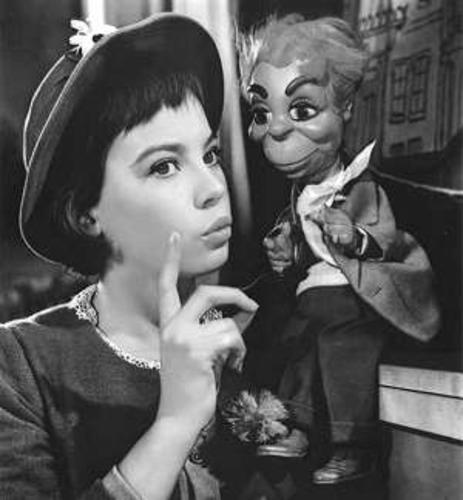
This is the focus of this year’s CMBA blogathon, Film Passion 101. Members are to write about the film that was the impetus for their love of old Hollywood, and the story that goes along with it. For me, the story goes back to my earliest childhood and the movie was Lili, released in 1953 and starring Leslie Caron and Mel Ferrer.
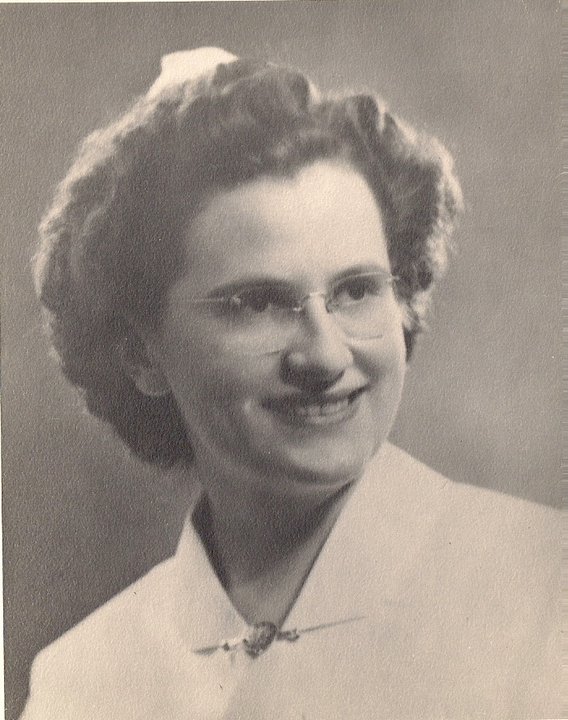
I was lucky enough to have grandparents who always lived close by and were a large part of my growing up. There was always talk of movies around my grandparents’ house–my grandmother loved movies and was very knowledgeable about them. Growing up in a large Russian Jewish immigrant family in Winnipeg, Canada, my grandmother had been very poor as a child and life was difficult. Her escape was the movies, and she developed a keen fascination for the lives of the personages onscreen. She soon became a movie expert, something she held onto for the rest of her life and when she became a nurse, she worked at Cedars of Lebanon Hospital where many major movie stars received treatment. After I became enamored of classic movies, she would regale and delight me with stories of all the big stars she took care of.
My grandmother, circa 1946.
Almost as soon as I was born, my grandmother started showing me movies. I saw The Red Shoes, Les Demoiselles de Rochefort, and Brigadoon almost before I could walk, and I still treasure those memories. But it wasn’t until I saw Lili at age 5 that I really became obsessed with movies.
In many ways, Lili is not a children’s movie. It has dark themes, including strongly suggested sexual abuse and attempted suicide of the main character. Even the puppets, used as a tool of the puppeteer to get the attention and love of the main character, are bizarre and slightly creepy. But at the age of 5, all of that went right over my head and I was taken immediately by the beautiful colors, the catchy music, and the main character’s sincere interaction with the puppets.
Lili is a young orphan who goes to find a baker friend of her father’s who her father said would help her. When she gets to the address, she finds that he is dead but the shopkeeper who owns the business gives her a room in exchange for work. After he sexually assaults her, she flees. She is rescued by a carnival magician, who offers her a job as a waitress for his dinner show (where he is assisted by the sexy Rosalie, played by Zsa Zsa Gabor) at the circus. But Lili is more interested in watching the show than waitressing, and she is fired. Not having anywhere to go, she climbs the ladder to the diving board at the circus where she intends to jump. Halfway up the ladder, she hears a voice calling out to her from down below, asking her to stop. The voice is coming from a puppet on a puppet stage with red hair and freckles, and she warily comes down and starts engaging in conversation with the puppet, called “Carrot Top.” Soon, several other puppets join in the conversation (“Reynardo,” a fox, “Marguerite,” a ballerina, and a giant named “Golo”) and they begin to sing a song that Lili had sung with her father. A crowd forms, and Lili is given a job with the puppet show.
The puppeteer, Paul (played by Mel Ferrer), is a former dancer who suffered a leg injury in the war that ruined his career. He started puppeteering to make ends meet, but he finds it inferior to his career as a dancer. He soon falls in love with Lili, but fears that she will reject him due to his impairment. Lili, meanwhile, is in love with Marc, the magician who saved her from the shopkeeper. Soon, Marc decides to leave the act, taking along Rosalie, his sexy assistant, who soon reveals that she is his wife. Lili is heartbroken, and invites Marc to her trailer where he tries to seduce her. Paul walks in, and his plans are thwarted. Afterward, Lili finds Marc’s wedding ring in her couch cushion. She tries to run after him, but Paul, thinking that she is running after him for love, stops her and slaps her for being a fool.
Lili decides to leave the carnival. She gives Marc back his ring and tells him that every girl has to wake up from her selfish dreams. As she leaves, she is stopped by Carrot Top and Reynardo, who ask her to take them with her. She remembers that there is somebody behind the curtain and pulls it back, revealing Paul. They have an argument, Paul telling her that several impresarios from Paris have come to offer him a job, and Lili telling him that he is incapable of love and accusing him of hiding behind the puppets. He responds that he is the puppets, with all their different personas. Lili concludes the argument by walking away and intending to leave Paul forever. As she leaves the carnival, she thinks of all the puppets and a small dream sequence ensues with the puppets, all life-size, turning into Paul. She rushes back to the carnival and falls into Paul’s arms…while the puppets applaud.
The relationship between Lili and Paul is a complex one. On the one hand, Paul wants to love her but doesn’t know how. He was mean and abusive to her, and the fact that Lili ends up with him at the end is a bit troublesome–in that she is essentially going back to a man who abused her. On the other hand, it can be said that this was Paul’s awakening, and he now knows how to love. From a modern feminist standpoint, it is a difficult ending to come to terms with, and is certainly a male-centered one. As an adult, I have trouble with the ending, but it’s difficult to think of a better one, especially in a film made under the code where Lili could not have broken up Marc’s marriage.
Whenever I would go over to my grandparents’ house, my grandmother would take me to the video store to pick out a movie and for several years, it would ALWAYS be Lili. I memorized the exact location of movie in the store, and would always make a beeline right for it. I loved it so much that I would watch it again and again, until finally my grandmother made an executive decision to try to expand my horizons. One day I discovered that my grandmother had brought a different movie home from the store herself–Meet Me In St. Louis. At first I was terribly distraught that I couldn’t watch Lili, but Meet Me In St. Louis simply expanded on what Lili had started. I was officially a bona fide classic movie fan at the age of 7.
My grandmother passed away in 2010, and I miss her terribly. But I thank her every day for showing me Lili and introducing me to classic movies because without her and without that movie, I wouldn’t be the classic film fan I am today. Thank you to my grandmother, and thank you to the CMBA for hosting this blogathon, providing me with an opportunity to write this story.
Glamor, fashion, and beautifully seductive images are hallmarks of George Hurrell’s unmistakable photographic style. The preferred photographer of many classic Hollywood stars, he became indelibly associated with the Golden Age of Hollywood, and one of the most famous names in portrait photography.
Jean Harlow as photographed by Hurrell. As seen in GEORGE HURRELL’S HOLLYWOOD.
Never has Hurrell been more aptly celebrated than in Mark Vieira’s big and beautiful new coffee table book George Hurrell’s Hollywood (published by Running Press Books), that chronicles Hurrell’s life and work, his relationship to his photographic subjects, and his growth as a photographer over the course of his monumentally lengthy career. A detailed biography of Hurrell is accentuated by hundreds of stunning photographs, ranging from Norma Shearer and Joan Crawford all the way to Sharon Stone and Michael Douglas.
Carole Lombard, as photographed by Hurrell. Seen in GEORGE HURRELL’S HOLLYWOOD.
Vieira was a longtime friend of Hurrell’s, and draws on exclusive archival research, interviews, and diaries to create a portrait of the artist never before seen in any book. He details Hurrell’s rise to fame, his flourishing career in Hollywood’s Golden Age, and ultimately his perseverance when times got extremely hard due to scandal and corruption from the underworld of the art collectors’ community.
The book is also a treasure trove for lovers of old Hollywood gossip, providing the reader with information about the mystery of Greta Garbo that existed offscreen as well as on (Vieira relates an anecdote on the unusual way in which Hurrell finally succeeded in getting Garbo to smile for a picture), the eccentricities of Marlene Dietrich, and the resistance of Olivia de Havilland to Hurrell’s unorthodox methods of getting a shot. One of my favorite parts of the book is an examination of how Hurrell airbrushed his subjects. A famous Hurrell photograph of Joan Crawford, glamorous, sexy, and a true movie star, is shown alongside its original negative–and we see Crawford as the freckle-faced, normal woman she was when she came into Hurrell’s studio. The difference between the two photographs is astounding, and shows what Hurrell was capable of long before the days of digital airbrushing and Photoshop.
Hurrell expanded his horizons a bit during the second half of his career, photographing such musical notables as Diana Ross, David Bowie, and Natalie Cole (Hurrell’s photograph of Cole appeared on the cover of her album Unforgettable…With Love). Sharon Stone, his last photographic subject, provides the foreword to this book and an alluring photograph of Stone graces the first page of text.
Hurrell’s photograph of Sharon Stone that appears alongside the foreword of GEORGE HURRELL’S HOLLYWOOD.
Click here to order your copy of the book. George Hurrell’s Hollywood is a must-have for anyone interested in classic Hollywood, photography, the art world, or simply the life of a fascinating personality whose career survived multiple setbacks and difficulties. A truly loving and fitting portrait to a photographic genius, featuring 420 breathtaking images that testify to the man and his art.
Joan Crawford in 1930, as seen in GEORGE HURRELL’S HOLLYWOOD.
For the past few months I have been on a rather unshakable Barbara Stanwyck kick. I have always been aware of her gifts as an actress and have always enjoyed her work, but over the past few months I have not been able to get enough of her. All this was simply expanded when I had the honor to interview Victoria Wilson, the author of the new Barbara Stanwyck biographyA Life of Barbara Stanwyck: Steel True 1907-1940–and when my book arrived, I devoured it almost as quickly as it reached my hands. I’ve gone mad for Missy (the nickname given to her by a maid in the 1930s that stuck), and there seems to be no turning back now.
Thus, I have decided to make a post on what is one of my favorite Stanwyck films that does not seem to get enough credit. It is The Miracle Woman, co-starring David Manners and released by Columbia in 1931 under the direction of Frank Capra. This was Stanwyck’s second film with Capra after 1930’s Ladies of Leisure, and would be followed by three more collaborations over the course of 11 years.
The Miracle Woman draws much of its material from the life of popular preacher Aimee Semple McPherson and from the hit 1927 novel Elmer Gantry. A scathing critique of popular Christianity and revival meetings featuring charismatic preachers, Elmer Gantry was banned in several cities across the United States for denouncing popular preachers as frauds and false prophets. Several key components in the book are reflected in The Miracle Woman, not the least of which seems to be the similarity of the names of the main female characters, “Sharon Falconer”in Elmer Gantry and “Florence Fallon” in The Miracle Woman.
Florence Fallon hushes the crowd.
Florence Fallon is a preacher’s daughter who calls out the sins of her father’s congregation after they cast him out shortly before his death. Her impassioned speech scares the congregation out of the church, but one person remains–an out-of-towner named Hornsby who sees the fire in her soul and teaches her how to make money preaching.
I must digress from the plot a bit to tell you to watch how Barbara Stanwyck, age 23 and still a novice in Hollywood, plays this scene. A true testament to her gifts, and to Frank Capra’s understanding of her as an actress. In his autobiography, Capra states that in his films with Stanwyck, he rehearsed with the entire cast before he brought her in. Stanwyck gave her best performances, he said, on the first take. If he tried to do multiple takes with her, the subsequent performances would merely be carbon copies of the first. That fact makes this scene even more astounding.
Florence teams up with Hornsby to create a veritable preaching empire, beginning with broadcasts over the radio and branching out into revival meetings for her loyal followers. One man named John Carson, a veteran who was blinded in battle, hears Florence’s voice over the radio just as he was about to commit suicide over the misery of his condition. Her voice and words make him find new light in his life, and he decides to attend one of her revivals. There, he volunteers to sit in the cage of lions to prove that one cannot be hurt with “love and understanding in your heart.” We soon learn that, much to Florence’s disillusionment, he is the only volunteer that has not been pre-selected by Hornsby and paid to feign healing.
John hears Florence Fallon’s voice for the first time.
On her way out of the theatre, she runs into the man again. She offers him a ride home in the rain, and he offers to bring her into his home. They start to talking, and cultivate a close friendship. Soon, it turns into romantic love. Florence begins sending him notes, assembled tirelessly in raised letters so that he can “read” them.
At a party, one of the staff members of Florence Fallon’s revival show demands a share of the profits, and threatens to expose her as a fraud if he doesn’t get it. In the paper a few days later, we see that the worker has been found dead. The staff suggests that they move to a different town to get away from the scandal. When Florence refuses telling him that he doesn’t own her, Hornsby claims that he holds a sort of “first mortgage.” Then he assaults her, grabbing her body and kissing her on the lips.
This scene shows more evidence of Stanwyck’s magnificent acting abilities. When Hornsby grabs her and she eventually pushes him away, the horror on her face is real, palatable. She holds a hand to her mouth, and her eyes show legitimate fear. As she begins to warn him of what will happen if he ever does that again, her voice quivers with shock. This is an incredibly nuanced, emotional moment, one that requires intense emotional depth from its 23-year-old actress. And Stanwyck delivers.
It is also this scene that establishes Hornsby as a malicious character. Shortly thereafter, and following a birthday celebration with John in which they declare their love for each other, Florence sees a newspaper article that says she is going to the Holy Land. When she asks Hornsby to retract it, he refuses–saying that his idea of the Holy Land is Monte Carlo, and they will go together. Florence resists him, until Hornsby says that it’s either Monte Carlo or jail. He plans to frame her for embezzlement of funds, or pin on her the death of the staff worker.
In tears before her final sermon.
This leaves Florence no choice but to go with him–and when she sees John to tell him that she is going away, she exposes herself as a fraud. John does not care, and hatches a scheme to make her think that she really can perform miracles. Before Florence’s farewell tour, he pretends to be able to see to make her think that she has performed a miracle on his eyesight. She is not fooled, but credits him with a miracle nonetheless–that he “made [her] see.” It is at this moment that she officially separates herself from Hornsby, just before she goes onstage. Hornsby sees that John is the catalyst for this, and knocks him out after Florence leaves the room.
As Florence goes onstage, Hornsby gets his revenge. He allows an electric fire to start, and the tabernacle burns. John is awakened by the smoke, makes his way down to the stage and rescues Florence from the fire. He spends a few days in the hospital, where they begin to repair his eyesight. Florence gives up preaching and instead joins the Salvation Army. A telegram at the end of the movie shows that she and John are to be married, delivered as Florence marches with the rest of the Salvation Army, singing “Battle Hymn of the Republic” as the movie ends.
The ending of The Miracle Woman is taken almost entirely from Elmer Gantry, but differs slightly in an important way. In the latter story Sister Sharon Falconer perishes in the fire, prompting the main character, Elmer Gantry, to give up his religious ways. In The Miracle Woman, religion is treated with more reverence. Florence is rescued from the fire and simply finds a new and better outlet for her religious convictions.
A publicity still with Barbara Stanwyck and David Manners.
There was an official production code in place in 1930, but its enforcement did not begin until 1934 (incidentally, following a string of risque Barbara Stanwyck films. I wrote a post on the subject nearly a year ago, click here to read it). One of the restrictions outlined by the Production Code of 1934 was that religion was to be treated with nothing but reverence–thus this film likely would not have passed the censor board had it been made under the Code due to its questioning of the legitimacy of religious revivals, regardless of Florence Fallon maintaining her religious devotions at the film’s conclusion.
Though The Miracle Woman was made several years before the strict enforcement of the Production Code, filmmakers were still limited by common standards of what the public would accept. In order to appease the influential masses of Christian viewers, Capra and Columbia played it safe with this story, avoiding the issue of religious denouncement that was the hallmark of Elmer Gantry. In doing so, they created a unique film–one that both celebrates religion and questions it. The Miracle Woman really makes us think, which is a sure sign of a well-made film.
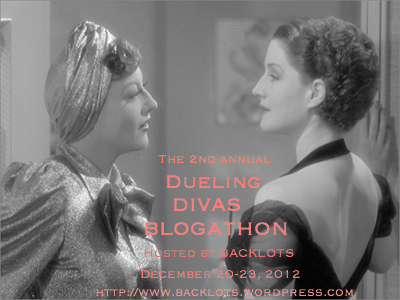
Take a seat and get ready to see some sparring, ladies and gentlemen, because on December 22 for the third year in a row, Backlots will be hosting the Dueling Divas Blogathon! This blogathon has proven to be lots of fun in the past, and always elicits very interesting entries. I look forward to what’s to come this year!
On December 22, write about your favorite dueling divas. Your piece can be on one of those legendary offscreen duels (ex. Bette Davis and Joan Crawford) or an onscreen one (ex. Eve Harrington and Margo Channing). You can even write about an actress (or actor, we’re gender-neutral here at Backlots!) who played a dual role in a classic film if you would like–such as Olivia de Havilland in The Dark Mirror or Hayley Mills in The Parent Trap. We don’t often get many entries of this type, but it’s there if you want it!
Olivia de Havilland in THE DARK MIRROR.
You don’t have to just focus on two people. You can talk about the various duels a single actor had (good heavens, Bette Davis’ duels alone could fill a book!) or duels within a group. Last year I wrote about the divas in The Women, which was a lot of fun.
So to sum up, here are the guidelines on who to write about:
Those who had a rivalry in real life, either over a particular film role or over a personality clash, ie Bette Davis and Joan Crawford
Those who had a rivalry on the screen, ie Mildred and Veda from Mildred Pierce
Any dual role played by an actor or actress in a classic film, ie Hayley Mills in The Parent Trap.
Please do try to stay on track with the theme! Since this is an open-ended blogathon with a lot of choices, it’s easy to get carried away. But if you just refer to the guidelines above, you’ll be good to go.
Comment on this post with your diva choices and I will add you to the list. So far we have:
Well, readers, today was an exciting and exhausting day to say the least. It began around 9:45 in the morning when, running on adrenaline and caffeine only (I didn’t get very much sleep), I arrived at the Warner lot for the VIP tour. After getting formally acquainted with several classic film bloggers whose names I knew well, we were led into a special screening room where we watched a short video of the history of Warner Bros. and then headed out on the tour itself with our friendly guide, John.
We bloggers got some very special treatment–our first stop was the costume department, which is not normally part of the tour. There, a woman by the name of Elaine showed us stock costumes while explaining to us how the costume system works at Warner Bros. It turns out that costumes are owned by Warner Bros. but can be rented by other studios–there is a bit of a kinship there that allows costumes to be shared. Upon questioning her about a sign on one of the door that said “Trades not allowed,” Elaine also informed me that there is a trade system in place for some of the costumes. If a costume from the collection is lost or damaged, often the person who lost or damaged it can replace it with another costume of the same value. However, in that particular department, trades are not allowed if the costume is lost or damaged. The person must pay, out of pocket, the value of the costume. Very interesting stuff, and really gives you an insight into some of the politics of the inner departments of the studio.
Some hats from 1920-1960.
As many of my readers know, I am a big fan of Barbara Stanwyck and was keen to know where Stanwyck’s pre-Code Warner Bros. films were shot. I posed my question to John, who was wonderful in getting the answer to me. He handed the question off to several people until I finally got an answer, and the answer was that most of the Barbara Stanwyck pre-Codes were filmed in Studio 14. When we passed Studio 14 later, John incorporated this new information into the tour. The Warner Bros. tour guides clearly respect and value new information, and I appreciated his diligence in answering my question and imparting it onto the whole group.
A scene from BABY FACE, shot on Warner Bros. Stage 14.
One of my favorite aspects of the tour was the prominent inclusion of A Star is Born. Having seen the movie at least two dozen times, I recognized the set where the opening shot was filmed, and we also passed Stage 7 where many prominent films were shot including A Star is Born, 42nd Street, and Casablanca. Though there were ladders blocking the bottom part of the plaque, I was able to get a bit of it in a picture. I hope you can read the text!
From the opening shot of A Star is Born.
Halfway through the tour, we got a taste of the more modern Warner Bros. with a visit to the set of Friends. As this was a tour specifically geared toward bloggers, several of us classic film bloggers, John was kind enough to also include a lamp from The Maltese Falcon that appears alongside the Friends set. It was fascinating for me to experience the gamut of Warner Bros. through my lens of a classic film fan. It truly gives the visitor a holistic view of the company, and how its history (with which I am mostly familiar) has shaped its present.
The tour ended with a bang, as we were given special access to take pictures in the museum, something not generally allowed on tours. I have a real soft spot for costumes, so I was thrilled to be able to take photos of such costumes as the three dresses shown below.
Costumes worn by Joan Crawford (left) and Elizabeth Taylor.
Harry Warner’s granddaughter, Cass Warner, happened to be on the lot that day and visited with our group, which was a wonderful moment. She is part of Warner Bros. 90th anniversary speaker series, “Meet the Family,” telling the story of the Warner family through the eyes of its members. Cass has her own production company, the Warner Sisters, that is doing very prominent work in the industry right now. She also shared stories of the family, how she wanted the Warner record set straight. People often think of the movie moguls of classic Hollywood as being tyrannical and controlling–and Cass Warner wanted to reiterate that her grandfather was a loving man with whom she was close. She has also devoted much of her life to learning more about her family history. “I’m sort of the family detective!” she joked. She was very interested in the work we classic film bloggers were doing, and I was lucky enough to get a picture with her.
The tour ended at the commissary, where we were given a very delicious lunch. My blogging friends Kimberly Truhler, Kristen Lopez, Elise Crane Derby and I had exciting and lively discussions about our favorite classic film stars, little-known old Hollywood gossip, and our modest but vibrant online classic film community. We are indeed a rather small, devoted, and tight-knit bunch.
I got an added bonus after the tour–my friend Marya, who works at the Warner Archives, brought me up to see the closet where they keep all the Warner Archive DVD releases. Needless to say, I was like a kid in a candy shop. Marya and I talked about all the movies, I got to see where she works, and of course I got a picture with Robbie the Robot.
I can’t imagine a more fun-filled day for a classic movie fan. I departed Warner Bros. an exhausted, but very happy blogger.
Now for the good stuff!
If you would like to go on a Warner Bros. tour, I would highly recommend it. It was a lot of fun, and if you’re a film fan in L.A. it’s a great thing to check out. The VIP tour package looks like this:
Departs: Mon-Sat 8:15am-4pm and Sundays (limited availability) Duration: 2hrs 15 min Cost: $52.00/person Children 8yrs + are welcome
We technically went on a VIP tour, but with the added special access it was actually more like a Deluxe tour in many ways. This is what the Deluxe tour looks like:
Departs Mon-Fri 10:15 am
Duration: 5 hrs.
Cost: $250.00/person
As I mentioned before, Cass Warner is speaking on tours through the end of the year, so if you would like to see her then this is the time to go. Also, apparently there is a tour in French, if you (like your author here!) speak French. However, act fast for that one because it’s only going on through November.
If you’re in Los Angeles and have a school or club who would like to see Warner Bros., give them a call because hey have special discounts for groups larger than 24. More information can be found on their website.
Thank you, Warner Bros., for this wonderful opportunity!
As I write to you, dear readers, I am on Highway 5 heading from my home in Oakland down to Los Angeles. The purpose of my visit, this time, is to blog for the Warner Bros. 90th Anniversary VIP tour which is happening tomorrow. I was invited along with several other classic film bloggers to be among 10 featured writers on the tour.
A brief history of the company: Warner Bros. was founded by four brothers, Albert, Sam, Harry and Jack Warner who had been collecting and distributing films for many years, in 1923. It remained a fledgling studio until Warner Bros. had the foresight to see that the future of movies was based in sound. In 1927, the studio released The Jazz Singer and Warner Bros. became a household name.
In the 1930s and 1940s, Warner Bros. had under contract some of the most gifted and eminent stars in the business. Bette Davis, Olivia de Havilland, Errol Flynn, Edward G. Robinson, Humphrey Bogart, and directors such as Michael Curtiz, Busby Berkeley, Mervyn LeRoy and William Wellman all called Warner Bros. home at seminal points in their careers. Such diverse films as The Maltese Falcon, Casablanca, A Star is Born, My Fair Lady, Cool Hand Luke, and The Exorcist were all shot at Warner Bros., securing the studio a reputation for staggering versatility.
Today, Warner Bros. is known and appreciated by classic film fans for the incredibly vast library of films available in the Warner Archive. Previously unreleased or rare films get a new audience with the Warner Archive Collection, and it has proven to be a very valuable resource to those researching classic film. It recently procured a license to release Paramount pictures under the Warner name, so the releases from the Warner Archive will continue to grow exponentially as time goes on.
The Warner Archive release of Thirteen Women.
In recent times, many high profile television shows have been shot at the studio, and on the tour I expect to see the sets of modern television shows like ER and Friends, both shot at Warner Bros. in the 1990s. I will be taking pictures and live-tweeting, and at the end of the day I will make a blog post here about my experience and some information about the Warner Bros. tours themselves, should you want to go on one.
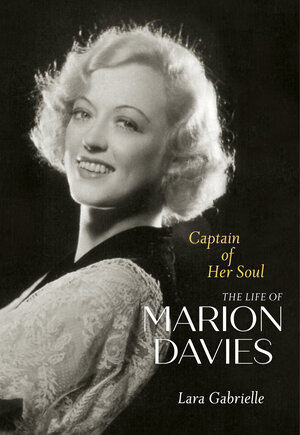
Captain of Her Soul: The Life of Marion Davies is now available at your favorite bookseller! Click hereto order it, and visit mariondaviesbook.com for all the latest.
Backlots is devoted to honoring and celebrating all aspects of classic film and is written by Lara Gabrielle, a California-based classic film writer and historian. Lara is the author of CAPTAIN OF HER SOUL: The Life of Marion Davies (UC Press, 2022).
Here you will find pieces on frequently seen classics and some lesser-known gems, as well as book reviews, festival coverage, and pieces on the history, theory and culture of film as it relates to the study of classic cinema.
Enjoy the site, and thanks for reading!
AFFILIATIONS & AWARDS
2019 CMBA Award for Best Profile of Classic Movie Performer or Filmmaker--"The Activism of Myrna Loy"
Winner of the 2018 CiMBA Award for Best Classic Movie Series, BACKLOTS AT THE COURTHOUSE: OLIVIA DE HAVILLAND VS. FX
Winner of the 2014 CiMBA Award for Best Profile of a Classic Movie Performer or Filmmaker: A Q&A WITH JOAN FONTAINE IN HONOR OF HER 96TH BIRTHDAY
Winner of the 2011 CiMBA Award for Best Classic Movie Discussion, THE FINAL SCENE OF THE HEIRESS
I am honored to be a judge of the Animal Film Festival in Grass Valley, CA.
EVENTS
BACKLOTS ON THE WEB
Join us at the Backlot Commissary, the place for Backlots' readers to share content and discuss movies!
Walter Pidgeon and Greer Garson in "Mrs. Miniver."


 Joan Fontaine cuddles with a dog on the set of The Constant Nymph, 1943.
 Shortly after the her arrival in California.
 Winning the Oscar for “Suspicion” at the 1942 Academy Awards ceremony.
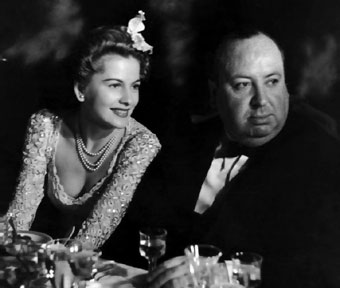 With Alfred Hitchcock, a director with whom Fontaine was paired twice. In addition to securing Fontaine her first Academy Award nomination, the first film the two made together, “Rebecca,” was Hitchcock’s debut picture in the United States and the only Hitchcock film that has ever won Best Picture. Fontaine is also the only actress that has ever won Best Actress for a role in a Hitchcock film, for “Suspicion” the following year.
 Joan with her two daughters Martita (adopted from Peru) and Debbie, feeding the pigeons in Paris.



























_03.jpg)

 Backlots