


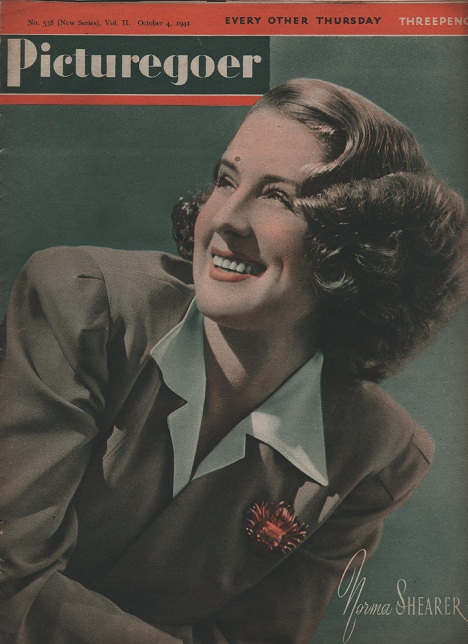


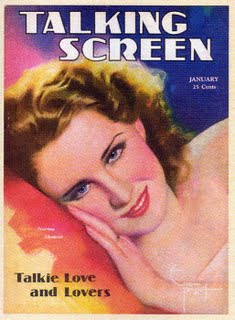


Today is what would have been the 109th birthday of Backlots’ Star of the Week, Norma Shearer! One of the great stars of both the silent and sound eras, her birthday deserves to be celebrated.
One very sad thing I don’t understand is how her name seems to be lost on those not interested in classic film. She made so many incredible, high quality movies, and is horribly underrated in modern culture. I guess since she retired relatively early, and her films don’t tend to be shown on television outside of TCM, her visibility is limited these days. However, the love and appreciation of her within the classic film community more than makes up for the lack of it outside. Silent film fans basically bow to her, and she is universally hailed by critics as one of the finest actresses of her time. Her films are frequently shown on TCM because the powers that be know that their demographic WILL watch her. I just think it’s a shame that more people aren’t aware of her brilliance as an actress.
A question for readers: What is your favorite Norma Shearer movie?
Here is a photographic and video tribute. Happy birthday Norma!


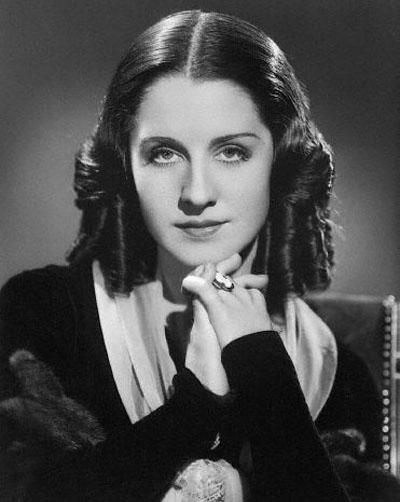


With fan mail, 1925
The Women, 1939
Part 1 of The Divorcée. Norma Shearer was pitted against herself at the 1929-1930 Academy Awards–nominated twice in the same category. She won for The Divorcée. The entire movie is youtube for your viewing pleasure!
Posted in Lara Gabrielle Fowler
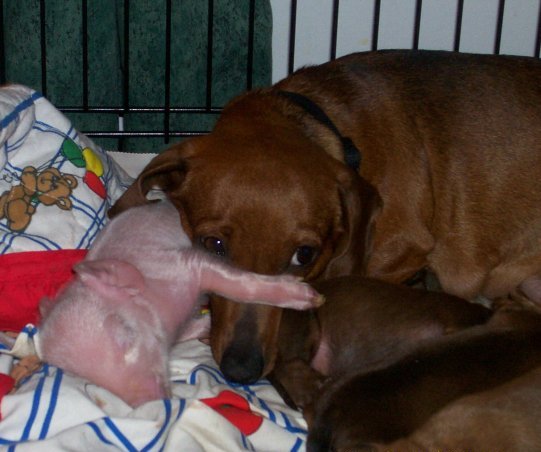
I am writing this in a state of distress, because the dog I was looking after has just died. She was very old, and seemed to have died in her sleep. It’s a real reminder of how fleeting life can be, and this was the most alive, sweet dog you could ever imagine. As a tribute to Weasy, and as sort of a healing for myself, I am doing a post on dogs in the movies.
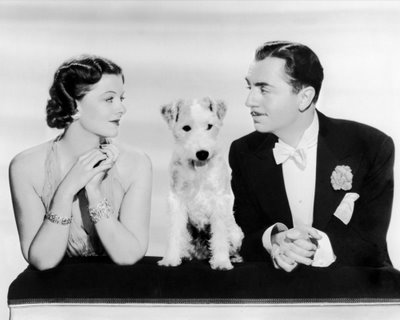
ASTA
Asta was the dog in the Thin Man movies, who also had a good career in films like The Women, Bringing Up Baby, and The Awful Truth. Originally named Skippy, his was a very comedic dog, whose name was changed to Asta after his popularity in the Thin Man movies. His trainers were Henry East and Frank Weatherwax.

TOTO
Terry, a female Cairn Terrier, was cast to play Toto in The Wizard of Oz in 1938. She was paid $125 per week, which was more than the Munchkins were paid. Because of the popularity of the role, and because this was the role she was most known for, Terry’s trainer Carl Spitz officially changed her name to Toto. She died in 1945, after a career that spanned 13 films.

LASSIE
Lassie was actually played by a number of dogs, all male. The first of these was Pal, who appeared in seven films at MGM between 1943 and 1951, and the future Lassies, in film and on television, were all descendants of his–Lassie Junior, Spook, Baby, Mire, Hey Hey, Boy, The Old Man, and Howard played the dog until the late 1990’s. In 1997 the company producing the Lassie series got a new, non-Pal descended dog, but due to fan outrage, Hey Hey II was employed instead. Lassie has continued to be a fan favorite, ever since the first Lassie movies in the early 1940’s. Most of the Lassies were trained by Frank Weatherwax.

OLD YELLER
Old Yeller, whose real name was Spike, was a dog who was found at the Van Nuys animal shelter, and whom Frank Weatherwax rescued for $3 as his personal dog. When he learned that Disney was casting Old Yeller, he urged Disney to accept him for the role of the titular dog, and he was accepted. Spike has the distinction of being a dog in one of what is called the most tearful scenes in movie history. I myself can never watch Old Yeller because of what happens to him at the end.
This post is a tribute to Weasy, the best dachshund I have ever met. RIP Weasy, you are missed.
Posted in Lara Gabrielle Fowler

As we seem to be on somewhat of a birthday kick here at Backlots (so many stars were born in August!), this week we are celebrating the August 10 birthday of Norma Shearer, an actress personifying, for me, what it truly means to be a star. She began her career in silents, and unlike many of her contemporaries, eased seamlessly into talking pictures without blinking an eye. Her soothing, gentle voice was a real asset to her in making that transition, and her charming demeanor appealed to audiences both in the silent era and after movies began to talk.

She was born Edith Norma Shearer in Montréal, Quebec to a financially stable but emotionally volatile family. Her father had his own construction company, but struggled with what is now termed bipolar disorder, which would also affect Norma’s older sister Athole. Her mother Edith was a flamboyant socialite who encouraged her daughter to become a concert pianist–but when Norma showed more interest in becoming an actress, her mother was not opposed. She was concerned, however, about what she thought to be Norma’s lack of beauty–shoulders too broad, hands too big, and a lazy right eye–and this was something that Norma noticed, too. Despite her reservations, she became determined to overcome these obstacles in her appearance, moved to New York, and landed a small role in a picture called The Stealers at Universal in 1921. She eventually made the trip to Hollywood, and having undergone treatment for her eye, she managed to procure a contract with Mayer Studios (soon to become MGM), headed by Louis B. Mayer and vice-president Irving Thalberg.

In "Pleasure Mad" (1923)
After a rocky start there, she was cast in Pleasure Mad, and when the company became MGM Studios in 1924, she was already becoming a big star. She was cast in their first official production, entitled He Who Gets Slapped (see Backlots’ review of this film here), and soon afterward she fell in love with MGM’s vice president, Irving Thalberg. They were married in 1927, and remained so until his death in 1936.

With new husband Irving Thalberg. Shearer converted to Judaism to marry him.
Shearer began in talking pictures in 1929, two years after The Jazz Singer (credited as the first “talking picture”) was released. The picture, The Trial of Mary Dugan, was a tremendous success, and Shearer’s career in talking pictures was assured. In 1930 she convinced her husband to allow her to play the lead role in a new film entitled The Divorcée, a racy piece about a woman who has an affair with her husband’s best friend. That film, too, was a hit, and Shearer won the Academy Award for Best Actress of 1930 for her role.

By this time, because of her success in films as well as her marriage to Thalberg, Shearer was known as “The Queen of MGM.” She was nominated 6 times for the Academy Award, and Joan Crawford, her MGM rival, famously complained that it was impossible to compete with her because “she’s sleeping with the boss.” Ironically enough, Crawford was Shearer’s stand-in during the filming of Lady of the Night (1925), in which Shearer played a dual role, when Crawford was an aspiring starlet.

Crawford, right, playing Norma Shearer's double in "Lady of the Night" (1925)
After her husband’s death in 1936, Shearer began to cut back on film roles. She starred in Idiot’s Delight with Clark Gable in 1939, followed by The Women, a hilarious comedy starring an all-female cast, also in 1939. She retired for good in 1942, and married a second husband, Martin Arrougé. She lived a secluded life after retirement, and died in 1983 following a battle with Alzheimer’s disease.
Norma Shearer is one of the great ladies of the early motion picture years. I am always happy when I see her movies playing at the classic movie theaters around my house, because it means that her glamor, acting talent, and beauty (and yes, she WAS beautiful, despite all she thought to the contrary) are not forgotten.
Here are some clips. Happy birthday, Norma!
Lady of the Night, 1925
The Women, 1939
Idiot’s Delight (1939) had two endings. Here are both of them. For those who haven’t seen the movie, I won’t say which is the real one!
Posted in Lara Gabrielle Fowler
What a birthday weekend! Yesterday was, of course, the 100th birthday of Lucille Ball, for which a brilliant blogathon was organized over at True Classics, and today marks what would have been the 127th birthday (whew!) of one of the truly underrated character actresses of the 1930’s, the marvelous Billie Burke.
Mary William Ethelbert Appleton Burke (whose name was probably longer than she was) is primarily known for being the kindly Glinda in The Wizard of Oz. She was also featured prominently in such comedies as Dinner at Eight and Everybody Sing, and became known for her birdlike voice and for playing dizzy, scatterbrained characters. She was nominated for an Academy Award in 1938 for Merrily We Live, and another of her claims to fame is that she was, at one point, married to Florenz Ziegfeld.
It’s a shame that Billie Burke is not so well-remembered today as some of her contemporaries. If people know her at all, it is for her role as Glinda, and though we can’t really be surprised, many of her other roles are just as good, if not even better (and better suited to her talent), than Glinda.
Here is a small tribute. Happy birthday, Billie Burke!


Dinner at Eight, 1933

Topper, 1937

Everybody Sing, 1938

Merrily We Live, 1938

The Wizard of Oz, 1939

With husband Florenz Ziegfeld.
Posted in Lara Gabrielle Fowler

Thank you to the Large Association of Movie Blogs for deeming Backlots quality enough for inclusion in the association! We’re movin’ on up!
Necessary video:
Posted in Lara Gabrielle Fowler
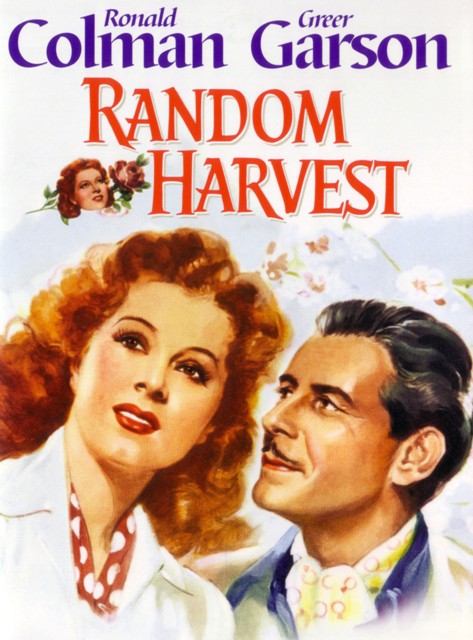
Today being Ronald Colman day on TCM’s Summer Under the Stars schedule, I was so pleased to see that Random Harvest had been scheduled for the primetime slot. One of the greatest screen romances and nominated for seven Academy Awards in 1942, this is one of my all-time favorite movies.

A brief speed-through of the (rather complicated) plot: The story is of Paula (Greer Garson), a chorus girl who befriends a shell-shocked army veteran (Ronald Coleman) who has lost his memory. The man calls himself “John Smith” or “Smitty,” though he knows that is not his real name. Paula and Smitty become great friends, ultimately falling in love and getting married. Smitty’s condition improves and he finds work, and after Paula gives birth to their child, a boy, he goes off to an interview. He is hit by a taxi on the way and the shock reverses him back to his old self–his life with Paula is completely erased from his memory. He returns to his original life and family, and becomes a successful businessman named Charles Rainier, taking over the family company. By this time Paula has lost her son, and having searched for Smitty for many years, she finds his picture in the newspaper as Charles Rainier. Under the name of Margaret, she goes to work as his secretary, hoping to jog his memory. He does not remember her, and she does not tell him of her true identity. She constantly drops clues about his identity, but to no avail–the memories do not come back. Eventually Charles goes into politics, and proposes to Margaret. She accepts. As they build (or rebuild) a life together and Charles’ political life flourishes, Margaret tells Charles about her life before him–not revealing that the man she lost was him. He tells Margaret of the past he doesn’t remember, and hopes that their marriage can help heal their heartbreak. Margaret finally can’t take it anymore and goes on a vacation–visiting the little cottage in Liverpool that she and Smitty inhabited when they were married. Charles is called to handle a strike in Liverpool, and when he goes to mediate, the surroundings trigger memories in him. His life as Smitty slowly comes back, and he makes his way to the cottage, he and Margaret/Paula meet–and Smitty’s memory comes back. The film ends with Smitty yelling “Paula!” and a passionate embrace.
It is a beautifully done film in all respects. Despite its intense romantic tone, the plot is pretty believable (and probably even more so to 1942 audiences, who were accustomed to hearing about shell-shock victims) and we really identify with and feel for the characters. Greer Garson is magnificent, as is Ronald Colman. I must say that there is really something about Greer Garson in black and white. We all love seeing her flaming red hair in the color movies she made, but her lovely chiseled features are better accentuated in black and white and I actually prefer her in films like Mrs. Miniver and Random Harvest rather than her color films. She is certainly a stunningly beautiful woman, and the softness of the photography in Random Harvest really serves her well. Not to mention, of course, the quality of the material shows us her tremendous skill as an actress. Both she and Ronald Colman were nominated for Academy Awards for their performances, in addition to 6 other nominations for the film:
This song, sung at the very beginning of the film, when Paula and Smitty first meet, I think is the highlight of the film:
I truly adore Random Harvest. If you haven’t had the chance to see it, I highly recommend it.
Posted in Lara Gabrielle Fowler

I just got an email informing me that Backlots has been accepted into the Classic Movie Blog Association!! I am told that it was one of only two blogs to be accepted this round. Thank you, dear readers, for your loyalty, and for your wonderful comments and contributions that make this blog what it is. I really appreciate all of you and your insight, and thanks for reading!
Woohoo!!
Many thanks,
-Lara
Posted in Lara Gabrielle Fowler

Last night I went to see “Mildred Pierce” at the Castro Theatre with Tony, a good friend of mine and fellow classic film lover. I had seen it on the big screen when I was in Paris, but it’s always so much fun to watch it with a huge crowd–especially at the Castro! One thing that really jumps out at me when I watch it on the big screen is just how spectacular the visuals are–the cinematography, the lighting, and the costumes. My friend Tony is a true fashion aficionado, he can tell you who made what outfit, what costume designer was at which studio during what time period, and who influenced whom in the fashion world. When I remarked on the beauty of the costumes in the middle of the movie and asked him who was the designer, I was surprised to hear that it was not a known name.
By way of a quick google search, I found out that the costume designer was named Milo Anderson, a Warner Brothers resident designer who also worked on such movies as The Adventures of Robin Hood and To Have and Have Not. Clearly he deserves more credit than he receives–the costumes in all these movies are spectacular.

The first costume that caught my eye was this one–the sort of default outfit for Mildred. She wears it during her interview at the detective’s office and at the very end of her flashback sequence, so throughout the movie we associate Mildred with this outfit. This is a medium-length fur coat with a matching hat, and a dress whose color (we can’t really tell, but I’m guessing maybe brown?) is matched by her gloves. I am not a fan of fur at all, in fact I’m very much set against it, but Joan Crawford wore a lot of it in this movie and it suits her character.

Veda first appears in this beautiful white shimmering gown with a large white flower in her hair. The color white I think is meant to be a trick on the audience–we assume she can’t have anything to do with the murder that just took place, because she’s wearing these innocent, virginal colors, and wearing them very well. Though this is not my favorite Veda outfit from the movie (the huge flower always makes me think of Billie Holiday for some reason), it is nonetheless a beautiful creation. I think it actually might be the hair that makes it work. Look at those beautiful ringlets.
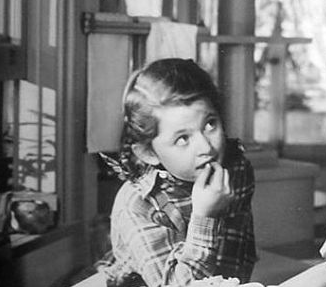
The starkest contrast in this movie is Veda’s younger sister Kay, a tomboy who is forced into ballet lessons when she would rather play football and get dirty. Her costume here really shows her character, and not only her character, but also the versatility of the designer. Among all these beautiful dresses, here he is unafraid to make the little girl look like a total hillbilly.

Here is my favorite Veda costume. Look how EVERYTHING matches color-wise, and how she’s using those accessories–I’m loving that pin, and the collar, and never even mind about that glorious hat. I basically want this outfit.

Eve Arden is one of my all-time favorite character actresses, and here she is dressed up in this bizarre Hawaiian number that seems almost anachronistic. It oddly suits her character though, and when she came on the screen wearing it, the fashion-conscious Castro crowd all started murmuring to themselves about it!
Here are some more brilliant fashion moments from the movie:


Posted in Lara Gabrielle Fowler

I apologize, dear readers, for the lack of posting this past week, I’ve been very busy with various things and haven’t had the wherewithal to dedicate as much time to the blog as it demands. So to make up for it, as I am on a Joan Fontaine kick in the wake of the new additions to my collection, I am going to review a lovely little film called The Affairs of Susan, a jolly romp in the life of one girl with a few too many suitors.
The girl is, of course, Joan Fontaine, playing Susan, the girl men can’t really figure out. The film begins with the latest love interest of Susan’s, Richard, who wants to marry her, but it soon becomes clear that he doesn’t know the first thing about her. He learns that she has had multiple boyfriends and an ex-husband that she has never told him about, and she is still on speaking terms with them. They attend Susan and Richar’d engagement party, and we learn about her past through a series of flashbacks about her relationships, told by all her suitors, and it turns out that Susan is not an easy lady to understand!
The movie is a comedy, and after all the dramas and Hitchcock movies that Joan Fontaine made, it’s lovely to see her in something light. The suitors are played by Walter Abel (Richard), George Brent, Dennis O’Keefe and Don DeFore. Brent does a great job as Susan’s befuddled Broadway producer ex-husband, but I find the rest of them to be rather dull. How an exciting woman like Susan found anything in them, I’ll never know, but Joan Fontaine plays Susan so surprisingly well (as I mentioned before, we’re used to her in dramas, so a comedy seems a little out of place, but she has a real comic flair) that she makes us believe whatever she’s doing. I was very impressed with her in this movie.
The script is mediocre, but quite funny. In one of my favorite scenes, when George Brent first meets Susan, he thinks that she is just an aspiring actress buttering him up for a part. When Susan explains to him that she never reads newspapers, never sees plays, never goes to movies, Brent says to her “But you’d like to be a star, wouldn’t you?” Susan begins to look wistful and responds “Yes….I think I’d like to be Venus.”

All in all, this is a cute little movie that you should see if you can get your hands on it. I can’t find it on Netflix, and I’ve never seen it played on TCM, but if you’re interested, check eBay or amazon.com, there might be some collector’s copies available. I don’t think it’s released on DVD, so that probably explains Netflix. It’s really worth seeing for Joan Fontaine more than anything else!
Posted in Lara Gabrielle Fowler


2019 CMBA Award for Best Profile of Classic Movie Performer or Filmmaker--"The Activism of Myrna Loy"
Winner of the 2018 CiMBA Award for Best Classic Movie Series, BACKLOTS AT THE COURTHOUSE: OLIVIA DE HAVILLAND VS. FX

Winner of the 2014 CiMBA Award for Best Profile of a Classic Movie Performer or Filmmaker: A Q&A WITH JOAN FONTAINE IN HONOR OF HER 96TH BIRTHDAY

Winner of the 2011 CiMBA Award for Best Classic Movie Discussion, THE FINAL SCENE OF THE HEIRESS






I am honored to be a judge of the Animal Film Festival in Grass Valley, CA.







Join us at the Backlot Commissary, the place for Backlots' readers to share content and discuss movies!


_03.jpg)
Walter Pidgeon and Greer Garson in "Mrs. Miniver."
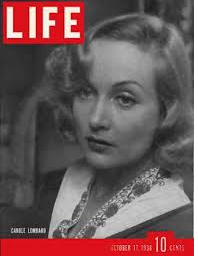
Carole Lombard's beautifully haunting Life magazine cover, that I am honored to have in my personal magazine collection.

A woman whom I consider to be one of the most beautiful to ever grace the screen, the magnificent Gene Tierney.
 Backlots