First off, let me extend a big thanks to Angela over at The Hollywood Review for hosting this excellent blogathon! Film fashion holds a special fascination for me, and I have a real soft spot for any film in which fashion is a key element. As such, it was a real task to try to come up with what I was going to focus on for Backlots’ contribution. A number of months ago I wrote a piece on the costumes of Mildred Pierce, but other than that, Backlots has not, in its young age, written in great detail about the rich history of fashion in cinema. So here, finally, is the opportunity! After much thought, the honor will go to the exquisite fashion in the 1939 classic The Women.
MGM costume designer Adrian was given the task of creating outfits worthy of this film, a witty, quirky, and often zany tribute to women, which features a cast completely devoid of men. It is fitting, then, that his chief inspiration in designing the costumes was that avant-garde female designer, Elsa Schiaparelli.
Known for her off-the-wall and unique approach to fashion, Schiaparelli’s designs occur frequently in the film, but are always modified by Adrian so as to make the costumes truly his own.
One of Schiaparelli’s most famous designs is the “broche d’oeil,” a brooch designed in the shape of an eye, which was the result of Schiaparelli’s collaboration with Jean Cocteau.
Schiaparelli and Cocteau's "broche d'oeil."
Now check out Rosalind Russell’s “Seeing Eye” dress: Perfect for the nosy character of Sylvia Fowler (with prying eyes everywhere!), this dress exemplifies the forward-thinking fashion sensibilities of the film.
This strange cape closure with a gigantic hand on it, featured in the beautiful fashion show sequence (the only scene in color), is based on another Schiaparelli collaborative design with Cocteau.
Notice the hand holding the flower at the bottom of the dress. Adrian appropriated this design to create his own.
Also worth taking a look at in the fashion show sequence is the red-and-white gown seen below:
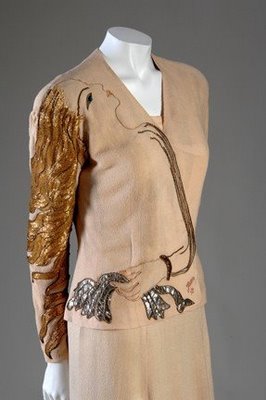
For those familiar with the designs of Schiaparelli, it is interesting to see what Adrian did here. The dress is reminiscent of the classic Schiaparelli “lobster dress,” without being a complete rip-off of the original:
A truly marvelous tribute to a truly marvelous designer.
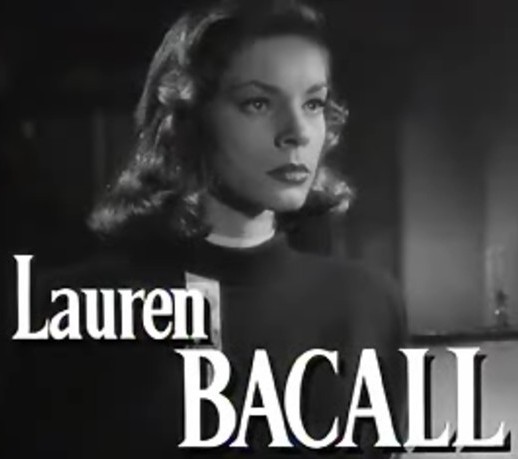
Lauren Bacall is turning 87 today. One of the most lasting stars of the classic Hollywood era, and a true testament to what it means to be a star, she had the good fortune to have made her first appearance on film opposite someone who knew how to act and mentor her–her future husband, Humphrey Bogart–and then embarked on one of the most famous and lasting relationships in Hollywood history. Known for her lanky figure and low, sultry voice, she had great success in film noir in the 1940’s, and branched out to Broadway in her later career. She seems to be still going strong today, and I certainly hope that we will be celebrating many more of her birthdays in the future. She is one of our precious few left, and I am so glad that she is still with us, healthy and happy living at her apartment in New York.
Called “Betty” by her friends throughout her life, I am posting a small tribute to her in honor of her birthday. Happy birthday Betty Bacall!!
e
On the cover of Harper’s Bazaar, the pose that helped turn her modeling career into film.
Her first moment on film, opposite Humphrey Bogart in To Have and Have Not.
Singing “How Little We Know” in To Have and Have Not.
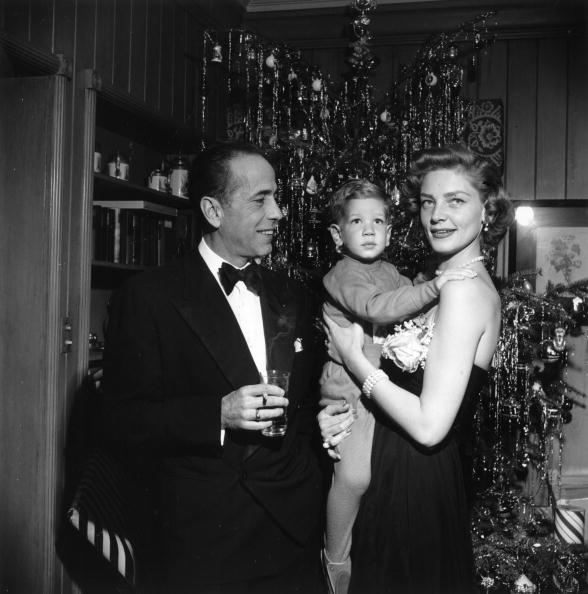
On her wedding day to Humphrey Bogart.
With Marilyn Monroe and Betty Grable in How to Marry a Millionaire.
Here are the new additions to my collection, soon to arrive:
John Fricke’s latest book! I met John Fricke last year at the Judy Garland Festival in Minneapolis, and this book was on the horizon but still kind of an enigma. Glad to see it materialized! And I can’t wait to read it! John Fricke’s books are always incredible, and I think his work is the cream of the crop in terms of accuracy and volume of information. Everyone go read “World’s Greatest Entertainer.”
Bette Davis’ autobiography, which includes an open letter to B.D. Hyman, her horrendous daughter. I can’t wait.
A fantastic movie, which includes this brilliance:
I came within 15 feet of the cash register at Border’s with this book last month, and was perfectly willing to shell out $35 for this gem of a book, but then my friend Sarah talked me out of it saying I could get it for half that price on Amazon. And she was exactly right. Except I got it for 1/3 of that price. Thank you, Sarah.
I’ve been wanting to read this book forever. I really love Hugo Vickers’ book on Vivien, and being at the Vivien Leigh/Laurence Olivier weekend in London this past May made me think that I’m a freak for not having read it. So here is my chance.
In late September, the Classic Movie Blog Association is having a blogathon devoted to guilty pleasures–that is, those films of questionable technical quality, but those we love nonetheless. I jumped at this opportunity. There are so many films that I adore but are…let’s face it…really bad (hello, half of Judy Garland’s filmography! I love every movie she has ever made, but Everybody Sing? That movie sucks, and I adore it), and I have never been able to declare my love publicly for them. For the purposes of the blogathon, I chose to profile the terrible and deliciously campy Mame, made in 1974 with Lucille Ball, Bea Arthur, and Robert Preston. Both Ball and Arthur publicly denounced the movie after it was made. Lucille Ball can’t sing. No one will ever accept anyone other than Rosalind Russell or Angela Lansbury as Mame Dennis, so it was really doomed from the start. But it is SO FUN TO WATCH.
So please be sure to tune in on September 18 when Backlots will profile Mame! To pique your interest, here are some gems from the film. Enjoy!
Seriously, listen to that! IT’S SO BAD! I love it so much!
REVIEWS FOR MAME:
“The movie spans about 20 years, and seems that long in running time . . .”
-TIME Magazine
“After forty years in movies and TV, did [Lucille Ball] discover in herself an unfulfilled ambition to be a flaming drag queen?”
-Pauline Kael, New Yorker Magazine
“Hopelessly out-of-date musical … will embarrass even those who love Lucy. Calling Fred and Ethel Mertz!”
I’m back, dear readers! My paper is finally done, and I can post to my heart’s content. Today actually happens to be my birthday. I’m not entirely sure how I got to be 26, but here I am and I have to deal with the fact that I’m now in my mid-late 20’s.
For your entertainment, and to ease the pain of aging, I have compiled a list of those classic actors and actresses who share my glorious birthday month of September. Here they are!
Dear readers, I apologize profusely for my prolonged absence. I have been working on the VERY last paper of my college career, and when I’m not hashing out my paper, I’m at my new job–working as a preschool teacher! So, my life has been very busy recently. But bear with me–as soon as this paper is finished (I’m expecting it to be finished by this weekend), Backlots will be back to its regular posting schedule.
To tide you over, here is a picture of Olivia de Havilland, wishing you a happy new year 1937 by falling down in the snow. Thank you so much for reading, I really appreciate all the love that Backlots has been getting recently, and I can’t wait to come back and post to my heart’s content!!
Golddiggers of 1933, with its story of young showgirls trying to make ends meet during the Depression, is one of the most prominent films of the early 1930’s and is a brilliant commentary on the problems encountered by people of all walks of life during the Great Depression. Alternately funny and quick-witted and serious and slow, the film is an exercise in opposites, examining both the difficulties of the era and the pervasive hope that all will turn out ok in the end. The dialogue is interspersed with magnificent stage numbers choreographed by the legendary Busby Berkeley, but the movie avoids cheesiness or false sentiments by having all the musical numbers appear within the context of a stage show.
Without a doubt, the most poignant moment in the film is the last number, a startlingly real and grim analysis of the economic situation of the day and its effect on the population. The number, sung by a young woman who is clearly a prostitute, is a lamenting torch song dealing with the harsh realities that the American public has to deal with during this difficult time, and alludes to the fact that now that this woman’s significant other can’t support her anymore, she is resigned to the streets–not an unreal situation during the Depression.
The song also points specifically to the irony that the generation affected most by the Depression was that of the young men who served their country in World War I. The lyrics as articulated by Joan Blondell are more spoken than sung:
“Remember my forgotten man?/You put a rifle in his hand/You sent him far away/You shouted ‘Hip hooray!/But look at him today.”
The next verse touches on the physical labor that people put into the land, a land that no longer gives to them.
“Remember my forgotten man?/You had him cultivate the land/You had him walk behind a plow/The sweat fell from his brow/But look at him right now.”
Then the woman turns back to herself:
And once he used to love me/I was happy then/He used to take care of me/Won’t you bring him back again?
‘Cause ever since the world began/A woman’s got to have a man/Forgetting him, you see/Means you’re forgetting me/Like my forgotten man.
Very powerful stuff.
Note the song’s usage of “you” instead of “they,” addressing the unknown force at fault directly. It is not sung out of self-pity, but out of anger. It addresses the universalism of this crisis, affecting everyone from all walks of life, leaving them without a thing in the world.
We then see scenes of those affected by the Depression, beginning with a single mother and an old woman in a rocking chair, before being shown scenes of men returning home from war, on the battlefield, in breadlines, and finally marching in silhouette, reinforcing them as “forgotten men.” As they march, we see men in ragged clothes and their families on the stage, while Joan Blondell appears at the center and brings the song home, singing the last stanza in an incredibly heartbreaking, powerful moment, surrounded by the breadline men, the soldiers marching behind her, and the families at her side.
One of the things I like about this number is that it is able to show intense pain and sadness, without feeling like it has to tie it all off with a happy ending. It ends on an uncertain note and tone, not only emotionally but musically as well. There are tones in the last chord that sound final, but the chord is a dissonant one, not entirely sure where it is going. And though the number marks the end of the film, there is an unfinished air about it, musically telling the audience “We don’t know what’s going to happen to us.”
I dare say that this is one of the most memorable moments of the early 1930’s. Not only does it pack an intense punch, but it really sums up the era of pre-Code talkies. Stark, expressive, and poignant, it really shows what the future of cinema could have been, if the Hays Code hadn’t come in and dictated filmmaking for the next 35 years.
Catherine Sloper ascends the stairs in the final scene, leaving fortune-hunter Morris Townsend banging on the door.
Browsing through TCM’s Summer Under the Stars lineup a few weeks ago, I was very pleased to see one of my favorite movies of all time, The Heiress, scheduled for a primetime spot during TCM’s lineup of Montgomery Clift movies yesterday. An intensely human story against the backdrop of straight-laced and cold 1840’s New York, I consider The Heiress to be not only one of the great films of the decade, but a real triumph in filmmaking. The film was directed by William Wyler, and stars Olivia de Havilland in the title role of Catherine Sloper, a young and naive heiress set to inherit her father’s significant fortune. Montgomery Clift plays a charming suitor by the name of Morris Townsend, and Ralph Richardson is Catherine’s cold and undemonstrative father, suspicious of Morris’ motives. Catherine firmly believes that Morris’ intentions are correct, and the conflict between Catherine and her father becomes more escalated as the film progresses. Ultimately Morris’ true intentions are revealed, and the final scene is a chilling act of psychological manipulation and revenge.
I am going to begin by giving you the video of the final scene so you may examine it at any point as you read.
By this time in the movie, we have learned that Morris’ intentions are not honorable, as he deserted Catherine when her father threatened to disinherit her if they married. In the wake of Morris’ desertion, Catherine, previously a sweet, naive girl, turns into a cold, distant woman. When her father dies, Catherine inherits his fortune and lives alone in the large house, rejecting any form of kindness or compliments. Two years later, Morris suddenly returns, asking for forgiveness for his desertion. Catherine initially says it is too late for apologies, but then becomes strangely seductive with him, accepting his proposal for marriage. When he comes for her later that evening, instead of leaving to marry him, she turns the tables and commits her own act of desertion, leaving him pounding on the door and calling her name, while she ascends the stairs away from him.
My reading on the ending is that Catherine has been so hardened by the constant abuse from her father and by the treachery of Morris that her only answer is to become jaded and cold, as they were. However, de Havilland’s portrayal of Catherine gives us an incredibly real portrait of this woman, and it is magnificently clear that there many, many facets to Catherine. Take a look at her face, at 1:22 of the first video I embedded. Her mouth turns up into a small, hopeful, optimistic smile when she hears the bell signaling Morris’ arrival. This indicates that Catherine is NOT over Morris, and still maintains a hope that he might come. We see that she has not been totally hardened after all–a bit of the old Catherine is still there, waiting and hoping for Morris to come. The little glimmer of optimism disappears as quickly as it came, and she immediately becomes angry with her aunt for asking Morris over. Then we see what is probably my favorite bit in the entire movie.
Take a look at 2:00-2:31. If we saw a little spark of the old Catherine in that tiny smile, this 31-second character examination is that smile magnified x 1000. For me, this is what single-handedly secured de Havilland’s Best Actress Oscar. Look at how her expression changes so subtly and gracefully–from cold and distant, to sad, to hopeful, to wistful and nostalgic, to sad again, and then ultimately back to cold and distant, but this time with an air of calculation about her. There is SO MUCH to be analyzed about this character. The actions of the others in her life have hardened her, but the right circumstances can make her soften to what she used to be. When Morris comes in and asks for forgiveness, Catherine’s expression changes only around 6:51, when we see that she’s beginning to accept his coming on to her. But strangely, her tone of voice is almost that of a villain, and it becomes clear that she is putting on an air for Morris. They agree to marry, and Morris says he will come for her at 9. Catherine continues this act of happiness until he leaves, and proceeds to let her aunt know that she has no intention of going with Morris.
Here, Catherine starts to show signs of an almost hypnotic possession. Her voice changes as she says:
He came back here with the same lies. The same silly phrases. He has grown greedier with the years. The first time he only wanted my money. Now he wants my love, too. Well, he came to the wrong house. And he came twice. I shall see that he doesn’t come a third time.
As Morris comes, Catherine instructs the maid: “Bolt it, Maria.” Maria bolts the door, then proceeds to go to bed. Catherine completely ignores Morris, leaving him outside knocking and banging on the door to be let in. As Catherine ascends the stairs, we see another faint glimmer of a smile, this time seemingly triumphant.
A friend and fellow cinephile, with whom I discussed this scene, reads into the ending a bit differently than I do. I see Catherine as a very cold and calculating person at the end, who has discovered tremendous power within herself due to the abuses of her father and Morris, and uses the powers to hurt. My friend sees it from a feminist perspective–Catherine’s newfound power gives her the ability to do what she wants and what she feels is best for her. One of the marvelous aspects of this movie is that thanks to Wyler’s brilliant direction and de Havilland’s magnificent performance, there are multiple ways to read into the ending and its significance.
I would like to pose to you, dear readers, the question of how you read the ending of the movie. Do you see Catherine’s desertion of Morris as an action committed by a jaded, embittered woman, or do you see it as an act of liberation? I look forward to hearing from you!
Olivia de Havilland poses with her Oscar for “The Heiress.”
This post has been awarded Best Classic Movie Discussion of 2011 by the Classic Movie Blog Association.
This quick-witted, fast-paced, sassy and fabulous movie is, in my opinion, one of the best movies of that stellar year 1939. Starring two of the reigning queens of MGM, Norma Shearer and Joan Crawford, and directed by George Cukor, the film is comprised of over 130 speaking parts, runs at a whopping 133 minutes, and here is the clincher: nowhere in that 133 minutes is there one single man. All the animals used in the film are female, and the art on the wall features only women. You will not find any evidence of a male anywhere in the film.
The Women was directed by George Cukor, who was known in the industry as being a “woman’s director,” universally loved by actresses and sometimes abhorred by actors for the attention he gave to the women. It is no surprise that The Women would be a tour de force of his, alongside such classics as the 1933 version of Little Women and the 1954 A Star is Born, all films centered on female characters. The direction in The Women is truly magnificent, one of the best things about a film that I think has not a single bad moment in its entirety.
Though there are no men seen in the movie, they are constantly talked about, leading to the very fitting tagline: The Women–It’s All About the Men! The story centers on Mary Haines (Norma Shearer) who discovers, thanks to her nosy and gossip-crazed cousin Sylvia Fowler (Rosalind Russell) who has been listening to gossip at the salon, that her husband is having an affair with a woman named Crystal Allen (Joan Crawford), a perfume counter worker at Black’s 5th Avenue. It turns out she is the last to know–Sylvia has already told all her friends (specifically Edith Potter, played by Phyllis Povah, and Peggy Day, played by Joan Fontaine), and chaos ensues. Eventually all the girls (except for Edith, a character with about 10 children) end up in Reno for divorces, where they meet a divine multiple-time divorcee by the name of Countess de Lahve (Mary Boland), and Sylvia meets Miriam Aarons (Paulette Goddard), the woman with whom her husband is having an affair.
(Confused yet?)
The result of the meeting is an absolutely hilarious catfight scene.
After a series of events, the girls end up back with their husbands. We find out that after marrying Stephen Haines, Crystal Allen has begun an affair Buck Winston, the husband of the Countess de Lahve, leaving Stephen free to get back together with Mary. Mary hears the news from her daughter, and uses Sylvia’s gossipy personality to her advantage in worming confirmation of the affair out of her. The Countess tells Crystal that she has been supporting Buck’s radio program and Buck will be penniless without her. Crystal resigns herself to Reno herself, and tells the ladies:
“Well girls, looks like it’s back to the perfume counter for me. And by the way, there’s a name for you ladies…but it isn’t used in high society…outside of a kennel. So long, ladies!”
The film ends with Mary running into the arms of Stephen, who of course is off-camera.
The plot is multi-layered and complex, as you can well see. All the performances are brilliant, and as I said, I don’t think there is one bad scene in the entire film. One of my favorite bits is a Technicolor fashion show in the middle of the movie–not only was this advanced technology for 1939, but also showcases some of the absolutely stunning fashion of the day.
Although the vast majority of the movie is, of course, in black and white, color is a recurring theme. In addition to the fashion show, the fashionable nail color that all the girls get from the manicurist is known as “Jungle Red.” The color becomes a symbol of just who has what information, and at the end, “Jungle Red” transforms into a symbol of power. When Mary goes to win Stephen back, she says to her mother:
“I’ve had two years to grow claws, Mother! Jungle Red!”
This is also in direct correlation, I think, to the tagline of the movie. So much is below the surface, which leads the viewer to read into it himself, making for a truly entertaining movie experience.
The lovely blog A Person In the Dark has very generously awarded Backlots the Irresistibly Sweet Blog Award! The award will be proudly displayed in our Affiliations and Awards section, and I am so grateful that this blog is loved!
Now, this award comes with stipulations. Awardees must:
Thank and link to the person who nominated the blog
Share 7 random facts about themselves
Pass the award to 12 of their blogging buddies
Notify the recipients
So here we go.
7 RANDOM FACTS ABOUT ME
1. I was born in Oakland, CA and raised in Oakland and San Francisco.
2. I am a French major in college, and recently spent 5 months in France.
3. I play the cello, and attended an arts magnet high school in San Francisco.
4. I have met: June Allyson, Mickey Rooney, Patty Duke, Rita Moreno, Carol Channing, Jane Powell, Barbara Eden, Olivia de Havilland, Maureen O’Hara, and all of the surviving munchkins from The Wizard of Oz (except Karl Slover).
5. When I was 2, I swallowed a penny.
6. I am deathly afraid of heights, but I have no problem with spiders.
7. I once taught myself how to sing “We’re In the Money” in Pig Latin like Giner Rogers in Golddiggers of 1933. I can still do it.
12 OF MY FAVORITE BLOGS
GARBO LAUGHS. Run by my friend Caroline, this blog is full of insights on all kinds of films, from the very obscure to classic favorites. Very intelligently written.
CLASSIC BECKY’S BRAIN FOOD. A wonderfully amusing and diverse blog focusing on both classic films and literature. Its design truly reflects the nature of the blog, and contributes to its considerable charm!
VIVANDLARRY.COM. THE go-to Vivien Leigh and Laurence Olivier site on the net, written by another friend of mine–Kendra Bean. I consider Kendra to be right up there with the most elite Viv and Larry historians, and she recently hosted a very successful weekend devoted to them in London, which I attended. For anyone looking for information on Viv and Larry, this site will give you everything you need, and more.
THE LADY EVE’S REEL LIFE. A very well-written blog focusing on all the ins and outs of classic film. Chock full of interesting and useful information!
VIA MARGUTTA 51. This is a fun one! Written by a Chilean gal (who speaks very good English, I might add!), the site takes its name from the address in Roman Holiday, and is a sweet devotion to classic film.
OLIVIA AND JOAN: SISTERS OF THE SILVER SCREEN. Those who have been following Backlots for some time know of my love for the de Havilland sisters, and this site is a marvelous tribute to them. With detailed sections about both Olivia and Joan, it is one of a kind in their compilation of accurate and well-presented information about the two sisters without a focus on their famous feud, which is very refreshing.
CLASSIC FILM AND TV CAFE. One of the most fun blogs out there! Great polls, trivia games, and lots of discussion among readers. A charming treat!
CLASSICFILMBOY’S MOVIE PARADISE. Great and detailed analyses of films, and a recurring segment on Audrey Hepburn entitled “Audrey of the Month” with fantastic and rare pictures.
CAFTAN WOMAN. Beautifully put-together blog with tons of info. She also incorporates wonderful snippets of her life outside of film, making for a truly comprehensive blogging experience for the reader.
TRUE CLASSICS: THE ABCs OF CLASSIC FILM. This dedicated and fun blog recently hosted the Loving Lucy blogathon, resulting in an incredible showing of love for Lucille Ball. Also a very diverse blog, discussing everything from classic film to TV shows to burlesque!
THRILLING DAYS OF YESTERYEAR. I was so incredibly impressed with Ivan’s look at Lucille Ball’s work on “My Favorite Husband,” that I fell in love with this blog as soon as I discovered it. A fascinating and intelligent look at the classics of yesterday, touching on radio, television, and film, and one of the most detailed blogs I have ever come across. Major applause for this one.
CAROLE & CO. A sweet and devoted tribute to the brilliant and beloved Carole Lombard. Full of information about the star, and I have already learned so much from it! The blog is hosting a Carole Lombard birthday blogathon in honor of her 103rd birthday–details can be found here.
Whew! Thank you again to Person in the Dark for this award!
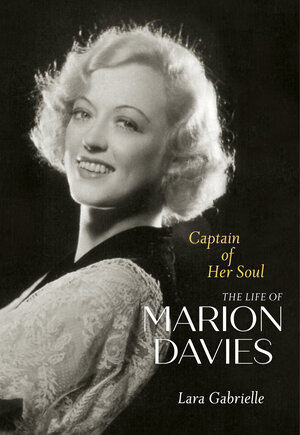
Captain of Her Soul: The Life of Marion Davies is now available at your favorite bookseller! Click hereto order it, and visit mariondaviesbook.com for all the latest.
Backlots is devoted to honoring and celebrating all aspects of classic film and is written by Lara Gabrielle, a California-based classic film writer and historian. Lara is the author of CAPTAIN OF HER SOUL: The Life of Marion Davies (UC Press, 2022).
Here you will find pieces on frequently seen classics and some lesser-known gems, as well as book reviews, festival coverage, and pieces on the history, theory and culture of film as it relates to the study of classic cinema.
Enjoy the site, and thanks for reading!
AFFILIATIONS & AWARDS
2019 CMBA Award for Best Profile of Classic Movie Performer or Filmmaker--"The Activism of Myrna Loy"
Winner of the 2018 CiMBA Award for Best Classic Movie Series, BACKLOTS AT THE COURTHOUSE: OLIVIA DE HAVILLAND VS. FX
Winner of the 2014 CiMBA Award for Best Profile of a Classic Movie Performer or Filmmaker: A Q&A WITH JOAN FONTAINE IN HONOR OF HER 96TH BIRTHDAY
Winner of the 2011 CiMBA Award for Best Classic Movie Discussion, THE FINAL SCENE OF THE HEIRESS
I am honored to be a judge of the Animal Film Festival in Grass Valley, CA.
EVENTS
BACKLOTS ON THE WEB
Join us at the Backlot Commissary, the place for Backlots' readers to share content and discuss movies!
Walter Pidgeon and Greer Garson in "Mrs. Miniver."



 Perfect for the nosy character of Sylvia Fowler (with prying eyes everywhere!), this dress exemplifies the forward-thinking fashion sensibilities of the film.


 e
e























_03.jpg)

 Backlots