Checking up on TCM this evening, it came to my attention that Backlots’ Star of the Week Myrna Loy is in the news. Biographer Emily W. Leider has written the very first book about Loy’s life, entitled Myrna Loy: The Only Good Girl in Hollywood, and slated to hit the bookshelves later this month. It has already been touted by Leonard Maltin as a “highly readable, informed biography,” and promises to reveal backstories on Loy’s many friendships in Hollywood and her extraordinarily long career.
It very much surprises me that no book like this (aside from Loy’s own autobiography, Being and Becoming, published in 1987) has been written about Myrna Loy up to now. She is and was so well-loved in the classic film world, and though a private person herself, was friends with just about everyone in Hollywood and it would have been very easy to research and write 30 years ago. In fact, I believe that Emily W. Leider has done a very difficult task in WAITING to write this book, as the vast majority of those who knew and worked with Myrna Loy are now gone.
At any rate, this promises to be an immensely interesting read, and I love that this came to my attention just as Myrna Loy became Star of the Week. Here is the link to pre-order your copy at Barnes and Noble. I will post a review of this book once it comes out!
The Classic Movie Blog Association is having its annual awards, and Backlots is nominated for Best Classic Film Blog Discussion! The nominated discussion was of the final scene of The Heiress, posted a few weeks ago.
It is truly an honor to be nominated for a blog award when I have only been a member for about a month! Thanks to the CMBA!
I’m going to need to work out my blog posting schedule in the wake of my new job, because I’m exhausted after work and feel like I haven’t posted in forever, which makes me feel really inadequate. In truth, it’s only been 2 days, but I still feel like I should be posting more. For my first star of the week for…quite some time, I took suggestions from my facebook and twitter followers, who have come back with some awesome suggestions for future posts, including a suggestion for Myrna Loy as the Star of the Week, which is something I got very excited about.
Myrna Loy is a very unique star. In real life a staunch liberal and dedicated feminist, she balked at the typical portrayal of the “woman who belonged in the home” and instead embraced such roles as Nora Charles, the independent wife, sidekick, and occasional sparring partner of detective Nick Charles in the Thin Man series–probably her most famous role and one of the best female parts of the 1930’s. The series was the first to show a married couple who could be friends, throwing friendly jabs and teases at each other while maintaining their loving relationship, and it’s hard to imagine anyone other than Myrna Loy in the role. She has a very modern air to her that allows her to play roles that may have bombed in the hands of another actress.
She was born Myrna Adele Williams in Helena, Montana on August 2, 1905, to a prominent political father and a mother who had studied at the American Conservatory of Music. Following the death of her father when Myrna was 12, the family moved to La Jolla, California, where she attended Venice High School and left at 18 to help her mother with her financial obligations, landing a job at Grauman’s Egyptian Theatre and posing for portraits that were eventually discovered by Rudolph Valentino, thus beginning her film career in silents. Her first appearance was as an extra in a film called Pretty Ladies, followed by a more lucrative role in What Price Beauty? which led audiences to notice this mysterious beauty. It followed that Loy’s silent screen roles were predominantly of ethnic femmes fatales, drawing upon her strangely exotic eyes (though her heritage was Welsh and Scottish) and dark features.
Her big break came in Manhattan Melodrama in 1934, which was followed shortly thereafter by the first Thin Man movie, securing Loy’s place as a feature player and a box office success. The second Thin Man film, After the Thin Man, came in 1936. Her stardom was quickly rising, and by 1938 she was one of the most popular and highest paid actresses in Hollywood. Another Thin Man, the third film in the series, came out in 1939, followed by Shadow of the Thin Man in 1941.
Some witty lines from The Thin Man movies.
This burst in popularity did not, however, cause Loy to abandon her principles–when the U.S. began its involvement in World War II, she left films altogether to focus on the war effort. Volunteering with the Red Cross and vehemently denouncing the policies of Hitler, she toured army bases with the group of Hollywood celebrities banding together to bring morale to the troops stationed around the country.
She returned to films in 1945 with the conclusion of the Thin Man series, The Thin Man Goes Home, followed by what she considered to be her best role, that of wife to an injured World War II veteran played by Dana Andrews in The Best Years of Our Lives in 1946. The film is a masterpiece and won countless awards, including Best Picture at the 1947 Oscars, and a place on the American Film Institute’s list of the best movies of all time (rating at #37).
Loy’s film career was then peppered with a number of mediocre films, with the exception of the delightful comedy Mr. Blandings Builds His Dream House (1948) which gave her career a slight boost. She was, surprisingly, never nominated for an Academy Award, though she did receive an honorary Oscar at the 1991 Academy Awards, shortly before her death in 1993 at the age of 88.
Myrna Loy was well-known in Hollywood and beyond for her tireless efforts toward liberal and egalitarian causes. She was a loyal and committed Democrat, and served as co-chairman of the Advisory Council of the National Committee Against Discrimination in Housing. She was also the first Hollywood celebrity to become a member of the National Commission for UNESCO, promoting equality and peace throughout the world through art. She was outspoken for the dignified treatment of black actors on film, and was quoted as saying “Why does every black person in the movies have to play a servant? How about a black person walking up the steps of a courthouse carrying a briefcase?”
As an actress and a person, Myrna Loy is deserving of a very high place in Hollywood history, and it truly is a shame that many of her movies have been forgotten or neglected. Thanks for the recommendation to have Myrna Loy as the Star of the Week!
Recommended by Jane (LouisaJanexxx) on Backlots’ twitter account.
Here are some of the things that have come in the mail over the past few days:
John Fricke’s newest book! As per all of John Fricke’s works, it is a wonderful source of information and beautiful photos, many of which I don’t think have ever been released. He remains the quintessential Judy biographer. A+++.
Bette Davis’ second autobiography–dealing mostly with her later, post-stroke life. One very interesting thing is her open letter to B.D. (her horrible daughter), which is a combination of anger, disappointment, and sadness. The reader can feel Davis’ sense of closure with her daughter, which is in itself both sad and comforting.
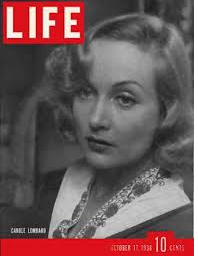
This came in the mail a few days ago, and it has become one of my favorite magazines in my collection. Chock full of interesting articles, not to mention a STUNNING cover with one of my favorite people on it, I’ve been obsessed with this magazine ever since it arrived. My only complaint is that the cover is coming off, so I have to be really careful when I handle it, especially since I am going to really treasure this one and want to handle it a lot.
My camera is broken so I can’t upload the actual picture, but I also got a coat made by the Hollywood fashion legend Don Loper. Famous for being one of the classiest fashion houses in Hollywood and also for his appearance on “I Love Lucy” (remember when Lucy gets herself into the fashion show with a sunburn? That was at Don Loper’s), I found a coat of his that was within my price range at an online vintage store. When it arrived, I discovered that it was way too big for me (that’s what I get for buying things online!), but at least I can say I have a Don Loper coat! That’s really special.
I’m still waiting on the Rosalind Russell magazine, that is taking forever to get here. I’m wondering if it went to my old address…
First off, let me extend a big thanks to Angela over at The Hollywood Review for hosting this excellent blogathon! Film fashion holds a special fascination for me, and I have a real soft spot for any film in which fashion is a key element. As such, it was a real task to try to come up with what I was going to focus on for Backlots’ contribution. A number of months ago I wrote a piece on the costumes of Mildred Pierce, but other than that, Backlots has not, in its young age, written in great detail about the rich history of fashion in cinema. So here, finally, is the opportunity! After much thought, the honor will go to the exquisite fashion in the 1939 classic The Women.
MGM costume designer Adrian was given the task of creating outfits worthy of this film, a witty, quirky, and often zany tribute to women, which features a cast completely devoid of men. It is fitting, then, that his chief inspiration in designing the costumes was that avant-garde female designer, Elsa Schiaparelli.
Known for her off-the-wall and unique approach to fashion, Schiaparelli’s designs occur frequently in the film, but are always modified by Adrian so as to make the costumes truly his own.
One of Schiaparelli’s most famous designs is the “broche d’oeil,” a brooch designed in the shape of an eye, which was the result of Schiaparelli’s collaboration with Jean Cocteau.
Schiaparelli and Cocteau's "broche d'oeil."
Now check out Rosalind Russell’s “Seeing Eye” dress: Perfect for the nosy character of Sylvia Fowler (with prying eyes everywhere!), this dress exemplifies the forward-thinking fashion sensibilities of the film.
This strange cape closure with a gigantic hand on it, featured in the beautiful fashion show sequence (the only scene in color), is based on another Schiaparelli collaborative design with Cocteau.
Notice the hand holding the flower at the bottom of the dress. Adrian appropriated this design to create his own.
Also worth taking a look at in the fashion show sequence is the red-and-white gown seen below:
For those familiar with the designs of Schiaparelli, it is interesting to see what Adrian did here. The dress is reminiscent of the classic Schiaparelli “lobster dress,” without being a complete rip-off of the original:
A truly marvelous tribute to a truly marvelous designer.
The Classic Movie Blog Association, of which Backlots is a member, is hosting a very interesting blogathon–dealing with those films that we know are stinkers, but that we love anyway. This is a real opportunity for me not only to extol my love for a bad movie, but also to explain WHY I love this failure as much as I do! So without further ado–light the candle, get the ice out, roll the rug up, it’s….MAME!
The story is of Mame Dennis, a madcap bon vivant who takes in her orphaned nephew Patrick and raises him as her own, teaching him that “life is a banquet” and educating him in the ways of her world. Mame is initially awkward with him, but over the course of the film we see a strong maternal love develop within her, and Patrick becomes close with her too. It is a simple plot that really touches on basic human emotions, and that in itself makes it a successful story.
Mame was inspired by a long line of successful stagings of the classic Patrick Dennis story Auntie Mame: An Irreverent Escapade, written in 1955. Though the plot was entirely created, Dennis passed it off as autobiographical by employing his own name as that of the book’s narrator. As he stated in LIFE magazine in 1962: “I write in the first person, but it is all fictional. The public assumes that what seems fictional is fact; so the way for me to be inventive is to seem factual but be fictional.” The book was an instant success, and shortly thereafter a Broadway show, entitled Auntie Mame, was created by Jerome Lawrence and Robert E. Lee with Rosalind Russell in the lead role. The play opened in 1957, and Russell’s portrayal of Auntie Mame landed her a Tony nomination. The following year, Russell reprised her role on film, which in turn earned her a Golden Globe and an Oscar nomination, and Auntie Mame became the highest grossing film of the year.
Rosalind Russell in Auntie Mame.
In 1966, the plot was revisited again for a musical version of the Broadway show, this time entitled simply Mame and headed by Angela Lansbury in the title role and Bea Arthur as Mame’s best friend Vera. This production had enormous success, running a total of 1,508 performances in New York before touring the country. Both Lansbury and Bea Arthur won Tonys for their performances. The 1969 West End production of the show starred Ginger Rogers and ran for 14 months.
Angela Lansbury performing “It’s Today” during the revival run in 1983.
Then came the film.
Deeming Angela Lansbury too unknown in films to reprise her role (which I think makes no sense, because by that point she had been in 36 films and had been nominated for the Academy Award 3 times), Lucille Ball was booked to play Mame Dennis in a planned film version in 1972. Shortly before filming was to begin, Ball broke her leg in a skiing accident and could not start work on the film until she was healed. The proposed director, the legendary George Cukor, was forced to withdraw from the film due to the delay in shooting, and the task of directing the film went to Gene Saks, who had directed the Broadway production (and who happened to be married to Lansbury’s Broadway co-star Bea Arthur, also slated for the film version). The disasters of the production were not over. Madeline Kahn was cast as Agnes Gooch, Mame’s secretary, and when filming started, Ball (who had casting approval) was not satisfied with her performance and had her fired. It also became devastatingly clear that Lucille Ball could not sing, and was far too old to be playing Mame Dennis with any sort of credibility (she was 62 when filming began). This necessitated the use of soft-focus filters to disguise her age.
Note the soft-focus in this trailer.
Ball had to have long rehearsal sessions with Jerry Herman in order to increase her singing ability, but it was in vain–she could not sing. It is very clear in the film that Ball is uncomfortable.
Despite all the problems, Mame WAS a successful film, breaking records during its run at Radio City Music Hall, but Lucille Ball could not be saved. Critics were very harsh, and reviews included:
“Miss Ball has been molded over the years into some sort of national monument, and she performs like one too. Her grace, her timing, her vigor have all vanished. When she is photographed at close range, the image goes soft, indicating that the lens was smeared with Vaseline and shrouded in gauze. The other actors in the movie are clear enough on their own. But when they step into a shot with her, they go out of focus too.”
-TIME magazine
“After forty years in movies and TV, did [Lucille Ball] discover in herself an unfulfilled ambition to be a flaming drag queen?”
-Pauline Kael, New Yorker Magazine
“Hopelessly out-of-date musical … will embarrass even those who love Lucy. Calling Fred and Ethel Mertz!”
–Leonard Maltin, Movie Guide
I often wonder what would have happened if just a few changes were made to the film–if they had realized that Angela Lansbury DID have clout on film, and if George Cukor had stayed. I have a feeling that it would have been a much better film.
It does have some saving graces, for example the magnificent Bea Arthur, who I’m convinced can do no wrong. She won a Tony for the role of Vera on Broadway, and her performance here is really the highlight of the film.
Arthur and Lucille Ball singing “Bosom Buddies.”
Needless to say, the music is also extremely quality. Jerry Herman’s successful Broadway score translated into some brownie points for the film, but one can hardly say that this is a credit to the film, as Herman simply uprooted the Broadway score and placed it onscreen–a simple cut-and-paste job.
Now let me tell you why I love this movie.
It is SO INCREDIBLY CAMPY.
You know how sometimes a movie is so bad, it’s good? This is one of those. It may not be in the category of Plan 9 From Outer Space bad, but the campiness of this one blows Plan 9 out of the water. The colors, the lighting, the ridiculously expensive production (estimated at $12 million), and the sheer low quality of the script and acting make it a recipe for a cult smash.
I first saw this movie when I was about 12 years old at a friend’s house, and I was immensely taken with it. My friend and I developed a whole new set of inside jokes from it (see above re: the script), and it became an instant favorite. That’s really what this movie is good for, and despite its bad quality, it’s still a great and fun movie-watching experience.
Thank you to the CMBA for hosting this fun blogathon!!
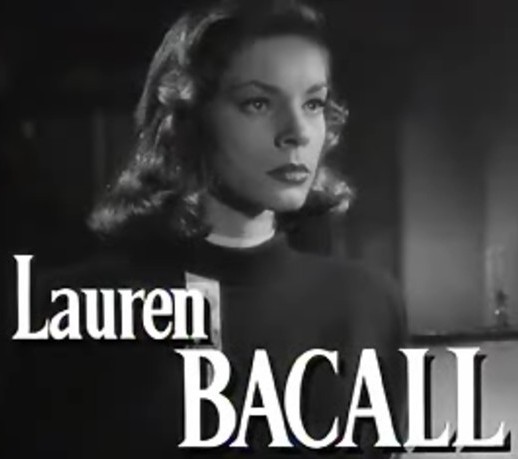
Lauren Bacall is turning 87 today. One of the most lasting stars of the classic Hollywood era, and a true testament to what it means to be a star, she had the good fortune to have made her first appearance on film opposite someone who knew how to act and mentor her–her future husband, Humphrey Bogart–and then embarked on one of the most famous and lasting relationships in Hollywood history. Known for her lanky figure and low, sultry voice, she had great success in film noir in the 1940’s, and branched out to Broadway in her later career. She seems to be still going strong today, and I certainly hope that we will be celebrating many more of her birthdays in the future. She is one of our precious few left, and I am so glad that she is still with us, healthy and happy living at her apartment in New York.
Called “Betty” by her friends throughout her life, I am posting a small tribute to her in honor of her birthday. Happy birthday Betty Bacall!!
e
On the cover of Harper’s Bazaar, the pose that helped turn her modeling career into film.
Her first moment on film, opposite Humphrey Bogart in To Have and Have Not.
Singing “How Little We Know” in To Have and Have Not.
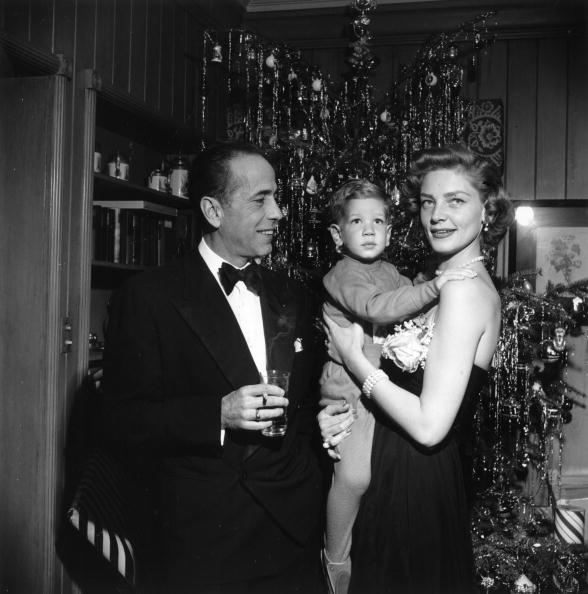
On her wedding day to Humphrey Bogart.
With Marilyn Monroe and Betty Grable in How to Marry a Millionaire.
Here are the new additions to my collection, soon to arrive:
John Fricke’s latest book! I met John Fricke last year at the Judy Garland Festival in Minneapolis, and this book was on the horizon but still kind of an enigma. Glad to see it materialized! And I can’t wait to read it! John Fricke’s books are always incredible, and I think his work is the cream of the crop in terms of accuracy and volume of information. Everyone go read “World’s Greatest Entertainer.”
Bette Davis’ autobiography, which includes an open letter to B.D. Hyman, her horrendous daughter. I can’t wait.
A fantastic movie, which includes this brilliance:
I came within 15 feet of the cash register at Border’s with this book last month, and was perfectly willing to shell out $35 for this gem of a book, but then my friend Sarah talked me out of it saying I could get it for half that price on Amazon. And she was exactly right. Except I got it for 1/3 of that price. Thank you, Sarah.
I’ve been wanting to read this book forever. I really love Hugo Vickers’ book on Vivien, and being at the Vivien Leigh/Laurence Olivier weekend in London this past May made me think that I’m a freak for not having read it. So here is my chance.
In late September, the Classic Movie Blog Association is having a blogathon devoted to guilty pleasures–that is, those films of questionable technical quality, but those we love nonetheless. I jumped at this opportunity. There are so many films that I adore but are…let’s face it…really bad (hello, half of Judy Garland’s filmography! I love every movie she has ever made, but Everybody Sing? That movie sucks, and I adore it), and I have never been able to declare my love publicly for them. For the purposes of the blogathon, I chose to profile the terrible and deliciously campy Mame, made in 1974 with Lucille Ball, Bea Arthur, and Robert Preston. Both Ball and Arthur publicly denounced the movie after it was made. Lucille Ball can’t sing. No one will ever accept anyone other than Rosalind Russell or Angela Lansbury as Mame Dennis, so it was really doomed from the start. But it is SO FUN TO WATCH.
So please be sure to tune in on September 18 when Backlots will profile Mame! To pique your interest, here are some gems from the film. Enjoy!
Seriously, listen to that! IT’S SO BAD! I love it so much!
REVIEWS FOR MAME:
“The movie spans about 20 years, and seems that long in running time . . .”
-TIME Magazine
“After forty years in movies and TV, did [Lucille Ball] discover in herself an unfulfilled ambition to be a flaming drag queen?”
-Pauline Kael, New Yorker Magazine
“Hopelessly out-of-date musical … will embarrass even those who love Lucy. Calling Fred and Ethel Mertz!”
I’m back, dear readers! My paper is finally done, and I can post to my heart’s content. Today actually happens to be my birthday. I’m not entirely sure how I got to be 26, but here I am and I have to deal with the fact that I’m now in my mid-late 20’s.
For your entertainment, and to ease the pain of aging, I have compiled a list of those classic actors and actresses who share my glorious birthday month of September. Here they are!
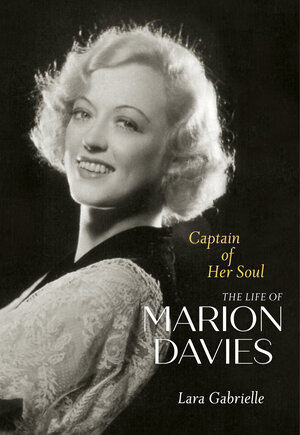
Captain of Her Soul: The Life of Marion Davies is now available at your favorite bookseller! Click hereto order it, and visit mariondaviesbook.com for all the latest.
Backlots is devoted to honoring and celebrating all aspects of classic film and is written by Lara Gabrielle, a California-based classic film writer and historian. Lara is the author of CAPTAIN OF HER SOUL: The Life of Marion Davies (UC Press, 2022).
Here you will find pieces on frequently seen classics and some lesser-known gems, as well as book reviews, festival coverage, and pieces on the history, theory and culture of film as it relates to the study of classic cinema.
Enjoy the site, and thanks for reading!
AFFILIATIONS & AWARDS
2019 CMBA Award for Best Profile of Classic Movie Performer or Filmmaker--"The Activism of Myrna Loy"
Winner of the 2018 CiMBA Award for Best Classic Movie Series, BACKLOTS AT THE COURTHOUSE: OLIVIA DE HAVILLAND VS. FX
Winner of the 2014 CiMBA Award for Best Profile of a Classic Movie Performer or Filmmaker: A Q&A WITH JOAN FONTAINE IN HONOR OF HER 96TH BIRTHDAY
Winner of the 2011 CiMBA Award for Best Classic Movie Discussion, THE FINAL SCENE OF THE HEIRESS
I am honored to be a judge of the Animal Film Festival in Grass Valley, CA.
EVENTS
BACKLOTS ON THE WEB
Join us at the Backlot Commissary, the place for Backlots' readers to share content and discuss movies!
Walter Pidgeon and Greer Garson in "Mrs. Miniver."



 Perfect for the nosy character of Sylvia Fowler (with prying eyes everywhere!), this dress exemplifies the forward-thinking fashion sensibilities of the film.


 e
e




















_03.jpg)

 Backlots