Many years ago, I was flipping through a magazine of my mother’s when I came across a familiar face in the “editorials” section. It was the face of Rita Hayworth, who always fascinated me and in whose life I was pretty versed. Daughter of a Spanish dancer, married Orson Welles and Prince Aly Khan, had two daughters…but what I saw in this editorial really shocked me. It said something to the effect of: “How courageous Rita Hayworth was! After the horror she went through, she remained strong.”
This confused me. I had never heard of any unusual problems in Rita Hayworth’s life…and I couldn’t imagine what they were talking about. So I promptly ordered this biography, If This Was Happiness, by Barbara Leaming, began reading…and promptly found out.
Let me first give you my impression of the book, because it would be very hard not to get carried away with discussing the revelations therein.
The book is very well-written and well-researched. It’s clear that Leaming has done her homework, and having written a previous book on Orson Welles (drawing on interviews she had with him), Leaming certainly had material to work with. She uses testimony from everyone from Orson Welles to Rita’s secretary Shifra Haran, to her elementary school teacher in New York. It is quote-heavy, and Leaming carefully analyzes all the assertions she puts forth–questioning herself, dissecting quotes, and giving credit and doubt where they are due. Overall, it’s a well-crafted biography.
I intentionally steered clear of this when I outlined Rita Hayworth’s life for the Star of the Week post, because it’s slippery territory, but Leaming’s book reveals some very shocking and disturbing details about Rita Hayworth’s childhood, particularly surrounding her father. Barbara Leaming had previously written a book about Orson Welles, whom she had the privilege to interview, and Rita’s traumas came up while Leaming was talking to him. These issues are serious and certainly affected Rita’s entire life, and we finally have an answer as to perhaps why certain aspects of her life turned out the way they did.
However, my one complaint about this book is that she places what I consider to be too much emphasis on it. Obviously, a revelation like this is a major selling point, and Leaming probably knew that. It seems that on every page there is some reference to her father’s abuses, and a psychological evaluation as to why she may have acted that way and how it is a victim’s behavior. Though I think she may be right in a good deal of her assertions, I think it’s way too easy to blame everything in her life on the traumas of her past.
Leaming gives a very positive characterization of Rita, painting her as a gentle, kind soul who, despite having essentially no education, had more street smarts than many of the big shots in Hollywood. She was very sensitive about her lack of education–at one point during her marriage to the intellectual Welles, she was caught reading Ivanhoe, and was terrified of being made fun of. Leaming makes it a point to say that though many of her contemporaries thought little of her intellect (she and Welles were dubbed “The Beauty and the Brain,” a probably well-intentioned but hurtful moniker that made Rita uncomfortable), had she had a better education, she probably would have been one smart cookie. She includes an anecdote from Fred Astaire, claiming that Rita could be shown a long and complex piece of choreography before lunch, and after lunch she would have the dance completely memorized. That is really something.
All in all, this is a fascinating read. It’s cheap on Amazon, and I’ve seen it at a few used bookstores too. I recommend it, it’s a nicely written biography of one of our most interesting stars.
Remember about 2 weeks ago when I announced that Backlots was up for an award from the Classic Film Blog Association? I am pleased to announce that we won, tying with another very quality post by Classic Film and TV Cafe.
I was casually checking my email, when I received a message from Rick (from Classic Film and TV Cafe, and also one of the moderators of the CMBA), likening the two of us to Katharine Hepburn and Barbra Streisand. Anyone familiar with the 1968 Oscars will know that this is a reference to the tie win of Barbra Streisand and Katharine Hepburn for Funny Girl and The Lion in Winter, respectively, so I rushed over to the CMBA website, where I discovered the results, with Backlots and Classic Film and TV Cafe tied for Best Classic Movie Discussion.
Thank you to everyone at the CMBA, and to all my readers. I also send my congratulations to my co-winner, Rick. This is a real achievement!
I was all prepared to do a Star of the Week post on Carole Lombard (after getting a request for a profile of that divinely funny actress on Twitter), when I realized that today, October 17, is the birthday of the magnificent Rita Hayworth. Along with being one of classic Hollywood’s greatest beauties, Hayworth gets far too little credit for her extraordinary abilities as an actress and dancer, and she is very deserving of a celebration this week in honor of what would have been her 93rd birthday.
To most audiences, Rita Hayworth is known for playing the seductive title role in the classic film noir Gilda (1946), characterizing the epitome of the femme fatale capable of destroying men with a single glance. She played the role with such aplomb that audiences began to believe that the real Rita Hayworth was just like Gilda, an assumption that couldn’t have been further from the truth and became the source of much frustration in her personal life. She is said to have complained to a friend: “Men go to bed with Gilda and wake up with me.”
In reality, Hayworth was a quiet, almost pathologically withdrawn woman who almost always declined interviews due to her shyness. As a result of this, we have very few insights from Hayworth herself about her life, much of it being related second-hand by her family and friends.
She was born Margarita Carmen Cansino on October 17, 1918 in Brooklyn, New York, the eldest of 3 children born to Spanish dancer Eduardo Cansino and his wife Volga (nee Haworth). Her father was born in Seville, Spain, and was of Roma (Gypsy) origin, while her mother was an American of Irish and English descent who had been a chorus girl in the Ziegfeld Follies. The Cansino family soon left New York to settle in Chula Vista, CA, just outside of San Diego, where Eduardo could commute back and forth to Tijuana for dancing gigs. When Margarita was about 10 and already a seasoned dancer (having been coached by her father almost as soon as she could walk), Eduardo began bringing her along as his dancing partner.
In the early 1930’s, she was discovered by an executive from 20th Century Fox at one of the nightclubs where she and her father were performing. This led to her debut in Under the Pampas Moon (1935), followed by a series of small films where she was billed as “Rita Cansino.” After seeing that her future at Fox was rather slim, the studio dropped her contract and soon after it was picked up by Columbia Pictures, the studio with which she would be affiliated for the vast majority of her career. At Columbia, studio head Harry Cohn made a number of significant changes to her persona–including prescribing painful electrolysis to make her look “less Mediterranean” by lifting her hairline, and giving her a new name–Rita Hayworth.
Publicity photo for "Only Angels Have Wings" (1939)
Cohn began by casting Hayworth in a series of small roles, including “Only Angels Have Wings” and “Music in My Heart,” continuing to mold her appearance to shape what Columbia wanted for her persona. She starred in numerous films that showcased her phenomenal dancing ability, including You’ll Never Get Rich (1941) and You Were Never Lovelier (1942) with Fred Astaire, and Cover Girl (1944) with Gene Kelly. By dancing with both these dancers, she became he first star to pair with both Astaire and Kelly.
With Fred Astaire in You’ll Never Get Rich, 1941.
You Were Never Lovelier, 1942.
With Gene Kelly in Cover Girl, 1944.
By 1944, her career had skyrocketed to the point of being the top box office star for 3 consecutive years, and she also became known as one of the most popular pin-up girls with the soldiers fighting in World War II.
At the height of her career in 1943, Hayworth met and married cinematic legend Orson Welles, with whom she soon had a daughter, Rebecca, in 1944. Two years later, Hayworth filmed the iconic Gilda, with which she would be forever associated. So powerful was her “bombshell” performance as Gilda, that it is said that the first postwar nuclear bomb tested, sent off in the Bikini Atoll, had Hayworth’s picture on it, causing her great distress.
After Gilda, Hayworth’s film career slowed so she could concentrate on motherhood. A significant film was made in 1947 with The Lady From Shanghai, co-starring (now ex-) husband Orson Welles, who also directed. Hayworth and Welles had stayed on amicable, friendly terms, each one declaring throughout their lives that the other was the love of their life. The Lady From Shanghai is a real triumph, and the famous “hall of mirrors” scene is often studied in film classes today.
In 1949, Hayworth married Prince Aly Aga Khan, thereby becoming Hollywood’s first princess–7 years before Grace Kelly’s wedding to Prince Rainier. Their daughter, Princess Yasmin Aga Khan, was born in December, but by the time the child was 4, her parents were divorced and a bitter, high profile custody battle ensued. Hayworth ended up with custody of Yasmin, and raising her daughters became the primary focus of her life.
With daughters Yasmin (left) and Rebecca, at home.
By the 1950’s, Hayworth’s roles were getting fewer and more far-between. With the possible exception of Salome (1953) and Separate Tables (1958), the roles were in mostly insignificant films, and it was becoming clear to many people that there was something wrong in her life. She often appeared looking disheveled or confused, and though most people blamed it on alcohol (of which she often partook), what it was ultimately deemed to be was early onset of Alzheimer’s disease. The disease made it impossible for her to continue to work, and it plagued her for the rest of her life, until her early death in 1987. She spent her last years at home, cared for by Yasmin, and apparently though she ultimately could not speak, she would tap her feet to music, in what Yasmin called a “memory of her days as a dancer.”
In her memory, Yasmin has set up the Rita Hayworth Alzheimer’s Gala, to benefit the Alzheimer’s Association, and was a primary contributor to the documentary I Remember Better When I Paint, documenting art by Alzheimer’s patients, in 2009.
Here is one of the few interviews Rita Hayworth ever did, in 1970. Thanks for reading, and happy birthday Rita!
On the occasion of Backlots’ 7-month birthday tomorrow (has it already been that long??), I have decided to tackle the daunting task of a blogathon. I really hope this works.
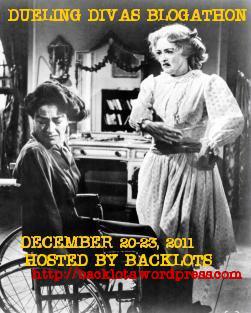
The idea for this blogathon came from a very clever movie marathon at the Castro Theatre a number of years ago, entitled the “Dueling Divas” marathon. Each day, the theatre would show a double feature–each film starring one lady of the silver screen who had a rivalry with the lady starring in the other. For example, they had an entire week devoted to Joan Crawford and Bette Davis, where they showed double features of Possessed/The Letter, The Women/All About Eve, Johnny Guitar/In This Our Life, etc.
So drawing on that very clever idea, I am hosting the Dueling Divas Blogathon, which I have scheduled to take place between December 20-23. It’s a ways off, so as to leave enough time to plan your blogging schedules accordingly.
Participants may blog about any of the following types of Dueling Divas:
Those who had a rivalry in real life, either over a particular film role or over a personality clash, ie Bette Davis and Joan Crawford
Those who had a rivalry on the screen, ie Mildred and Veda from Mildred Pierce
Any dual role (see what I did there? Duel? Dual? Be proud.) played by an actor or actress in a classic film, ie Hayley Mills in The Parent Trap.
It’s totally free reign, you can write about the divas themselves, compare and contrast one of each of their films, and if you’re going to write about dual roles, you can talk about the differences in their characters or the actor’s technique in portraying them…you get the idea.
Ok, a select few rules and regulations:
1) You can write your entry whenever you want, but please do submit your entries between December 20 and 23, so I can keep track of them.
2) Drop me a comment on this post to let me know you would like to participate, and I’ll add your blog to the list of contributing blogs. I’ll be making an official post as the event gets closer, and to submit your entry, please comment with a link to your entryon the official post.
3) Write on something you love and are interested in! Make funny posts! Make overly dramatic posts! This theme can elicit lots of crazy awesome entries, and it would be so much fun to see a diverse range of posts with many different tones and topics. One of the fun things about blogathons is that we get to experience the different tones of each individual blog, so make it your own! I’m so excited to read all the entries.
I’m leaving a few banners for you to use. Questions? Comments? Concerns? Nagging annoyances? Friendly reminders? Emotional outbursts? Drop me a comment! I look forward to reading all your entries come December!
CRÍTICA RETRO: This post is a lovely examination of that wonderful film full of dueling divas, The Women! The cast, the film, backstories and trivia. Written in Portuguese, but don’t worry–there’s a translate button on the right. http://criticaretro.blogspot.com/2011/12/as-mulheres-women-1939.html
A PERSON IN THE DARK: I had so much fun reading this one! I’m a big fan of Josephine and Daphne, so I’m so glad someone chose to profile them for this blogathon. Here, they go head to head in 10 mini competitions such as Best Hair, Best Legs, and Least Conflicted About Her Gender.. http://flickchick1953.blogspot.com/2011/12/dueling-divas-handicapping-daphne-vs.html
HELIUM.COM: Joann Spears profiles many many films featuring a great many dueling divas in her comprehensive and informative post “Top Movies for a Baby Boomer Night of Chick Flicks.” http://www.helium.com/items/2179566-chick-flick
Also, see her comment below for Joann’s contribution of some of the great dueling diva scenes she talks about in her post!
Drawing on yesterday’s post on the Bette Davis interview, here is a new poll for readers. Feel free to vote here, or if you would like to vote later, the poll will be featured in the Polls section for the next week or so. Thanks, and have fun!
During its relatively short run between the years of 1968 and 1972, the Dick Cavett Show managed to procure the best in show business as guests, with the likes of Katharine Hepburn, Gloria Swanson, Pearl Bailey, Groucho Marx, and even Janis Joplin appearing on the program for interviews. Dick Cavett was a casual host, which in turn led the stars to let their hair down and be themselves on the program, sometimes revealing rather personal insights about their lives and careers.
One of the best incidences of a star really being herself on the program is the unlikely example of the 63-year-old Bette Davis, appearing toward the end of the show’s run wearing go-go boots (not kidding) and a rather short skirt. The interview revealed a side of Bette Davis that the public was not familiar with–the very funny woman who was not afraid to share secrets and drop innuendos that would make anyone else blush.
The ten-time Academy Award nominee (and twice winner) also very casually relayed her view of the importance of discipline in the medium, and her own longevity in comparison to the early demises of many of the classic Hollywood stars of the same era under the studio system. She also commented on the movies of the 1970’s and what she thought had changed and why, showing the audience a real depth of knowledge, thought, and intelligence.
It was especially interesting to me to hear her talk about the book she considers to be the most accurate portrayal of Hollywood in the classic era, What Makes Sammy Run? by Budd Schulberg. If any of my readers have read this book, I would love for you to comment with your views on it, because when I read the book, it struck me as a really gruesome portrayal of Hollywood, showing the truly ugly side of the business and the dog-eat-dog mentality of the executives in power. The fact that Bette Davis cites it as the most accurate book about Hollywood says a lot about how she, as an insider, views the system, and to me it is a sobering reminder that Hollywood was far from being all tinsel and glitter back in the days of the studio system.
It is undeniable that Bette Davis was one of the great screen actresses of the 20th century, but this interview also shows her as a smart, thoughtful, and pensive human being. The entire interview can be found on youtube, but it is in fragments titled with the subjects Davis talks about in the clip. Here are some other choice moments. As always, thanks for reading, and don’t forget to comment with your perceptions of What Makes Sammy Run? I look forward to talking with you!
Talking about her highly publicized suit against Warner Brothers.
On her allergic reaction to wasp stings.
On writers, Myra Breckenridge, and sexual repression, among other things. The latter part of this video appeared earlier in the post, but what I really wanted to share was everything from 5:16 on. Her casual demeanor is not something you would expect from such a monumentally successful movie star, but she really shines through in this clip. I think a lot of the credit also goes to the charm of Dick Cavett, who prompted her to go to that next level.
If you have been following my blog at all, one look at the cover of this book should tell you why I felt obligated to procure a copy for myself. For those who may be new here–first off, welcome. Second, I am 1) obsessed with Olivia de Havilland, a longtime resident of Paris, and 2) obsessed with Paris itself. I studied there for 5 months, and I love everything about the city and Parisian culture. More about my time there, and my meeting Olivia de Havilland (yes, I did!) later on in this post, but first, let me give you a brief history of this book, what it is, and why it exists.
Olivia de Havilland wrote this book in 1961 as a sort of disjointed memoir about her life in Paris. It has no plot, follows no sequence of events, but rather is a series of vignettes relating to life as she has experienced it, as a foreigner abroad, and all the joys, difficulties, miscommunications and funny stories she has encountered along the way.
De Havilland moved to Paris in 1953 to start life anew after a divorce from her first husband, Marcus Goodrich. She fell in love with Pierre Galante, the editor of the prominent French magazine Paris Match, and they soon married, planting her in the home where she still lives today, almost 60 years later.
But being a foreigner (de Havilland was born in Japan to English parents, and became a U.S. citizen in 1943) proved rather daunting at first. The title of the book, in fact, refers to the French liver–and its capacity for consuming alcohol, something she was not accustomed to. In another particularly funny chapter, she recounts her problems learning French:
“Not long after [being] intoxicated by a really brilliant showing at my lesson, I gave some quite detailed instructions to another taxicab driver as to where I wanted him to stop. This time I made a splendid bouillabaise of “la crepe” (pancake), “le crepe” (widow’s weeds) “arret” (stop), “arete” (fishbone), and rather authoritatively asked him to put me down at the fishbone of the autobus where the lady was standing wearing the pancake. He did, too.”
She goes on to say:
“Then there was the day I shook my professor. I’d been on a household shopping excursion and had been rather dismayed at the high cost of things. Well, I don’t know if you see much difference between “matelot” and “matelas,” and I don’t know how you’d complain about the price of a mattress. But anyway I rushed in to my professor at lesson time in a state of outrage and indignantly proclaimed that I had discovered that French sailors were VERY expensive!”
This is the tone of Every Frenchman Has One. Olivia de Havilland is an immensely talented and entertaining writer, and each chapter of the book is laugh-out-loud funny. It is evident to the reader just how much de Havilland loves Paris, the French, and living abroad. It’s also interesting to read about her devotion to her children, Benjamin (12 years old at the time of the writing) and Gisele (5 years old). She mostly talks about Benjamin in this book, truly gushing about his intelligence, his fluency in French, and how much Gisele adores him. It’s really sweet.
She even briefly mentions Joan in this book, which is something I was looking for when I first read it. When talking about her religious background and how it pertained to the French way of practicing religion, she related this anecdote from her school days at the Convent of Notre Dame high school:
“When I entered the convent, I did so under a decided handicap. My sister Joan, fifteen months younger than I, had been there for six months before me, and with the really beastly shrewdness that younger sisters are wont to have, she had a VISION. Right there, during Mass, she had seen the Virgin Mary, and had immediately fainted. Of course, the nuns were in a dither of excitement about it, and Joan, who had already earned among them the gentle appellation “duckie,” departed from the convent at Christmastime with their tender blessings, leaving behind her an aura of unsurmountable prestige. Now, you just try following to a convent a younger sister who has had a Vision. Just try it.”
It’s a wonderful, funny book, and I read the 200 pages in about 24 hours. I literally couldn’t put it down. If you can find it, I highly recommend it–it’s long out of print, and it only had two printings, so you’re going to really have to search to find a copy. They go up for sale on Amazon every now and then, but they’re always ridiculously expensive. I got my copy on Amazon, for a bargain price of $60.
So if you do get a chance to read her book, please do. You’ll have a fantastic time with this great read. Next line of business–waiting for Olivia’s autobiography to come out!! It should be pretty soon now, I’ve heard through the publishing grapevine that she’s finished with it. I’m excited to read her perspective on the latter part of her life in France–her son Benjamin sadly passed away from cancer in 1991, and Gisele now lives in Los Angeles, but Olivia still lives in the lovely house on that “attractive, tranquil street” that she describes in Every Frenchman Has One. She has led a remarkable life, indeed.
Continuing on in Star of the Week mode, I am offering up my review of a comedy well-known in the world of classic film, but rarely broadcast on television outside of TCM. It is the delightful Mr. Blandings Builds His Dream House, starring our Star of the Week Myrna Loy and co-starring Cary Grant, with Louise Beavers in a great supporting role as the Blandings’ maid. It was released in 1948 by RKO Radio Pictures.
The story concerns an upper-middle class liberal family, the Blandings, who are living in a small apartment in New York City where Jim Blandings has an advertising office. The family’s dream is to move away from the hustle and bustle of city life to a country house in Connecticut, where Jim could commute to work every day and come home to peace and quiet in the evenings. When they discover an old abandoned house in Connecticut for an affordable price, they consider their dream realized–though they realize the house will need some work. They set out to fix it, and…it turns out that the Blandings got more than they bargained for with this house.
With the problems increasing in number and severity as the film goes on, they begin to dominate the family’s pocketbook and infiltrate the family’s very sanity. The house also begin to threaten Jim’s work, as he is so exhausted and frustrated by the problems with the house, he is unable to meet the deadline for a slogan for his company’s client, the WHAM ham company. He eventually quits his job when he is told to come up with a slogan by midnight, only to come home to his family, including his maid, Gussy, who, incidentally, loves WHAM. When Jim’s children ask if they’re going to have WHAM for breakfast, Gussy tells them “If you ain’t eatin’ WHAM, you ain’t eatin’ ham!” The lightbulb over Jim’s head goes off, he tells his wife to give Gussy a raise, and he rethinks his idea to quit his job. From there, everything in the Blandings’ life goes uphill, thanks to Gussy, and the house problems resolve themselves.
The film is very advanced in many ways, and really does stand the test of time. I watched it recently with my sister, who is not particularly a classic film fan (though she does have respect for movies that are quality), and she LOVED this movie. She thought it was very funny and very modern, and I agree with her–it could very easily have been made within the past few years. Cary Grant and Myrna Loy have fantastic chemistry (I mean…did anyone doubt those two would be amazing together?), but I think the star of the show has to be Louise Beavers, in the role of Gussy the maid. Gussy coming up with that ridiculous catchphrase for WHAM was probably the best part of this very funny movie, and it’s a real testament to her talent that she could steal the show away from the likes of Cary Grant and Myrna Loy.
The very talented Louise Beavers.
One caveat I might give to this otherwise glowing review is that the problems the Blandings family faces sometimes get a bit too much for the audience to handle, especially since we do get so invested in these characters, and I found myself rather embarrassed to admit that I had sort of taken on their problems personally by the time the movie was over. So this may not be the correct movie to watch when you have a lot to worry about in your life–you don’t need the Blandings’ problems! But on the other hand, it might make you realize how sane your life is compared to theirs.
Check out some clips below. It’s unfortunate that there are so few clips on youtube, and it’s not usually readily available at your local video store, because it’s a real gem. Enjoy!
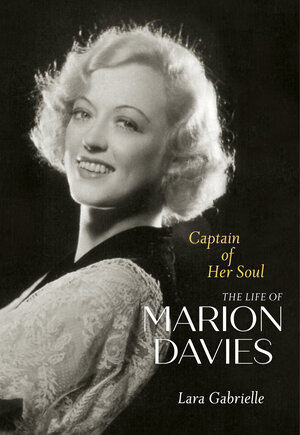
Captain of Her Soul: The Life of Marion Davies is now available at your favorite bookseller! Click hereto order it, and visit mariondaviesbook.com for all the latest.
Backlots is devoted to honoring and celebrating all aspects of classic film and is written by Lara Gabrielle, a California-based classic film writer and historian. Lara is the author of CAPTAIN OF HER SOUL: The Life of Marion Davies (UC Press, 2022).
Here you will find pieces on frequently seen classics and some lesser-known gems, as well as book reviews, festival coverage, and pieces on the history, theory and culture of film as it relates to the study of classic cinema.
Enjoy the site, and thanks for reading!
AFFILIATIONS & AWARDS
2019 CMBA Award for Best Profile of Classic Movie Performer or Filmmaker--"The Activism of Myrna Loy"
Winner of the 2018 CiMBA Award for Best Classic Movie Series, BACKLOTS AT THE COURTHOUSE: OLIVIA DE HAVILLAND VS. FX
Winner of the 2014 CiMBA Award for Best Profile of a Classic Movie Performer or Filmmaker: A Q&A WITH JOAN FONTAINE IN HONOR OF HER 96TH BIRTHDAY
Winner of the 2011 CiMBA Award for Best Classic Movie Discussion, THE FINAL SCENE OF THE HEIRESS
I am honored to be a judge of the Animal Film Festival in Grass Valley, CA.
EVENTS
BACKLOTS ON THE WEB
Join us at the Backlot Commissary, the place for Backlots' readers to share content and discuss movies!
Walter Pidgeon and Greer Garson in "Mrs. Miniver."






















_03.jpg)

 Backlots