Tag Archives: tcmff

Live From the TCM Classic Film Festival Day 4: 5TH AVE GIRL (1939), EMPLOYEES’ ENTRANCE (1933), THE LADY FROM SHANGHAI (1947), Closing Night Party

The final day of the TCM Classic Film Festival was by far the lightest in terms of screenings, but I also found it to be among the most enjoyable. One of the wonderful things about this festival, speaking for those of us who write about classic film, is that there is never any shortage of community here. The classic film writers’ world is quite a tight-knit one, and I found myself constantly surrounded with fellow bloggers and friends comparing schedules and trying to coordinate screenings, chatting in line about Barbara Stanwyck and Irene Dunne, and updating each other on what’s new on our blogs. The TCM Classic Film Festival is known for valuing bloggers, so many of us in the online classic film community received credentials this year and it was nice to put faces to names, and reunite with those I saw last year.

The first showing today was a repeat, a movie that had sold out in a previous time slot and they scheduled it in another to get more people in. It was a Ginger Rogers movie called 5th Ave Girl, directed by Gregory La Cava (of My Man Godfrey fame) and co-starring Walter Connolly, telling a story about a young woman who is hired by a lonely man to live in his house with his wife and children, and make his life a little less boring. It was not, in my opinion, a hugely successful effort, but it is a feel-good movie and it showcases Ginger’s ability to do some pretty top-notch deadpan comedy.

Interestingly, it was made in 1939, the year known as “the best year for movies,” alongside Gone With the Wind, The Wizard of Oz, Mr. Smith Goes to Washington, and Stagecoach. But in those days, studios were an essential factory line for movies, and it’s sobering to think that even in a year like 1939, the sheer amount of movies coming out of Hollywood ensures some troublesome ones. Though it was not a bad movie, it was rather slow with a bit of a loose plot that I found tedious. It is one of the few films I’ve seen at festival that I haven’t particularly liked.

Loretta Young and Walter William in EMPLOYEES’ ENTRANCE.

Next up was Employees’ Entrance, a 1933 film about a corrupt and evil boss that uses people and then throws them out. It stars Warren William as the evil boss and a young Loretta Young as the wife of his next-in-command. The boss is such a tyrant that he won’t let his employees get married, so the two have to keep their marriage secret, and the movie is about their lives and those of everybody else who is privy to the antics of this deranged person.

One of the highlights of the Employees’ Entrance screening was an informative and entertaining lecture about the pre-Code era from the president of the Film Forum in New York City, Bruce Goldstein. Goldstein gave a witty and fun overview on what the pre-Code era meant for Hollywood, and referenced several strong pre-Code films and the strong women characters that are indicative of that era.

As my readers know, I have a real fascination with the pre-Code era and I have just learned that TCM will soon be having a tribute to the women of pre-Code Hollywood, who make up some of the most exciting characters ever to be seen onscreen. Stay tuned for more details as they become available, as I will be doing a series on Backlots related to this.

Rita Hayworth and Orson Welles in THE LADY FROM SHANGHAI (1947).

My final screening of the festival was a movie that I have had the privilege of seeing before on the big screen, but this was a world premiere presentation of a new digital restoration that I was anxious to see. It was The Lady From Shanghai, a movie that presenter Eddie Muller called “noir poetry,” directed by Orson Welles and starring his recently separated wife Rita Hayworth opposite himself. The movie is notable for the brilliant “hall of mirrors” scene, and for the surprise of seeing the beautiful Rita Hayworth with short blonde hair–as well as the magnificent directing of Welles and his innovations in cinematic technique. The plot is a bit muddy, but in this case it doesn’t much matter because the focus is primarily on the visuals and Welles’ beautiful manipulation of the camera.

The restoration was gorgeous. There are some mixed feelings within the classic film community about digital restorations, and in my opinion it’s possible for a film to be “over-restored.” A few years ago I had the privilege of seeing a new digitally restored print of Pabst’s Pandora’s Box, one that was hailed as being such a superb restoration that it was near flawless. And it was a flawless restoration. To my mind, too much so. It looked computerized in how perfect it was, and it didn’t look like it came from film stock. It turned me off a little. But this one was simply a pristine clean-up–it was still clear that this was a movie that had been shot on film, and it was just the restoration that was done digitally. I enjoyed it quite a lot.

And that was the end of the TCM Classic Film Festival. I spent the rest of the evening at the closing night party, talking to friends and preparing to miss them until next year. But the good news is that we all know each other online, so it’s only goodbye to faces–not goodbye to people. Thank goodness for the internet, keeping us all connected though miles away.

A huge thank you to TCM for allowing me to attend this festival, to Chelsea Barredo for all her help with the red carpet credential, and to all the wonderful people I met and reconnected with this year. Here’s to the next one!

Live From the TCM Classic Film Festival Day 3: CITY LIGHTS (1931), I REMEMBER MAMA (1948), HOW GREEN WAS MY VALLEY (1941), Hollywood Home Movies, THE WOMEN (1939), FREAKS (1932)

On what was my busiest day of the festival thus far, my film experiences yesterday ran the gamut of human emotion. From the laughs and tears of City Lights to the nostalgia of I Remember Mama, to delight at the naughtiness of The Women to the uncomfortable but ultimately triumphant horror of Freaks. It was quite a long day and so, dear readers, I was compelled to begin writing this post on the morning of the last day of the festival, in the name of sleep and sanity.

The first film of the day yesterday was City Lights, a 1931 Charlie Chaplin masterpiece that is one of his many tours-de-force and happens to be one of my personal favorites of all time. It tells the story of a blind girl who is befriended by Chaplin’s “little tramp” character, and when she is unable to afford her rent, he goes through a series of precarious (and often hilarious) circumstances to get the money for her. The movie is laugh-out-loud funny, but with a certain poignancy in Chaplin’s scenes with the blind girl, a poignancy that serves to give the tramp character his humanity. This is typical of Chaplin–right when we are about to write the tramp off as nothing but a silly clown, we are shown a side of him that is so sweet, gentle, and kind, we cannot help but relate to him in some way and think of him on our own human terms.

The ending of City Lights is, in my opinion, one of the most beautiful endings ever in the history of the movies. For those of you who have not seen it and prefer not to have the ending spoiled, skip this paragraph and clip! But for those of you who don’t mind spoilers, I will show you an ending that is sure to melt the coldest of hearts. When the tramp is with the blind girl at one point in the movie, she discusses the possibility of surgery on her eyes so that she may see. It is inferred that with the money that the tramp gives her for her rent (he manages to get her a lot more than her rent required, by enlisting the help of a millionaire friend who, through a series of circumstances, ends up not remembering him and the tramp is thrown in jail for extortion), she is able to afford the operation, but as the police believe that the tramp stole the money, he ends up in jail and unable to see the girl until he is out. Autumn comes, and the tramp is out of jail…disheveled with raggedy clothes on, he sees the girl, who has had her operation. This is the scene:

http://www.youtube.com/watch?v=LHBHdYgg9fI

Needless to say, it was an emotional moment in the theater. It is rare that a movie can make you laugh so hard, and then tug at your heartstrings with such grace and beauty.

Next up was I Remember Mama, a glimpse into the life of a Norwegian immigrant family in San Francisco in the early 1900s. The plot is simple–a young woman recounts her childhood in flashback, recalling the days with her family, the good times and the bad times. TCM’s theme this year is “Family: The Ties That Bind,” and they couldn’t have picked a more appropriate addition to the festival than I Remember Mama. The film earned Irene Dunne her final Academy Award nomination, and in my personal opinion she was robbed that year. Though the competition was tough–she was up against Olivia de Havilland for The Snake Pit, Barbara Stanwyck for Sorry, Wrong Number, Ingrid Bergman for Joan of Arc, and the ultimate winner, Jane Wyman in Johnny Belinda–Irene Dunne’s performance as the devoted Norwegian mother is flawless. She speaks with a convincing Norwegian accent, and in one scene in which she has to leave her child alone in a hospital, you can feel her pain and guilt. It is a remarkable movie, and a love poem to mothers everywhere.

Maureen O’Hara and Walter Pidgeon in HOW GREEN WAS MY VALLEY (1941)

I was concerned about getting into the next movie, as there would be a special guest–and not just any special guest. The legendary Maureen O’Hara was slated to appear at the screening of How Green Was My Valley, and as I expected, the line was the longest I had ever seen at this festival. I did end up getting in, and they showed a beautiful montage of clips from Maureen O’Hara movies before Maureen came out–teary-eyed with emotion. At 93 years old she is still strikingly beautiful, and speaks elegantly with a touch of an Irish brogue that came and went during her film career but now seems here to stay. I had the great privilege of meeting Maureen O’Hara several years ago when I was in Ireland, and she is truly a larger-than-life personality. A great lady with great convictions that are apparent whenever she speaks.

How Green Was My Valley is a touching coming-of-age story set in a Welsh mining town, and Maureen O’Hara plays Angharad, sister of main character Huw (Roddy McDowall). The film makes a great many points about family and fairness, especially in regard to labor and treatment of others. It is a simple film that doesn’t put on any airs, yet it won the Academy Award for Best Picture in 1942–winning over Citizen Kane.

http://www.youtube.com/watch?v=T7CV9SZovfU

The next activity was a showing of several Hollywood home movies from the Academy Film Archive, including home movies from the Ziegfeld family, footage from Hearst Castle, the set of Oklahoma, and rare backstage footage of a young Jean Harlow. Accompanied by a live piano, the silent clips were shown with live commentary from special TCM guests, including, notably, the great-granddaughter of Florenz Ziegfeld and Billie Burke.The Academy Film Archive is a treasure trove of films, newsreels and film clips, and their selections for the festival are always fascinating. This is becoming a yearly event at the TCM Classic Film Festival, and I always make it a point to go. The audience was enraptured and enthusiastic, and it was great fun to experience.

http://www.youtube.com/watch?v=nWNR7CQZ6Xk

After having coffee with fellow blogger Vincent Paterno, who is in town for the festival, I headed off to see The Women, a movie readers of Backlots are quite familiar with by now as I have written about various facets of the movie on many different occasions. It is one of the smartest, wittiest movies of the 1930s and, I would argue, of all time. Yesterday’s screening featured a talk with Anna Kendrick, Oscar-nominated actress who happens to be a huge fan of The Women. Kendrick spoke intelligently and passionately about this movie, and she and Ben Mankiewicz (who interviewed her) clearly have a great rapport. It was a lot of fun, and the talk went overtime because Kendrick had so much to say.

I won’t delve into the movie in this write-up, as I would be writing about it all day and you can read my varied analyses of this movie here, here, and here, but suffice it to say that it’s one of my favorite films to discuss. I am especially fascinated by the the influence that designer Elsa Schiaparelli had on the film’s costume designer, Adrian, evidenced in the fashion sequence and throughout the movie.

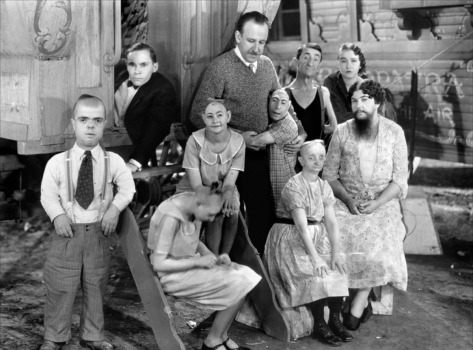
My final viewing of the night was a midnight showing of Freaks, a dark look into the world of circus sideshows that ultimately brings light to the way people with disabilities were treated within the confines of so-called “freak shows.” It is a movie whose concept makes a lot of people uncomfortable, and I think it’s partly because there is a misunderstanding of the film’s title from those who have not seen the movie. It is often passed over by people who are either offended by what they assume the movie will be, or by those who fear the dark and bizarre subject matter. But at its core, Freaks is a movie that turns stereotypes upside down. Previously (and since), actors who had some sort of physical disability were often cast as villains or characters to be feared. In Freaks, it is the disabled characters who are the “good guys,” and the able-bodied characters are the ones to be feared. It is quite an unusual and progressive scenario. Tod Browning spent much of his life working in circuses, and knew this world very well, which makes his interpretation all that more fascinating. In addition, nearly all of the characters were portrayed accurately, by disabled actors or real life sideshow performers.

Tod Browning with some of the cast members of FREAKS (1932).

Today, as the last day of the festival, is a bit of a lighter day, but there are some good things on the horizon to look out for tomorrow! See you then!

Live From the TCM Classic Film Festival, Day 1: Press Roundtable, Red Carpet Coverage, THE HEIRESS (1949)

Readers, I apologize for the delay in this post–I returned from a screening of The Heiress last night to find that my internet had taken a holiday of its own and was on the blink. Unable to post online but determined to get you the coverage you expect from me, I started writing on my phone but it had been such a long day that I fell asleep before the post could be entirely written. Hopefully that won’t be happening again and my internet will behave for the duration of the festival.

Yesterday was the opening day of the TCM Classic Film Festival, and what a day it was! Normally the TCM press events happen the Wednesday before the festival, but due to conflicting events at the Roosevelt Hotel, the powers that be decided to move the press day to Thursday, and into the TCL Chinese 6 theater, upstairs in the Hollywood and Highland mall complex on Hollywood Boulevard. We heard from Robert Osborne, Ben Mankiewicz, Charlie Tabesh and Genevieve McGillicuddy (the latter two work in network programming), and we heard a slew of fantastic questions and fascinating answers. Robert Osborne answered questions about his associations with Lucille Ball and Jane Darwell (“She wasn’t funny,” he said of Lucy, referring to her offscreen demeanor, “but she could BE funny”) as well as a question about what TCM’s greatest gift to him has been. He answered that the TCM family has been a great gift–the fact that there are so many knowledgeable people at the network, as opposed to the staff at previous jobs he has worked–and hearing from fans. He noted that TCM often gets letters from fans who say that the network has helped them through unemployment, hospital stays, and cancer treatments, and that he never realized that part of his job would be that of nurse. Ben Mankiewicz echoed Osborne’s sentiments that the TCM family has been a great gift to him, and added a bit about his own illustrious family having given him the boost that he may have needed to attain the job that has “changed the direction of [his] life.”

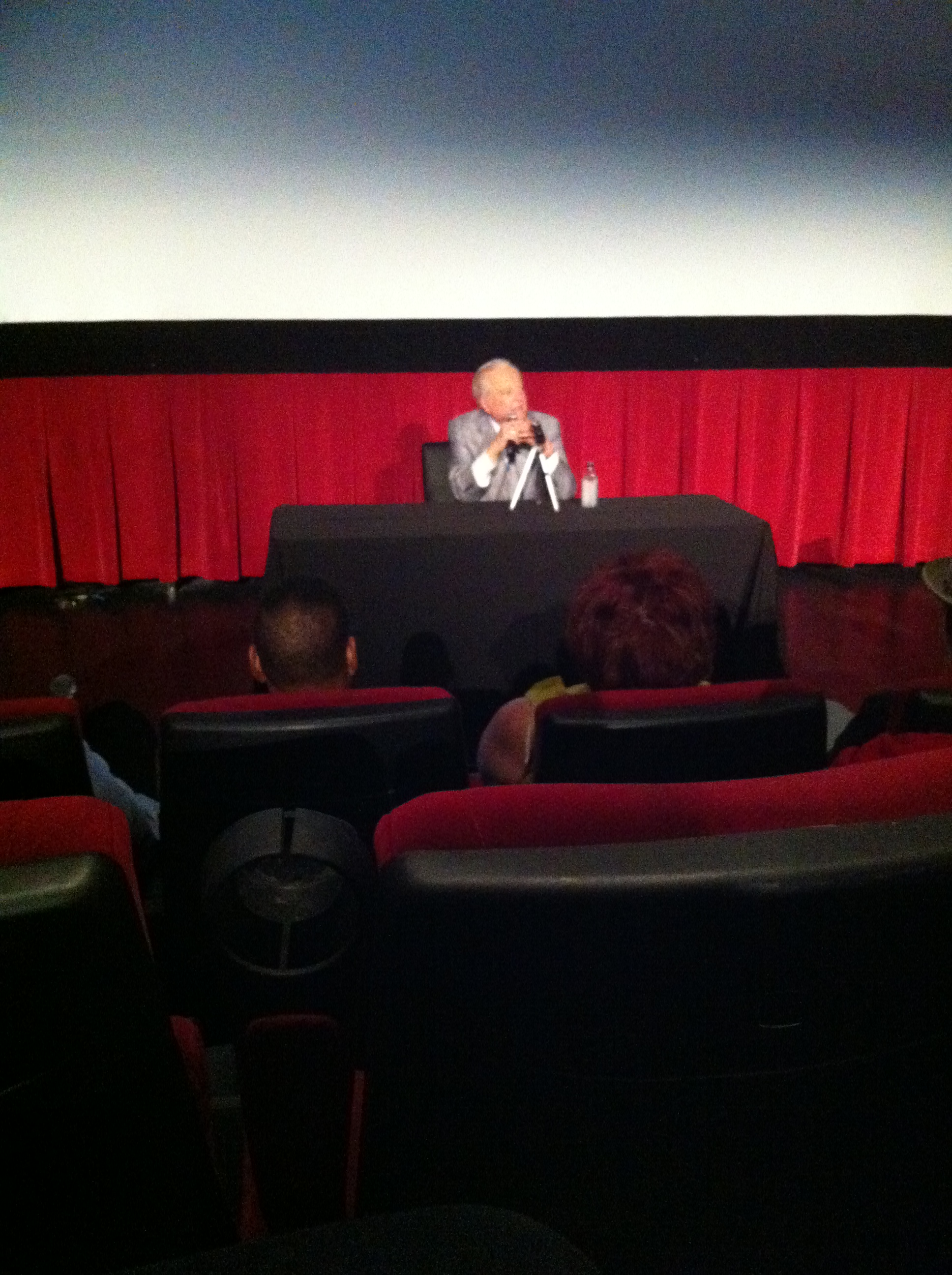
Robert Osborne answers questions.

Robert Osborne answers questions.

My question was posed to Charlie Tabesh and Genevieve McGillicuddy, and it related to original programming. I am a big fan of TCM’s programming, and especially love the documentaries that they have produced in the past. I referenced the beautiful Clara Bow documentary that was done many years ago, and asked if there was anything other documentaries on the horizon. They responded that there is a separate department for original programming, and that there are indeed some things on the table, but it was good to hear that there is interest in these documentaries because it spurs action on their part. They said they would pass on my words to the department, so hopefully in the future we will be seeing more of TCM’s beautiful original work.

Notably, during Robert Osborne’s time to speak, he also referred to the Private Screenings interview with Olivia de Havilland that was supposed to have taken place last October. There has been some buzz online that it didn’t happen, and Osborne confirmed that it unfortunately did not. 97-year-old Olivia had taken ill with pneumonia shortly after they arrived in Paris, and was not able to do the interview. Extremely apologetic, she said that she would come to New York and do one–but when that was scheduled, she had another flare-up of pneumonia and ended up in the hospital again. “It’s not meant to be,” said Osborne.

On my end, I had heard that Olivia had been ill and in the hospital with a lung infection, and thus wondered if there was truth to the rumor that the interview did not happen. Obviously, pneumonia at 97 years old is quite serious. Certainly, a Private Screenings with Olivia de Havilland would be a major coup for TCM, but Olivia’s health needs to come first and Backlots sends her great healing wishes.

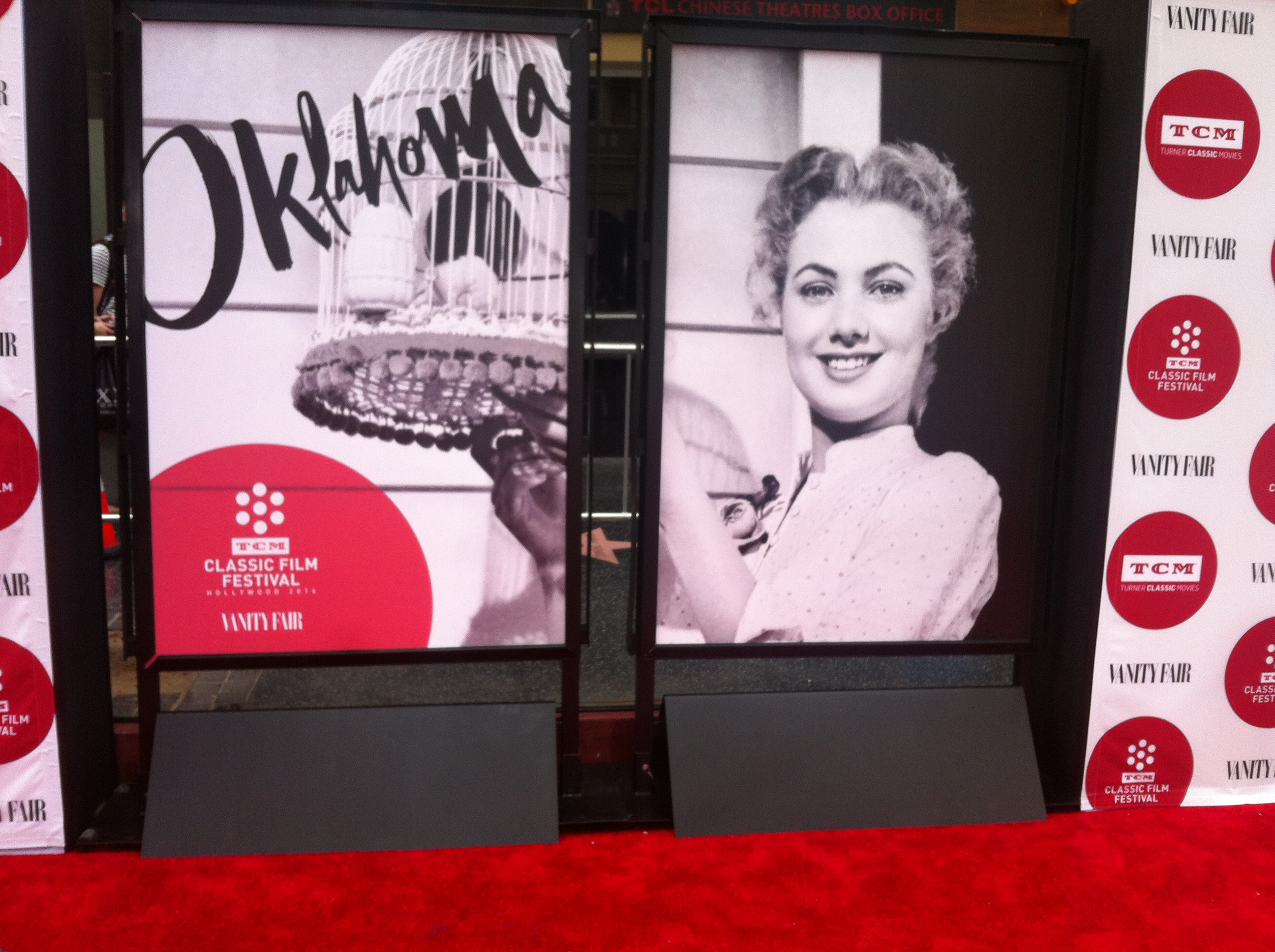
Next on the agenda was coverage of the red carpet. It was great fun to watch stars such as Shirley Jones and Margaret O’Brien walk down the carpet into the screening of Oklahoma! at Grauman’s Chinese Theatre. Unfortunately I didn’t get to talk to anyone (save a rather awkward exchange with Leonard Maltin, who caught me off guard and for whom I didn’t have any legitimate questions), but I got some fantastic pictures.

001

012

My view.

015

Shirley Jones on the red carpet.

After a brief rest following the red carpet, I headed out to see a screening of The Heiress, meeting up with fellow blogger Kristen from Journeys in Classic Film, her friend Michelle, and also TCM notable Lawrence Carter-Long (you may remember him from the marvelous series on disability in film that aired on TCM last year). The Heiress is a movie that I have seen literally dozens of times, but never on the big screen, and seeing it this way was a truly thrilling experience. The audience was laughing and gasping at parts that I had never paid particular attention to, and I heard witty dialogue that simply disappears when one sees the movie on a small screen. Olivia de Havilland’s performance in the magnificent final scene was all the more powerful when viewed on a huge scale, and the expressions on her face magnified to create a grand perspective. The Heiress is a gorgeous film in any size, but like anything else, it is meant to be seen on a screen of these dimensions.

Click here to read my analysis and discussion of the final scene of The Heiress.

Today is a full day, and hopefully my internet will be working when I get home so that I can give you the scoop while it’s still hot!