Day 3 was one filled with favorites and laughs. I started off the day with Why Be Good? (1929), a movie I had seen a few months ago when a new restoration was screened at the Los Angeles County Museum of Art. This same restoration was shown here, and I loved the movie so much the first time that I had to see it again.
The plot of the movie centers around a young girl who falls in love with a wealthy banker’s son, but has to prove that she’s a “good girl” before his father will allow him to date her. The premise sounds contrived, but in reality the film is unique and refreshingly feminist in many spots, with lines that resonate with much of feminist thought today. Colleen Moore is as cute as can be, with big, expressive eyes and movements that radiate the jazz age. It was great fun to see it screened at the festival, and I’m happy that this sweet film is getting the attention it deserves.
Next up was 42nd Street (1933), a personal favorite. Featuring much of the same cast as the seminal Golddiggers of 1933, what this movie lacks in originality it makes up for tenfold with a spectacular cast and Busby Berkeley’s creative musical numbers. Ruby Keeler is a delight as always, and the title number is one of the first real ballet sequences within a film that tells its own story within the film. The famous ballet sequences in An American in Paris and Singin’ In the Rain followed 42nd Street‘s lead in creating a veritable “show within a show,” but 42nd Street takes it one step further–the title number is indeed a story within a story within a story. Take a look:
42nd Street and Golddiggers of 1933 are hallmarks of the pre-Code era, and are extremely popular with the TCM Festival crowd, yet pre-Codes are often put in the smaller theaters and easily sell out. My dream is to one day see a pre-Code programmed at Grauman’s Chinese Theater, where it will not only look beautiful but also bring a lot of excitement to the festival-going crowd. I would have loved to have seen Ruby Keeler on that giant screen!
I had a large break in my schedule on Day 3, during which I relaxed with friends and got ready for the evening screening, Earthquake!, poolside at the Roosevelt Hotel. A Q&A with Richard Roundtree preceded the film, and then we were treated to one of the most fabulously low-budget movies I have ever seen. The inspiration for future disaster films such as the Airport movies and the spoof Airplane!, Earthquake! stars Charlton Heston and Ava Gardner (who hilariously insisted on doing her own stunts) and focuses on a disastrous earthquake in Los Angeles, ultimately destroying the city. Its low-budget special effects left the audience in stitches, and satisfied my frequent craving for camp film. I left with a pain in my stomach from laughing so hard. Thanks, Earthquake!
Dear readers, I’m usually so good about posting right after festival events, but after several late nights, I needed some sleep. The festival is now over, and I’m getting back into the swing of things. I apologize for the delay!
Day 2 was a jam-packed one at the TCM Classic Film Festival, the first day of the festival with a full docket of programming. I started off the day with a beautiful presentation called The Dawn of Technicolor, based on the new book by David Pierce and James Layton. Pierce and Layton were there discussing the facets of early Technicolor, and the differences between the two-strip Technicolor process and the much better-known three-strip process, as seen in movies like The Wizard of Oz. It was a fascinating discussion, touching on such concepts as lighting techniques for early Technicolor and difficulties in getting certain colors to register (blue was especially difficult), and Pierce and Layton showed the audience clips of very early Technicolor musicals that were a delight.
Since many of the early Technicolor clips that the audience saw yesterday are extremely rare, I will instead post here two clips that demonstrate the two-strip process and the three-strip process, respectively.
This is the “Tell Me, Pretty Maiden” number from The Florodora Girl. Pierce and Layton noted that, in addition to the difficulty in photographing blue tints, yellow tints were next to non-existent in the two-strip Technicolor process. The focus was on reds and greens, which came out in beautiful shades and this lends itself to the signature look of two-strip Technicolor.
You can see the difference between two-strip and three-strip Technicolor by looking at this beautiful clip, in which all the colors of the rainbow are represented as Dorothy goes over it. By 1939, three-strip Technicolor had all but replaced two-strip as the color standard in film, though color wouldn’t become industry standard until several decades later.
A wonderful and informative presentation, that I would recommend to anyone interested in film!
Next I went to Club TCM to hear legendary film historian Jeanine Basinger speak about portrayals of history in the movies. Professor Basinger is the head of the film department at Wesleyan University, and founder of the renowned film library there, as well as one of the most respected figures in the world of film studies. She discussed the way history has been portrayed in Hollywood and what devices filmmakers use when trying to depict events for which we may not have all the information, or when trying to make history interesting and screen-worthy. One thing she talked about was what she calls the “letters of transit” device, referring to the plot of Casablanca that hinges on Victor Laszlo getting letters of transit out of Morocco when letters of transit did not exist in reality. The filmmakers used this device to add spice to the story, and it worked brilliantly. No one seems to care that letters of transit did not exist in reality, they existed in Casablanca and that seems to be enough. It was a great discussion, and hearing Professor Basinger speak is something that all students and scholars of film should be able to do.
A scene about “letters of transit” in Casablanca (1942).
Next up was the Buster Keaton classic Steamboat Bill, Jr., complete with a new score by silent composer Carl Davis, who also conducted the orchestra. It was a brilliant score and great fun to watch. Buster Keaton is typically hilarious and, naturally, gets into some real shenanigans. This is the movie with what is probably Buster Keaton’s most famous scene:
Steamboat Bill, Jr. was made in 1928, when Buster Keaton was at the peak of his career. Unfortunately, it was also right before his downfall, with contract switches and the coming of sound essentially putting a halt to what was one of the most glorious careers of the silent era. It was interesting to watch it in this context, as one of the great silent comedians was at the top of the world…only to fall off shortly thereafter.
A personal favorite, Rebecca, came next. I have written about this movie many times before, but it’s such a masterpiece of lighting, cinematography, and acting that I see something new every time. This time, I noticed that director Alfred Hitchcock uses very long lines in his camerawork, perhaps to emphasize the tallness of the estate Manderley. Nearly all the doorways and windows are structured to draw the eyes upward, and even the furniture and shadows are designed to guide the eyes up. Take a look at this scene, and notice the narrow, vertical light on the wall from the window, as well as the narrow structure of the window itself:
It is said that nothing in Hitchcock is accidental. If that adage holds true, this is a genius work of subtlety on his part.
The festival this year features an unusually high number of films that one can read through a queer lens–and Rebecca is certainly one of them. The relationship between the evil Mrs. Danvers and the late Rebecca de Winter can be inferred very clearly in this movie, as evidenced by this scene. Though filmmakers were kept from stating the relationship explicitly, the eerie scenes with Mrs. Danvers in Rebecca’s room do more for a queer reading of the film than anything that could have been stated explicitly.
The next movie, Boom!, is one that I have seen before on the big screen and it is a movie so bad that it’s a lot of fun to watch. I can barely tell you the plot, except that it takes place on a Greek island and Elizabeth Taylor is a drug addict who is visited by death, played by Richard Burton. It features monstrously terrible and nonsensical dialogue, and my friends and I were laughing the whole time. It’s the perfect midnight screening.
A few days ago, I received confirmation that Backlots will be covering the TCM Classic Film Festival in Hollywood, as a member of the press for the third year in a row.
Over the past 6 years of its existence, the TCM Classic Film Festival has become synonymous with class and sophistication, and has provided a haven and meeting place for classic film lovers from all over the world. Featuring a plethora of classic film related events to augment the film showings, and world-class guests from all areas of the entertainment world, the TCM Classic Film Festival is truly not to be missed.
Though the full schedule for this year is yet to be released, the theme of “History According to Hollywood” has yielded such exciting programming choices as Gunga Din, Dr. Zhivago, The Hunchback of Notre Dame, and 1776.
Stay tuned, as I will be posting exciting updates to the schedule in these weeks leading up to the festival. In the meantime, if you are in the Los Angeles area, be sure to go to http://www.tcm.com/festival to learn more about the pass options and how to attend. I look forward to seeing you there!
All September long, TCM is shining the spotlight on those films made during the illustrious years of 1929-1934, the saucy and seductive era we call “pre-Code.” In the days prior to codified morality on film, writers and filmmakers were free to tell the stories they thought their audiences would accept, and these films often defy the stereotypes that mainstream audiences visualize when they conceptualize classic film.
In pre-Code Hollywood, sex and seduction drove plots and defined characters. Women and men knew what they had, and weren’t afraid to flaunt it. It was an open, expressive time for film, and a time to push the social envelope and challenge audiences to analyze those things outside their comfort zone.
At the height of the pre-Code era came Red Dust (1932), a story about an American rubber farmer (Clark Gable) in Indochina who is torn between a stable relationship with one woman, and a steamy affair with another. One woman is a prostitute, and the other a refined lady of the city.
Think you know which one is the stable relationship, and which is the steamy affair?
The prostitute Vantine cares for Dennis Carson after he is shot by the jealous woman with whom he is having an affair (Mary Astor).
The film forces the audience to rethink pre-conceived notions of morality and goodness by switching expected characterizations of women. In this film, it is Jean Harlow’s character of the prostitute Vantine who represents core, upstanding virtue. Though she is a lady of the night, she strives to maintain her standards and dignity when the cards are stacked against her.
Early in the film, after a passionate night with Dennis, the rubber farmer offers her money without a word of judgment. Here we learn two things: though Dennis has just spent the night with a prostitute, he holds his head high the next morning and does what he feels is right. He holds core values and does not shame or feel shamed. We also learn that Vantine is more than just your average prostitute. She yearns for sincere love and a stable partner. When Dennis offers Vantine the money, she sweetly refuses, letting Dennis know that she enjoyed the evening with him.
Mary Astor’s character, a classy, ladylike woman named Barbara, soon arrives in Indochina with her husband, who is to work as an engineer on the rubber plantation. Dennis is attracted to Barbara, and sends her husband away on a long trip whereupon he begins to seduce her. Dennis is so enamored with Barbara that she persuades her to leave her husband for him, but he soon has a change of heart when he learns just how much her husband loves Barbara. Dennis pretends never to have loved her, and Barbara, in a rageful moment, shoots him. When her husband runs in, they simultaneously cover their relationship and provide Barbara an alibi by saying that Dennis had tried unsuccessfully to seduce her. The film ends with Vantine sitting by Dennis’ side on the bed, reading him bedtime stories.
Visual symbolism. The prostitute, shunned by society, sits on a higher plane than the woman whom society labels as dignified.
This gray moral area and complex characterization of a female character is common in pre-Code cinema, but becomes far less so when one examines movies released from late 1934 on. The modification of the Hays Code in July of 1934 signified a major shift in the portrayals of women on film, and erased once and for all any gray moral area that may have existed prior to the Code’s enforcement. The Hays Code clearly stipulated that there should be no doubt as to where morality existed and where it did not, especially in regard to women, spelling out a clear message for the audience and leaving little room for speculation or analytical thought. In response to these new rules, filmmaking itself experienced a massive upheaval after the enforcement of the Code, and a new cinematic technique developed. In order to make the movies they wanted to make, screenwriters, directors, producers, and actors had to come up with subtle ways to trick the censors and make the film’s message as clear as it could be. The result was the biting innuendo, suggestive costuming, and creative use of props and dialogue that make up the landscape of post-Code cinema.
A movie like Red Dust, however, is a hallmark of the pre-Code era, and would have been nearly impossible to make had it been attempted just a few years later. We’re lucky that it was made when it was.
Upon glancing at TCM’s schedule for this month, I was thrilled to see that the network is paying tribute to the wonderful June Allyson as their featured Star of the Month. In addition to her status as one of the most charming and charismatic stars at MGM, I have a special connection to June Allyson that makes me especially happy to see her honored this month. I will talk about that later in this post.
Known for her sweet, girl-next-door image, June Allyson reigned as one of the top stars of MGM in the 1940s and 1950s. In contrast to her wholesome, suburban persona onscreen, the girl who was born Ella Geisman grew up in poverty, raised by various relatives in the New York City projects. Despite a childhood accident that rendered her unable to walk for several years without a steel brace, she became a seasoned dancer and eventually began to land gigs in nightclubs and acting roles in musical short subjects with Vitaphone Pictures. In 1938, at the age of 21, she got her first Broadway role in Sing Out the News, and her first starring role came 3 years later in George Abbott’s production of Best Foot Forward.
Due to her performance in the Broadway show, MGM asked Allyson to appear in the film version that was in pre-production in Hollywood. She agreed, and made the trip west. Upon her arrival, she found that Best Foot Forward was going slower than expected, and she was cast in a tiny role in Girl Crazy (1943) to keep her occupied. This is June Allyson’s first appearance in a feature film.
Best Foot Forward came to fruition later the same year, and when Arthur Freed saw her screen test, he demanded that she be put under a long-term contract immediately. Allyson thrived at MGM, using her cherubic face, wide smile, and arrestingly husky voice to her advantage in such films as Two Girls and a Sailor (1944), Good News (1947) and Little Women (1949).
With Peter Lawford in Good News (1947)
The trailer for Little Women (1949)
In 1945, June Allyson married heartthrob Dick Powell, much to the chagrin of Louis B. Mayer who thought Powell was bad for her studio image. She was placed on suspension, but she and Powell remained married until Powell’s death in 1963 and the couple adopted 2 children together. After Powell’s death, Allyson was invited to appear alongside old MGM rival Judy Garland on “The Judy Garland Show,” marking one of the most delightful episodes of the series.
Acting on a lifelong interest in medicine, in later life June Allyson committed herself to educating the public about gynecological and urological diseases in seniors, eventually founding the June Allyson Foundation for Public Awareness and Medical Research. She continued with this work until she died in 2006, at the age of 88.
Now for my connection to June Allyson. I was lucky enough to have met this wonderful woman in the summer of 1998, when I was 12 years old. My very obliging mother had taken me halfway across the country to attend the Judy Garland Festival in Grand Rapids, MN, and June Allyson was the guest of honor that year. I remember her so vividly. Her spirit filled the room, her voice was warm, her character gentle and sweet. She loved children, so my sister and I were subject to great affection. I remember several big bear hugs, and she interacted with me with great tenderness and love. I felt that we were dear friends. I’ve carried that beautiful memory of June Allyson with me always, and I miss her dearly.
Don’t forget to tune in to TCM tonight for an evening with June Allyson! Showing tonight: Two Girls and a Sailor at 8:00 EST, Best Foot Forward at 10:15, and Good News at midnight.
On what was my busiest day of the festival thus far, my film experiences yesterday ran the gamut of human emotion. From the laughs and tears of City Lights to the nostalgia of I Remember Mama, to delight at the naughtiness of The Women to the uncomfortable but ultimately triumphant horror of Freaks. It was quite a long day and so, dear readers, I was compelled to begin writing this post on the morning of the last day of the festival, in the name of sleep and sanity.
The first film of the day yesterday was City Lights, a 1931 Charlie Chaplin masterpiece that is one of his many tours-de-force and happens to be one of my personal favorites of all time. It tells the story of a blind girl who is befriended by Chaplin’s “little tramp” character, and when she is unable to afford her rent, he goes through a series of precarious (and often hilarious) circumstances to get the money for her. The movie is laugh-out-loud funny, but with a certain poignancy in Chaplin’s scenes with the blind girl, a poignancy that serves to give the tramp character his humanity. This is typical of Chaplin–right when we are about to write the tramp off as nothing but a silly clown, we are shown a side of him that is so sweet, gentle, and kind, we cannot help but relate to him in some way and think of him on our own human terms.
The ending of City Lights is, in my opinion, one of the most beautiful endings ever in the history of the movies. For those of you who have not seen it and prefer not to have the ending spoiled, skip this paragraph and clip! But for those of you who don’t mind spoilers, I will show you an ending that is sure to melt the coldest of hearts. When the tramp is with the blind girl at one point in the movie, she discusses the possibility of surgery on her eyes so that she may see. It is inferred that with the money that the tramp gives her for her rent (he manages to get her a lot more than her rent required, by enlisting the help of a millionaire friend who, through a series of circumstances, ends up not remembering him and the tramp is thrown in jail for extortion), she is able to afford the operation, but as the police believe that the tramp stole the money, he ends up in jail and unable to see the girl until he is out. Autumn comes, and the tramp is out of jail…disheveled with raggedy clothes on, he sees the girl, who has had her operation. This is the scene:
Needless to say, it was an emotional moment in the theater. It is rare that a movie can make you laugh so hard, and then tug at your heartstrings with such grace and beauty.
Next up was I Remember Mama, a glimpse into the life of a Norwegian immigrant family in San Francisco in the early 1900s. The plot is simple–a young woman recounts her childhood in flashback, recalling the days with her family, the good times and the bad times. TCM’s theme this year is “Family: The Ties That Bind,” and they couldn’t have picked a more appropriate addition to the festival than I Remember Mama. The film earned Irene Dunne her final Academy Award nomination, and in my personal opinion she was robbed that year. Though the competition was tough–she was up against Olivia de Havilland for The Snake Pit, Barbara Stanwyck for Sorry, Wrong Number, Ingrid Bergman for Joan of Arc, and the ultimate winner, Jane Wyman in Johnny Belinda–Irene Dunne’s performance as the devoted Norwegian mother is flawless. She speaks with a convincing Norwegian accent, and in one scene in which she has to leave her child alone in a hospital, you can feel her pain and guilt. It is a remarkable movie, and a love poem to mothers everywhere.
Maureen O’Hara and Walter Pidgeon in HOW GREEN WAS MY VALLEY (1941)
I was concerned about getting into the next movie, as there would be a special guest–and not just any special guest. The legendary Maureen O’Hara was slated to appear at the screening of How Green Was My Valley, and as I expected, the line was the longest I had ever seen at this festival. I did end up getting in, and they showed a beautiful montage of clips from Maureen O’Hara movies before Maureen came out–teary-eyed with emotion. At 93 years old she is still strikingly beautiful, and speaks elegantly with a touch of an Irish brogue that came and went during her film career but now seems here to stay. I had the great privilege of meeting Maureen O’Hara several years ago when I was in Ireland, and she is truly a larger-than-life personality. A great lady with great convictions that are apparent whenever she speaks.
How Green Was My Valley is a touching coming-of-age story set in a Welsh mining town, and Maureen O’Hara plays Angharad, sister of main character Huw (Roddy McDowall). The film makes a great many points about family and fairness, especially in regard to labor and treatment of others. It is a simple film that doesn’t put on any airs, yet it won the Academy Award for Best Picture in 1942–winning over Citizen Kane.
The next activity was a showing of several Hollywood home movies from the Academy Film Archive, including home movies from the Ziegfeld family, footage from Hearst Castle, the set of Oklahoma, and rare backstage footage of a young Jean Harlow. Accompanied by a live piano, the silent clips were shown with live commentary from special TCM guests, including, notably, the great-granddaughter of Florenz Ziegfeld and Billie Burke.The Academy Film Archive is a treasure trove of films, newsreels and film clips, and their selections for the festival are always fascinating. This is becoming a yearly event at the TCM Classic Film Festival, and I always make it a point to go. The audience was enraptured and enthusiastic, and it was great fun to experience.
After having coffee with fellow blogger Vincent Paterno, who is in town for the festival, I headed off to see The Women, a movie readers of Backlots are quite familiar with by now as I have written about various facets of the movie on many different occasions. It is one of the smartest, wittiest movies of the 1930s and, I would argue, of all time. Yesterday’s screening featured a talk with Anna Kendrick, Oscar-nominated actress who happens to be a huge fan of The Women. Kendrick spoke intelligently and passionately about this movie, and she and Ben Mankiewicz (who interviewed her) clearly have a great rapport. It was a lot of fun, and the talk went overtime because Kendrick had so much to say.
I won’t delve into the movie in this write-up, as I would be writing about it all day and you can read my varied analyses of this movie here, here, and here, but suffice it to say that it’s one of my favorite films to discuss. I am especially fascinated by the the influence that designer Elsa Schiaparelli had on the film’s costume designer, Adrian, evidenced in the fashion sequence and throughout the movie.
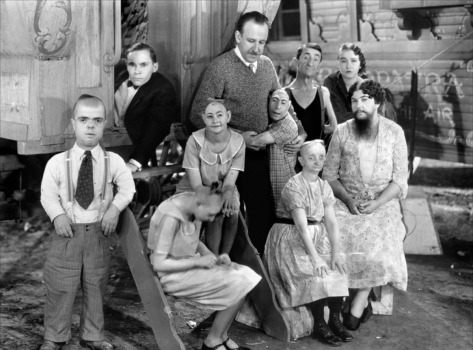
My final viewing of the night was a midnight showing of Freaks, a dark look into the world of circus sideshows that ultimately brings light to the way people with disabilities were treated within the confines of so-called “freak shows.” It is a movie whose concept makes a lot of people uncomfortable, and I think it’s partly because there is a misunderstanding of the film’s title from those who have not seen the movie. It is often passed over by people who are either offended by what they assume the movie will be, or by those who fear the dark and bizarre subject matter. But at its core, Freaks is a movie that turns stereotypes upside down. Previously (and since), actors who had some sort of physical disability were often cast as villains or characters to be feared. In Freaks, it is the disabled characters who are the “good guys,” and the able-bodied characters are the ones to be feared. It is quite an unusual and progressive scenario. Tod Browning spent much of his life working in circuses, and knew this world very well, which makes his interpretation all that more fascinating. In addition, nearly all of the characters were portrayed accurately, by disabled actors or real life sideshow performers.
Tod Browning with some of the cast members of FREAKS (1932).
Today, as the last day of the festival, is a bit of a lighter day, but there are some good things on the horizon to look out for tomorrow! See you then!
Readers, I apologize for the delay in this post–I returned from a screening of The Heiress last night to find that my internet had taken a holiday of its own and was on the blink. Unable to post online but determined to get you the coverage you expect from me, I started writing on my phone but it had been such a long day that I fell asleep before the post could be entirely written. Hopefully that won’t be happening again and my internet will behave for the duration of the festival.
Yesterday was the opening day of the TCM Classic Film Festival, and what a day it was! Normally the TCM press events happen the Wednesday before the festival, but due to conflicting events at the Roosevelt Hotel, the powers that be decided to move the press day to Thursday, and into the TCL Chinese 6 theater, upstairs in the Hollywood and Highland mall complex on Hollywood Boulevard. We heard from Robert Osborne, Ben Mankiewicz, Charlie Tabesh and Genevieve McGillicuddy (the latter two work in network programming), and we heard a slew of fantastic questions and fascinating answers. Robert Osborne answered questions about his associations with Lucille Ball and Jane Darwell (“She wasn’t funny,” he said of Lucy, referring to her offscreen demeanor, “but she could BE funny”) as well as a question about what TCM’s greatest gift to him has been. He answered that the TCM family has been a great gift–the fact that there are so many knowledgeable people at the network, as opposed to the staff at previous jobs he has worked–and hearing from fans. He noted that TCM often gets letters from fans who say that the network has helped them through unemployment, hospital stays, and cancer treatments, and that he never realized that part of his job would be that of nurse. Ben Mankiewicz echoed Osborne’s sentiments that the TCM family has been a great gift to him, and added a bit about his own illustrious family having given him the boost that he may have needed to attain the job that has “changed the direction of [his] life.”
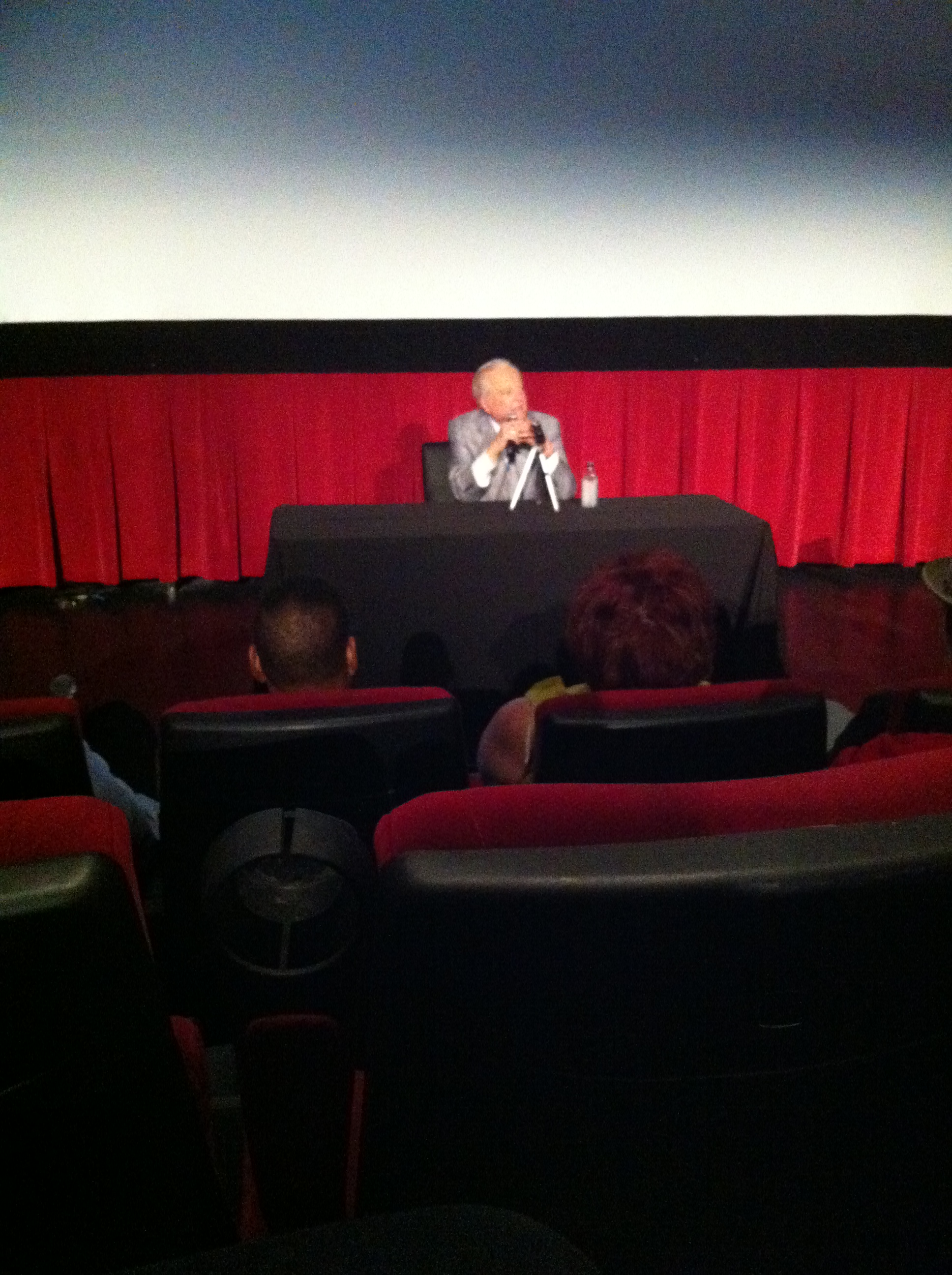
Robert Osborne answers questions.
My question was posed to Charlie Tabesh and Genevieve McGillicuddy, and it related to original programming. I am a big fan of TCM’s programming, and especially love the documentaries that they have produced in the past. I referenced the beautiful Clara Bow documentary that was done many years ago, and asked if there was anything other documentaries on the horizon. They responded that there is a separate department for original programming, and that there are indeed some things on the table, but it was good to hear that there is interest in these documentaries because it spurs action on their part. They said they would pass on my words to the department, so hopefully in the future we will be seeing more of TCM’s beautiful original work.
Notably, during Robert Osborne’s time to speak, he also referred to the Private Screenings interview with Olivia de Havilland that was supposed to have taken place last October. There has been some buzz online that it didn’t happen, and Osborne confirmed that it unfortunately did not. 97-year-old Olivia had taken ill with pneumonia shortly after they arrived in Paris, and was not able to do the interview. Extremely apologetic, she said that she would come to New York and do one–but when that was scheduled, she had another flare-up of pneumonia and ended up in the hospital again. “It’s not meant to be,” said Osborne.
On my end, I had heard that Olivia had been ill and in the hospital with a lung infection, and thus wondered if there was truth to the rumor that the interview did not happen. Obviously, pneumonia at 97 years old is quite serious. Certainly, a Private Screenings with Olivia de Havilland would be a major coup for TCM, but Olivia’s health needs to come first and Backlots sends her great healing wishes.
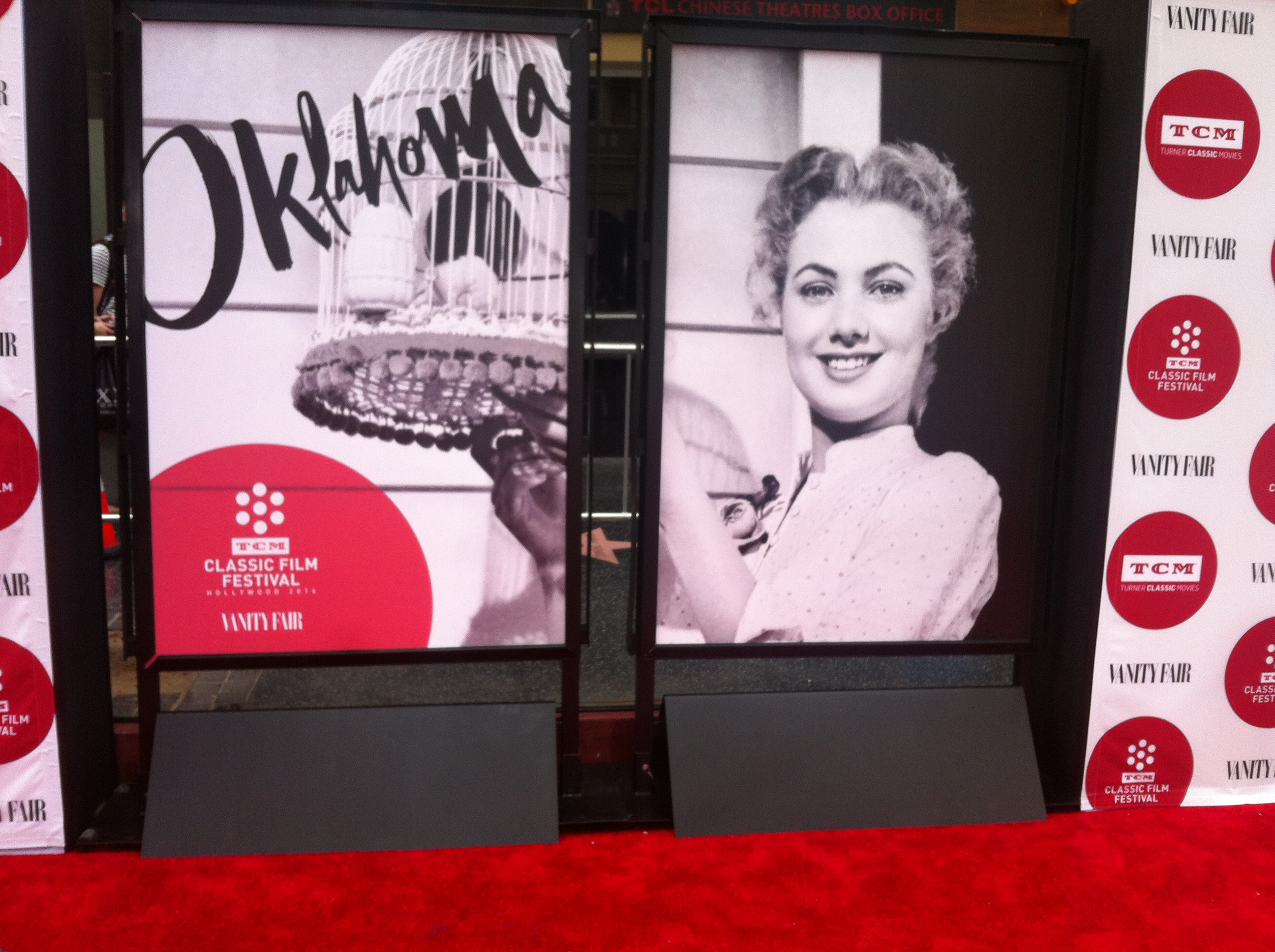
Next on the agenda was coverage of the red carpet. It was great fun to watch stars such as Shirley Jones and Margaret O’Brien walk down the carpet into the screening of Oklahoma! at Grauman’s Chinese Theatre. Unfortunately I didn’t get to talk to anyone (save a rather awkward exchange with Leonard Maltin, who caught me off guard and for whom I didn’t have any legitimate questions), but I got some fantastic pictures.
My view.
Shirley Jones on the red carpet.
After a brief rest following the red carpet, I headed out to see a screening of The Heiress, meeting up with fellow blogger Kristen from Journeys in Classic Film, her friend Michelle, and also TCM notable Lawrence Carter-Long (you may remember him from the marvelous series on disability in film that aired on TCM last year). The Heiress is a movie that I have seen literally dozens of times, but never on the big screen, and seeing it this way was a truly thrilling experience. The audience was laughing and gasping at parts that I had never paid particular attention to, and I heard witty dialogue that simply disappears when one sees the movie on a small screen. Olivia de Havilland’s performance in the magnificent final scene was all the more powerful when viewed on a huge scale, and the expressions on her face magnified to create a grand perspective. The Heiress is a gorgeous film in any size, but like anything else, it is meant to be seen on a screen of these dimensions.
Click here to read my analysis and discussion of the final scene of The Heiress.
Today is a full day, and hopefully my internet will be working when I get home so that I can give you the scoop while it’s still hot!
Debbie Reynolds on the red carpet of the 2012 TCM Classic Film Festival.
While wandering around the shopping center at Hollywood and Highland today, I was alerted of an incoming email message through the vibrations of the trusty iPhone in my pocket. I took out my phone, opened my email inbox and discovered, to my great delight, that Backlots has been approved for red carpet coverage of the TCM Classic Film Festival.
So, readers, what does this mean? A red carpet credential allows a journalist to procure once in a lifetime interviews with special TCM guests, and to obtain high quality, exclusive content for his or her media outlet. For Backlots, this is an opportunity to talk to stars such as Shirley Jones and Margaret O’Brien, both of whom have significant fan bases on this site and I predict that interviews with them will prove to garner great visibility for both Backlots and TCM.
Shirley Jones in particular has proven to be very popular with readers of Backlots–feedback from readers shows great interest in her films, and all of the articles I have written about Shirley Jones rank among the most frequently visited posts in the history of Backlots. Jones, who is in fine form following her 80th birthday late last month (she wanted to go skydiving for her birthday, before her children talked her out of it) will be in attendance for Oklahoma!, the opening night movie and her feature film debut.
I am also hoping to get a chance to talk to Robert Osborne and Ben Mankiewicz about programming choices, themes, and features for the upcoming year. If any of my readers have questions they would like asked, please feel free to leave them in the comments section or email me at fowler.lara@gmail.com. I would love to hear from you!
I have been in L.A. since March 31, and have been having a marvelous time leading up to the TCM Classic Film Festival. Come Thursday, I very much look forward to sharing my festival experience with you, my dear reader. As usual, I will be live tweeting on the red carpet, between movies, and at social events, as well as blogging every evening. This is definitely one of the highlights of any classic film fan’s year.
Following several days of great anticipation among festival attendees, the TCM Classic Film Festival unveiled its final lineup yesterday via its website. Featuring a veritable amalgam of lesser-seen movie classics and fan favorites, this is sure to be a year to remember.
One of the unexpected highlights of this year will be a midnight showing of the 1932 cult classic Freaks, a dark look into the world of circus sideshows and one of my personal favorite films of the early 1930s. Freaks includes a cast comprised almost exclusively of real-life sideshow performers, and is startlingly progressive and forward-thinking in its treatment of people with disabilities and analysis of the sideshow life. I will definitely be attending this film and will be reporting back with a full analysis.
Another highlight for me is the fact that TCM has programmed two Oscar-nominated Barbara Stanwyck films, Double Indemnity (1944) and Stella Dallas (1937), to be shown on Friday and Saturday. Double Indemnity celebrates its 70th anniversary this year, and the screening will be a special 70th anniversary restoration of the film. Both Stella Dallas and Double Indemnity feature some of Barbara Stanwyck’s best work in a career made up of great performances. Watch this heartwrenching scene at the end of Stella Dallas, followed by her turn of evil in Double Indemnity, and you will see why Barbara Stanwyck is considered one of the greatest and most versatile actresses of her time. I very much look forward to seeing both of these movies on the big screen.
Last year TCM paid tribute to filmmaker Albert Maysles, and this year they show one of his seminal works, the classic documentary Grey Gardens, a stark but ultimately endearing examination of aristocracy in decline. Maysles and his brother, David, befriended Edith Ewing Bouvier Beale (known as “Big Edie”) and her daughter, Edith (“Little Edie”), aunt and cousin to First Lady Jacqueline Kennedy Onassis, and filmed them over the course of several months as they dealt with the consequences of embezzlement of their funds by a corrupt family member. They lived in squalor in Grey Gardens, their formerly glamorous estate in upstate New York, and had essentially become isolated from everyone but each other. It is a beautiful, funny, and sweet examination of what it means to be family, and how to make the most of a negative situation.
I am a huge fan of Grey Gardens. I think Little Edie is one of the greatest characters, real or created, in the history of cinema. Her outlook on life, her unique relationship with her mother, and her outrageous fashion sense (she has a talent for converting clothing items into other clothing accessories) makes for a character that a filmmaker could only dream of. Watch her below, in the famous clip of her describing her “costume for the day.”
As the festival approaches, I will post a complete list of what readers may expect to see on the blog, and my tentative schedule. To see the complete TCM lineup, click here!
On February 1, TCM will begin its annual salute to the Oscars, 31 days of Oscar-winning films shown back to back until the Academy Awards ceremony on March 2. Kicking off what TCM calls “31 Days of Oscar” this year will be a new documentary from acclaimed filmmakers Rob Epstein and Jeffrey Friedman, produced as a joint effort between TCM and the Academy of Motion Picture Arts and Sciences and celebrating the history of the Oscars and where they came from. The production is called …and the Oscar goes to…, and I had the great privilege to be able to see its world premiere this past Thursday night at the Academy of Motion Picture Arts and Sciences’ Samuel Goldwyn Theater in Beverly Hills.
It was a real event, and TCM pulled out all the stops. In attendance were several TCM luminaries including Ben Mankiewicz (who gave a pre-screening introduction) and Illeana Douglas who has served as a guest host on the network. Also there was George Chakiris, best known for his Oscar-winning role as Bernardo in West Side Story and for his role as a dancer in several high profile musicals. I was also glad to see many of my fellow classic film bloggers, along, as I was, to cover the screening.
George Chakiris, here in the red jacket as Bernardo in WEST SIDE STORY, attended the screening of …AND THE OSCAR GOES TO… on Thursday.
Before the film began, we heard a talk by the directors and saw a beautiful promo for TCM’s “31 Days of Oscar.” In the 31 days leading up to the Academy Awards, TCM often makes some of its most brilliant programming choices–as the films chosen are all Oscar winners, they are almost universally superb, and TCM’s “31 Days of Oscar” is a highly anticipated event in the classic film community.
…and the Oscar goes to… began at 7:30. It tells the story of the Oscars from its inception in 1927 straight through to the present day, with ample anecdotes and stories behind many of Hollywood’s finest Oscar moments. It draws on interviews from contemporary stars and directors such as Whoopi Goldberg, Steven Spielberg, and Michael Moore to illustrate what the Oscars are all about, and uses plenty of archival footage to show the audience what the Oscars were like before the popularization of television. I was happy to see the film feature several of my very favorite Oscar speeches of all time, including those given by Hattie McDaniel at the Academy Awards of 1940 and Dustin Hoffman at the Academy Awards of 1980.
In Dustin Hoffman’s speech, he talks about the fallibility of the Oscars and the inherent unfairness in competition between peers. I was pleasantly surprised to see that the film is quite unbiased in its attitude toward the Oscars. Instead of the Academy flouting what it does as somehow the be-all, end-all in Hollywood, it highlights several people who emphasize the idea that the Oscars are not really what Hollywood is all about. My absolute favorite quote from the film came from a director who said that everyone thinks the Oscars are the real Hollywood. They are not, he said. He continued on to say that the real Hollywood is seen when the actors, directors, and crew members show up on the set the day after the lavish Oscar party, wearing jeans and eating bad doughnuts and drinking stale coffee. Hollywood is not the Oscars, he emphasized. Hollywood belongs to the people who work all day and all night for the perfect shot and put their blood, sweat and tears into what they do.
Following that quote, the entire theater burst into applause.
There are a number of awkward segues that could be fixed in the editing room, but all in all, the film was a success and lots of fun to watch. This screening was the first time …and the Oscar goes to... has been shown in public, and I would venture to say that the awkwardness of the segues may be fixed before the film airs on TCM. I would highly recommend that you catch it when it kicks off “31 Days of Oscar” on February 1 at 8:00 PM EST, as I think it provides a wonderfully intimate glimpse into this storied Hollywood tradition.
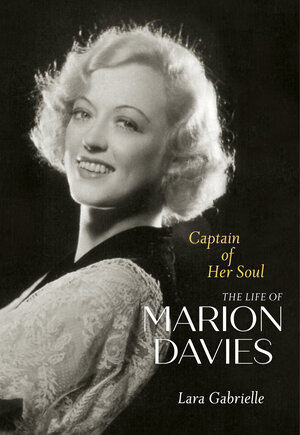
Captain of Her Soul: The Life of Marion Davies is now available at your favorite bookseller! Click hereto order it, and visit mariondaviesbook.com for all the latest.
Backlots is devoted to honoring and celebrating all aspects of classic film and is written by Lara Gabrielle, a California-based classic film writer and historian. Lara is the author of CAPTAIN OF HER SOUL: The Life of Marion Davies (UC Press, 2022).
Here you will find pieces on frequently seen classics and some lesser-known gems, as well as book reviews, festival coverage, and pieces on the history, theory and culture of film as it relates to the study of classic cinema.
Enjoy the site, and thanks for reading!
AFFILIATIONS & AWARDS
2019 CMBA Award for Best Profile of Classic Movie Performer or Filmmaker--"The Activism of Myrna Loy"
Winner of the 2018 CiMBA Award for Best Classic Movie Series, BACKLOTS AT THE COURTHOUSE: OLIVIA DE HAVILLAND VS. FX
Winner of the 2014 CiMBA Award for Best Profile of a Classic Movie Performer or Filmmaker: A Q&A WITH JOAN FONTAINE IN HONOR OF HER 96TH BIRTHDAY
Winner of the 2011 CiMBA Award for Best Classic Movie Discussion, THE FINAL SCENE OF THE HEIRESS
I am honored to be a judge of the Animal Film Festival in Grass Valley, CA.
EVENTS
BACKLOTS ON THE WEB
Join us at the Backlot Commissary, the place for Backlots' readers to share content and discuss movies!
Walter Pidgeon and Greer Garson in "Mrs. Miniver."






















_03.jpg)

 Backlots