Tag Archives: tcm classic film festival

Live From the TCM Classic Film Festival, Day 1: Press Roundtable, Red Carpet Coverage, THE HEIRESS (1949)

Readers, I apologize for the delay in this post–I returned from a screening of The Heiress last night to find that my internet had taken a holiday of its own and was on the blink. Unable to post online but determined to get you the coverage you expect from me, I started writing on my phone but it had been such a long day that I fell asleep before the post could be entirely written. Hopefully that won’t be happening again and my internet will behave for the duration of the festival.

Yesterday was the opening day of the TCM Classic Film Festival, and what a day it was! Normally the TCM press events happen the Wednesday before the festival, but due to conflicting events at the Roosevelt Hotel, the powers that be decided to move the press day to Thursday, and into the TCL Chinese 6 theater, upstairs in the Hollywood and Highland mall complex on Hollywood Boulevard. We heard from Robert Osborne, Ben Mankiewicz, Charlie Tabesh and Genevieve McGillicuddy (the latter two work in network programming), and we heard a slew of fantastic questions and fascinating answers. Robert Osborne answered questions about his associations with Lucille Ball and Jane Darwell (“She wasn’t funny,” he said of Lucy, referring to her offscreen demeanor, “but she could BE funny”) as well as a question about what TCM’s greatest gift to him has been. He answered that the TCM family has been a great gift–the fact that there are so many knowledgeable people at the network, as opposed to the staff at previous jobs he has worked–and hearing from fans. He noted that TCM often gets letters from fans who say that the network has helped them through unemployment, hospital stays, and cancer treatments, and that he never realized that part of his job would be that of nurse. Ben Mankiewicz echoed Osborne’s sentiments that the TCM family has been a great gift to him, and added a bit about his own illustrious family having given him the boost that he may have needed to attain the job that has “changed the direction of [his] life.”
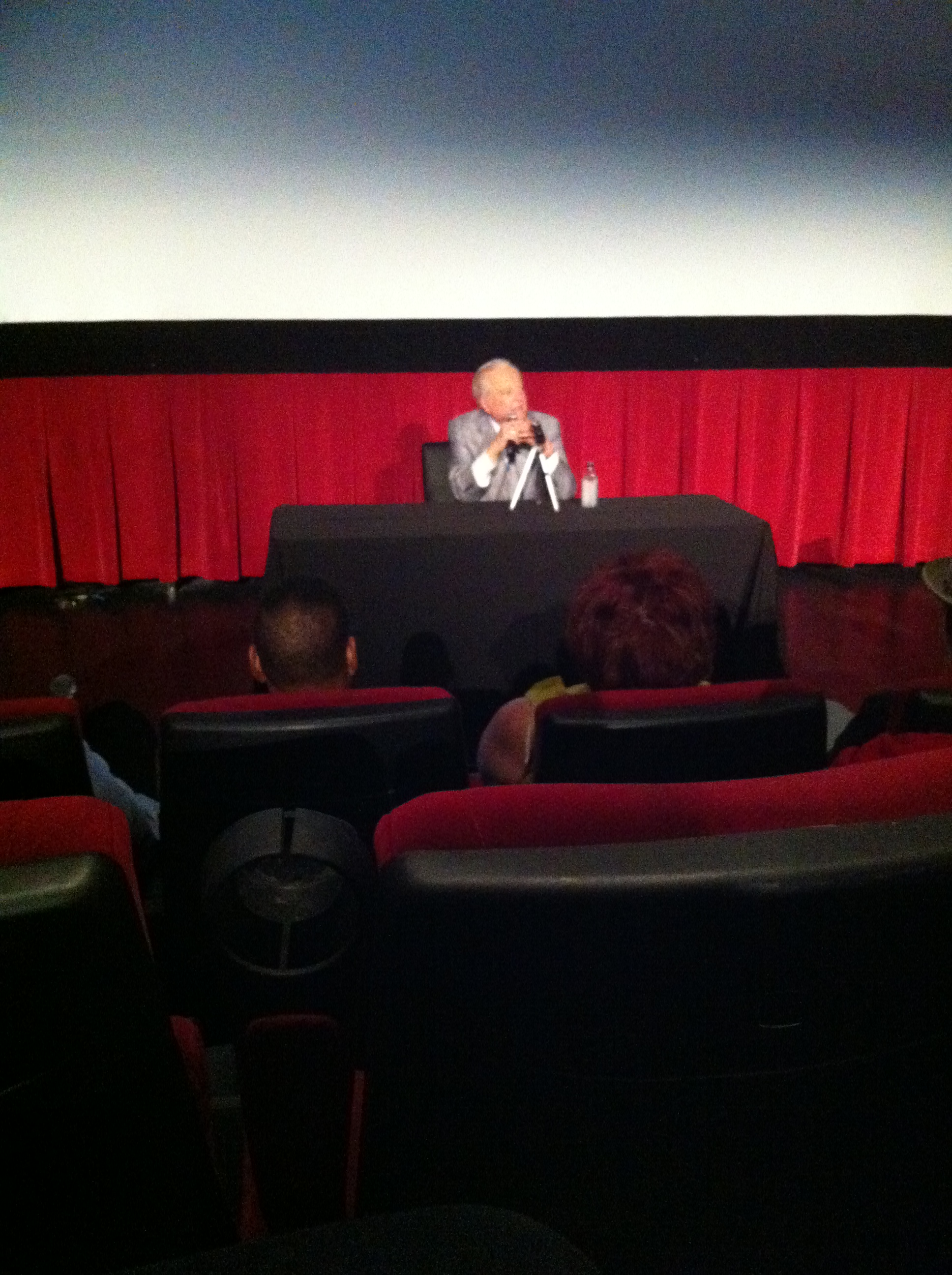
Robert Osborne answers questions.

Robert Osborne answers questions.

My question was posed to Charlie Tabesh and Genevieve McGillicuddy, and it related to original programming. I am a big fan of TCM’s programming, and especially love the documentaries that they have produced in the past. I referenced the beautiful Clara Bow documentary that was done many years ago, and asked if there was anything other documentaries on the horizon. They responded that there is a separate department for original programming, and that there are indeed some things on the table, but it was good to hear that there is interest in these documentaries because it spurs action on their part. They said they would pass on my words to the department, so hopefully in the future we will be seeing more of TCM’s beautiful original work.

Notably, during Robert Osborne’s time to speak, he also referred to the Private Screenings interview with Olivia de Havilland that was supposed to have taken place last October. There has been some buzz online that it didn’t happen, and Osborne confirmed that it unfortunately did not. 97-year-old Olivia had taken ill with pneumonia shortly after they arrived in Paris, and was not able to do the interview. Extremely apologetic, she said that she would come to New York and do one–but when that was scheduled, she had another flare-up of pneumonia and ended up in the hospital again. “It’s not meant to be,” said Osborne.

On my end, I had heard that Olivia had been ill and in the hospital with a lung infection, and thus wondered if there was truth to the rumor that the interview did not happen. Obviously, pneumonia at 97 years old is quite serious. Certainly, a Private Screenings with Olivia de Havilland would be a major coup for TCM, but Olivia’s health needs to come first and Backlots sends her great healing wishes.

Next on the agenda was coverage of the red carpet. It was great fun to watch stars such as Shirley Jones and Margaret O’Brien walk down the carpet into the screening of Oklahoma! at Grauman’s Chinese Theatre. Unfortunately I didn’t get to talk to anyone (save a rather awkward exchange with Leonard Maltin, who caught me off guard and for whom I didn’t have any legitimate questions), but I got some fantastic pictures.
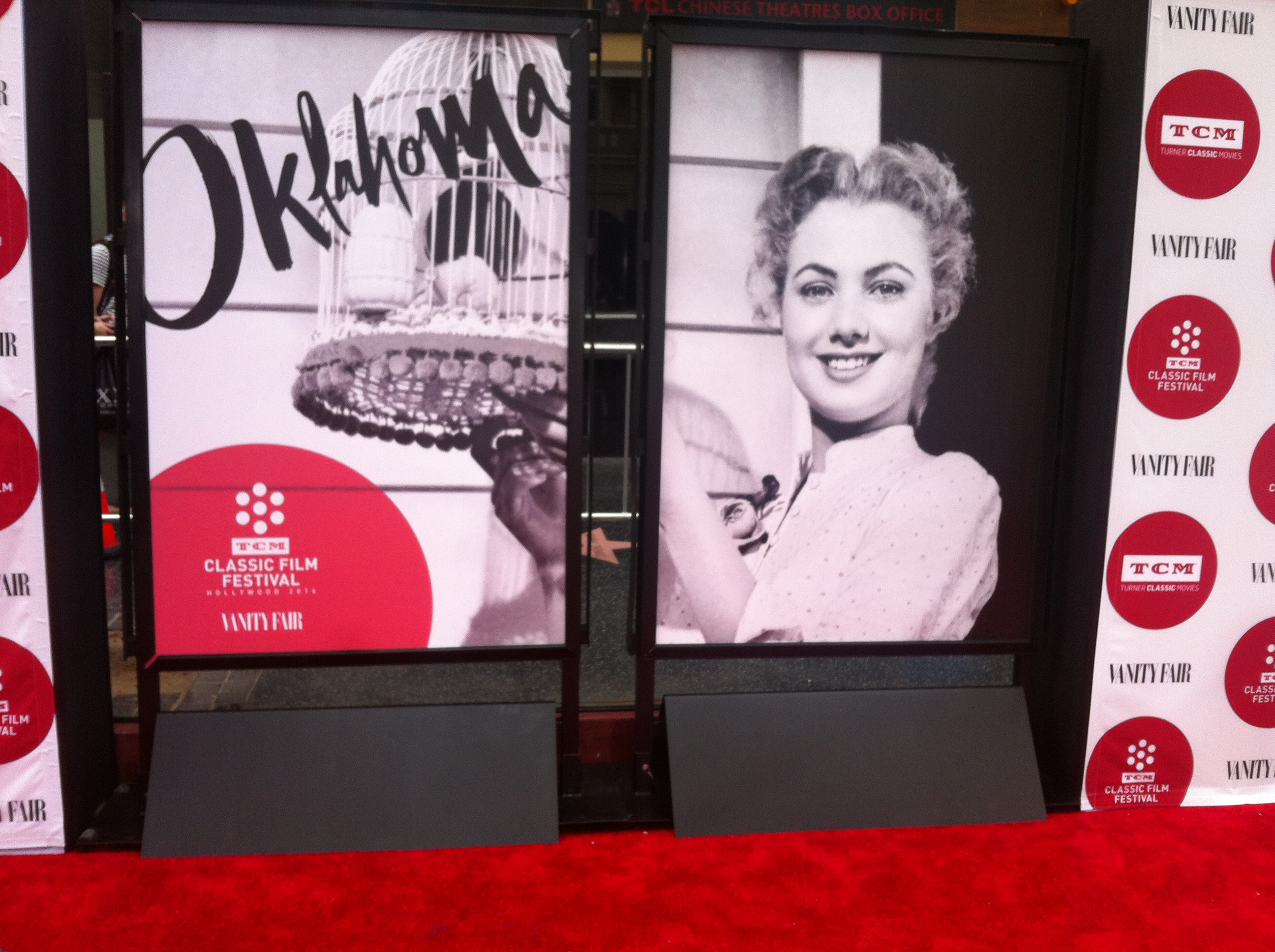

001

012

My view.

015

Shirley Jones on the red carpet.

After a brief rest following the red carpet, I headed out to see a screening of The Heiress, meeting up with fellow blogger Kristen from Journeys in Classic Film, her friend Michelle, and also TCM notable Lawrence Carter-Long (you may remember him from the marvelous series on disability in film that aired on TCM last year). The Heiress is a movie that I have seen literally dozens of times, but never on the big screen, and seeing it this way was a truly thrilling experience. The audience was laughing and gasping at parts that I had never paid particular attention to, and I heard witty dialogue that simply disappears when one sees the movie on a small screen. Olivia de Havilland’s performance in the magnificent final scene was all the more powerful when viewed on a huge scale, and the expressions on her face magnified to create a grand perspective. The Heiress is a gorgeous film in any size, but like anything else, it is meant to be seen on a screen of these dimensions.

Click here to read my analysis and discussion of the final scene of The Heiress.

Today is a full day, and hopefully my internet will be working when I get home so that I can give you the scoop while it’s still hot!

Full Schedule Released for the 2014 TCM Classic Film Festival

Following several days of great anticipation among festival attendees, the TCM Classic Film Festival unveiled its final lineup yesterday via its website. Featuring a veritable amalgam of lesser-seen movie classics and fan favorites, this is sure to be a year to remember.

One of the unexpected highlights of this year will be a midnight showing of the 1932 cult classic Freaks, a dark look into the world of circus sideshows and one of my personal favorite films of the early 1930s. Freaks includes a cast comprised almost exclusively of real-life sideshow performers, and is startlingly progressive and forward-thinking in its treatment of people with disabilities and analysis of the sideshow life. I will definitely be attending this film and will be reporting back with a full analysis.

Another highlight for me is the fact that TCM has programmed two Oscar-nominated Barbara Stanwyck films, Double Indemnity (1944) and Stella Dallas (1937), to be shown on Friday and Saturday. Double Indemnity celebrates its 70th anniversary this year, and the screening will be a special 70th anniversary restoration of the film. Both Stella Dallas and Double Indemnity feature some of Barbara Stanwyck’s best work in a career made up of great performances. Watch this heartwrenching scene at the end of Stella Dallas, followed by her turn of evil in Double Indemnity, and you will see why Barbara Stanwyck is considered one of the greatest and most versatile actresses of her time. I very much look forward to seeing both of these movies on the big screen.

Last year TCM paid tribute to filmmaker Albert Maysles, and this year they show one of his seminal works, the classic documentary Grey Gardens, a stark but ultimately endearing examination of aristocracy in decline. Maysles and his brother, David, befriended Edith Ewing Bouvier Beale (known as “Big Edie”) and her daughter, Edith (“Little Edie”), aunt and cousin to First Lady Jacqueline Kennedy Onassis, and filmed them over the course of several months as they dealt with the consequences of embezzlement of their funds by a corrupt family member. They lived in squalor in Grey Gardens, their formerly glamorous estate in upstate New York, and had essentially become isolated from everyone but each other. It is a beautiful, funny, and sweet examination of what it means to be family, and how to make the most of a negative situation.

I am a huge fan of Grey Gardens. I think Little Edie is one of the greatest characters, real or created, in the history of cinema. Her outlook on life, her unique relationship with her mother, and her outrageous fashion sense (she has a talent for converting clothing items into other clothing accessories) makes for a character that a filmmaker could only dream of. Watch her below, in the famous clip of her describing her “costume for the day.”

As the festival approaches, I will post a complete list of what readers may expect to see on the blog, and my tentative schedule. To see the complete TCM lineup, click here!

See you next time!

LIVE FROM THE TCM CLASSIC FILM FESTIVAL DAY 4 (Closing Day): “Gilda,” Women of Early Hollywood, “It Happened One Night,” “The General,” Closing Night Party

By Lara Gabrielle Fowler

Well readers, the 2013 TCM Classic Film Festival has come to a close. It has been a busy and very exciting 4 days, and your author is at once exhilarated, exhausted, and ready for next year!

In my humble opinion, this 4th day held the best lineup of the festival. Gilda was first on the agenda at the Egyptian Theatre, and though I had seen it on the big screen once before I was all too eager to see it again. The movie tells a story that is complex and hard to follow, but in all truth, the movie is not about the story. The audience is too busy watching Rita Hayworth to have any time for following a plot anyway. It is the ultimate noir, almost a caricature of the genre, and it really seems as though everything  that happens when Rita Hayworth is offscreen is just filler. Rita is the heart and soul of the movie, and because of her, the film is considered to be one of the great noir films of all time. Instead of trying to describe Rita in this movie with words, I will give you some clips so that if you haven’t seen this film, you will see what Gilda is all about.

Hayworth’s performance is rendered even more stunning when one examines who she was offscreen. By all accounts sweet, quiet, and timid, Rita Hayworth was the antithesis of the character of Gilda. She only gave a handful of interviews in her life due to paralyzing shyness, and Louella Parsons (who had met Rita as a teenager just starting her career) noted that she could barely look strangers in the eye. Here she is sultry, sexy, steamy, and an all-around tiger with every man she meets. Suffice it to say, I am of the opinion that Rita Hayworth was robbed of an Oscar nomination for this role.

Our next event happened in Club TCM, a discussion with Cari Beauchamp about women writers in early Hollywood, focusing specifically on Frances Marion. Beauchamp has produced a documentary on Frances Marion, and offered fascinating insight into who she was as a woman, as a writer, and as a member of a fledgling industry. Marion was extremely prolific–one surprising trivia bit Beauchamp related was that out of the 9 pictures nominated for Best Picture at the 1st Academy Awards, Frances Marion had written 7 of them. She eventually left the industry as it became increasingly production- and output-oriented, and she decided to pursue other tasks in which she did not have to compete. She became an accomplished sculptor and painter in her later years.

I must say that I find Cari Beauchamp to be one of the most fun, enthusiastic, and accessible film historians I have ever come across. She is a renowned scholar, and has written highly respected biographies and documentaries, yet her presentations are always down-to-earth and casual, with plenty of humor and no shortage of one-liners. As an example of a classic Cari Beauchamp utterance, she referred to the papers of Fred Thomson (Frances Marion’s husband), noting: “His stuff on de Mille is freaking hilarious.” She is very popular among us young classic film bloggers, enthusiasts, and devotees!

Next up was It Happened One Night, introduced by Cari Beauchamp once again. She pointed out a number of the continuity errors in the movie, ones which I had never noticed in my literally dozens of times seeing this movie. For example, in the famous “Man on the Flying Trapeze” number, the inside of the bus is rocking back and forth while the outside stays still. At one point, Claudette Colbert’s handkerchief disappears and reappears a number of times. The road Clark Gable drives on sometimes has a line, sometimes does not. Regardless of these errors, this movie remains the cream of the screwball comedy crop–one of the very first, and one of the very best.

The next movie was one I was very excited to see–not only is The General (1926) Buster Keaton’s best known film and arguably (or not arguably) his best, but the movie was to be shown at Grauman’s Chinese Theatre, giving it the majestic treatment it deserves. The movie is about a young engineer in Georgia during the Civil War who wants to enlist in the army but is rejected because he would be more use to the South as an engineer. However, when he sits on the wheel of a train to think, the train starts and he is carried to an army base. Buster Keaton antics ensue, and he ends up foiling deserters, hearing enemy plots, and derailing trains from the North. It is Buster Keaton on a grand scale, and his antics are more polished and refined in this movie than they are in his shorts or even his other feature films. I am used to a Buster Keaton whose comedy is mostly slapstick, but this film highlights his ability to create subtle humor through facial expressions. One scene in particular stands out for me–when Buster sees yet another obstacle in his path, he expresses his incredulity through blinks of his eyes. It gives the audience a clear view of what he is feeling, yet Buster never for a minute lets go of his famous deadpan face.

Keaton was also known for dangerous stunts that he performed himself. Here are some stunts from the movie that demonstrate what he was capable of.

The General marked the final event of the TCM Classic Film Festival. A closing night party tied off the festivities, during which we said goodbye to friends and acquaintances that we met here, and even made plans to meet up again before the next festival. I always have fun at the TCM Classic Film Festival, and I can’t wait for next year!

Thank you, dear readers, for following along during these 4 days that seem to have gone by so quickly. I hope you enjoyed this coverage, and I will be resuming regular blogging duties upon arrival back home, including catching up on the Carole Lombard Filmography Project.

See you soon!

LIVE FROM THE TCM CLASSIC FILM FESTIVAL, DAY 3: Jane Fonda’s Handprint Ceremony, “On Golden Pond,” “The Lady Eve,” “Mildred Pierce”

By Lara Gabrielle Fowler

Day 3 started with a bang, as the first event of the day was a very special one. Jane Fonda was scheduled to have her hand and footprints put in the courtyard of Grauman’s Chinese Theatre, right alongside those of her father, Henry Fonda. The event was very crowded, and the security tight and closely monitored. For obvious reasons, this is to be expected at an event for a major celebrity, especially one who is as politically controversial as Jane Fonda. Once all attendees successfully passed the security screenings, the event began. We saw a number of major celebrities in attendance, including Jim Carrey, friend and 9 to 5 costar Lily Tomlin, brother Peter Fonda, and longtime friend Maria Shriver. Jane Fonda’s son gave a keynote address, followed by warm words from Lily Tomlin and Maria Shriver. My friends and I happened to be in a spot where we could see Jane behind the scenes as the speeches were read, and she was clearly very emotionally moved. Because of the massive crowd, pictures were hard to get. Here are a few pictures from the official TCM collection of the event.

Jane and Peter Fonda sit next to their father's hand and foot prints at Grauman's Chinese Theatre.

Jane and Peter Fonda sit next to their father’s hand and foot prints at Grauman’s Chinese Theatre.

pv_23632_006_2248_7

Putting her hands into the cement.

pv_23632_006_2242_7

Finishing the prints.

The ceremony slowly began to break up after Jane’s prints were sufficiently down in the cement, and we began to prepare for the next event–a screening of On Golden Pond (1981) introduced by Jane, clearly the woman of the day. She told some beautiful stories about the filming,  particularly relating to her relationship with Katharine Hepburn on set. Jane Fonda was the perfect person to introduce the film, as she had a position as actor and producer on the film as well as being Henry Fonda’s daughter. It was wonderful to hear her talk.

This widescreen print magnified the lush beauty of the photography, shot on location in New Hampshire with breathtaking shots of the fall leaves and loons. It is a simple story, taken from the stage play about Norman and Ethel Thayer (Katharine Hepburn and Henry Fonda), an elderly couple dealing with the effects of age. Norman’s failing health and grumpy personality alienate everyone around him, but Ethel is devoted to him and loves him unconditionally and with all of her soul. Norman and their daughter Chelsea (Jane Fonda) have a severely damaged relationship due to Norman’s inability to be a demonstrative father, and much of the movie deals with their healing process as Norman nears death. It is a beautiful movie on so many levels. The relationship between Norman and Ethel is one that I think everyone hopes they will have with their spouse as they age together, and watching Hepburn and Fonda together is so touching that the mere thought of it provokes tears.

Next up was the brilliant comedy The Lady Eve, another in the Fonda family pantheon. Henry Fonda plays Charles, the heir to a beer fortune who, unbeknownst to him, gets mixed up with a father and daughter pair of card sharps on a cruise ship. He ends up falling in love with the daughter Jean (played by Barbara Stanwyck), and when Charles finds out who she is, he breaks off the relationship. To get him back, Jean collaborates on an elaborate plan to pose as the Lady Eve Sidwich, fictional niece of wealthy Sir Alfred McGlennan Keith. “Lady Eve” and Charles fall in love all over again, and Charles is none the wiser that this is the same woman with whom he had broken up on the cruise ship.

This is a classic screwball comedy by the brilliant Preston Sturges, who has a unique and specific style that leaves its mark on any movie he makes. As film historian Carrie Beauchamp said at the beginning of the screening, Sturges’ films center on dialogue and a hand-picked, stellar cast. The supporting cast in The Lady Eve is especially good, with Sturges mainstay William Demarest, Eugene Pallette, and Charles Coburn playing small but significant roles.

Below is a scene which Roger Ebert called the sexiest scene ever on film. The Hays Code forced filmmakers to be cleverer with their depiction of sexual or steamy content, and this scene is a prime example of how a scene can be extremely charged without the two leads ever even hugging or kissing.

Next on the agenda was Mildred Pierce (1945) with special guest Ann Blyth, Veda in the film. By all accounts that I have heard, Ann Blyth is one of the nicest celebrities in Hollywood, and she certainly showed that tonight. Gentle and sweet, she is the complete polar opposite of her character in Mildred Pierce. Robert Osborne interviewed her about her time in the movies, and she spoke of nothing but good memories of Joan Crawford, a celebrity who often gets a bad rep in Hollywood gossip circles.

pv_23632_003_5246_1

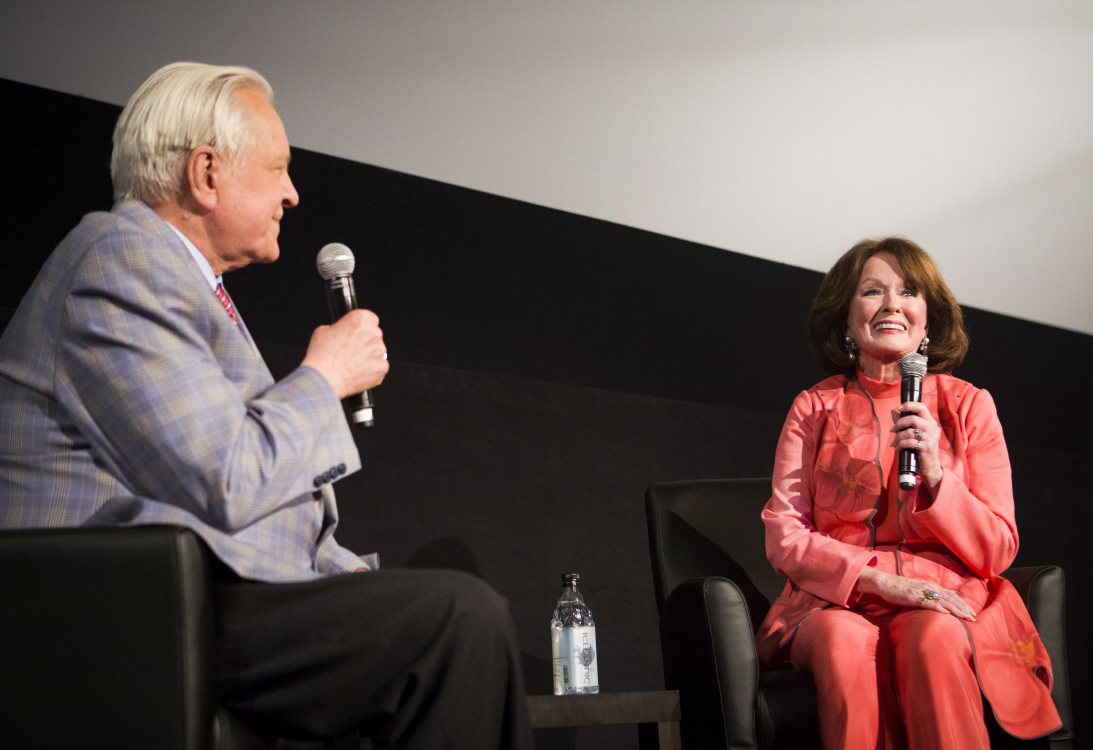
Robert Osborne interviews Ann Blyth.

Mildred Pierce is another wonderful ensemble movie, though the plot centers around the relationship between Mildred (Joan Crawford) and her devotion to her daughter Veda, who proves to be a spoiled, ungrateful child with an evil streak. The supporting cast includes such character actors as Jack Carson and the witty and hilarious Eve Arden, who pops up and provides some oft-needed comic relief every now and then.

This was the third time that I had seen Mildred Pierce on the big screen, and it never fails to impress me. It is wonderful on the small screen, wonderful on any medium, but there is nothing like the big screen for this movie. Everything is accentuated and magnified, and Veda’s evil is all that more powerful.

For a previous post I have written about the costumes of Mildred Pierce, click here.

Stay tuned tomorrow as Backlots puts the blame on Mame, with a review of Gilda!