Tag Archives: barbara stanwyck

LIVE FROM THE TCM CLASSIC FILM FESTIVAL, DAY 3: Jane Fonda’s Handprint Ceremony, “On Golden Pond,” “The Lady Eve,” “Mildred Pierce”

By Lara Gabrielle Fowler

Day 3 started with a bang, as the first event of the day was a very special one. Jane Fonda was scheduled to have her hand and footprints put in the courtyard of Grauman’s Chinese Theatre, right alongside those of her father, Henry Fonda. The event was very crowded, and the security tight and closely monitored. For obvious reasons, this is to be expected at an event for a major celebrity, especially one who is as politically controversial as Jane Fonda. Once all attendees successfully passed the security screenings, the event began. We saw a number of major celebrities in attendance, including Jim Carrey, friend and 9 to 5 costar Lily Tomlin, brother Peter Fonda, and longtime friend Maria Shriver. Jane Fonda’s son gave a keynote address, followed by warm words from Lily Tomlin and Maria Shriver. My friends and I happened to be in a spot where we could see Jane behind the scenes as the speeches were read, and she was clearly very emotionally moved. Because of the massive crowd, pictures were hard to get. Here are a few pictures from the official TCM collection of the event.

Jane and Peter Fonda sit next to their father's hand and foot prints at Grauman's Chinese Theatre.

Jane and Peter Fonda sit next to their father’s hand and foot prints at Grauman’s Chinese Theatre.

pv_23632_006_2248_7

Putting her hands into the cement.

pv_23632_006_2242_7

Finishing the prints.

The ceremony slowly began to break up after Jane’s prints were sufficiently down in the cement, and we began to prepare for the next event–a screening of On Golden Pond (1981) introduced by Jane, clearly the woman of the day. She told some beautiful stories about the filming,  particularly relating to her relationship with Katharine Hepburn on set. Jane Fonda was the perfect person to introduce the film, as she had a position as actor and producer on the film as well as being Henry Fonda’s daughter. It was wonderful to hear her talk.

This widescreen print magnified the lush beauty of the photography, shot on location in New Hampshire with breathtaking shots of the fall leaves and loons. It is a simple story, taken from the stage play about Norman and Ethel Thayer (Katharine Hepburn and Henry Fonda), an elderly couple dealing with the effects of age. Norman’s failing health and grumpy personality alienate everyone around him, but Ethel is devoted to him and loves him unconditionally and with all of her soul. Norman and their daughter Chelsea (Jane Fonda) have a severely damaged relationship due to Norman’s inability to be a demonstrative father, and much of the movie deals with their healing process as Norman nears death. It is a beautiful movie on so many levels. The relationship between Norman and Ethel is one that I think everyone hopes they will have with their spouse as they age together, and watching Hepburn and Fonda together is so touching that the mere thought of it provokes tears.

Next up was the brilliant comedy The Lady Eve, another in the Fonda family pantheon. Henry Fonda plays Charles, the heir to a beer fortune who, unbeknownst to him, gets mixed up with a father and daughter pair of card sharps on a cruise ship. He ends up falling in love with the daughter Jean (played by Barbara Stanwyck), and when Charles finds out who she is, he breaks off the relationship. To get him back, Jean collaborates on an elaborate plan to pose as the Lady Eve Sidwich, fictional niece of wealthy Sir Alfred McGlennan Keith. “Lady Eve” and Charles fall in love all over again, and Charles is none the wiser that this is the same woman with whom he had broken up on the cruise ship.

This is a classic screwball comedy by the brilliant Preston Sturges, who has a unique and specific style that leaves its mark on any movie he makes. As film historian Carrie Beauchamp said at the beginning of the screening, Sturges’ films center on dialogue and a hand-picked, stellar cast. The supporting cast in The Lady Eve is especially good, with Sturges mainstay William Demarest, Eugene Pallette, and Charles Coburn playing small but significant roles.

Below is a scene which Roger Ebert called the sexiest scene ever on film. The Hays Code forced filmmakers to be cleverer with their depiction of sexual or steamy content, and this scene is a prime example of how a scene can be extremely charged without the two leads ever even hugging or kissing.

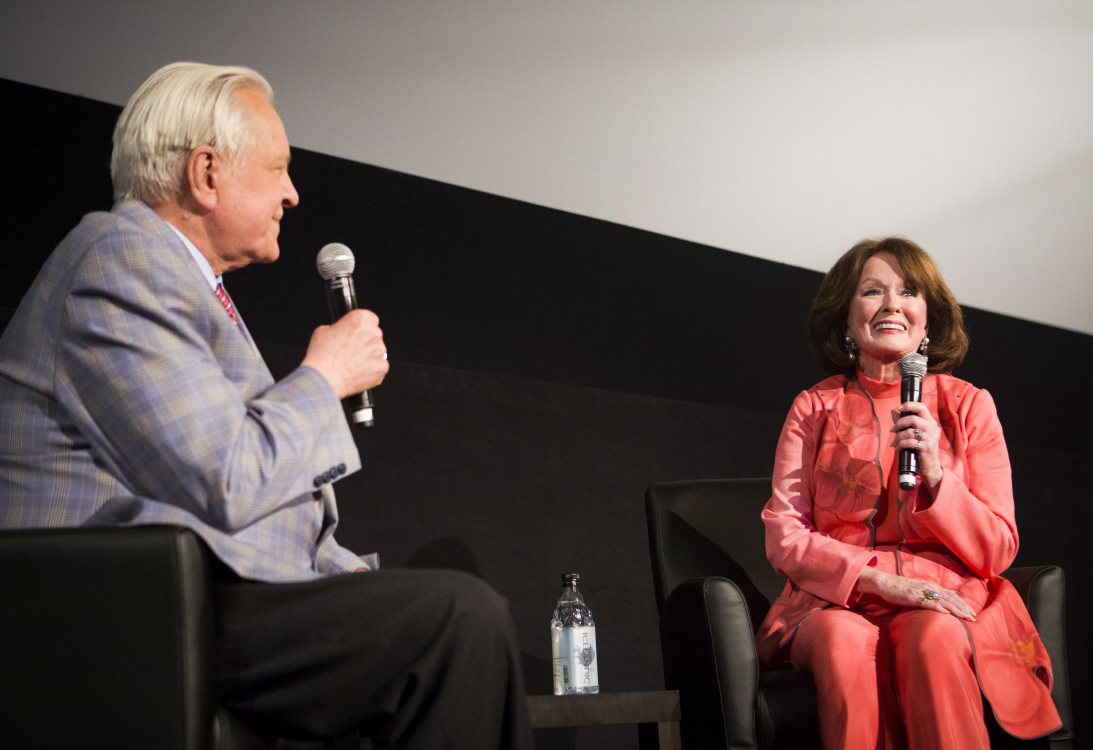
Next on the agenda was Mildred Pierce (1945) with special guest Ann Blyth, Veda in the film. By all accounts that I have heard, Ann Blyth is one of the nicest celebrities in Hollywood, and she certainly showed that tonight. Gentle and sweet, she is the complete polar opposite of her character in Mildred Pierce. Robert Osborne interviewed her about her time in the movies, and she spoke of nothing but good memories of Joan Crawford, a celebrity who often gets a bad rep in Hollywood gossip circles.
pv_23632_003_5246_1

Robert Osborne interviews Ann Blyth.

Mildred Pierce is another wonderful ensemble movie, though the plot centers around the relationship between Mildred (Joan Crawford) and her devotion to her daughter Veda, who proves to be a spoiled, ungrateful child with an evil streak. The supporting cast includes such character actors as Jack Carson and the witty and hilarious Eve Arden, who pops up and provides some oft-needed comic relief every now and then.

This was the third time that I had seen Mildred Pierce on the big screen, and it never fails to impress me. It is wonderful on the small screen, wonderful on any medium, but there is nothing like the big screen for this movie. Everything is accentuated and magnified, and Veda’s evil is all that more powerful.

For a previous post I have written about the costumes of Mildred Pierce, click here.

Stay tuned tomorrow as Backlots puts the blame on Mame, with a review of Gilda!

Scandal On Film: “Illicit” (1931), “Forbidden” (1932) and “Baby Face” (1933)

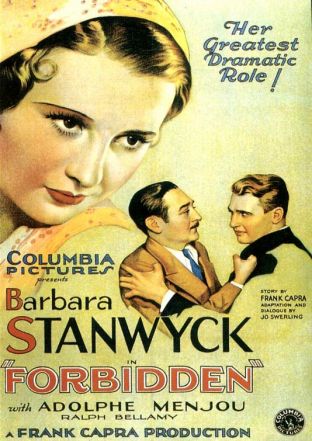
Barbara Stanwyck has an affair with married politician Adolphe Menjou, and subsequently has his baby, in “Forbidden” (1932).

From her first forays into sound film, Barbara Stanwyck was known for her portrayals of strong, gutsy, and independent women. In Illicit, she sleeps with her boyfriend without intent of marriage. In Forbidden, she carries out an affair with a married politician–then gives birth to his child. In Baby Face, she plays a fiery and motivated woman who works her way to the top of a company, entirely through sexual favors. Unapologetic about defending themselves and using guile and sensuality to their advantage, Stanwyck’s characters embodied the spirit of the pre-code era and threw the Catholic establishment into a rage.

Though studios were generally at liberty to film the content they wished (before 1934, censorship decisions were left to state boards), they were ultimately concerned about profit. The Great Depression was taking its toll on the movie business, and with budgets and salaries cut, no one could afford to take the chance of a movie bombing. Catholic groups, including the Catholic Legion of Decency, were handing out lists of films to boycott, and the films of Barbara Stanwyck often appeared at the top of the list. With everyone struggling to stay afloat, it was the moral crusaders threatening boycott who won out the vast majority of the time. When Illicit was released, some local censor boards barred any mention even of its title.

Two young lovers, happy simply living together without marriage, face the societal pressure to marry. Anne (Barbara Stanwyck) is reluctant to, as she thinks it will ruin their spark. Dick (James Rennie) is more inclined, but he respects Anne’s wishes. As the societal pressure begins to come from their own families, they finally do marry–but just as Anne had predicted, their marriage  renders them dull toward each other and their marriage begins to fail.

Local censor boards in New York required a good deal of cutting to appease the powerful Catholic moral forces in the state before the release of Illicit, and some cuts were so drastic that parts of the storyline were altered. Many censor boards cut overt references to the couple’s intimacy, and required less suggestive angles to hide any implied immorality on the part of Dick and Anne. The drinking in the movie was also of concern to the censors, who wanted it taken out as it did not “progress the story.” New York was also one of the censor boards objecting to the title of the film, but ultimately the title stayed.

On the heels of Illicit, which understandably sparked a major outcry among religious conservatives and moralists, came Forbidden, potentially an even more scandalous film than its predecessor.

https://backlots.net/wp-content/uploads/2013/01/forbidden2.jpg?w=212

A young librarian, Lulu, meets and falls in love with Bob, a married politician. When she becomes pregnant with his child, she cuts contact with him so as not to burden him or ruin his rising career. But when he shows up at her house one day, her life unravels. For the sake of appearances, she and Bob devise a plan to pose the child as an orphan to be adopted by the Bob and his wife. His wife, none the wiser, gleefully adopts the baby and she is raised as her daughter. Lulu, initially posing as the governess of the child, is let go by the wife for lack of experience. The daughter grows up without ever knowing who her mother was. However, Lulu and the Bob never stopped loving each other, and due to circumstance, she ends up at his deathbed and he dies holding her hand.

Upon its release in 1932, Forbidden was hailed as a “screen masterpiece” by an Italian jury of film professionals and government officials at an international film screening in Milan. It features many of the hallmarks of Frank Capra’s later works, and is a superbly crafted melodrama. However, when Columbia asked for a re-issue in 1935, the request was denied. In “glorifying adultery,” the film was very much in violation of the code. The code further stipulated that any wayward woman was to be punished for her ways, and Forbidden did just the opposite–depicting Lulu as self-sacrificial and noble in her actions toward the politician and their daughter.

One of the last films to be made pre-code was also one of the most risqué. In fact, it is often said that Baby Face might have been the Catholic establishment’s last straw before the implementation of the Production Code, as the suggestions are so explicit that it leaves very little to the imagination.

Lily Powers is a working class girl who runs off to New York and progresses up the corporate ladder by sleeping with all the necessary men. She is involved with none of them, using them only as tools for her own success. She eventually marries a man for his money, but doesn’t realize the way she really feels about him until the end. She is portrayed as a smart, cunning, and resourceful woman, and her use of men to get what she wants is shown as a positive and almost necessary trait.

The original cut of Baby Face was deemed too inappropriate for state censorship boards in 1933, and failed to pass the New York board due to its unabashed sexual content. Changes were made to comply with the up-and-coming production code, including a modified ending with Lily losing everything and atoning for her sins, living a modest life in her hometown. But the censors could remove little without damaging the entire movie, as the sexual content is the very thing that drives the story forward.

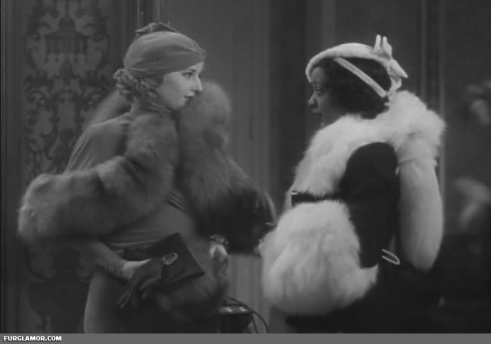
Another unique factor in this movie is the relationship between Lily and her best friend Chico, an African American woman from her hometown. The two join forces and run away to New York, and are fiercely loyal to each other throughout the movie. Interracial relationships of any kind were extremely rare in any film prior to the lifting of the production code in 1968, and this relationship between Lily and Chico is a lovely note in the film that serves to soften the hardened character of Lily into an emotional, feeling human being with a treasured best friend.

See you next time!

Summer Under the Stars Blogathon: “Ball of Fire” (1941)

While browsing through the Summer Under the Stars lineup for today, I saw that Ball of Fire, a delightfully unique screwball comedy with one very catchy musical number that I find myself singing often, was on tap for this evening. I knew that I had to write an entry on it, as it is indeed a fascinating film and ahead of its time in many ways. Dealing at once with intellectualism, gangsters, burlesque, and romance, featuring a snappy script complete with endless slang terms from the era, Ball of Fire is a movie lover’s smorgasbord, with a little something to suit everyone’s taste!

The story begins as a group of aging college professors, living together in a large house, try to complete an encyclopedia that they have started. Professor Bertram Potts (Gary Cooper) is writing an entry on modern slang, and to conduct research and gather participants for his study, he ventures out into the dingier parts of the city–pool halls, bars, anywhere where lower vernacular might be used. One of these establishments is a burlesque hall, wherein he sees a young dancer sing a sensual number called “Drumboogie.”

The drummer here is making a cameo appearance. Widely known and popular for their big band sound, this is the famous Gene Krupa and his orchestra. One of my favorite parts of the whole movie is how Krupa plays the matchbox like a drum at the end of this video, as the rest of the audience whispers the song. It reminds me of something Bob Fosse might have dreamed up some 30 years later.

With this number enters the character of Sugarpuss O’Shea (Barbara Stanwyck), with whom Professor Potts is very taken for her prolific use of slang. He decides to go backstage and ask Sugarpuss if she would be willing to take part in his project, but as we soon learn, Sugarpuss is a gangster’s moll whose boyfriend, Joe Lilac, is being linked to a murder case. When she hears a man knocking on the door wanting to talk to her, she is convinced that it is in relation to Joe and talks to Professor Potts in a very suspicious way. He is entranced with her usage of slang and though she keeps telling him she is not interested (“Shove in your clutch” is a phrase Professor Potts is most taken with), he leaves his card for her in case she ever is.

Those protecting Joe Lilac are concerned that if Sugarpuss were to go back to her apartment, the police would find her and make her talk. As they try to think about where to put her for the night so the police won’t know her whereabouts, Sugarpuss pulls out Professor Potts’ card, and the decision is made for her to go there for the night. She goes under the guise of being legitimately interested in Professor Potts’ investigation, and ends up staying much longer than the initial night.

Meanwhile, Joe Lilac is poised to marry her due to the fact that she wouldn’t be forced to testify against him. The protectors show up with a huge engagement ring, and though they downplay the not having to testify bit (one of my favorite lines is “He gets more bang outta you than any girl he ever met!”), it is clear that avoiding prosecution is his primary motive. However, what complicates things is that Professor Potts is beginning to fall in love with her. Eventually, the professor proposes and Sugarpuss is officially engaged to two men.

Through a series of circumstances, Sugarpuss is driven to Joe to be married along with Professor Potts and the rest of the professors in the house, but they all, including Professor Potts, think that Sugarpuss and the professor are going to be the ones having the wedding, not Sugarpuss and Joe. Once the professor finds out, he leaves Sugarpuss in anger and she is forced toward Joe. By this point, Sugarpuss really has fallen for the professor, and how exactly she gets out of her entanglement with Joe is what takes up the last 15 minutes of the movie.

I don’t usually like to spend too much time rehashing a film’s plot, preferring to leave more room for analysis, but the way this film unravels is truly like yarn–one thing leads to another, and in order to bring the character of the film into focus, the details of the plot are important to impart. In fact, the route of this plot is very typical of the comedies of Billy Wilder, who co-wrote the screenplay. When Ball of Fire is compared to a later Billy Wilder film such as Some Like it Hot (1959), the way the story unfolds is very similar.

Though today is technically Gary Cooper day on TCM, I think this is Barbara Stanwyck’s film, through and through. The real-life Barbara Stanwyck was a tough Brooklyn gal who grew up in poverty on the streets of New York, and that common slang of Sugarpuss O’Shea was her own way of speaking. I don’t think anyone else in Hollywood at that time could have been better for the part. The way she carries herself and even the way she walks is pitch perfect for the part she plays.

Stanwyck as a young girl in Brooklyn.

The others who steal the show are the absolutely adorable professors who share the house with Bertram Potts. Played notably by S.Z. “Cuddles” Sakall, Henry Travers, and Richard Haydn, they do such things as mapping out the steps to the conga through an algorithm, and after crashing the car into a sign, explaining that by the theory of relativity that it was the sign who crashed into them. The presence of Sugarpuss in the professors’ house was supposed to be reminiscent of Snow White and the Seven Dwarves, and the professors certainly honed the sweet and slightly otherworldly quality of the dwarves.

I get a huge kick out of this movie, and truth be told I have never met one person who didn’t love it. It’s just one of those movies that is universally liked and appreciated. If you haven’t seen it, it plays on TCM fairly frequently.

Here is Sugarpuss O’Shea in a great scene teaching the professors how to dance the conga. Thanks for reading! And don’t forget to tune in later this week for my coverage of Cinecon, starting Thursday. I’ll enable live-tweeting again, as I think that was a good way to keep you informed up to the minute!

Enjoy!