Friends, I am incredibly grateful for all the support and kind comments that have been coming into this blog during the first year of its existence. You are a wonderful audience, and I surely couldn’t continue this blog without all my readers, who keep me coming back to this rather stark wordpress template I have grown to love and associate with excitement, knowledge, and pride.
I have been lucky to have been accepted into 2 of the premier classic film blogging associations on the internet over the past year–the Classic Movie Blog Association, and the Large Association of Movie Blogs. The Classic Movie Blog Association bestowed upon Backlots its first competitive award earlier this year, a CiMBA for Best Classic Movie Discussion for my post on the final scene of The Heiress, and I was amazed and humbled at the honor. Given my success with the CMBA, I thought I’d take a stab at a LAMMY, the annual awards competition held by the Large Association of Movie Blogs. I am still a very new blog, competing with longstanding, established blogs for some of the highest blogging awards in the online film community, and I’m very aware of this. But I’ve decided to give it a try! Here are the things I feel I am eligible for:
If you are a member of the Large Association of Movie Blogs, please consider voting for Backlots in these categories! Thank you so much, I am truly honored to be part of this association, and able to be nominated.
Broadway dancer Annabelle Moore in Thomas Edison’s “Annabelle Serpentine Dance” (1894), the first appearance of color tinting on film.
Just the other night, while staying with the 7-year-old boys for whom I often babysit, I came across a rerun of “The Dick Van Dyke Show” while searching for quality entertainment to take the place of their obsession with Nickelodeon. I told them that “one of the best shows ever made is on,” and with reluctance they allowed me to change the channel. But when they saw the show was in black and white, they began to dig their heels in. “Black and white is boring!” I heard. “Why do you like so many things that are in black and white?” “Some of the best things ever made were shot that way,” I replied, and stood my ground when they asked to change the channel back. We got through the whole episode, but not without massive amounts of complaining about how this is terrible because it’s not in color.
It is worth exploring the desire we have for the “newest, realest” visions onscreen. There is a pervasive notion (that I find quite offensive) that black-and-white is somehow inferior, imperfect, and to be shunned in favor of color film because seeing things in color is more “real.” I have found that this is often the case for silent films as well, although as, tragically, silent films are all but absent from general TV programming (except for TCM’s Silent Sunday Nights), it is hard to see this attitude in action. People who think this way, I feel, are missing the entire point of suspension of disbelief, and of filmmaking itself. However, through the two centuries that film has been alive, there seems to be a constant effort to enhance color, enhance perception of reality, and enhance a sense of awe in the viewer, so as to make him forget that he is looking at a screen.
The first efforts to colorize film began in Edison’s West Orange, NJ studio, called “Black Maria,” in 1894. The building, designed by W.K.L. Dickson in 1892, sported a ceiling that could be opened when needed, in order to better capture light, and a base that was set on a revolving pivot so it could always be aligned with the sun. One of Edison’s many masterpieces was the kinetoscope, a cabinet affixed with a series of pictures running underneath a lamp, emitting flashes of light so quickly on each frame that the frame appeared to be frozen. The rapid succession of still frames created an optical illusion that the pictures were moving, and this was the genesis of the motion picture projector.
A man watching a moving picture through the kinetoscope.
By 1894, a number of years after Edison’s invention of the kinetoscope, mini “movie theaters,” known as kinetoscope parlors, began to emerge in New York City. For 10 cents, the customer could watch a “peep show” as they were called, and lines often formed around the block for the privilege. In June of that year, Edison and the owners of the Kinetoscope Exhibition Company staged a boxing match to be filmed at Black Maria. When the company showed the film in their kinetoscope parlor, people scrambled so desperately to see it that police had to be summoned to keep the crowds in line.
It was also there in Edison’s studios in 1894 that Edison invited Annabelle Whitford Moore, a well-known vaudevillian, to perform in a filmed dance for the kinetoscope. When the prints were finished, he had the novel idea to alter the film to create the illusion that Annabelle’s dress was changing colors as it moved. Frame by frame, he tinted the film by hand so that when the light passed through the film, it came through stained. What followed was the very first known color film, known as “Annabelle Serpentine Dance.”
Edison continued with several more hand-painted color segments in his work, most notably in The Great Train Robbery (1903), in which bright purples, oranges and yellows were used to tint the characters’ clothes, the smoke from gunshots, and the dust kicked up by horses in the film. George Meliès also employed it to great effect and beauty in A Trip to the Moon (1902).
The Great Train Robbery in its entirety.
A Trip to the Moon. Many scenes from this movie were used in Martin Scorsese’s Hugo, released last year.
A new process called Technicolor, which gave filmmakers the opportunity of entirely new spectrum of color, began to develop in the 1920’s, and though color film continued to be used intermittently in short subjects, it wasn’t until 1935 that a film was shot entirely in color. Becky Sharp, starring Miriam Hopkins, became the first feature film to be shot in three-strip Technicolor.
And in 1937 came a breakthrough in color cinema–the first full-length animated color film, also the first full-length animated feature produced in the United States.
The same year as Edison’s experiments with color came his experiments with sound. Utilizing his previous invention of the phonograph, he decided to attempt a marriage between the kinetoscope and the phonograph, to make the first “talking picture.” He set the stage at Black Maria with two men, a violinist, and a recording device into which the violin played. The men danced to the melody of the violin, while the sound was recorded on Edison’s phonograph. He synced the phonograph recording with the film on the kinetoscope, and when Edison’s kinetoscope viewers looked in, they saw, and heard, this:
It was labor-intensive and cumbersome, as it was nearly impossible to sync the phonograph exactly right with the film, but nonetheless, Edison had stumbled upon a gold mine. By 1895 he was distributing “kinetophones”–kinetoscopes with phonographs inside the cabinet, into which the viewer could look to see the film while listening to the sound from the phonograph, by way of rubber tubes to be inserted in the ears. The invention was a huge hit at first, but work on the still crude machine came to a halt when Dickson left Edison and the kinetophone was not heard from again for 18 years.
In 1913, Edison released a new version of the kinetophone, with the image to be projected onto a large screen, instead of through the peepholes of the kinetoscope. Edison connected the projector and the phonograph by way of a long pulley, so the sound and image could be synchronized as much as possible, and Edison had made a grand total of nineteen “talking pictures” by 1913. However, he became increasingly discouraged with the unions, that stipulated that only area union members could operate the machinery, resulting in misuse of the kinetophone due to lack of training. The dissolution of the Motion Pictures Patent Co., which deprived him of a patent for his inventions, led him to become further frustrated, and by 1915, he had quit sound pictures due to the difficulties he encountered.
In 1914, a former worker from Edison’s laboratory, Eugene Lauste, received the first patent for sound on film technology, which transformed sound into light waves which are recorded directly onto the film. The product was commercialized in 1919, leading the way to several landmark films–Don Juan (1926), the first film to employ a recorded soundtrack and sound effects, Sunrise (1927), the first film to feature human voices, and then finally, the very first commercially released talking picture, The Jazz Singer, in 1927.
These are the very first words ever spoken as dialogue in a motion picture.
I would like to thank the Library of Congress for providing me with invaluable information for this post. I hope I have sufficiently covered the early days of color and sound pioneering, without which nothing we take for granted today would have been possible. Thank you for reading!
Thomas Edison (center) with W.K.L. Dickson (standing on the left) and laboratory employees at Black Maria, 1892.
I’ve said this before and I’ll say it again–I try really hard on this blog NOT to dwell too much on those stars who get massive amounts of attention outside of the classic film world. This means that you will find very few posts about Audrey Hepburn or Marilyn Monroe here, though I think both of them are incredible, fascinating people who deserve to be remembered with respect. To me, the capitalization on the images of these two legends is disrespectful to their memories, and diminishes their achievements down to mere images to look at, and thus I won’t feed the fire by posting much at all about them. However, it is important to qualify that with an acknowledgment that Audrey and Marilyn ARE a part of classic film history and culture, and so when a story comes up relating to them, I want to honor it.
Today, May 4, would have been Audrey Hepburn’s 83rd birthday. I don’t have to reiterate what a beauty she was, what a beautiful voice she had, or what an influence she had on fashion, but what I will focus on is her immense, radiant kindness and generosity that marked not only her life, but permeated through in her film roles as well.
She spent the last years of her life devoted to children in third world countries, serving as Ambassador for UNICEF in several third world countries, including Somalia, Bangladesh, Ethiopia and the Sudan. She always said that she felt she owed her life to the United Nations relief organizations, as it was the UNRRA (United Nations Relief and Rehabilitation Administration) that saved her from complete starvation during her youth in war-torn Holland.
She was born in Brussels, Belgium, on May 4, 1929. As the child of a Dutch baroness and a British banker, Hepburn spent her early youth in the in relative comfort, an acknowledged tomboy who enjoyed climbing trees and playing with her two older half brothers. Her father, always a distant man, left when Hepburn was 6, and shortly thereafter her mother moved the family back to Arnhem, Holland. The first rumblings of Nazi occupation began to come to the Netherlands in the mid-1930’s, and with the full occupation of the country in 1940, Hepburn’s brother was sent to a Berlin labor camp, her other brother went into hiding, and her uncle was executed for taking part in a resistance uprising. The Germans eventually blocked off all food supply routes, and Hepburn suffered from severe malnutrition and anemia, often resorting to eating tulip bulbs as a source of nutrients. She escaped through dance, which had long been her passion, and drawing.
Artwork drawn by Audrey Hepburn during the war.
When the country was liberated, the UNRRA dropped heavy loads of food on Holland. Hepburn recalled eating so much sugar and condensed milk that she made herself ill, and she often said in her later life that she felt a great debt toward the organization. She vowed to repay it, and her identification with children affected by war and starvation drew her naturally to UNICEF.
She was appointed Goodwill Ambassador to UNICEF in 1988, and her first field mission was to Ethiopia, where she was intensely scarred by what she saw. She was sent there as an attempt to bring attention to the shocking condition of the country, which was ravaged by famine and war. The refugee centers were overpacked and were beginning to be at risk for spreading various epidemics. She testified for a Congressional subcommittee where she said about the experience:
I have a broken heart. I feel desperate. I can’t stand the idea that two million people are in imminent danger of starving to death, many of them children, [and] not because there isn’t tons of food sitting in the northern port of Shoa. It can’t be distributed. Last spring, Red Cross and UNICEF workers were ordered out of the northern provinces because of two simultaneous civil wars.
One of Hepburn’s duties was immunizing babies, and in this video we can see her complete attention to the task, and her true love for children.
After her field mission to Ethiopia she embarked on several more missions in the last 5 years of her life, to help children in some of the regions most devastated by war, famine, and drought. Her trip to Bangladesh came on the heels of extreme frustration in the UN’s dealing with the country, as Bangladesh had been hit by nearly every possible problem that a country could have. Audrey, however, said that she desperately wanted to go and help them, so she and Robert Wolders, her partner at the time, went to Bangladesh to raise awareness of their plight. John Isaac, a UN photographer, recalls his impression of her in Bangladesh:
“Often the kids would have flies all over them, but she would just go hug them. I had never seen that. Other people had a certain amount of hesitation, but she would just grab them. Children would just come up to hold her hand, touch her-she was like the Pied Piper.”
With a child in Bangladesh.
By far her most difficult mission was her last, a heartbreaking and nightmarish trip to Somalia in 1992. This was such a hellish experience for her that she could hardly speak of it afterward. She called it “apocalyptic,” and said “I walked into a nightmare…. I have seen famine in Ethiopia and Bangladesh, but I have seen nothing like this-so much worse than I could possibly have imagined. I wasn’t prepared for this. It’s so hard to talk about because it’s unspeakable.” To her son Sean, she said “I’ve been to hell.”
The earth is red-an extraordinary sight-that deep terra-cotta red. And you see the villages, displacement camps and compounds, and the earth is all rippled around them like an ocean bed. And those were the graves. There are graves everywhere. Along the road, around the paths that you take, along the riverbeds, near every camp-there are graves everywhere.
*A word to my readers–I am including below a photo of Audrey and a severely emaciated child in Somalia. If you would prefer not to see it, I am warning you now. I don’t want to shy away from posting photos like this, especially because Audrey Hepburn was working so hard to increase awareness of the situation. But I would like to warn those who would rather not see it.*
Upon her return from Somalia, Hepburn began having pains in her stomach. It was soon discovered that the pains were due to appendiceal cancer that had grown over several years and became worse while she was in Somalia. The prognosis was poor, and after a few treatments, Hepburn decided that she would rather spend her last Christmas in peace with her family. She went back to her home in Switzerland, where she died on January 20, 1993.
For me, Audrey Hepburn is less about acting and fashion and beauty, and more about extreme generosity of spirit. That is part of why her commercialization makes me so upset–the corporations don’t understand her and what she was all about. Her UNICEF missions make up the REAL Audrey, and the one that I prefer to keep in my mind.
I leave you with an interview she did for UNICEF while filming “Gardens of the World.” Happy birthday, Audrey. You are greatly missed.
All right, now unless you’ve been living under a rock for the past 73 years, the video you see above contains one of the most iconic and identifiable melodies in film history. Officially titled “Tara,” it is the main theme to Gone With the Wind, whose magnificence has been sending chills up the spines of generations of moviegoers for nearly over 7 decades. The melody is certainly familiar, but the composer, unfortunately, was never formally recognized by the Academy for his achievement in this epic drama, where music is central.
At the 1940 Academy Awards, Gone With the Wind swept up the awards in nearly every category, winning a grand total of 9 Oscars, including Best Actress, Best Supporting Actress, Best Art Direction, Best Cinematography, Best Editing, Best Screenplay, and Best Picture. Notably missing, however, was Max Steiner for his gripping musical score, whose nomination lost out to Herbert Stothart for his original score to The Wizard of Oz.
The opening to Herbert Stothart’s winning score.
However, Max Steiner’s contribution to film music goes far beyond Gone With the Wind, in fact it permeates nearly every notable film score to date, either through his own hand or by association (Steiner is said to have coached such contemporary greats as Alfred Newman, Franz Waxman, Erich Wolfgang Korngold, and Miklos Rosza in film composition). He is credited as the true pioneer of film composing, and is considered to be one of the greatest film composers of all time.
Steiner was born in Vienna in 1888, and was soon identified as a child composing prodigy. He had studied with Johannes Brahms and Gustav Mahler before the age of 16, and completed his studies at the Imperial College of Music in half the time of his contemporaries. He arrived in Hollywood in 1929 to orchestrate Rio Rita for RKO Studios, and soon garnered fame for his score of King Kong, and for conductingseveral Fred Astaire/Ginger Rogers musicals, such as Top Hat and Roberta.
The ending of Steiner’s score for King Kong.
His reputation continued to grow in the 1930’s, and after winning his first Academy Award in 1934 for The Informer, he left RKO Studios for Selznick International, then signed a long-term contract with Warner Brothers, where he undoubtedly left his biggest mark.
Instead of going through each Warner Brothers picture he scored individually, I am going to compile for you a number of videos that illustrate Steiner’s work in various well-known Warner Brothers films:
After leaving his contract with Warner Brothers, Steiner’s career began to wane, but not before composing the score for the John Ford classic The Searchers in 1956. He made a few ventures into television, notably scoring the 4th season of “Hawaiian Eye,” and his final film score was for the film Two on a Guillotine in 1965.
Max Steiner’s music is extremely versatile, and runs the gamut from intensely powerful to delicate and timid, often within the same score. Indeed, Steiner himself claimed that he had no set rule for writing his scores. “There is no Method,” he wrote. “My attitude–to give the film what it needs. And with me, if the picture is good, the score stands a better chance of being good. The hardest thing in scoring is knowing the location of your music. Music can slow up an action that should not be slowed up, and quicken a scene that shouldn’t be quickened. Knowing the difference is what makes a film composer.” He made use of any and all references at his disposal, including “borrowing” modes and melodies from other composers and making them his own. The most notable examples of this are from Casablanca, where variations on the Marseillaise and popular tunes are heard throughout the film–
And of course from Gone With the Wind, where Steiner interweaves American folk songs from the South with his own composition. In this clip, listen for Steiner’s transformation of the lively, upbeat folk song “Dixie” into a somber, melancholy moment by transposing it into a minor key.
We have Max Steiner to thank for much of what film music is today. When I mentioned to somebody that I was working on this blog post, she asked me “Well, is there anybody like Max Steiner today?” I was hard pressed to think of anyone, as he pioneered so much of that which we take for granted in the modern age. The only person I could think to possibly compare him to is John Williams, in the fact that both Steiner and Williams have an incredible number of stellar film scores to their credit, and are legends in the industry.
I leave you with a video compilation of some Steiner masterpieces. The history of film music is a subject I wish were better covered in print and other information outlets, as it is so often an underrated factor in our overall movie-watching experience. Max Steiner has contributed so much to the films we hold dear as a culture, and too few people know all that he has done. Thanks for reading!
In 1946, a former psychiatric patient by the name of Mary Jane Ward wrote a book called The Snake Pit, dealing with the living conditions inside mental institutions and the cruel and often sadistic ways in which patients were treated. The book, based on Ward’s own experiences as a patient at Rockland State Hospital, shed a previously unseen light on the practices that were commonplace in institutions, and the book was an enormous success critically and financially, bringing fame and renown to its author, who was at the time of publication still having serious trouble psychiatrically.
Shortly after the book’s release, director Anatole Litvak bought the film rights from Mary Jane Ward for $75,000 and began taking the property to various studio heads in order to try to get a film of the story made. The Hays Code was rooted firmly in Hollywood by 1948, and none of the studios to which Litvak brought The Snake Pit wanted to run the risk of making a film that would prove to be monumentally controversial. However, in the summer of 1946, Litvak brought the property to Darryl F. Zanuck, an old friend and the head of 20th Century Fox. Zanuck agreed to make the film, bought the script for $175,000 from Litvak and hired him as director and co-producer. It was to be the first full-scale examination of mental illness in the history of film.
For the role of Virginia Cunningham, the novel’s main character, the studio wanted Gene Tierney. The beautiful Gene Tierney, who suffered from mental instability herself, probably would have been a stellar choice for this part, was pregnant at the time and was unable to take the role. Litvak approached Olivia de Havilland, a recent Oscar winner for To Each His Own, with the script, and after a brief reading, de Havilland eagerly took the part. She undertook grueling research at Camarillo State Mental Hospital for her portrayal of Virginia Cunningham, including observations of electroshock therapy sessions. In a 2006 interview with the Academy of Achievement, de Havilland recalls what she saw:
In order to convey the starkness of the situation in the hospitals, Litvak permitted no hairdressers on the set, and requested that the woman not wear bras or girdles. For the costumes worn by de Havilland and Celeste Holm (playing a friend of Virginia at the institution), designer Bonnie Cashin made a composite of outfits observed at various institutions during research for the film, mostly consisting of drab, bulky shirts and skirts. The cinematography on the film is really quite incredible, and the credit for that goes to cinematogapher Leo Tover, who doesn’t get the credit he deserves for the masterful use of stark lighting and beautiful editing.
Olivia de Havilland and Celeste Holm in Bonnie Cashin's costumes for the opening scene.
An example of Leo Tover's expert lighting in a key scene of the film.
The film opened to great acclaim, with the Hollywood Reporter calling it “a picture so compelling, dramatically exciting and frankly courageous as to defy comparison. Nothing like it has ever been done before in films.” It was nominated for a multitude of Academy Awards, including Best Actress (the award went to Jane Wyman for Johnny Belinda) and Best Picture (the award went to Olivier’s Hamlet), as well as Best Directing, Best Writing and Best Music. It won an Oscar for Best Sound Recording. Many film outlets warned their viewers against seeing the film with children, and advised that it was “not recommended for the weak”–nonetheless, it became Fox’s highest-grossing film of 1948 and broke box-office records around the country.
I believe de Havilland was robbed of the Best Actress Oscar for this film. Though I love Jane Wyman in Johnny Belinda, I think de Havilland’s portrayal of Virginia Cunningham is far more nuanced and complex than Wyman’s of the deaf farm girl Belinda, and think the Academy put too much emphasis on the fact that Wyman didn’t speak and not enough on the fact that de Havilland played an intensely difficult role extremely well.
I want to thank tcm.com for providing many of these notes! Please visit their website and see what other gems they can provide you with. I leave you with the trailer to The Snake Pit. Thanks for reading!
*Dear Readers–I am SO SORRY this got to you so late! I’ve been working on this post for about a week, because Day 3 was so full. Enjoy!*
The TCM Film Festival ended on Sunday, and now that I am back home and back into the swing of things, I feel more able to reflect on my experiences from a distance. I recapped Day 4 a few days ago, and telling you I was going to work backwards, let you know that I would be writing about Day 3 at a later date.
I am now ready to do so!
Day 3 began with great excitement, as I anticipated my interview with TCM producer David Byrne. It would be held at 2:30 at the Hollywood Roosevelt Hotel, and I needed to program my schedule around it. But first, another showing of one of my all-time favorites, the raucous Auntie Mame. The character of Auntie Mame is one of my personal heroes, and to see her on the big screen, appreciated by an entire audience of laughing, joyous moviegoers, is a real treat. I have seen it on the big screen a few times before, but this is one movie of which I never tire. Instead of telling a regular story, it rather advocates a lifestyle–a lifestyle of seizing the day, taking nothing for granted, and treating life as if it were “a banquet–and most poor suckers are starving to death!” I feel many people in this day and age could take a lesson from Auntie Mame and her love of life, and though Rosalind Russell lost the 1958 Oscar to Joanne Woodward in The Three Faces of Eve, this was the defining role of her career and I believe she had much of Auntie Mame in herself.
Auntie Mame was followed by a showing of Casablanca, a movie that, surprisingly, I have some issues with. It’s not the movie itself, per se, but more the attention it gets. I think there are plenty of other, better classic films that should be getting as much or more attention than Casablanca. I decided to go only because my friend Christina is a Casablanca fan, and I was slightly restless during the film. There is, however, one scene in the film that I think is absolutely stellar, and when that came on, I became appreciative of the opportunity to see it on the big screen.
We so take for granted the outcome of WWII in the modern day, and coming from a movie at the height of the war, this scene is immensely powerful and eerily prophetic.
After Casablanca, it was time for my interview. I waited for David in the Hollywood Roosevelt lobby, and he showed up around 2:45 with a rather large camera crew! We headed to the pool to shoot the interview–David, myself, and about 5 sound and lighting men. I was stationed by the pool and asked questions like “What have you seen so far?” “What is your favorite thing about TCM?” “What do classic films mean to you?” Questions that were pretty standard. I never got to bust out with “Yeah, I’ve been to the Maureen O’Hara Classic Film Festival in Ireland and the Vivien Leigh/Laurence Olivier weekend in London and have met all these awesome celebrities…” Nope. None of that. I was a little disappointed, but he seemed to like what I gave him, so if you see my awkward face on TCM this August or September, you’ll know why.
After the interview Marissa and I got in line for Singin’ In the Rain at Grauman’s. Christina decided to see something else instead, but Marissa and I couldn’t pass up an opportunity to see Debbie Reynolds, so we got in the line that by that time was forming around the block. We ate dinner in line (Baja Fresh for the win…but looking at the menu, who knew that those taco salads were like, an entire day’s worth of calories?? Surprised me…), and when we got inside, we were lucky enough to get stellar seats, right in the center! Patricia Ward Kelly, Gene Kelly’s widow, was there again, introducing herself to as many people as she could get to in the gigantic Grauman’s Chinese Theatre. I came up to her and got her autograph on my festival pass, which was nice, and by that time it was time for the interview to start. Robert Osborne was introduced to the audience, and Osborne in turn introduced Debbie Reynolds, who came out looking EXACTLY the way I expected her to look. If you’ve seen Debbie recently, you know what her sort of “later life” look is:
Et cetera.
Anyway, she came out looking exactly like that, doing her signature hand gestures and looking all-around great for her age. The interview was hilarious. Here is a quote that basically sums up the interview:
Audience member: YOU HAVE GREAT LEGS!
Debbie: Oh thank you–*hikes skirt up* I have great tits too!
Debbie then began to tell outlandish stories about Singin’ In the Rain and Gene Kelly’s toupée, in a way that only Debbie Reynolds can. Allegedly what had happened was that during the filming of “You Were Meant For Me,” Debbie had been instructed to take out her chewing gum, which she placed on the bottom of the ladder on which she stood. Gene, dancing around the ladder, accidentally put his head a little too close to the ladder, and his hairpiece got stuck on the gum. It was a hilarious story that had the audience in stitches.
“You Were Meant For Me” as it appears in the movie, with Gene’s toupée intact.
By the end, Robert Osborne was realizing that he had lost control of both the audience and his interviewee, and wisely cut it a bit short so the movie could start.
Robert Osborne interviewing Debbie Reynolds.
It’s always great fun watching a classic movie on the big screen with like-minded fans, because there is always a wonderful enthusiasm and euphoria in the audience that you don’t ever get in a regular movie theater, or even watching a classic movie on the big screen with a regular audience. People are truly happy to be there, excited to see their favorite stars on the big screen, and know all the trivia of the movie. For example, at the end of the Singin’ In the Rain number, a silent film actor by the name of Snub Pollard makes a brief cameo when Gene Kelly hands his umbrella to him as he passes on the street. The audience all knew this, and applauded Snub for his cameo. It’s really a fantastic feeling. So people were laughing and clapping all over the place, I so much that my hands hurt by the end of the movie! After the film’s ending, Patricia Ward Kelly was slated to speak. She has done meticulous research on Singin’ In the Rain, and brought many documents with her to show us exact things that happened on the shooting. For example, she read from a paper that documented the happenings of a particular morning, that went something like this: “9:45 AM–Gene Kelly rehearses Singin’ In the Rain. 10:15 AM–Arthur Freed arrives on set, discusses notes with Gene Kelly.” That kind of thing. So, she said, the toupée incident with Gene couldn’t have happened because it wasn’t documented in the papers. A little slap to Debbie if I ever saw one!
We had to rush out of Singin’ In the Rain to get to our next showing, A Night to Remember, a British film about the sinking of the Titanic. It was shown on the 100th anniversary of the disaster, and, as the speaker beforehand told us, the film started almost at the exact time the sinking occurred. Rather chilling.
Marissa, Christina and I had all seen the movie before, but when a certain name came onscreen for the credits, we got very excited–We (at least Christina and I) had forgotten that Jack Merivale was a featured player in this movie. For those less familiar with the life of Vivien Leigh, Jack Merivale was the man who assumed the responsibility for Vivien’s care after her divorce from Laurence Olivier. The two were romantically close and involved, and he is a major figure in Vivien Leigh’s later life. Christina and I had forgotten that he plays a role in A Night to Remember, but Marissa told us she wanted to show us his name in the credits as a surprise.
The film started late, and though it is a brilliantly well made film (the most expensive British production of the time), I found myself falling asleep due to the hour. By the time the movie was over, I was ready to go home and not stay for the lecture afterward, conducted by Don Lynch, an established scholar of the Titanic and its aftermath. However, when he began to speak, I was awestruck. This man was a walking encyclopedia! He had met nearly every survivor, and of those he did not meet, he met relatives. From talking to these people and from his own meticulous research, he knew what occurred at every single moment of the sinking, and could answer audience questions with such detail that it was almost overwhelming. He fascinated me–and I forgot about being tired until he was finished. I now know more than I ever thought I would about the Titanic!
After that, we were all tired and ready for bed. We drove home and promptly fell asleep, ready for Day 4!
I have just returned from the closing night party of the TCM Classic Film Festival, and am completely exhausted. This festival has been an incredible experience for me, very different from the other classic film festivals I have attended, and I am extraordinarily lucky to have been able to attend.
My installment for days 3 and 4 will work backwards, as the events seem to take better shape in my memory when I start with the most recent events.
The closing night party was crowded and energetic. My friend Christina secured a booth for us in Club TCM, and we watched the action from the booth until…out of nowhere…Robert Osborne showed up. We were ushered into a line without knowing exactly what was going on, and it turns out that we were being set up for a meet and greet. It was a total surprise that he was even there, and to be literally set up for a meeting with him was a real gift on behalf of the TCM staff. After we got in line, a number of people lined up behind us and the formal meet and greet started. As we were first, we each got to have a little talk with Robert Osborne and have our pictures taken with him. My discussion with him consisted of talking about Cover Girl and Rita Hayworth–something I will always remember. I talked about Rita Hayworth with Robert Osborne! The Going to the TCM Festival facebook group took a group picture with Ben Mankiewicz, which provided me the opportunity to meet him briefly as well. He is a very nice man, and very gracious to his fans, which is wonderful.
Prior to the closing night party, we watched 4 movies–beginning with Black Narcissus which was followed by Charade, The Women, and Mr. Blandings Builds His Dream House. The audiences for all of them were fantastic, especially the one for The Women, which played to a completely packed house. I was so excited that it did as well as it did, because it was competing with How The West Was Won which featured Debbie Reynolds as the guest speaker. As The Women is one of my favorite films of all time and I had seen it on the big screen before in Ireland with a MUCH smaller crowd, it was wonderful to hear the audience’s enthusiasm and great peals of laughter at some of my favorite lines in all filmdom.
Some of the snappy lines in The Women.
Before The Women, Marissa and I saw Charade, one I hadn’t seen in quite a long time and forgot how much I enjoyed. I had to cut out early in order to get in line for The Women, but I adored seeing Paris on the big screen and recognized most of their location shots, and of course the chemistry between Cary Grant and Audrey Hepburn is pretty fantastic. It would have been great if they could have made more movies together. By the time Charade was made, they were both well into the second half of their careers, and their age difference was 25 years, so it would have been difficult to pass them off as a couple for much longer.
Audrey Hepburn and Cary Grant in Charade.
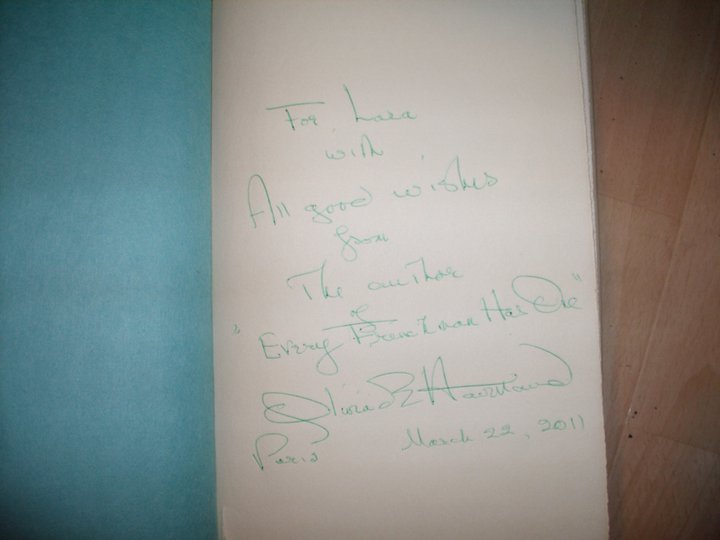
Before Charade, I had my Olivia de Havilland book appraised. I really didn’t care how much it was worth, I would never, ever sell it, but just thought it would be fun to know. It came out to be worth about $150, which is pretty good for what it is! Its value is so enormous to me that even if it were physically worth a million dollars, it still wouldn’t be enough to match its sentimental value.
The inscription inside my Olivia book.
The first thing we did on the last day of the festival was to attend a screening of Black Narcissus, an absolutely beautiful film starring Deborah Kerr and Jean Simmons. Shot on location in a beautiful Technicolor (exceeded in its beauty by only, in my opinion, The Red Shoes and The Quiet Man), it tells the story of a convent in the mountains of India. Again, I had to leave early to go to my Olivia book appraisal, but I highly recommend that you see this film. Deborah Kerr is stunning as usual, and a knockout performance is given by Kathleen Byron as a nun who, at one point, looks like she is literally possessed.
Trailer for Black Narcissus.
I will update Day 3 a little bit later, as we are going sightseeing now. Have a great day, everyone!
We woke up early this morning to attend the screening of Cover Girl at the Chinese Multiplex at 9:30, which proved to be a monumental choice, as Robert Osborne was there and talked about his personal love for the movie before it started. Also there was Gene Kelly’s widow, Patricia Ward Kelly who made it a point to introduce herself to every single audience member. We were all quietly trying to guess her age–as there is a gigantic age difference between Patricia and Gene–when Patricia came out and said “We’re 46 years apart! I was born in 1959, so you do the math!” She really seems to sincerely care about Gene’s legacy, and it is rather well-known that she tends to show up at every festival where Gene’s films are being shown. What a lovely lady!
Second on our agenda was Elmer Gantry at the Egyptian Theatre, for which we had to leave Cover Girl early to get in line. We got there JUST in the nick of time, as the line was just starting to move into the theatre. The program listed Shirley Jones as the guest speaker, and we were very excited to hear her speak–I had already devised a plan to ask her to sign my pass! But as it drew closer to the movie’s start time, an announcement was made–Shirley Jones would not be coming. A collective gasp was heard throughout the audience, as many of us had chosen this movie just for Shirley Jones’ guest appearance. The movie in its own right, however, is absolutely brilliant, and Shirley Jones or no Shirley Jones, I am so glad we saw it on the big screen. The story of a wayward Christian who turns to preaching in order to secure the affections of a young revival leader (played by Jean Simmons), and who ultimately sees the error of his ways by way of a young prostitute (Shirley Jones) with whom he had had a relationship many years prior and who was set on seeking revenge for his having wronged her. It is a movie with intensely complex characters and a compelling plotline, based on the novel by Sinclair Lewis. The woman who took the place of Shirley Jones, a film historian who has written many books and is well-known in the industry, turned our attention to the bizarre opening credits of Elmer Gantry, essentially condemning the film as an affront to Christian values. The text reads as follows, including all the exclamation points:
We believe that certain aspects of Revivalism can bear examination- that the conduct of some revivalists makes a mockery of the traditional beliefs and practices of organized Christianity! We believe that everyone has a right to worship according to his conscience, but- Freedom of Religion is not license to abuse the faith of the people! However, due to the highly controversial nature of this film, we strongly urge you to prevent impressionable children from seeing it!
We are then shown multicolored crosses upon which the cast and crew was credited. Here are the main credits, shown after the text is scrolled:
After Elmer Gantry we found that it was pouring rain, and we had to make our way back over to the area around the Kodak Theatre in order to be ready to get in line for Vertigo at Grauman’s Chinese Theatre at 5:30. I recall with chagrin that my socks got VERY wet in the rain and I was miserable for a full 6 hours of movie-watching in soaking socks and shoes. I’m currently back at Marissa’s house, relishing in my clean, dry socks!
We had a bit of time for lunch/dinner before getting in line for Vertigo, and we had some rather tasty sandwiches at a little cafe inside the Kodak Theatre mall area. Given that the crowd for Vertigo was massive, due to the caliber of the film and the special guest, Kim Novak, we decided to get in line especially early. Shortly after the line entered the theatre and we got our seats, the house completely filled and I’m guessing that many, many people were turned away. Kim Novak’s interview with Robert Osborne started around 6:30 and was relatively short, mostly focusing on Alfred Hitchcock as a director. She looks wonderful, and was sweet and witty during her interview
I must say that Vertigo is not my favorite Hitchcock film, despite being filmed in my hometown of San Francisco. There are, however, a few very redeeming scenes, including this very strange sequence that looks eerily modern and disturbs me every time I watch it:
We quickly went from Vertigo to one of my favorites, the Joan Fontaine tearjerker Letter From an Unknown Woman. Those who have been following my blog for a while know that I am a real sucker for both of the de Havilland sisters–Joan Fontaine (née Joan de Havilland) and Olivia de Havilland, and Letter From an Unknown Woman is one of Joan’s all-time best. I was thrilled to see it on the program for this year’s festival, and my friend Marissa, who had never seen it before, absolutely adored it, which made me very happy!
It is now time for bed. I must, however, tell my readers before signing off that I am going to be interviewed for TCM tomorrow. The producers read my “fan story” that I submitted a few months ago at their offer, and decided I was worthy of an interview! I am meeting a producer tomorrow to film it, and it will air on TCM in the near future. Wish me luck!! I will post all about it tomorrow.
Today was the first official day of the festival, and it kicked off for us around 9:00 when we arrived at the Hollywood Roosevelt Hotel to pick up our gift bags (meaning, for me, 2 copies of the official festival program–one outlining the movies to be shown and another with special features and stories inside). After claiming our bags, we headed down to the lobby to explore the gift shop and read our programs, where we saw a camera crew setting up. After a bit of investigating, we learned that Robert Osborne, movie expert and TCM host extraordinaire, would be shooting interviews there in a few hours. As huge fans (especially my friend Marissa), we stuck around the lobby in order to procure a good position in the crowd. When he finally arrived and began his interviews, we were beside ourselves. He interviewed a number of people from the industry, as well as some festival passholders. We managed to get a position in the crowd that allowed us to be seen from time to time on camera. If you happen to be watching TCM within the next few days and see the interviews Osborne does from the Festival, look for us in the bottom right corner of the screen.
Robert Osborne
We went for lunch after Robert Osborne was finished interviewing for the day, and then decided to hang out in Club TCM (the lounge where passholders can meet and mingle–held in the Hollywood Roosevelt Hotel room where the first Oscar ceremony was held) until it was time for Marissa and me to go to High Society and Christina to go to Cabaret. Due to a bout of evening rain, High Society was moved from the outdoor pool to Club TCM, so Marissa and I simply stayed where we were until High Society started. A surprise guest, Tina Sinatra, came onstage before the movie started to talk to Ben Mankiewicz about the movie and her father’s role in it, which was very entertaining and informative.
Unfortunately, the bar was still open as the movie played, so it was difficult to hear, but for someone who has seen High Society as much as I have, it was nothing really lost. I must say I am not a huge fan of this film, I find the songs hokey (though they were written by the great Cole Porter, strangely enough!), and the dialogue was completely phoned in from the earlier, non-musical version of the story, The Philadelphia Story, a far superior film.
Original trailer for High Society
Original trailer for The Philadelphia Story
Christina joined us after Cabaret was over, and we were anxious to hear her experiences on the red carpet and hearing the interview with Liza Minnelli, a bonus luxury afforded to those who held Essential and Spotlight Passes, a few notches above the pass I hold. It went very quickly, Christina told us, but the wondrous experience of witnessing Cabaret on the gigantic screen of Grauman’s Chinese Theater made it all worth it. Liza was in good form, and though Christina didn’t get to meet her, she sat 6 rows behind her during the movie. Also, a with our screening of High Society, a surprise guest appeared–Michael York!
Michael York with Liza Minnelli in Cabaret.
We were all tired after our full days, so we went back to Marissa’s house and it’s time for bed now. Expect more from the TCM Classic Film Festival tomorrow!
Day 0 you ask? Yes, the festival has not started yet, but I am currently in L.A. with two friends of mine I met at the Weekend With the Oliviers event in London, Christina and Marissa. We arrived yesterday, and have already done a bit of sightseeing, including a stop at George Cukor’s house. We had dinner at a nice Mexican restaurant in Hollywood and tried to pick up our festival memorabilia, but the info desk was closed by the time we got there and reopens at 9:00 this morning. So that’s our first item on the agenda today!
Our schedule today:
9:00: Pick up festival memorabilia
1:00: Meet TCM Panel
7:30: High Society poolside at the Hollywood Roosevelt Hotel
Unfortunately I have misplaced my camera cord, so I can’t upload photos while I’m here. However, once I get home, I will edit these posts with the photos added.
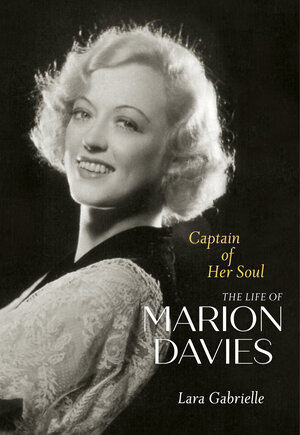
Captain of Her Soul: The Life of Marion Davies is now available at your favorite bookseller! Click hereto order it, and visit mariondaviesbook.com for all the latest.
Backlots is devoted to honoring and celebrating all aspects of classic film and is written by Lara Gabrielle, a California-based classic film writer and historian. Lara is the author of CAPTAIN OF HER SOUL: The Life of Marion Davies (UC Press, 2022).
Here you will find pieces on frequently seen classics and some lesser-known gems, as well as book reviews, festival coverage, and pieces on the history, theory and culture of film as it relates to the study of classic cinema.
Enjoy the site, and thanks for reading!
AFFILIATIONS & AWARDS
2019 CMBA Award for Best Profile of Classic Movie Performer or Filmmaker--"The Activism of Myrna Loy"
Winner of the 2018 CiMBA Award for Best Classic Movie Series, BACKLOTS AT THE COURTHOUSE: OLIVIA DE HAVILLAND VS. FX
Winner of the 2014 CiMBA Award for Best Profile of a Classic Movie Performer or Filmmaker: A Q&A WITH JOAN FONTAINE IN HONOR OF HER 96TH BIRTHDAY
Winner of the 2011 CiMBA Award for Best Classic Movie Discussion, THE FINAL SCENE OF THE HEIRESS
I am honored to be a judge of the Animal Film Festival in Grass Valley, CA.
EVENTS
BACKLOTS ON THE WEB
Join us at the Backlot Commissary, the place for Backlots' readers to share content and discuss movies!
Walter Pidgeon and Greer Garson in "Mrs. Miniver."






















_03.jpg)

 Backlots