On December 19, the Film Noir Foundation put together an early holiday gift for fans of film noir. In celebration of the season as well as the release of the official schedule for Noir City in January, the foundation held a showing of two noir-related films at the Castro Theatre in San Francisco. The first, Holiday Affair, is more in the spirit of the season while Lady in the Lake is a textbook noir–with a twist.
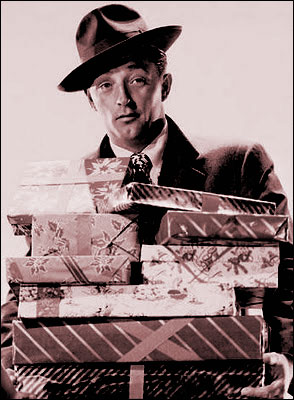
Holiday Affair stars Janet Leigh as Connie, a young war widow who meets and falls in love with Steve (Robert Mitchum), a toy salesman, despite being affianced to Carl (Wendell Corey), a rather straight-laced lawyer. Her young son much prefers Steve, and this puts a further strain on the relationship between Carl and Connie. It is clear that Carl is a good soul, but he is ultimately powerless to stop that which is going on between Steve and Connie.
In an introduction given by Eddie Muller at the start of the film, Muller noted that this movie was chosen due to its holiday theme as well as the casting of Robert Mitchum as Steve. Mitchum was a very versatile actor, but especially beloved for his work in film noir. In Holiday Affair, however, he shows off his comedic skill. The movie would be classified as a romantic comedy above all, with solid performances by all involved but especially noteworthy is Gordon Gebert, the 8-year-old child actor who plays Connie’s son. Gebert shows an unusually wide range of emotion throughout the movie, and ends up being the driving force behind the whole story. After the film ended, Eddie Muller provided an update on Gebert–he is still with us, and currently the professor of Architecture at City College of New York.
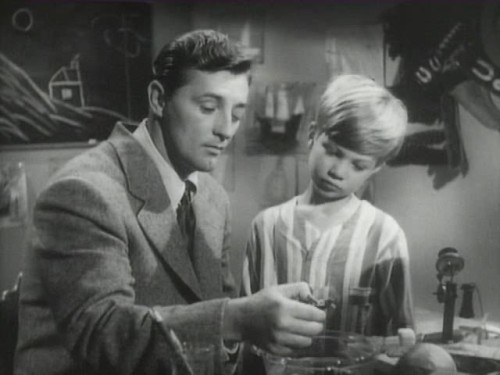
Gebert with Robert Mitchum in the film.
After a brief intermission, Muller got up to introduce the second feature of the evening, an unquestionably noir thriller entitled Lady in the Lake. Starring Robert Montgomery and Audrey Totter, this story about a detective turned writer who gets involved in a murder mystery is one of the most experimental movies of the 1940’s. Montgomery, both star and director, decided to film the entire movie from the perspective of the main character, which paves the way for some very creative cinematic choices–including, most interestingly, the fact that the only time we ever see Montgomery’s character is through his reflection in the mirror. In addition, there are some very dramatic and action-packed scenes that normally would be helped along with corresponding music, but Montgomery preferred to let the scenes speak for themselves–Lady in the Lake has no musical score.
In the mirror.
Despite these cinematic novelties and my enthusiasm for the film, the shaky camera work made for a laborious movie-watching experience. I often found myself looking away so as not to get dizzy. To be fair, Montgomery was not primarily a director, and it would be unfair to compare his work on this film to that of veteran directors of the same era. The ideas were all there, but the film could have benefited from some ironing out by an experienced director. Indeed, upon the initial release of the film, the New York Times film critic wrote:
“In making the camera an active participant, rather than an off-side reporter, Mr. Montgomery has, however, failed to exploit the full possibilities suggested by this unusual technique. For after a few minutes of seeing a hand reaching toward a door knob, or lighting a cigarette or lifting a glass, or a door moving toward you as though it might come right out of the screen the novelty begins to wear thin.”
Still, it was wonderful to see the movie after hearing so much about it, and the entire evening was great fun.
Backlots will be returning to Noir City for the full festival in January, so stay tuned for more coverage!
To all my readers who celebrate Christmas, I would like to wish you a very happy holiday. I hope you have a wonderful day filled with happiness, good cheer, and good company!
Some housekeeping notes:
Stay tuned for Backlots’ coverage of Noir City X-Mas! It should be appearing on the site within the next day or two.
Backlots will be covering the larger Noir City film festival in late January. If you can, join us at the Castro Theater between January 25 and February 3, 2013! And if you can’t, be sure to catch Eddie Muller on TCM for a talk with Robert Osborne about film noir, on January 17.
And finally…
The winner of Backlots’ Dueling Divas competition is Angela from The Hollywood Revue! Her analysis of the Joan Crawford/Norma Shearer feud was excellent, and her name was randomly drawn out of a hat for Backlots’ Dueling Divas competition. She has chosen to receive the TCM Leading Ladies book. Congratulations Angela!
Here are some pictures of some classic Hollywood stars celebrating Christmas. Have a great day and a great rest of your holiday season!
Joan Fontaine in a publicity photo.
Judy Garland and children Lorna and Joe on the Judy Garland Christmas Show, 1963.
Bette Davis in a Christmas war bond short.
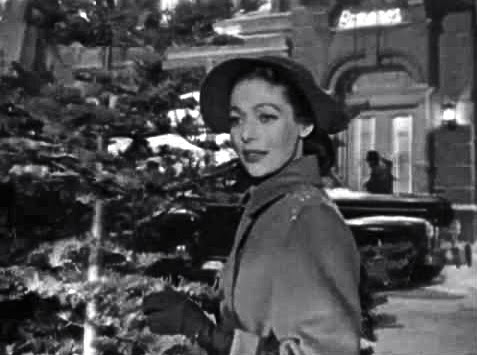
Loretta Young in a scene from “The Bishop’s Wife” (1941).
Barbara Stanwyck and Fred MacMurray in a publicity photo for “Remember the Night” (1940).
Carole Lombard receives a gift.
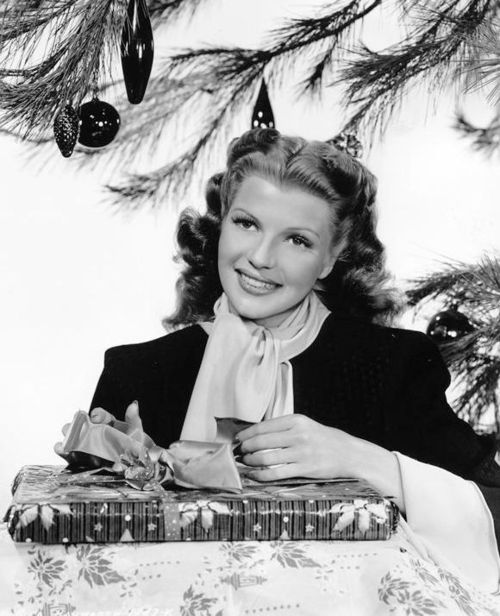
Rita Hayworth opens a present.
Clara Bow on the roof with Christmas toys, circa 1927.
Elizabeth Taylor and friend.
Cary Grant in a still from “The Bishop’s Wife” (1941).
Jimmy Stewart and Margaret Sullavan in “The Shop Around the Corner” (1940).
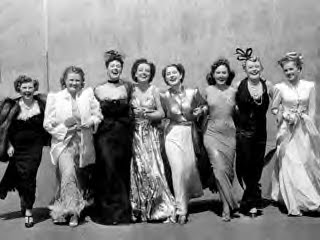
Some of the most entertaining duels ever depicted onscreen are concentrated in one single film. The Women (1939), directed by George Cukor and starring Norma Shearer, Rosalind Russell, Mary Boland, Joan Fontaine, and Paulette Goddard, is one of the most well-loved comedies of all time, and much of the acclaim it has received is due to the unique relationships the characters have with each other, and the complex web of competition that occurs among nearly every character with nearly every other.
The Women presents an unprecedented experiment with regard to casting a film, and in regard to the relationships between the characters. Based on the Broadway hit by Clare Boothe Luce, the tagline reads “The Women: It’s all about the men!” Indeed, the women in the film talk so much about their husbands, it may take a while for the viewer to recognize that something is missing. The husbands, when they are heard from, are always either spoken to over the phone or send their communication through letters. True to the Broadway show, the MGM casting department went to great lengths to ensure that every member of the cast was female. From the extras to the photographs to even the animals, there is not one male in the cast of 130 that makes up The Women.
Though a completely feminine picture, and very progressive in its treatment of divorce and extramarital affairs, The Women is still very much a movie made under the code. All divorces are eventually dissolved, and the “wayward” women are punished. Nonetheless, the code strangely holds this film together, leading to a tight finish and no problem unresolved. When the movie was remade in 2008, the filmmakers made an effort to make it more politically correct, liberated, and feminist, which ruined the story and led the film to be universally panned by critics. There is truly nothing like this original version of The Women, a hilarious story of friendship, competition, and gossip among society women.
There is a tightly woven network of duels in this movie, and the plot comes together through exploration of who is dueling with whom! I will list all the main characters here, and then delve into the duels.
Mary Haines (Norma Shearer) wife of Stephen Haines
Sylvia Fowler (Rosalind Russell), wife of Howard Fowler, cousin of Mary Haines
Crystal Allen (Joan Crawford), perfume counter saleswoman, mistress of Stephen Haines and Buck Winston
Edith Potter, wife of Phelps Potter
Miriam Aarons (Paulette Goddard), mistress of Howard Fowler
Peggy Day (Joan Fontaine), wife of John Day
The Countess de Lave (Mary Boland), married multiple times, currently involved with Buck Winston
Little Mary (Virginia Weidler), Mary and Stephen’s daughter
MARY HAINES vs. CRYSTAL ALLEN
While having her nails done, Mary’s cousin Sylvia Fowler learns of the infidelity of Mary’s husband. The mistress is a perfume counter saleswoman named Crystal Allen, and Sylvia immediately takes action by telling Mary to get her nails done with the same woman, so she can hear the story for herself. Mary does that, and upon learning the story, she decides to largely ignore it. Sylvia, however, will do nothing of the kind. Due to her meddling, Mary and Crystal square off when they meet at the fashion show in the middle of the film. Pay special attention to the racy and clever dialogue.
It finally becomes clear that Mary is going to need to get a divorce from Stephen, as Crystal will not give him up.
PEGGY DAY vs. SYLVIA FOWLER
The sweet and shy Peggy Day finally gets fed up with Sylvia’s meddling in Mary Haines’ business, and after a scene at the gym with Edith and Sylvia in which the women gossip about the situation, Peggy complains to Edith that Sylvia is a “dreadful woman” and vows to tell her so. Edith convinces her not to, because it’s just Sylvia’s bad luck that Sylvia ” wasn’t born deaf and dumb.” The clash between Peggy and Sylvia continues through the rest of the movie, though Peggy’s shy demeanor prevents her from making it into an issue.
Peggy’s personality is a bit of a paradox. On the one hand, she is very shy and unassuming, but on the other hand, she resents her husband for not letting her spend her own money. Eventually this becomes too much, and she ends up in Reno with Mary.
MIRIAM AARONS vs. SYLVIA FOWLER
On the train to Reno for her divorce, Mary Haines meets two women going to Reno for the same reason. One of them is the Countess de Lave, an exuberant multiple-time divorcee who nonetheless claims to believe in love by proclaiming “L’amour!” after nearly every sentence. She is intent on marrying Buck Winston, a singing cowboy and radio star with a popular show. The other woman is Miriam Aarons, a former chorus girl going to Reno for her first divorce.
Meanwhile, Sylvia finally gets a taste of her own medicine when she finds out about her own husband’s infidelity. She surprises Mary and Peggy with her own arrival to Reno. Shortly before Sylvia’s arrival, Miriam shared a secret with the Countess–she has been having an affair with Howard Fowler. Miriam does not know Sylvia, and it is a major surprise when Sylvia arrives and they are introduced.
Sylvia gets an article in the mail that shows with whom Howard has been having an affair, recognizes the name of Miriam Aarons. An all-out catfight ensues.
LITTLE MARY vs. CRYSTAL ALLEN
While in Reno, Mary finds out that Stephen has married Crystal. Little Mary, Mary’s daughter, does not like Crystal, but is civil to her because Mary has told her to be kind to Crystal. Crystal clearly is not the mothering type, and barely tolerates Little Mary. There is a confrontation between them where Crystal is on the phone in the bathtub with a mysterious man, and Little Mary becomes suspicious and eventually tells her mother.
SYLVIA FOWLER vs. CRYSTAL ALLEN
Sylvia and Crystal, who have become chummy, meet minutes after Crystal’s confrontation with Little Mary in the bathtub. Sylvia answers the phone when it rings, and it turns out to be the cowboy radio star Buck Winston. Crystal has been having an affair with the fiancé of the Countess de Lave.
By now, Little Mary has told her mother about the mysterious man, and with this newly found information about Crystal’s affair, Mary decides to take the initiative in getting Stephen back. She dresses for a party occurring that evening that Stephen and all the rest of the ladies are attending, and begins her recapture of her husband.
At the party, Mary tricks Sylvia into spilling the beans that Crystal is having an affair with Buck Winston, and thereby sets the ball rolling toward the end.
THE COUNTESS DE LAVE vs. CRYSTAL ALLEN
Also at the party, Buck Winston publicly declares his love for Crystal Allen. The Countess is humiliated, and Crystal goes for the jugular, implying that she is only after his money. The Countess reveals that all his money is gone, and that SHE is the sponsor of his popular radio show. Crystal is defeated, and her final line of the movie is:
“Well girls, I guess it’s back to the perfume counter for me. And by the way, there’s a name for you ladies, but it isn’t used in high society…outside of a kennel. So long, ladies!”
The movie ends with Mary running back to Stephen with arms outstretched.
Director George Cukor is magnificent in channeling all these feuds into fun and creative scenes. Though there is some serious dueling in the film, the sharpness of the script and slapstick humor keeps the audience entertained and keeps the film from getting too mean.
The Women remains one of the best films of that marvelous year of 1939, and one of the best comedies of all time, thanks to the brilliant performances by the actresses involved and the unparalleled directing of George Cukor.
Today is the final day of the Dueling Divas Blogathon! Be sure to check out all the entries here. Thanks for reading and a special thanks to those who contributed their hard work to this year’s blogathon. I can’t wait for next year!
Here they are, folks! I will be updating this page as the entries come in over the next few days. Be sure to check back often for the newest posts! At the end of each day I will re-post this page on Backlots’ social media sites for your convenience so you can read the official entries for each day. Have fun!
SILVER SCREENINGS: Art imitates life in Old Acquaintance. The onscreen feud between Bette Davis and Miriam Hopkins mirrors the one they had in real life, as analyzed in this very informative post over at Silver Screenings. We also learn a bit about “women’s films” as a genre. http://silverscreenings.org/2012/12/19/dueling-divas-old-acquaintances
December is a busy month for Backlots. This year with the San Francisco Noir Foundation’s Christmas event, “Noir City X-Mas,” occurring on the eve of the Dueling Divas Blogathon, I am looking forward to lots of blogging leading up to the Christmas holiday! This evening I will attend Noir City X-Mas, which will include showings of Holiday Affair and The Lady in the Lake. The foundation will also unveil the much-anticipated schedule for the larger Noir City event in late January.
As this event occurs on the eve of the Dueling Divas Blogathon, my coverage of the event will appear on the site after the Christmas holiday. However, as is my tradition when I cover classic film festivals, I will enable live tweets on the blog this evening, so you can follow the event as it occurs.
See you tomorrow for the kickoff of Dueling Divas!
Dear readers, the divas are unpacking their foils and sharpening their tongues, because the Dueling Divas Blogathon is happening in just a few days! Beginning on December 20 and going through December 23, the Dueling Divas Blogathon will highlight those classic duels of the silver screen, as written by you, the reader. If you have not yet signed up, you may comment on this post to reserve your entry! Click here for the official rules and guidelines.
And as promised, one lucky winner will receive his or her choice of a DVD of Whatever Happened to Baby Jane starring Bette Davis and Joan Crawford, two of classic Hollywood’s most famous dueling divas, or the book Leading Ladies, which is chock-full of great diva duels!
Please submit your entry to me at fowler.lara@gmail.com or if you prefer, leave your entry as a comment. I’ve been hearing from some people who have already decided which divas they’re going to write about, and as a sampler to whet your appetite, we have such fabulous diva duela as Olivia and Bette, Bette and Joan, Olivia and Joan, Gene Tierney and Jeanne Crain, and even Errol and Basil!
In modern times, the backdrop of classic Hollywood is often used to convey a sense of glamor, chicness, and style. Made-for-television movies about classic Hollywood stars have abounded in recent years, and filmmakers often place accuracy and respect for their subjects on the back burner, preferring to focus on opulent aesthetics to catch the viewer’s eye. The quality of these films generally ranges from barely adequate to completely disastrous, and Lifetime’s recent release of the train wreck Liz & Dick has magnified the issue and made many classic film fans extremely upset.
Though theatrical releases historically have not been much better, the past few years have seen an upswing in the frequency and quality of classic Hollywood’s representation on film. Beginning with The Aviator in 2004 and reaching an absolute creative apex with The Artist last year, there has been a steady increase of films created as odes to classic Hollywood in and of themselves, with details carefully adhered to and history accurately portrayed.
I went to see Hitchcock with an open mind. I have high standards for films dealing with classic Hollywood, and I was equally prepared for a Liz & Dick situation as I was for a triumph like The Artist. What I got was neither extreme, but rather an overall well-made, well-acted film with a great sense of fun and creativity, focusing on the filming of Psycho based on Stephen Rebello’s non-fiction book Alfred Hitchcock and the Making of Psycho. Hitchcock plays much like an episode of The Alfred Hitchcock Hour, with the character of Alfred providing a clever intro and outro to the movie.
The filming of Psycho was a difficult one. Hitchcock was plagued by problems with the studio and with the censor board, and seemingly all odds were stacked the film, his pet project. Anthony Hopkins plays a very convincing Hitchcock, pursuing the realization of the film with all the calm determination that characterized his personality. His talented wife Alma, who all too often gets pushed aside in discussions of Hitchcock’s life and work, is played aptly by Helen Mirren. Though the character of Alma is rather more sexualized than her real life counterpart, Mirren’s take on Alma is that of a caring but rather dominating wife, concerned about getting older and seeking an outlet for her considerable talent as a writer and director. Outside influences on their marriage add another layer to the story, and the end result is a tight, thoughtful plot that interweaves the personal and professional life of Alfred Hitchcock.
Alfred and Alma Hitchcock.
Hopkins and Mirren as Alfred and Alma Hitchcock.
I would not be surprised if this movie were to be a contender at the Oscars this coming year. Hopkins deserves a nomination as Hitchcock, and I would also venture to say that Mirren’s depiction of Alma will get some attention. I recommend this movie to anyone interested in the life of Alfred Hitchcock or his movies. Though it is not as groundbreaking or noteworthy as The Artist, it gives the viewer a good piece of entertainment and some informational value to boot.
Shortly after completing a rare drama film entitled They Knew What They Wanted in 1940, Carole Lombard began work on her next screwball, Mr. and Mrs. Smith. The director was a newcomer to Hollywood who had already made a name for himself in Britain with his talent for directing suspense films. He was beginning to develop a reputation in the United States as well, and expressed desire to leave his comfort zone and direct a comedy. The director’s name? Alfred Hitchcock.
In light of the newly released biopic about the filming of Psycho, it seems fitting that this installment of the Carole Lombard Filmography Project should focus on Mr. and Mrs. Smith. The sheer versatility of Alfred Hitchcock as a director and producer is often overlooked in the constant praise of his significant and legendary contributions to the horror genre. We forget that Alfred Hitchcock did indeed make movies outside of the genre for which he is so known and celebrated, and very good movies at that. Mr. and Mrs. Smith is a sharp comedy that benefits from Hitchcock’s able direction, a very clever script by Norman Krasna and just a twist of British humor.
Hitchcock and Robert Montgomery on the set of “Mr. and Mrs. Smith.”
Ann and David Smith have been married for 3 years and argue constantly. One morning at breakfast, Ann asks David if he were to go back in time and live his life again, would he marry her? He tells her no, and a large fight ensues before David leaves for work. At work, David learns that a technicality existed at the time of their marriage that rendered it invalid. Ann, who had been made aware of the news herself, becomes convinced that David will ask her to remarry him when they go out to dinner that night at their favorite restaurant. He doesn’t, and Ann throws him out of the house. After this, David goes to great lengths to get Ann back, including following her around and spying on her at work. David’s law partner decides to try to get the pair back together, but instead ends up falling for Ann. Through David’s continued attempts, he finally wins her back, replacing Jeff as Ann’s original love.
Though a very solid comedy with Lombard giving an especially skilled performance, the film is dated by its stance on the place of women in society. A movie in which a woman goes crawling back to a man who has stalked and tricked her is not one that would work in today’s society, and hence an otherwise immaculately crafted comedy suffers from the passage of time. There is, however, some very clever dialogue including a lengthy barrage of innuendo during a scene in which Jeff’s parents are introduced to David. Initially thinking he is just an acquaintance of Ann’s, they gradually learn that he and Ann have known each other for quite some time. Jeff’s mother remarks “You’ve probably seen a great deal of her!” This prompts some wonderfully awkward glances that let the viewer know that this innuendo was very much intended.
The chemistry between Lombard and co-star Robert Montgomery is fun to watch, but it is not as strong as Lombard’s chemistry with William Powell in My Man Godfrey. As with nearly all of Carole Lombard’s male co-stars, she and Montgomery were friends offscreen, though Lombard’s liberal Democratic political views clashed with Robert’s staunch Republicanism. Between takes, Carole would often sneak out and paste Roosevelt bumper stickers on Robert’s car, much to his chagrin.
Carole Lombard and Robert Montgomery play around on the set.
Mr. and Mrs. Smith was the last of Carole Lombard’s movies to be released during her lifetime. It premiered on January 31, 1941, almost exactly one year before her untimely death.
In this age of digital media and computer generated cartoons, the golden era of the Disney studio tends to be pushed to the back of our collective mind. It is often difficult for the modern viewer, accustomed to the strikingly lifelike animation coming out of the Pixar and Dreamworks studios, to see the quality behind such a film as Snow White and the Seven Dwarfs. The immense progress animation has made since 1937 leaves many modern viewers disenchanted with what they perceive to be antiquated technology. What many do not realize, however, is that much of the ground that animation has covered since the mid-1930’s was broken singlehandedly by Snow White and the Seven Dwarfs, and that the basis for animated films to this day simply build on many of the techniques that Walt Disney cultivated in creating this film.
The Disney studio invested an unprecedented amount of time, effort and manpower to bring Snow White and the Seven Dwarfs, the very first full-length animated motion picture, to fruition. It provides the prototype for all animated films to come out of the Disney studio since, and holds a place as one of only two animated films on the American Film Institute’s “100 Years, 100 Movies” list (the other film being Fantasia). In addition to being the first full-length animated feature, it was the first to employ the use of Technicolor, and features the first large-scale use of the multiplane camera which became a signature at Disney for decades. In short, Snow White and the Seven Dwarfs is a masterpiece in animation, far ahead of its time in creativity and technological output.
The idea for an animated film version of the Grimm fairy tale came to Disney in 1933. His primary motivation for pursuing this project, he said, was due to his perception that dwarfs were “natural for the medium,” and the story’s setting in the woods provided ample opportunity for artistic creativity in animating birds and animals. By 1935, the storyboard had been completed and the voices chosen (Adriana Caselotti, the 19-year-old daughter of a Los Angeles vocal coach, was chosen to voice Snow White), and animation officially began in 1936.
Adriana Caselotti, the voice of Snow White.
The film’s opening reads: “My sincere appreciation to the members of my staff whose loyalty and creative endeavor made possible this production.” Disney’s staff on the film was comprised of 32 animators, 102 assistants, 20 layout artists, 25 watercolor artists, 65 effects animators, and 158 paint artists. His dedication to the project was evident in his perfectionism–after 6 months of work, he threw away the initial sketches and instead opted for the animators to employ representational drawing. He brought in live actors to go through the motions of what would eventually be animated, and photographed the actions he wished to replicate. The animators studied the film taken by Disney, and drew directly from them to create what would become the first animated rendering of live action footage. Over 60% of the film was animated in this way, and it is notable that the movement model for Snow White was none other than the dancer Marge Champion, best known as one half of the famous dance team of Marge and Gower Champion.
To create the “soft focus” that Disney wanted for the visual effect, the production team perfected the “multiplane” camera, an apparatus that that the studio had invented for a previous short subject. By painting foregrounds and backgrounds on different carriages of the camera and lighting each differently, this camera allowed for different levels of light that created a soft look that became the hallmark of the film. After the completion of Snow White and the Seven Dwarfs, the Disney studio used the multiplane camera for such films as Pinocchio, Bambi, Fantasia, and Peter Pan. It remained in use for over 50 years, and was used for the last time in The Little Mermaid (1989).
The original budget of the film was between $150,000 and $250,000, but Disney went far over budget. He was forced to take out a loan of $1,000,000 from Bank of America in order to ensure that the film would be completed, and the project became known as “Disney’s Folly” due to the huge sums of money invested in it. Each foot of film was nearly four times as expensive as that of the average Mickey Mouse cartoon and the final price tag on the completed project was nearly $1,500,000.
After nearly 5 years of production from concept to finish, Snow White and the Seven Dwarfs finally premiered on December 21, 1937, and was released in theatres across the country on February 4, 1938. Tickets for the premiere at the Carthay Circle Theatre sold at $5.00 apiece, grossing nearly $200,000 during its first 16 weeks at that theatre, and breaking attendance records upon its release at Radio City Music Hall. It was a smashing critical success, earning a place among the top 10 movies of 1938 according to the critics’ poll released annually by Film Daily.
The film won no Oscars, but the Walt Disney Music Department was nominated for Best Original Score. The next year, Walt Disney received a special award presented by Shirley Temple comprised of one full-sized Oscar statue and seven miniature statuettes, for his work on Snow White and the Seven Dwarfs, which the Academy “recognized as a significant screen innovation which has charmed millions and pioneered a great new entertainment field.”
I am grateful to Turner Classic Movies for their thorough work in studying this film for their website, which has helped tremendously in my research for this post. As a final note, I leave you witha special cinematic trivia moment. Listen to the voice at 0:54–that is the voice of Adriana Caselotti. Caselotti only appeared in 5 movies, 3 only featured her voice, and she was uncredited in all of them. She lived her life in comparative anonymity, though she was always active in the re-releases of Snow White and the Seven Dwarfs. She died in 1997 at the age of 80.
A few days ago, I received a message in my inbox from Dan Day over at The Hitless Wonder Movie Blog expressing interest in writing a piece on Vigil in the Night (1940) for the Carole Lombard Filmography Project. I am happy to have Dan as the CLFP’s first guest post! If you have any pieces about Carole that you would like to submit to the project, please email your piece to fowler.lara@gmail.com along with your name, website, and some brief biographical information so we can get to know you! I welcome any and all pieces related to Carole’s life and career, and look forward to supplementing this project with reader input.
Here is Dan’s post. Enjoy!
—————————————————-
“Vigil in the Night” (1940)
“Vigil in the Night” is a film that does not have a huge reputation, even among Carole Lombard fans. Most books and articles written on the actress barely mention it, and even the fact that the movie was directed by the acclaimed George Stevens doesn’t seem to help it. Despite the fact that “Vigil” is not a great film–it’s a somewhat depressing soap opera–it contains one of Carole Lombard’s most underrated and overlooked performances.
Lombard plays Anne Lee, a quiet, dignified English nurse. Despite her integrity and professionalism, Anne winds up in one major crisis after another, most of them involving her irresponsible sister Lucy (Anne Shirley). Along the way, Anne meets up with the ultra-noble Dr. Prescott (Brian Aherne). Anne and Prescott are drawn to one another but the both of them are too dedicated to their profession to really become a couple.
As mentioned, “Vigil” is very much a medical soap opera, and it is heavy going at times. Most of the plot revolves around sick children (a major epidemic makes up the film’s climax). This is certainly a long way from the “fun” movies Lombard made in the mid ’30s. This is probably why Lombard fans have never really warmed to it. Her character is nothing like the usual Carole role.
Anne Lee’s self-sacrificial nature may be a bit hard to swallow for a 21st Century viewer. But Carole makes Lee’s actions totally believable. Lombard is brilliant here. Her accent is perfect–but it’s not just the accent that makes her English. Lombard’s whole manner, her body language, her speech patterns, are of a decent, dedicated, responsible professional. It may not be the Carole that her fans wanted to see, but her performance perfectly suits this story. If the film had a better script, or had been better received, Carole could have very well gotten an Academy Award nomination.
This film was made during the period when Carole was doing very different work than she had before. Other films she appeared in around this time include “Made for Each Other”, “In Name Only”, and “They Knew What They Wanted”. These films–and “Vigil”–are usually not considered among her best work, but they show that there was more to Carole than just wild comedy. They also show that Lombard was aware that the Screwball Era was over, and she had to try other roles and other types of stories.
Vigil in the Night” is not a BAD film….it’s very well made, with capable direction by George Stevens. It has a believable English “look”, courtesy of the technical departments of RKO. The supporting cast is fine. Mention must be made of a very young Peter Cushing, who has a small role. He would later become famous for his roles in several Gothic horror films.
The main problem with “Vigil” is the heavy-handed dramatics. One gets the feeling that RKO was trying to make an “important” film. That being said, “Vigil” is worth a look for any true Carole Lombard fan. It contains one of her best performances, and proves that Lombard was not just a funny, beautiful woman–she was a great actress, period.
“Vigil in the Night” is available on DVD-R from the Warner Archives.
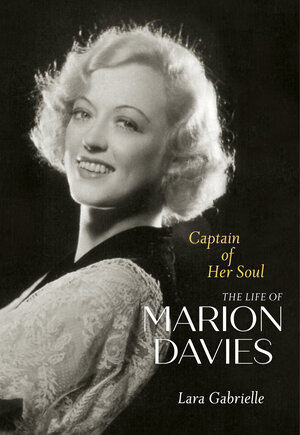
Captain of Her Soul: The Life of Marion Davies is now available at your favorite bookseller! Click hereto order it, and visit mariondaviesbook.com for all the latest.
Backlots is devoted to honoring and celebrating all aspects of classic film and is written by Lara Gabrielle, a California-based classic film writer and historian. Lara is the author of CAPTAIN OF HER SOUL: The Life of Marion Davies (UC Press, 2022).
Here you will find pieces on frequently seen classics and some lesser-known gems, as well as book reviews, festival coverage, and pieces on the history, theory and culture of film as it relates to the study of classic cinema.
Enjoy the site, and thanks for reading!
AFFILIATIONS & AWARDS
2019 CMBA Award for Best Profile of Classic Movie Performer or Filmmaker--"The Activism of Myrna Loy"
Winner of the 2018 CiMBA Award for Best Classic Movie Series, BACKLOTS AT THE COURTHOUSE: OLIVIA DE HAVILLAND VS. FX
Winner of the 2014 CiMBA Award for Best Profile of a Classic Movie Performer or Filmmaker: A Q&A WITH JOAN FONTAINE IN HONOR OF HER 96TH BIRTHDAY
Winner of the 2011 CiMBA Award for Best Classic Movie Discussion, THE FINAL SCENE OF THE HEIRESS
I am honored to be a judge of the Animal Film Festival in Grass Valley, CA.
EVENTS
BACKLOTS ON THE WEB
Join us at the Backlot Commissary, the place for Backlots' readers to share content and discuss movies!
Walter Pidgeon and Greer Garson in "Mrs. Miniver."






























_03.jpg)

 Backlots