A Q&A With Joan Fontaine in Honor of Her 96th Birthday

tumblr_n74jv4xo9Z1tdh0obo1_500

By Lara Gabrielle Fowler

October 22 marks the 96th birthday of Oscar-winner Joan Fontaine, an actress with the exceptional talent and intelligence to become a veritable Hollywood legend. Graced with a delicate, porcelain beauty, Joan captured Hollywood’s heart early on and with her formidable acting talent became the youngest performer ever to win a Best Actress Oscar, a record that was not broken for 44 years.

Born Joan de Beauvoir de Havilland in Tokyo in 1917, she moved to Saratoga, CA with her mother and older sister Olivia when she was 17 months old. Joan grew up in Saratoga (with a year back in Japan during her high school years) and acted in local productions before heading off to Hollywood as a teenager. She started in several small pictures, before her career suddenly took off and began to soar  with her triumphant performance in Rebecca (1940), for which she earned her first Academy Award nomination. She won the Oscar the following year for her role in Suspicion, and a third nomination came in 1943 for The Constant Nymph. She replayed many of her roles on radio and later took to the stage, notably in Tea and Sympathy and The Lion in Winter, among others, establishing herself as an extremely versatile performer.

Today, Joan lives in Carmel, CA and enjoys life at home with her 4 dogs (she is a lifelong animal lover) and a large garden. She moved to Carmel from New York City in the mid-1980s as she was just beginning to retire from a long and rewarding working life, and it was from Carmel that Miss Fontaine very kindly and generously agreed to answer some questions for Backlots. It is a great honor for me to be able to share them with you, and I hope that you will enjoy her answers as much as I greatly did.

A very happy birthday to Joan, and many more to come!

A Q&A WITH JOAN FONTAINE IN HONOR OF HER BIRTHDAY

       You have a very unique name—Joan de Beauvoir de Havilland. I understand that the name de Havilland comes from Guernsey. How did your parents come to choose de Beauvoir as your middle name?

My parents paid tribute to a close family friend killed in service.

Shortly after the her arrival in California.

      Your autobiography mentions that you have reaped many benefits from being born in Japan, and there have been few drawbacks. You mention the inquisitions into Japanese-born people after the bombing of Pearl Harbor as one of the drawbacks. What are some of the benefits you have had due to your Japanese birth?

Another culture. The wide world opening up.

      Another question about Japan—having spent some time there as a teenager during the Depression, as well as time at home in the United States during the same period, what were your perceptions of the similarities and differences between Japan and the United States during that difficult time in history?

I was in school, so I wasn’t exposed during that time (Japan). And in the U.S., I was working, so again I wasn’t exposed to the hard times that so many were experiencing.

      You began your career at a relatively young age, and acted alongside some of the most established stars of the period while you were still in your teens. Before your 25th birthday you were an internationally renowned Oscar winner. As a naturally introverted young person, were you aware of any stress or overwhelm due to all the attention that you received?

We were all actors doing a job. Everyone was professional. I respected them and they gave me respect. After the Oscar, things did change, they seemed intimidated.

Winning the Oscar for “Suspicion” at the 1942 Academy Awards ceremony.

      Taking into account your international background, did you identify more as a British actress or as an American actress? I know that you officially became an American citizen in 1943. How, if at all, did that affect your identity within the industry, both within yourself and among your peers?

British. The parts I was given were for a British “lady”. I was cast because I was a young British actress. After becoming an American citizen, really nothing changed. By that time I was established.
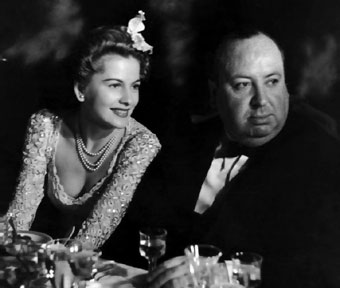
With Alfred Hitchcock, a director with whom Fontaine was paired twice. In addition to securing Fontaine her first Academy Award nomination, the first film the two made together, “Rebecca,” was Hitchcock’s debut picture in the United States and the only Hitchcock film that has ever won Best Picture. Fontaine is also the only actress that has ever won Best Actress for a role in a Hitchcock film, for “Suspicion” the following year.

      You are an extraordinarily versatile performer, appearing in films, on television, on the stage, and on radio. Which medium gave you the most pleasure, and for what reasons that you can pinpoint?

I have always enjoyed stage work. You can feel the audience reactions and are able to adjust your performance accordingly.

      Like you, I am a native of the San Francisco Bay Area (born and raised in Oakland). As you are a person who grew up in the San Francisco Bay Area and moved back to the general area as an adult, I am very interested in your perspective on how things have changed. Can you tell me a bit about how the demographics, attitudes, pace of life, and landscapes were when you were growing up, as opposed to the way they are now?

This area has grown so much, it is almost unrecognizable.

41_lr

The coastline along Carmel, CA, a place I consider to be among the most beautiful spots in the country.

      I understand that you have a love for animals, especially dogs. If I am correct, you have 5** of them! Can you tell me a bit about your passion for animals and how it began?

Animals, all kinds, are one’s friends. As a child, Mother never allowed me to have pets. As an adult I found them to be loyal friends.

      (**NOTE: I was under the impression that Joan had 5 dogs, but she crossed out 5 and wrote 4. One of her dogs unfortunately died, so she now has 4.)

At home with one of the many dogs Joan has had over the years.

      You are a very multi-talented individual. In addition to your gifts for acting, you have also been an interior decorator, a licensed pilot, a cook, a balloonist, and an author. What do you consider to be your crowning achievement in life, regarding your work, your personal life, or your many hobbies?

Receiving the Oscar. Adopting a Peruvian girl.

Joan with her two daughters Martita (adopted from Peru) and Debbie, feeding the pigeons in Paris.

Rita Hayworth and Her Dance

By Lara Gabrielle Fowler

Today marks what would have been the 95th birthday of Rita Hayworth, the legendary screen goddess best known today for her seductive portrayal of Gilda in the 1946 film of the same name. Beautiful, long-legged, and mysterious, she was Columbia’s biggest star of the 1940’s and became a pin-up girl during the war years with a popularity rivaling that of Betty Grable. Her popularity as a sex symbol became so overwhelming that many lost sight of exactly who she was, and from whence she had come. As with the vast majority of sex symbols, she became objectified, and her career prior to her 1946 portrayal of Gilda was almost completely forgotten and her background washed away. The sex symbol image bothered her. “I’ve never really thought of myself as a sex symbol,” Hayworth once said, “more as a comedienne who could dance.” Today, on her birthday, I would like to go back to Rita Hayworth’s origins and focus on what was important to her in her life and career–dance.

Rita Hayworth’s background was almost exclusively in dance. Born Margarita Carmen Cansino into a well-known Spanish dancing family (her father was Spanish flamenco dancer Eduardo Cansino, and her mother was an American former Ziegfeld girl of Irish and English descent), she began dancing under the tutelage of her father when she was 4 years old. Eduardo soon realized that his daughter had an exceptional talent, and he eventually took her south from their home in Chula Vista, CA to the Mexican city of Tijuana where they performed as a dancing duo. Shy, quiet and self-conscious offstage, Margarita came alive when she danced and audience members often noticed the dichotomy between the fiery creature dancing onstage and the silent girl they witnessed offstage. The experience dancing with her father in Tijuana certainly honed Margarita’s dancing abilities, and it was there that she learned the ins and outs of show business, something that would help her when she soon went to Hollywood.

During her years working in Tijuana with her father.

Rita’s Hollywood career began in a small role in a movie entitled Under the Pampas Moon, and from there her roles increased in frequency if not in quality, until Hollywood finally noticed her in the late 1930s. After some Hollywood grooming which included painful electrolysis to raise her “ethnic” hairline, she was paired with dancing great Fred Astaire with whom she starred in 2 movies, You’ll Never Get Rich and You Were Never Lovelier.

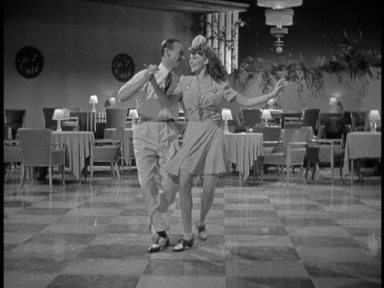
In You Were Never Lovelier, Rita and Fred danced what I consider to be one of the most phenomenal and challenging technical routines in movie history. The “Shorty George” number from this film truly demonstrates how skilled Rita was as a dancer, and how easy it was to watch her, still a relative novice at this point, in lieu of Fred Astaire. All eyes draw toward her, and she is the star of this complex routine. In spite of his legendary partnership with Ginger Rogers, Fred Astaire always called Rita his favorite dancing partner. He recalled how gifted and quick she was in learning the most advanced routines–often learning the steps in the morning, mulling over them during lunch, and after lunch performing the dance without a single mistake.

Rita also seemed to have a propensity to use dance when life became difficult for her. She was always an intensely insecure person, and this caused problems in her relationships. Orson Welles recalled that, when they married in 1943, he would often set her up with a record of Spanish music in a private room, and just let her dance out her anxiety. Her experiences with her father in Tijuana seemed to be the catalyst for both her affinity for dance and her anxiety. According to Barbara Leaming in her biography If This Was Happiness, the situation brought out the worst in Eduardo in regard to his relationship with his talented pre-teen daughter. Leaming conducted interviews with Orson Welles in which he revealed years of physical and sexual abuse Rita endured at the hands of her father. As can be expected from these early traumas, Rita’s relationship with her father was severely damaged and it is almost certain that her many destructive relationships with men were results of these cruel experiences. Yet this seemed to only solidify her tendency to use dance as an outlet and means of expression during hard times, one upon which she relied for her whole life.

At the end of her life, when Rita was unable to communicate due to the ravages of Alzheimer’s Disease, her daughter Yasmin often put music on and watched as Rita’s feet began to move rhythmically, as if she were remembering her life as a dancer. Her ability to dance was one of the last things to go–a glimmer of solace in the terrible world of Alzheimer’s Disease.

The Legend of Carmen Miranda

By Lara Gabrielle Fowler

Though many outside of the classic film world might not know her name, Carmen Miranda is, nonetheless, one of the most widely recognized figures of Hollywood’s Golden Age. Her signature look, featuring an elaborate hat often made of fruit, has inspired countless imitations in popular media and introduced to American audiences to a colorful manifestation of Brazilian culture, one that has stuck with us through her films and the many incarnations of Carmen Miranda tributes and imitations.

Lucille Ball does an imitation of Carmen Miranda on an episode of I Love Lucy.

It is a bit ironic that the woman who is so strongly associated with Brazil was actually born outside of the country. Maria do Carmo Miranda da Cunha was born in 1909, in the village of Varzea da Olveha e Oliviada in northern Portugal. She moved with her family to Brazil when she was one year old, and grew up in Rio de Janeiro. She was always attracted to show business, but despite her obvious talent, she was forced to put her aspirations on hold to go to work at 14 to help pay medical bills for a sister who had contracted tuberculosis. Interestingly, one of her most notable jobs was as a hatmaker.

She was discovered in 1929 by a Brazilian composer by the name of Josue de Barros, and soon she became the first contract radio singer in Brazil. Her career rose quickly and she was a household name in Brazil by 1936, having appeared in several movies as well as her work in radio.

Her trademark outfit is based on the cultural costume of largely poor Afro-Brazilian locals from the Bahia region of Brazil. She adopted it (in a glamorized style) in 1939 for the movie Banana-da-Terra and the song she sang in the movie, “O que é que a Baiana tem?” became one of her signature songs, intended to shed a new, cheerful light on the often marginalized black Baiana population. Through her usage and popularization of this costume in the United States, and her eventual evolution into the face of Brazil to American audiences, the traditional costume of Bahia is now likely the most recognized cultural outfit of Brazil.

Baiana women in traditional costumes.

She ventured to the United States shortly after making Banana-da-Terra, and, only speaking a few words of English, was given a 4-word part in an Abbott and Costello movie entitled The Streets of Paris. Though her part was minuscule, she nonetheless received good reviews and, as in Brazil, her popularity grew quickly. She was signed to a contract at 20th Century Fox the following year and made Down Argentine Way, in which she sang two songs which would become trademarks.

(Be sure to watch the entirety of the second video–after her signature “Mamae Eu Quero,” she sings another song that is not widely known, but is one of my favorites.)

Miranda soon found herself among the most popular stars in the business. One of her best films, The Gang’s All Here, was made in 1943 and in the same year, she become one of the first Latina entertainers to have her handprints imprinted at Grauman’s Chinese Theatre. By 1945, she was the highest paid actress in Hollywood.

But despite her wild popularity in the United States, her popularity in her native Brazil was beginning to decline. Audiences there felt that she was selling out to American commercialism, exploiting the culture, and forgetting her roots. In addition, Brazilian prejudice was still alive and well–and many criticized Miranda’s numbers as “too black.” Audiences in Argentina were also upset–Miranda’s film Down Argentine Way was heavily criticized for her appearance in a movie about Argentina, when she was singing in Portuguese and wearing her trademark Baiana garb. This, they argued, stereotyped South America. When Miranda returned to Brazil in 1940 for a tour, she was met with mixed to negative reactions. At one performance, the audience booed her when she began to sing “South American Way,” and this deeply affected her. She would not return to Brazil for over a decade.

Suffering from a sense of rejection at the hands of her Brazilian audience, as well as reeling from the effects of a rocky marriage to producer David Alfred Sebastian (whom she had married in 1947), Miranda began to rely heavily on drugs and alcohol. She collapsed during a performance at an Ohio club in 1953, and her doctors advised her to go somewhere where she could rest. That, to her, meant Brazil. She was apprehensive about returning, but upon her arrival she was greeted warmly, and remained in Brazil for over a year.

After her recovery, she went back to the United States and agreed to appear in a segment of the Jimmy Durante Show, but began to feel unwell before filming. During a dance number with Durante, she suddenly fell to her knees, telling Durante that she was “out of breath.” Durante, known for being a generous and demonstrative performer, offered to take her lines, but she pushed through and finished the segment. It turned out that Miranda was not simply exhausted, but had suffered a small heart attack. She suffered a larger one the next day, and she died later that day at her home in Beverly Hills.

Jimmy Durante decided to air the segment as a tribute to her and gave a heartfelt speech at the opening of the show, calling Carmen Miranda “one of the greatest performers I’ve ever known.” We are lucky that the clip survives and is on YouTube. The quality is bad, but here you may see the final performance of the great Carmen Miranda.

Many of the criticisms of Miranda’s image as a quintessential “South American” are well founded. By casting Miranda in Down Argentine Way, a movie about Argentina, the producers at 20th Century Fox expressed the idea that all of South America was homogeneous, demonstrating a lack of respect for the individual countries and cultures of the continent. This was not Miranda’s fault. This was Hollywood in the 1940s and Miranda was under contract. She had to bow to their demands, no matter how ill-advised they were, and until her contract was up, she had no choice but to cater to the commercialism of her culture and other cultures on the South American continent.

Her intense suffering at the rejection of her country, ultimately turning to drugs and alcohol to ease it, is the tragic truth of how much Brazil meant to her. I believe that it was the Brazilian public’s ultimate forgiveness of her was what enabled her to be well enough to come back to the United States for her final performance.

Thanks for reading!

October Events on the Blog

By Lara Gabrielle Fowler

Hello dear readers, Lara here to update you on what is coming in the month of October on the blog. There are a few very exciting things on the horizon, and here is what you may expect to see this month.

In my last blog update, I spoke of a special surprise to appear on the blog this month. On October 22, in celebration of Joan Fontaine’s 96th birthday, I will present a Q&A that I conducted with the legendary actress a few months ago. This is a huge honor–Miss Fontaine very rarely does interviews, and she was incredibly kind and generous to grant one to me. You will see her answers in response to questions about her childhood, her career, her life now, and her perceptions of herself as an actress and a human being.

I waited until now to let my readers know, because I want to keep the hype to a minimum and emphasize that this Q&A was conducted in honor of a very great actress’s birthday. My motive is very simply to present the reader with this wonderful gesture on the part of Miss Fontaine, and to share with you what she so graciously shared with me. So be sure to tune in on October 22 to honor, with me, the birthday of a great lady.

I am a very proud friend, because a personal friend of mine, Kendra Bean, is a first-time author and her book about Vivien Leigh, entitled Vivien Leigh: An Intimate Portrait,  has already received accolades as one of the top film biographies of Fall 2013.

Kendra has agreed to a formal interview with Backlots, and I am very much looking forward to talking with Kendra about the book, the process of which I have watched, as a friend of Kendra’s, since its inception. Stay tuned for what promises to be a very insightful interview with Kendra about Vivien Leigh: An Intimate Portrait.

Victoria Wilson, the author of the new Barbara Stanwyck biography A Life of Barbara Stanwyck, Steel-True 1907-1940 (known in classic film circles lately as simply Steel-True), has also graciously agreed to an interview. Classic film aficionados have been anxiously awaiting this book for over a decade–15 years in the making, Steel-True covers the first 33 years of Barbara Stanwyck’s life, and consists of a whopping 1056 pages. We are in for the biography of the century.

The interview will be conducted toward the end of the month, and will appear on the blog a few weeks before the book’s release on November 12.

Watch your showers and stay away from those birds, everyone, because Hitchcock Halloween is fast approaching! If you haven’t yet signed up, please do so and I will add you to the list. You can write about anything you like related to Hitchcock–his life, movies, technique–and I am quick to welcome submissions about the Alfred Hitchcock Hour as well. It will take place on October 31, for one day only, so let me know what you would like to write about and get those submissions in by the 31st!

That’s the news for October! See you soon!

Breaking News Blogathon: MEET JOHN DOE (1941)

By Lara Gabrielle Fowler

My good friends Jessica of Comet Over Hollywood and Lindsay of Lindsay’s Movie Musings have collaborated on a blogathon focusing on journalism in film–a topic that yielded some of the most intricate films to come out of Hollywood. From the epic Citizen Kane to the quirky and comedic Nothing Sacred, journalism is often portrayed in Hollywood as a bitter and cynical profession, and journalists as merciless in their pursuit of a story. Interestingly, several significant films involving journalism were released between the years of 1940 and 1941, including His Girl Friday (1940), Citizen Kane (1941), and Meet John Doe (1941).

These were the war years–Hitler’s troops invaded Poland in 1939 and war was in full throttle in Europe by 1940. No one yet knew when or if America was going to get involved. In this era of insecurity, Americans and others worldwide relied heavily on newspapers to keep them informed of constantly changing events. As movies sway with the tides of public consciousness, an influx in journalism-based movies seems to be a logical expectation for the years 1940 and 1941. The general distaste for the morality of the profession was magnified, no doubt, by the negative external forces at play in the world during that time that journalists had to report. Though the genres of these films range from screwball comedy (His Girl Friday) to epic drama (Citizen Kane), the portrayal of journalists as scavengers remains constant through all of them.

Meet John Doe goes one step further. Barbara Stanwyck plays a journalist who, as an act of vengeance upon being fired from her job, pens a letter from a fictional “John Doe” and submits it as her final column. The letter says that John Doe will commit suicide on Christmas Eve by jumping off the roof of City Hall as a protest against the state of civilization. It is published in the paper and it causes an uproar, with some thinking the letter is fake and others disturbed about John Doe’s distress. The newspaper editor calls her in for the letter, but she calmly tells him that there is no letter, she made it up. She outlines a plan to use the public’s outrage to the newspaper’s advantage, and create a “real” John Doe to sell more papers. Out of dozens of men who come to the newspaper office to say that they wrote the John Doe letter, they choose to use John Willoughby, an injured former baseball player who had just come to look for a job. He is groomed into John Doe, and little by little the story of John Doe is created. He is the downtrodden everyman with whom everyone identifies, and he attracts millions of listeners on the radio as well as creating a boom in newspaper sales. The lies grow, until John Willoughby and John Doe become one and the same in the eyes of those who created him.

Though it is officially listed as a comedy, the truth of the matter is that it this movie is virtually unclassifiable. There are moments of humor, moments of intense drama, and all through the movie John Doe’s phoniness is palpable and uncomfortable. This is the genius of Frank Capra, the director of the movie and Hollywood visionary extraordinaire. In the early 1930s, it was Capra who saw potential in young Barbara Stanwyck, casting her in his film Ladies of Leisure (1930) and helping build her image. Meet John Doe was the last of their 5 movies together, and Capra instinctively understood how to make the best of Stanwyck physically, emotionally, and through outside influences like lighting and camera angles. All of these things helped secure her character as a cunning and cutting journalist who pulled off the dupe of the century to get her job back. It works magnificently.

Meet John Doe is prescient in many ways–cinematically and socially. In 1976 Network, which focused on a ploy to keep television ratings alive by using a crazy man’s rantings to get people to tune in, was created with a very similar plot outline.

Though the filmmaking practices were markedly different due to different filmmaking standards (the fall of the production code allowed Network to be raw and gritty, while Capra’s signature smooth and soft camerawork gives Meet John Doe a gentle quality), the similarities are evident and both are reminders of the power of journalism to influence and brainwash. Today, in the era of biased 24-hour news networks, we would do well to remember Meet John Doe to remind ourselves of what journalism can make us believe and how easily we can be persuaded.

Thanks to Jessica and Lindsay, and be sure to check out all the other great entries over at Comet Over Hollywood and Lindsay’s Movie Musings!

Lara G. Fowler

SHOW PEOPLE (1928) and the Rise of Self-Reflection in Hollywood

Marion Davies and real-life director King Vidor in a scene from “Show People.”

By Lara Gabrielle Fowler

For many decades, Hollywood has been fascinated with movies about movies. Ranging from the highest celebrations of Hollywood stardom (Singin’ In the Rain) to analyses of the most terrible tragedies of the industry (A Star is Born), the films that come out of this penchant for self-examination consistently do extremely well at the box office to this day, often winning major industry awards and proving that audiences and critics alike share this passion for “Hollywood on Hollywood.”

Singin’ In the Rain (1952), about the coming of sound to Hollywood, has earned a place as the only musical in the top 10 of “AFI’s 100 Years…100 Movies” list.

Argo (2012), about a plot to rescue Iranian hostages by creating a blockbuster Hollywood movie, won the Oscar for Best Picture last year.

Self-awareness in movies dates back to the earliest days of cinema.  Mack Sennett often appeared as himself in the Keystone Kops movies, acknowledging the disconnect between reality and the movies and making an attempt to sew them together to create a fluid illusion for the audience member. In “The Playhouse” (1921), Buster Keaton attends a show in which he plays all the parts. He (as his character) quips “This Keaton fellow seems to be the whole show!” This was a nudge to the audience, a peek over the 4th wall to let the audience know that Keaton is aware of himself as an actor.

Building on these early indications of self-awareness, the first full-scale “Hollywood on Hollywood” movie appeared in 1928 with the King Vidor comedy Show People, about the transformation of a young country girl  into a major movie star. Starring Marion Davies and based on the early career of Gloria Swanson, Show People is a thorough and intelligent look at the complexities of stardom, and its quality rivals that of the later movies who drew from its precedent. It is truly a movie that, despite the passage of 85 years, solidly stands the test of time.

Peggy Pepper is the young Georgia girl who wants to be in movies, so her father drives her out to Hollywood where she lands a contract as a comedic bit player, often getting squirts in the face with seltzer water. She befriends a fellow comedic actor named Billy Boone, and they act together in low-budget films while remaining best of friends offscreen. At the screening of her first movie, Peggy gets an autograph request from none other than Charlie Chaplin (playing himself in a cameo) and promptly faints. Several other stars make cameos in the film, including Marion Davies herself. When Peggy sees Marion Davies, she reacts with disdain, an extremely clever demonstration of the film’s self-awareness.

Marion Davies as “Marion Davies.”

Soon, Peggy is signed to “High Art Studios,” where she becomes a big star and slowly loses touch with society as her ego grows. She shuns Billy Boone as a lower-class actor, even though he tries desperately to maintain their friendship and bring her back to reality. She runs into him on a film set and reacts coldly to him, until he squirts her with seltzer water like he used to in their low-budget films together. She becomes enraged and storms off.

Shortly thereafter, she is informed by her studio head that theaters around the country are pulling her movies because her image is becoming too snooty. She is about to get married to a fake count Andre Telefair, when Billy bursts in and squirts her in the face with seltzer water, then throws a pie in the face of the fake count. This brings Peggy to her senses, and she and Billy make up. Peggy’s next movie is set in a World War I village, and she convinces director King Vidor (the real life director of Show People), to hire Billy as her new leading man, as a surprise. Billy is thrilled to see that Peggy is his leading lady, and the film ends as Peggy and Billy kiss on the set of their new movie together.

Show People is one of the finest silent movies to come out of the 1920s. It is strikingly modern, and could easily have been made today, needing very few changes. Though it is a comedy, one can see the influence it had on such later Hollywood on Hollywood movies such as A Star is Born, chronicling a male actor’s assistance to an actress, and that star witnessing her rise over his. It is said that this movie is loosely based on the career of Gloria Swanson, who later starred in her own Academy Award-winning film about Hollywood–the incomparable Sunset Boulevard.

See you next time!

CINECON DAY 4: APRIL LOVE (1957)

By Lara Gabrielle Fowler

Today was a very special day at Cinecon, as guests anxiously awaited a much-anticipated Q&A session with the legendary Shirley Jones following a screening of April Love. As you may know, I am a big fan of Jones’ portrayal of the prostitute Lulu Barnes in Elmer Gantry and I was excited to tell her so. She was to sign copies of her recently published memoir after the screening and Q&A, so I had been looking forward to the screening all weekend.

I had never seen the movie before, and had no idea what to expect. What I found was that this film was a hearty slice of Americana starring wholesome crooner Pat Boone as a “wayward” teenager sent to live with his aunt on a farm after stealing a car, where he meets the tomboy neighbor and horse enthusiast played by Jones. As can be expected, they fall in love. How Boone could have been a “bad boy” is beyond me, he’s a complete angel in the movie. I have never seen a more wholesome teenager. Though he ultimately gets in trouble again for driving a car without a license, he redeems himself by coming clean and the police officer forgives him. Basically this movie was a censor’s dream.

Prior to Elmer Gantry, Shirley Jones played almost exclusively these types of girl-next-door, Americana good girls. Her sweet face and beautiful soprano voice allowed her to play these roles to great effect, and her talent in this milieu was well-known.

“People Will Say We’re In Love” from Oklahoma, Jones’ film debut after a successful career on the Broadway stage.

April Love is no exception to the rule, and her performance is, once again, the highlight of the film. One moment especially stands out–during a song called “Do It Yourself,” Jones gets the opportunity to demonstrate her solid musical technique. She sings two brief operatic cadenzas within the song, and not only are they musically flawless, but she hits one VERY high note, one so high it is close to unheard of in Jones’ field of musical theater. In addition to her expertise in musical theater, my guess is that Jones must have had some operatic training. Her voice shows evidence of opera technique, and her ability to hit those extremely high notes suggests a vocal range honed in operatic studies.

“Do It Yourself.”

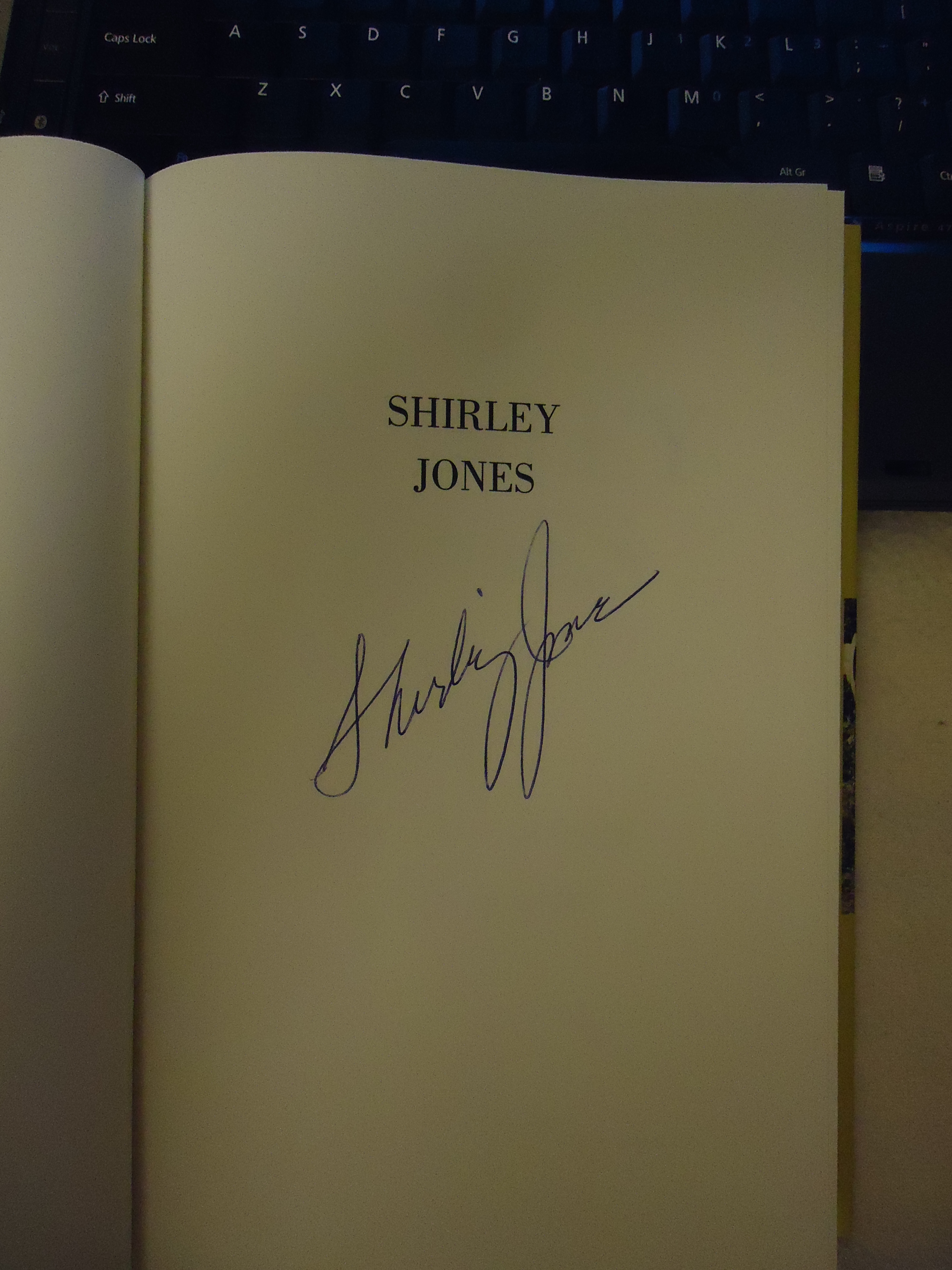
After the movie, I intended to go up to Shirley Jones, tell her about my admiration for her role in Elmer Gantry and ask about any operatic training she may have had. She and Pat Boone, who was also there, answered some questions posed in an interview and then Shirley headed up to the lobby to sign copies of her newly published memoir. I own a copy, so I brought it for her to sign so that I could meet her. There were many people waiting, and understandably, Shirley needed to keep the line moving. I did tell her about my love for role in Elmer Gantry, which she appreciated and she commented on how well the movie still holds up today. Unfortunately I didn’t have enough time with her to ask about her opera training, but I’m hoping that someday I might get to meet her again. She makes frequent appearances at festivals and still does concerts, so perhaps our paths will cross again and I will have more time with her.

002

I recently made a post about Shirley Jones in Elmer Gantry, explaining more about Shirley Jones’ career before the movie and how it changed her perception in the industry. Click here to read it.

CINECON DAY 3: SUDDENLY IT’S SPRING (1947)

MOV_a33bda59_b


By Lara Gabrielle Fowler

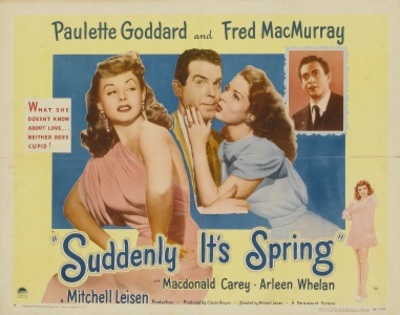
A hysterically funny screwball comedy about a female marriage counselor in the army who is going through a divorce with her own husband, Suddenly It’s Spring has been the #1 highlight of the festival for me thus far. I was very excited to see it, as it was the sleeper hit of the TCM Classic Film Festival this past year and I missed the screening there. It was the talk of the festival, and left many wondering how it is that this movie is not more widely known. It does not have a DVD release, nor is it available (to my knowledge) on VHS.

The movie stars Paulette Goddard, one of my favorite actresses, paired with Fred MacMurray, one of the most versatile actors of the 1930s and 1940s. Fred MacMurray has played screwball comedy, drama, and noir with equal flair, and in this movie he plays the perfect clueless husband in a great comedic performance.

Paulette Goddard is a very interesting actress. In the 1930s she had a reputation for playing strong, rjch, well-defined roles such as the sassy dame Miriam Aarons in The Women, and the orphaned gamine in Modern Times with Charlie  Chaplin. She starred with Chaplin again in 1940 as the Jewish girl caught in the throes of a familiar-sounding anti-Semitic dictatorship in The Great Dictator.

Goddard in The Great Dictator.

(To digress a bit, Charlie Chaplin was commonly known to be married to Paulette Goddard. The public knew nothing of the circumstances of their marriage, and to this day there exists no definitive proof that they ever were married. Chaplin referred to Goddard once as his wife, but neither of them discussed their marriage publicly to the press. It remains a topic of contention among classic film aficionados, though the general consensus is that they were indeed married.)

In Suddenly It’s Spring, her role is strikingly less defined than the films she made in the 1930s and early 1940s. She plays a generally calm and ordinary housewife, with conflicting emotions about divorcing her husband that come out in very funny ways. In one scene, as her husband tries to drive her away at the bequest of his current girlfriend, he starts acting like a drunken buffoon, scaring away her army friends who are paying a visit. When the ladies leave, she looks at him and basically throws herself at him, saying she has never been so attracted to him as when he acts that way. It is a classic screwball moment, and it got a huge laugh from the Cinecon audience.

Another interesting side note–the role of Paulette Goddard’s mother in the movie is played by none other than Lilian Fontaine, the mother of Joan Fontaine and Olivia de Havilland. I was very pleasantly surprised to see her name in the opening credits. Though she appeared in several films, this is the largest role I have seen her play. She has a lovely, lilting voice, and looks remarkably like her older daughter Olivia, with many of the same mannerisms. I recently wrote a post about her relationship with Joan, click here to see it!

This was by far the best movie I have seen yet at Cinecon this year, and perhaps last year as well. I regret that there are very few stills that exist of this movie. I wish I could share them on this post, but they are just not there to share. My wish for this movie is that it can be more widely seen, and perhaps Universal (who owns Paramount, the distribution company) will recognize its appeal and put it out on DVD.

See you tomorrow!

CINECON DAY 2: The Racial Context of ONE MILE FROM HEAVEN

By Lara Gabrielle Fowler

After an exhausting day of movie-watching and hours of research at the Margaret Herrick Library, I was ready to head home around 11:00 after 3 evening movies. But when I learned that the final movie of the night was about a newspaper reporter who covers the story of why a black mother has a white child, I knew I had to stay and see just how they handled this.

The story begins as a newspaper reporter (Claire Trevor) is passing through a black neighborhood and she sees a policeman (played by Bill “Bojangles” Robinson) leading the neighborhood children in a tap dance. Around comes a young girl who is significantly lighter than her friends. It comes to light that there has been discussion in the neighborhood that the girl, named Sunny, may not be her mother’s biological child. The newspaper reporter picks up the story and through a series of circumstances that would be deemed very racist, we learn that Sunny is NOT in fact her mother’s biological child and she had been left in her care by another couple (the woman was played by Sally Blane, best known as being the sister of Loretta Young), who come to claim her at the end. But the couple tells the woman who raised Sunny that she will not have to leave the child–she can come along and be the child’s nurse.

It usually takes a good deal for me to become offended and angry, and this movie did it for me. It is completely unapologetic about its racist attitudes and almost boasts of them. I will not justify its racism, nor will I extol this movie in any way. I will, however, provide some context.

The year was 1937, and this was segregated, discriminatory America both in real life and on film. In the movies, those of African-American heritage were portrayed almost exclusively as cooks, servants, or maids, and almost always in an unflattering light. In real life, Jim Crow laws were in effect and interracial relationships were illegal. Movies often shot just a few scenes featuring black actors in an otherwise white cast, because in order to be able to sell movie tickets in the American South, those parts would have to be removed before distribution in that area. In this regard, the producers of One Mile From Heaven probably thought they were being progressive–a mixed cast? In 1937? That was close to unheard of.

But the one step of progress the movie made in that regard was promptly nullified by two steps back…and back…and back. The beautiful, heartwrenching performance of Fredi Washington as the woman who raised Sunny is the highlight of the movie, and everything else is a mess. What is missing in this movie is any sort of empathy toward the woman who has raised this child from the time she was a baby. The movie almost goes out of its way to say, almost word-for-word, that the baby belongs in a white family. There are other movies like this, but this movie, to me, symbolizes just how big of a mess America was in during this time period.

When watching classic films, it is important to remember context and judge movies accordingly. Thankfully, attitudes have shifted considerably over the past 70, 80, 100 years. We are lucky to live in a society that can call out segregation, discrimination, and racism as inherently unfair, and to understand just how lucky we are, it is necessary to look to the past. The situations in One Mile From Heaven were, unfortunately, cruel realities.

At some point soon, I would like to make a larger post discussing racial issues in classic film. There is a lot to say, and it’s far too complicated for an impromptu article right in the middle of Cinecon. When I get back, stay tuned for my opinionated take on the issue and I will invite you, the reader, in for a discussion. As for this post, please feel free to weigh in with your thoughts on the movie. Have you seen it? Would you see it?

See you tomorrow for more coverage!

CINECON DAY 1: DOWN ARGENTINE WAY (1940)

By Lara Gabrielle Fowler

Hello readers, I have had a very full day at Cinecon and am back with the latest returns! I have decided that this year I will do things a bit differently. Normally when I cover festivals, I give a brief rundown of the experience and a bit about each movie I watched. This year, since I am seeing close to 10 movies a day at Cinecon, I will pick one movie from the day that made an impact on me and discuss and dissect it on the blog. I feel that with 10 movies each day, trying to cover all of them would be respecting none of them, and I would rather pick one each day and give it the attention it deserves.

The movie I chose today is one with which I am very familiar and was excited to see on the program. I first saw Down Argentine Way when I was still a young teenager, and it has always been a delight to watch. Sporting a combination of a young Betty Grable, the lively and seductive Carmen Miranda, and the spectacular dance routines of the Nicholas Brothers, Down Argentine Way is a relatively undiscovered treasure that merits a viewing.


The film begins with Carmen Miranda, still unknown to American audiences, singing “South American Way” in her trademark Brazilian garb, full of charisma and spark. Though already a major star in her native Brazil, Down Argentine Way marks Carmen Miranda’s American film debut, introducing her to American audiences and securing her meteoric rise to international fame. Carmen Miranda soon became a major star for 20th Century Fox and quickly became one of the most widely imitated stars of the day.

Carmen Miranda singing “Mamae eu quero” in Down Argentine Way.

Lucille Ball doing the number on “I Love Lucy.”

Another star on the rise in the film is Betty Grable, also making her first feature under contract at 20th Century Fox. Grable would go on to be a huge box-office draw, her lithe figure and especially legendary legs leading her to become a pin-up girl and a major booster to American morale during World War II.

With Don Ameche in Down Argentine Way.

Grable’s famous pin-up shot.

Don Ameche plays Ricardo Quintana, a young man from an Argentinian horse racing family who falls in love with Glenda Crawford (Grable), an American who wants to purchase one of his racehorses. Complicating matters is that Ricardo’s father has a vendetta against a man named Crawford, Glenda’s uncle, so Ricardo tells his father that Glenda’s last name is actually Cunningham so that they may continue their relationship. Ricardo’s father takes a liking to Glenda, but when he finds out that her last name is actually Crawford, trouble ensues. After a miscommunication and ultimate resolution regarding Ricardo’s racehorse and his chances of winning a championship, all is resolved and the film ends on a happy note. Truthfully, I couldn’t really tell you how Ricardo’s father forgot his vendetta so quickly and easily after a decades-long feud with the Crawford family. But in 1940’s musicals, dwelling on minor plot points will often just result in more confusion. These movies are designed to be taken lightly!

Probably the highlight of the movie for me was the inclusion of a very elaborate dance sequence by the Nicholas Brothers (Harold and Fayard). At the screening today, we were lucky enough to have the son of Fayard Nicholas there to introduce the film. He told a lovely story of how Darryl Zanuck stood up for the Nicholas Brothers at the “whites only” entrance to the 20th Century Fox commissary, and greatly respected them for their talent. And talented they are. Just take a look at this number they performed in the movie.

This type of acrobatic dancing and especially the move with the sliding splits is characteristic of the Nicholas Brothers. They performed, often uncredited, in many musical movies during Hollywood’s Golden Age, securing huge amounts of respect within the industry.

The Nicholas Brothers performing the “Jumpin’ Jive” in Stormy Weather. Fred Astaire once referred to this sequence as the greatest dance number ever filmed.

If you haven’t seen Down Argentine Way, I would highly recommend it. It’s a fun story, and packs a terrific punch of star power.

See you tomorrow for more Cinecon coverage!