Well, readers, I must say, this blogathon has been a great success! On behalf of Carole & Co. and myself, thank you to everyone who submitted your posts. We so appreciate all the time and energy that went into these fantastic, informative entries, and we love reading all your work.
So without further ado, here are the final installments:
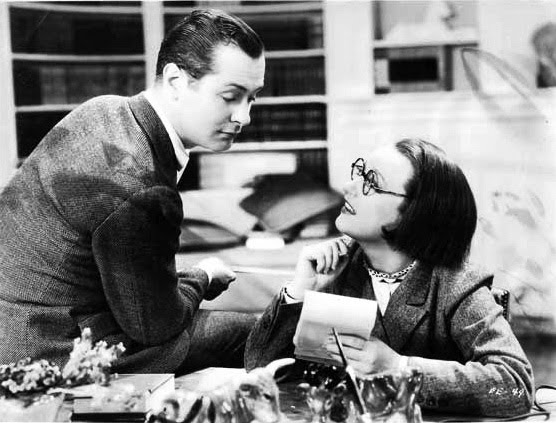
For my own entry in the Romantic Comedy Blogathon, hosted by Carole & Co. and myself, I have decided to focus on a lesser-known but undoubtedly very funny comedy by the name of Ever Since Eve, made at Warner Bros. in 1937. This was the second time Marion Davies and Robert Montgomery appeared onscreen together (the first was in Blondie of the Follies five years prior) and this movie also marks the final film appearance of Marion Davies.
Ever Since Eve tells the story of Marge, a young secretary who, unable to find a job due to her attractiveness, dresses down and immediately finds employment as an assistant to writer Robert Montgomery. But ultimately when he sees, quite by accident, how she really looks, he falls for her and we are treated to a joyous and clever spectacle of mistaken identities for the remainder of the movie, highlighted by Marion Davies’ comedic talent and that of the delightful Patsy Kelly, who plays her roommate.
Patsy Kelly, a veteran character actress who often played wisecracking maids or roommates, is a gem. Though she is not referenced often, her face is familiar to the vast majority of people familiar with 1930s Hollywood because of the memorable characters she creates and the boisterous energy she exudes onscreen. Kelly has a penchant for stealing the show in any movie she’s in, and this is no exception. Her smart-aleck line delivery and almost manic characters make for a winning combination, and she has some of the best moments in the movie. Ever Since Eve was her 14th movie, and she continued acting through the 1970s in movies like Merrily We Live, Please Don’t Eat the Daisies, and even appeared in the classic horror film Rosemary’s Baby in 1968.
Though by today’s standards the basic plot structure of Ever Since Eve, revolving around physical beauty as a factor in whether or not a woman was hired, might be considered rather misogynistic, it oddly doesn’t seem to matter in this film. The comedy is so sharp and the mistaken identities so expertly crafted that one gets the sense of a Shakespearean comedy of errors. The dialogue is witty and the ensemble work is masterful. Ever Since Eve is a great movie.
Despite a widespread publicity campaign, Ever Since Eve didn’t get the attention that Warner Bros. thought it would get upon its initial release. Combined with three prior Marion Davies movies that failed to live up to box office expectations at Warner Bros., this seemed to be the logical end of the line for Marion’s career at the studio. In addition, William Randolph Hearst, companion to Marion Davies and head of Cosmopolitan Productions at Warner Bros., was having severe financial difficulties. Marion thought, for the sake of her beloved “W.R.”, this would be a good time for her leave the movies and act as his full-time companion and caretaker. And that she did, devoting herself to taking care of Hearst, never leaving his side until the day he died. It is said that Marion Davies was one of the kindest, most generous people in all of Hollywood. And this act of sacrificing her film career to take care of her companion confirms it.
Marion and Hearst were together for 32 years, until his death in 1951.
Ever Since Eve is a true delight. I leave you with a fun scene.
This has been an entry in the Romantic Comedy Blogathon. See you next time!
Well readers, we’ve got a light load today, but one that packs a punch! Here are the three entries we received for the Romantic Comedy Blogathon this evening. Remember, tomorrow is the last day, so get those entries in!
The Romantic Comedy Blogathon rolls on today with some more fantastic entries! Without further ado, here they are. Thanks to everyone who has participated thus far, Vince and I are very pleased with the turnout!
We at the Romantic Comedy Blogathon do not discriminate against newer films, and we are delighted to have our first look at a modern-era romantic comedy this evening, as Rich at Wide Screen World looks at Bridget Jones’ Diary.http://widescreenworld.blogspot.com/2014/05/bridget-joness-diary.html?m=1
Thanks all, and see you tomorrow for Day 3 of the Romantic Comedy Blogathon! 2 more days to get those entries in!
It’s here, readers! Vince and I have been collecting entries all day for the Romantic Comedy Blogathon, and without any further ado, I give you the 7 entries we received today. Enjoy, and be sure to tune back in tomorrow for Day 2!
And finally, last for today but certainly not least, my fabulous co-host for this blogathon over at Carole & Co. takes a look at Carole Lombard’s Lady By Choice. When Vince talks about Carole Lombard, you’re hearing from a true expert! http://carole-and-co.livejournal.com/691567.html
That’s all for today, folks! Tune in tomorrow for the next installment of the Romantic Comedy Blogathon!
May is upon us, readers, and you know what that means–it’s time for the Romantic Comedy Blogathon! Co-hosted by Backlots and Vince over at Carole & Co., the Romantic Comedy Blogathon runs from May 1-May 6 and is an opportunity for bloggers to swoon over their favorite romantic comedies and give us all a taste of that romance that classic Hollywood did so well.
We have a huge list of participants this year and we’re still accepting requests, so if you have something you would like to submit, let us know! This is shaping up to be a monumental blogathon, and I’m so excited to read all the entries.
For participants, there are two ways you may submit your post:
When your post is finished, link to this post. We will then post your link live on Backlots and Carole & Co. so all of our readers can go to your blog and read the entry.
Leave your link as a comment on this post.
In past blogathons I have accepted email submissions, but I find that sometimes emails get lost, so to keep all the submissions in one place I would like to have the entries linked or left as comments. My sanity thanks you!
Marion Davies in THE PATSY sums up how many entries we’re expecting.
If you have any further questions, feel free to leave them in the comments or email me or Vince, but if not…see you tomorrow for the Romantic Comedy Blogathon!
When I heard that my fellow bloggers over at Shadows and Satin, Silver Screenings, and Speakeasy were getting ready to host The Great Villain Blogathon a few days ago, I knew that an opportunity to celebrate my favorite movie villains with other film fans was just too good to pass up. I signed up immediately, and the minute I saw the banner…I knew my topic.
Many of my readers know that I have a great fondness for all things Barbara Stanwyck. And as my recent article about Baby Face and pre-Code Hollywood has proven to be a rather popular one, I have decided to write today about another significant era of Hollywood and two prominent villains to come out of it–Phyllis Dietrichson, the alluring wife of an ill-fated husband, and her partner-in-crime, Walter Neff, villains of that noir-est of all film noirs, Double Indemnity (1944). The film was deftly directed by Billy Wilder, and co-written by Wilder and author Raymond Chandler.
Born out of the German Expressionist movement and honed in the years leading up to U.S. involvement in World War II, film noir is a rich and complex genre. Primarily taking the form of crime drama and most often told with narrative voice-over, it breaks many of the social norms that were in place under the Code, and often takes a view of women little seen since before the Code was in place. In movies under the Code, women were seen as sweethearts, submissive, and existing only for the pleasure of man. In noir films, the woman is often the villain of the story, and through her sex, wiles, and manipulation, she brings about the man’s downfall. It is out of the noir genre that we get the term femme fatale–“deadly woman.”
Never was a femme fatale more deadly, in every sense of the word, than in Double Indemnity, starring Barbara Stanwyck and Fred MacMurray and released at the height of World War II in 1944. In this story of a woman who partners with an insurance salesman to kill her husband and collect on his insurance money, Barbara Stanwyck is at her best and most evil. Her performance earned her a third Academy Award nomination, and remains one of the most outstanding performances in her career.
In keeping with the genre standard of telling a story with narrative voice-over, Double Indemnity begins with Walter Neff (Fred MacMurray) speaking into a Dictaphone, confessing to the crime of killing Phyllis Dietrichson’s husband. We see the story unfold through flashback, expounded upon by Neff’s voice-over. Taken by Phyllis’ charm and raw sex appeal and upset at Phyllis’ claims that her husband treated her badly, Neff allowed himself to be talked into hatching an elaborate scheme to murder Mr. Dietrichson, making it look like an accident to take advantage of a loophole in insurance laws allowing for the “double indemnity” clause to be invoked in the case of an accident resulting in death. Though Neff was initially reluctant to go through with the scheme, his lust and desire for Phyllis Dietrichson, and his sympathy for her as a woman trapped in an unhappy marriage, caused him to take leave of his senses. Phyllis, for her part, played hard to get. This scene’s magnificent dialogue, written by screenwriters Billy Wilder and Raymond Chandler, demonstrates perfectly the initial relationship between Neff and Phyllis.
As the story progressed, Neff’s lust for Phyllis increased as the consequences of their crime built. The sexual tension in the film is so thick it is almost palpable, and it is clear that the two are in love not only with each other, but with the thrill of their lawlessness. Though it seems at first that their plan is foolproof, the authorities catch on to them and knowing what will happen to Phyllis when they are caught, Neff kills Phyllis, in essence giving credence to the saying that man kills the thing he loves most. Neff then turns himself in, and the film ends.
Though film noir always skirted at the very edge of what was acceptable under the Code, it still had to abide by the rules set forth by the Hays Office. Owing to the section of the Code that stated that an audience member “must feel that evil is wrong and good is right,” those characters that committed evil crimes must be punished accordingly–and for all the wrong that Phyllis Dietrichson committed, there is no alternative ending for Phyllis in a film made under the Production Code.
This is the great dichotomy in the genre, and what separates the femme fatales of classic film noir from the women of pre-Code Hollywood. In Hollywood before the Code, women were celebrated for their power over men. They were the protagonists, and were praised for ridding themselves of the controlling men in their lives. They were liberated women, while for all their power over men, the women in film noir could never be seen as upstanding or correct in their actions. It is interesting to imagine Double Indemnity as a pre-Code, and to think how Phyllis would have been portrayed if the movie had been made ten years earlier.
Thank you to Shadows and Satin, Silver Screenings, and Speakeasy for hosting this great blogathon!
In a scene cut from the original theatrical release, Barbara Stanwyck breaks a beer bottle over the head of a man trying to assault her.
When discussing classic film with those who may have little knowledge of its history, a common grievance I hear is that people take issue with the contrived storylines and docile women that they perceive to make up the cinematic landscape of classic Hollywood. “The stories are all the same,” they often state, “and the women are so wholesome and pure. It’s not real.” When I hear statements like these, I try to give as much historical context as is appropriate for the conversation, and then…I almost always recommend a pre-Code.
Before the strict enforcement of the Production Code in 1934, Hollywood was the antithesis of what most people consider “old movies” to be. A far cry from the sweet, obedient women who always ended up married to the good guy at the end, women in this era of filmmaking were often driven, manhunting, sexual creatures who lived their own lives, their own way. They got divorces, slept their way to the top, and weren’t afraid of the power of men.
This was the world of pre-Code Hollywood.
Norma Shearer in THE DIVORCEE (1930), a story of a woman’s divorce and illicit affairs that won Norma Shearer an Oscar for Best Actress.
In 1922, following a series of Hollywood scandals that culminated in the accusation and ultimate acquittal of Fatty Arbuckle in 1921 in the famous Virginia Rappe rape trial, Hollywood realized that its morals were coming into serious question by certain political factions. The studios hired Will Hays, Presbyterian clergyman and former head of the Republican National Committee, to try to tame what they perceived to be an industry spiraling out of control. He drafted a series of “Do’s, Don’ts, and Be Carefuls” that ultimately morphed into the first Hollywood Production Code, put into effect in 1930. Jason Joy was employed as the chief enforcer of the new mandate, holding the post until 1932.
Roscoe “Fatty” Arbuckle, whose 1921 trial and acquittal for the rape and murder of Virginia Rappe called into question the morality of Hollywood.
Though the code existed as a technicality, Jason Joy was not too keen on its enforcement and the first film that was reviewed under the new system, The Blue Angel (1930), was passed through with very few changes. The story of an elderly professor who falls in love with a cabaret singer is one that has become a classic of German cinema, but in 1930 it was branded as indecent by a California state censor. As there was poor communication between Joy’s office and the studios, and poor infrastructure regarding who had the power over what, there was not much that Joy could do had he wanted to.
While the studios and the Production Code office fumbled with the cumbersome new laws, box-office sales skyrocketed. Out of this era of lack of code enforcement came films that were sexy, steamy, brutal, and raw. Women were loose and manipulative, men killed and massacred. There were overt references to sex, and near-nudity.
In Night Nurse (1931) Joan Blondell and Barbara Stanwyck dress and undress 3 times in the first half hour.
Despite the Code’s ban on sexual suggestion and nudity in silhouette, this scene from Golddiggers of 1933 appeared, a clear slap in the face to the Production Code office and one of the raciest scenes to come out of the 1930s.
There was an air of lawlessness in the movies, and the public loved it. The studios were making movies that people wanted in spite of the powers-that-be, and they were doing it right under their noses.
And then came Baby Face (1933).
Film scholars often cite Baby Face as the film that served as the tipping point for all the changes that would take place the following year. At the TCM Festival a few weeks ago Bruce Goldstein, president of the New York Film Forum, described Baby Face as the Citizen Kane of pre-Codes, a film so good, so racy, and so much in defiance of everything the Code stood for that it singlehandedly rallied the office to action.
Baby Face is the story of a young woman who, tired of her life as a prostitute in the saloon owned by her father, decides to use her powers over men to get a job and rise to the upper echelons of New York society. Literally sleeping her way to the top, she is the epitome of the power pre-Code women had over their men. All the men in the movie simply crumble to her will, she uses them as rungs on the ladder to get to where she wants to be.
Even by today’s standards, Baby Face in its original form is a monument to feminism, a story of how a woman uses her wiles to outsmart all the men in her life. But upon its completion in mid-1933 the Production Code office, now headed by Joseph Breen, panicked. The film broke so many rules of the Code, it was essentially unfit for release and was banned by censors across the country. Serious cuts were made to Baby Face to make it palatable to censors, and less than 6 months after the release of Baby Face in December of 1933, an amendment was added to the Code to require all films released after July 1, 1934, to obtain a certificate of approval before their release into theatres. An important shot of a muder/suicide scene in Baby Face was cut to comply with restrictions on murder. Scenes such as this one were cut to comply with the restriction on illicit sex being presented as attractive:
The original cut of Baby Face was tragically presumed lost, until 2004 when a print of the original negative was discovered at the Library of Congress. It premiered at the London Film Festival, and is now widely available via several DVD releases. The print is magnificent. The original theatrical release shows a movie that is nothing special, a run-of-the-mill production with few particularly memorable moments. But when one views the original, uncut version, it is magical. The movie comes to life, and it is a rich, complex story of a woman’s drive and motivation to better herself. Baby Face is the ultimate pre-Code, and the discovery of the uncut version in 2004 stands as one of the most important cinematic discoveries of the last 20 years.
As for the Code itself, it slowly chafed away until its replacement by the MPAA in 1968. It is a controversial subject among film scholars. In my personal view, though the Code severely restricted the freedom of artists to express themselves in Hollywood, its enforcement had its benefits to the progression of the movie industry. In order to make the films they wanted to make, filmmakers were forced to resort to subtlety and innuendo, clever and biting dialogue that went under the radar of the censors, and that audiences had to listen or watch for. Movies played to smarter audiences, because the Code forced them to.
The Women (1939)
But as the Code lasted for such a long span of film history, far too few people know about the rich history before its enforcement, when films were decidedly modern and extremely thrilling. For further reading on this subject, I would recommend Mick LaSalle’s 2000 book Complicated Women, all about the women of pre-Code Hollywood and the roles they played. A great read on an immensely fascinating subject.
Happy Easter, readers! On this Easter Sunday, I bring you a look at Here Comes Peter Cottontail, a movie that signifies childhood for many of us. The movie was originally made for television in 1971, but its re-release on VHS in 1990 made it such a huge hit that that many of us who grew up in the era of VHS tapes remember this movie with great fondness.
Featuring the voices of Danny Kaye, Vincent Price, and Casey Kasem, the movie is a family-friendly story told by eccentric narrator Seymour S. Sassafrass (Danny Kaye) about Peter Cottontail, a young bunny in egg-producing April Valley who is about to be named Chief Easter Bunny and supervise all the egg-making that happens there. But his plans are foiled by evil Iron Tail (Vincent Price), who wants to name himself Chief Easter Bunny and ruin Easter, as revenge for his tail being run over by a child and replaced with a ball of iron.
Iron Tail.
As the constitution of April Valley states that whoever delivers the most eggs on Easter morning gets to be Chief Easter Bunny, Iron Tail proposes a contest…and wins. But with the help of Seymour S. Sassafrass and his time machine, along with a few friends he meets along the way, Peter is able to travel back in time and change the outcome of the contest.
Though created as a children’s movie, Here Comes Peter Cottontail has some wonderful things for adults to look out for as well. Those familiar with the personas of Danny Kaye and Vincent Price will notice that Seymour S. Sassafrass displays many of Danny Kaye’s unmistakable features–including his prominent nose and red hair. Vincent Price is the perfect Iron Tail, with his background in macabre pictures and villainous voice.
In addition, the film is a wonderful example of production company Rankin/Bass’ signature stop-motion animation. “Animagic,” as the company called it, was put to use in several Rankin/Bass productions including Willy McBean and His Magic Machine (1965) and Rudolph the Red Nosed Reindeer (1964), and this technique has become synonymous with the company. The animation was nearly all created by pioneer Japanese animator Tadahito Moshinaga, whose MOM Studio in Japan partnered with Rankin/Bass to create animation for the stories written by the studio. Moshinaga has become a legend in Japanese animation circles, and Moshinaga and Rankin/Bass collaborated on over 130 titles.
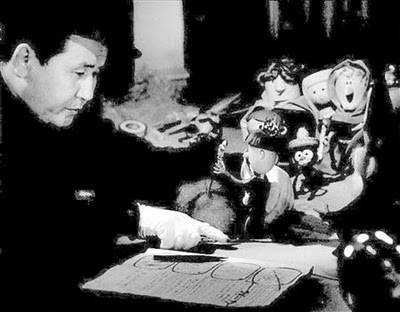
Tadahito Mochinaga at work on WILLY MCBEAN AND HIS MAGIC MACHINE (1965).
Here Comes Peter Cottontail is a testament to how great films are able to achieve a renaissance because of home viewing media. In addition to its reissue in 1990, it has seen several DVD releases and the entire movie has been uploaded to YouTube. I am embedding it here, so that you and any children in your life may watch this fun movie right here on the site.
For more than 12 years, the accessibility of classic film on mainstream television has been limited to a single channel. Following the change of direction that American Movie Classics (AMC) undertook in 2002, Turner Classic Movies (TCM) has been the classic film fan’s holy grail, the one station showing classic films 24 hours a day, 7 days a week. Due to its near monopoly on the showing of these films, it has attracted legions of devoted fans and become a brand unto itself–with the annual TCM Classic Film Festival and TCM Classic Cruise drawing participants by the thousand.
Now there is another channel on the market, just launched in February of this year in major U.S. cities and expanding quickly across the country, that may have all that to look forward to. GetTV, owned by Sony Pictures Television Networks, is the newest channel to make classic film programming its primary business model. Like TCM, GetTV shows classic films around the clock, but there is one significant difference–GetTV is available to viewers completely free, no cable subscription required. For this reason, GetTV shows 3 hours per week of educational programming in order to comply with FCC standards on public broadcasting, and this consists of quality entertainment directed toward a demographic crucial to the survival of classic films–children.
For the vast majority of hours in the week, GetTV shows films primarily from Sony Pictures’ Columbia Library and has had in its lineup thus far such notable films as To Sir With Love (1967), Picnic (1956) and Anatomy of a Murder (1959). I was also thrilled to see The Fuller Brush Girl, one of my favorite lesser-known Lucille Ball comedies on the schedule a few days ago, cementing my notion that GetTV is a market force to be dealt with.
As a general access public broadcasting network, GetTV has certain restrictions as to what they are and are not able to show. At the present time, the network is focusing on films from the mid-1930s through the late 1960s, which aligns more or less with the time frame of the Production Code’s enforcement in Hollywood. This allows the channel to comply with broadcasting standards and the needs of advertisers (the channel does carry commercials).without editing a film for content. In addition, GetTV is committed to never editing a film for time. In an interview with Will McKinley over at Cinematically Insane, they state:
“We are trying not to get into the zone of editing. We’re trying to present the whole movie, but at the same time, we are on broadcast TV, which has tighter restrictions than cable, and tighter rules in terms of community standards. And we’re not editing films for time. So if something runs from 10 a.m. until 12:40 p.m., that’s when the next movie is going to start.”
For classic film lovers, this is great news. Though I have not as yet seen any silent movies on the schedule for GetTV, this doesn’t mean that silent films are off the table for the future. I would love to see GetTV tap into the lucrative silent film market, as in this way they could reach several crucial demographics–the huge community of silent film devotees that make pilgrimages every year to events like the San Francisco Silent Film Festival, the Kansas Silent Film Festival, and the Pordenone Silent Film Festival in Pordenone, Italy, as well as the deaf community, many members of which have a huge passion for silent cinema and would likely tune in as regular viewers.
A scene from King Vidor’s THE PATSY (1928), a silent film that I think would work wonderfully on GetTV. Funny, engaging, and appropriate for public broadcasting, it would be a fantastic gateway film to introduce many viewers who might not be familiar with silent cinema to this beautiful art form.
We have great reason to be excited about this new development in the classic film world. I will stay on the pulse of GetTV and update readers with any news.
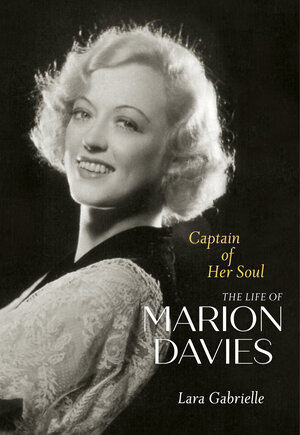
Captain of Her Soul: The Life of Marion Davies is now available at your favorite bookseller! Click hereto order it, and visit mariondaviesbook.com for all the latest.
Backlots is devoted to honoring and celebrating all aspects of classic film and is written by Lara Gabrielle, a California-based classic film writer and historian. Lara is the author of CAPTAIN OF HER SOUL: The Life of Marion Davies (UC Press, 2022).
Here you will find pieces on frequently seen classics and some lesser-known gems, as well as book reviews, festival coverage, and pieces on the history, theory and culture of film as it relates to the study of classic cinema.
Enjoy the site, and thanks for reading!
AFFILIATIONS & AWARDS
2019 CMBA Award for Best Profile of Classic Movie Performer or Filmmaker--"The Activism of Myrna Loy"
Winner of the 2018 CiMBA Award for Best Classic Movie Series, BACKLOTS AT THE COURTHOUSE: OLIVIA DE HAVILLAND VS. FX
Winner of the 2014 CiMBA Award for Best Profile of a Classic Movie Performer or Filmmaker: A Q&A WITH JOAN FONTAINE IN HONOR OF HER 96TH BIRTHDAY
Winner of the 2011 CiMBA Award for Best Classic Movie Discussion, THE FINAL SCENE OF THE HEIRESS
I am honored to be a judge of the Animal Film Festival in Grass Valley, CA.
EVENTS
BACKLOTS ON THE WEB
Join us at the Backlot Commissary, the place for Backlots' readers to share content and discuss movies!
Walter Pidgeon and Greer Garson in "Mrs. Miniver."





















_03.jpg)

 Backlots