Category Archives: Lara Gabrielle Fowler

Article from Paris Match issue no. 159, from the week of March 29-April 5, 1952.

I translated this Paris Match article from the original French. Enjoy!

IN HER BROADWAY DRESSING ROOM, VIVIEN LEIGH RECEIVES HER SECOND OSCAR

By our special New York correspondent, Georges Pernoud

When reporters from the American press were admitted into Vivien Leigh’s dressing room at the Ziegfeld Theatre, an extraordinary event occurred: silence.

Where the press (specifically the American press) go, she usually expresses an energetic cooperative mood that shocks criminals and enchants politicians. This evening, though, in her small dressing room with mirrors covered in face powder, it was a different story. It was the usual tabloid braggarts, with their cigarette butts flattened on their lips, their felt pens and their hand-painted neckties, who seemed sheepish in front of their hosts. And it was the usual victims, Sir Laurence Olivier and Mrs. Olivier in this case, who had the upper hand. Dressed in dark gray with faint stripes, his coat halfway open to reveal a golden chain, impeccable from head to toe, Olivier stepped aside with the rigidity of an obelisk before the queen of Egypt, dressed in a black satin gown with a mischievous smile on a slightly weary face,  a bit too human without the effects of stage makeup and less striking than her two sets of three-string pearls , one set on her neck, the other on her wrist.

It was midnight. The curtain had long since fallen on the giant sphinx (5 m. 50 high and 4 wide), to the feet where Vivien Leigh dies of love three times a week, in the last scene of Antony and Cleopatra by Shakespeare. And at which, the other three nights of the week, she expresses her love for Caesar in the first scene of Caesar and Cleopatra by Bernard Shaw.

This evening, upon returning to her dressing room, Vivien learned that she had just won the 1952 Best Actress Oscar for her role of Blanche, the fallen coquette in Elia Kazan’s A Streetcar Named Desire by Tennessee Williams. Journalists had been waiting for an hour in the wings of the Ziegfeld Theatre–the doors to Vivien’s dressing room were not opened until Vivien and her husband, Laurence Olivier, were finished washing the stage makeup off their faces and ready to greet them properly attired.

“Maybe these gentlemen would like to drink something?” Vivien asked her publicity agent, Richard Maney, who agreed with her. This provoked a hustle and bustle among the reporters.

The glass being broken, the photographers began their duties. “Would you like to kiss your wife?” one cameraman asked Olivier. Acquiescing, without words, Olivier wrapped his arm around Vivien’s shoulders and gave her a peck on the cheek. “A big one!” protested the unauthorized photographers. Ever docile, Sir Laurence repeated the gesture, and considering his duty to the image-hunters done, he turned toward the reporters. Vivien served the drinks.

-“What effect does your second Oscar have on you, Miss Leigh?”

-“Exactly the same as the first one.”

-“What does that mean?”

-“I am humbled and honored.”

Apart from being rather a world unto itself, it is impossible to distinguish from her smile what her genuine mood is, and what is simply glamor.

-“And you, Mr. Olivier?”

-“He has three.”

Sir Laurence played with his golden chain.

-“And what do you do with them?”

-“We use them as table lamps,” said Laurence Olivier. “You see, we are very conventional people.”

Vivian approves absent-mindedly–“That’s right, they’re used as bookends.”

-“May I drive my wife home?” Olivier says abruptly, with a weary smile.

The camera flashes illuminated in the London couple a light of tragedy.

-“Bookends or lamps?”

-“May I drive my wife home?” repeated Sir Laurence, seriously. “You see, we are very conventional people.”

Outside the Ziegfeld, a taxi was waiting.While the journalists finished their drinks inside, Laurence and Vivien embraced each other as lovers. Behind the windows, at each entrance of the theatre, two large photographs shone in the lights of 6th Avenue. To the left, a sixteen-year-old Cleopatra, resembling Scarlett O’Hara, smiled at Caesar, while on the right, a forty-something Cleopatra gazed at Antony with a sad expression, recalling that of Blanche.

This couple is more difficult to approach than the royal family and even slight intimacies necessitate a retreat on horseback to their old abbey between Oxfordshire and Hertfordshire, Yet they are near slaves to the public, both of them having been born for the theatre. She came to the theatre through a longer route than he, but Vivien herself has said that ever since childhood, she has had no greater ambition than to become an actress. They apparently met by the merest of chances: waiting for a taxi at the door of the Savoy on a rainy day.

HOLLYWOOD PAYS FOR SHAKESPEARE

But Vivien’s destiny seemed to advance in zigzags. Nothing would suggest her status as a future movie star when she married barrister Herbert Leigh Holman in 1931–Vivien was 18, and had attended a few courses at the Dramatic Academy in London. But her strict education in an English convent between the ages of 5 and 14, then in a boarding house run by an austere Bavarian baron near Munich, had prepared her more than anything for the role of tender bourgeoise housewife. The end result was her leaving the marriage after 5 years, shortly after the birth of her daughter, Suzanne.

It was then that the theatre began to swirl in this Irish head, that came into existence under the Indian sun (her father was a senior officer in a cavalry regiment, stationed in Darjeeling in 1913). Vivien, in the calm of her London home, began to recall her childhood dreams.

When Mrs. Leigh Holman secretly met with a theatre director one day, he cast her right on the spot. The success of her first play, The Mask of Virtue, transformed the life of Mrs. Leigh Holman (who took her husband’s second first name as her stage name)–a nurse began to replace her duties in the care of little Suzanne, and at this point the two spouses were speaking only through correspondence. Each evening, Vivien left a ticket on her husband’s desk. She found another upon her return from the theatre, as the lawyer rose early and went to bed early.  And when Alexander Korda signed Vivien to a contract of 50,000 pounds per year, Mrs. Holman was effectively just Vivien. The divorce was finalized in 1939.

Within months, David Selznick, having embarked upon the most expensive production in Hollywood’s history, was searching in vain for a Scarlett, for that to which we now refer in cinematic capitals: GWTW (Gone With the Wind). Vivien went to California. Shooting had already begun on Gone with the Wind (they refer to it here by its French title, Autant en emporte le vent) and Vivien was invited to attend what would be the key scene in the film–the burning of Atlanta. As she was watching this tremendous scene, that of a city on fire, an assistant director named Fleming silently went over to Selznick and pulled on his sleeve.  He pointed at Vivien’s anguished and radiant face, a face that was the living image of Scarlett O’Hara…

It was then that Selznick decided to cast  Miss Leigh on the spot, for the best woman’s role in the history of cinema.

Between Gone With the Wind and Streetcar (her two Oscars) there was Shakespeare. Vivien’s career, like that of Laurence Olivier, is one of nearly all superstar roles, and Vivien always accepted popular roles to offset the costs of the difficult plays she wanted to perform. When Laurence Olivier brought her to Denmark to play in Hamlet on the desolate terraces of Elsinore, for a privileged audience of 500 people, she signed to play in Waterloo Bridge upon her return, opposite Robert Taylor. Anna Karenina paved the way for Romeo and Juliet. And Cleopatra, with the veritable Caesar of a producer/director Gilbert Miller, only brought in the $75,000 that Cleopatra cost, that the years of performances at the tiny St. James Theatre in London, would barely cover.

The St. James Theatre is closed, in its own way, like the Oliviers’ country house Notley Abbey. It is at this theater that Olivier cut his teeth as a director and to which the list of those invited included Anouilh, Menotti, and soon Marivaux and Claudel introduced by Jean-Louis Barrault and Madeleine Renaud, and was the permanent home of Shakespeare.

The daily life of the number 1 couple of the English stage? It is that of all the heros of the theatre. A friend of the Oliviers, the critic Alan Dant, told me of a few times, upon coming to spend the weekend at Notley Abbey, seeing one or the other of them gesticulating with a sublime furor, hurling invectives against an invisible enemy. In other moments, you would see Sir Laurence doing imitations, telling stories of the theatre. He made Churchill laugh hysterically one day by telling him a story of Lucien Guitry and Sacha, when he was little–“They saw a blind beggar, and Lucien gave a sou to his son to put in the beggar’s collection bowl. ‘You should have tipped your hat,’ said Lucien. ‘We must be polite to beggars.’ ‘But papa, he is blind.’ ‘And what if he were an imposter?'”

NECK TOO LONG, HANDS TOO BIG, VOICE TOO SMALL

The Oliviers have few intimate friends: Danny Kaye, Orson Welles, and Noel Coward (at whose Santa Barbara home they married in 1940) are the only ones with famous names.

If their passion for the theatre is exclusive, their tastes are diverse. For Vivien: gardening, canasta, Charles Dickens, and Siamese cats. For Laurence: Handel, and Bourgogne wine.

Vivien is 37. She fiercely guards her beauty secrets, and only one person knows her secret number 1: her mother, Gertrude Hartley, who had a beauty salon in Knightsbridge that she closed to devote herself to one client, Vivien.

-My neck is too long, my hands are too big, and my voice is too small,” Vivien said one day. Her dresser, Audrey Cruddas, is responsible for the neck. For hours, Vivien lets her dress her neck until her head and her shoulders are proportioned correctly. Her voice demanded, and still demands, patient exercises and causes her constant worries about her vocal cords. In regard to her hands: “I have learned,” she says, ” from a great actress, Ellen Terry, that one should never cover large hands. People notice much more when you try to cover them, than they do if you leave them bare.”

The public, although much more fabulous and more in charge of the prestige of superstars, who are not superstars in their own eyes, Vivien is sometimes “fed up,” she says disgustedly. Despite a weak constitution, she always chooses exhausting roles. The hysterical Blanche of Streetcar that she played for months in London, seriously affected her health.

Sometimes, when the audience is not enthusiastic, the actors close to her hear Vivien grumble curse words that are anything but classical.

To an admirer who saw her die on stage the other day and said to her “You are the most beautiful Antony and Cleopatra that we have seen since Antony and Cleopatra themselves,” she replied: “Yes, darling, and we are almost as tired.”

YAM Magazine’s LGBT Blogathon–VICTOR VICTORIA

This is definitely one of my all-time favorite feel-good movies. Going against all possibility of typecasting, it stars Julie Andrews as a struggling singer, Victoria, who, under the tutelage of a gay cabaret performer (Robert Preston) ends up making it as “Count Victor Grazinski,” a drag performer in a gay club. So basically, she is a woman, but everyone thinks she is a drag queen. Fabulous, right? I think so.

Essentially, this movie is an exploration of gender that both examines the position of gender in society and pokes fun at mistaken gender identity. In stark contrast to Some Like It Hot, which might be called the quintessential drag movie but was also a definite product of its time, Victor Victoria affords drag a good amount of dignity. It doesn’t regard the prospect of dressing as the opposite gender as inherently funny, nor does it mock either gender as Some Like It Hot tends to mock women. It treats drag as a respectable performing genre, and it is also worth noting that the venue at which Victor/Victoria performs is noticeably a high-end Paris club, and does not conform to any stereotype of what a gay club might be.

I think this movie is also a commentary on the times–Victor Victoria was made in 1982, right at the height of the AIDS epidemic in the United States. With the increased fear of the disease, and the public perception of it as a “gay disease,” a movie like this seems an effort to show the often misguided prejudices in society, by showing the fluidity of gender, sexuality, and identity in an otherwise light, funny movie.

The songs are written by Henry Mancini, also Blake Edwards’ collaborator on Breakfast at Tiffany’s, and are very memorable–especially the epic “Le Jazz Hot” sung by Julie Andrews as “Victor,” the drag queen:

Another of my favorites is this one, sung by Robert Preston as Toddy, the gay performer who becomes Victoria’s mentor. The first time I heard this song I was so thrilled I could barely stand it.

This movie is a very fun one to watch, is hilariously funny and I think makes some very good points about gender while it’s at it. I’m actually surprised at how many people, classic film fans included, haven’t seen this movie. It’s widely available and I recommend it to anyone looking for a light, funny and engaging romp with Julie Andrews.

A Weekend With the Oliviers

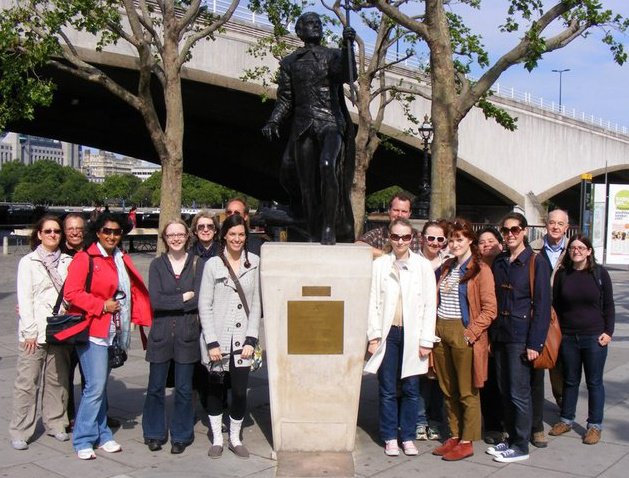
The entire group in front of the Laurence Olivier statue at the National Theatre, London.

This past weekend, as you may recall from previous posts, I attended a marvelous Vivien Leigh/Laurence Olivier event in London, organized by Kendra at vivandlarry.com and attended by people from all over the world. It was a truly wonderful experience, and we had so much good luck that came our way–including tea at Notley Abbey (that occurred by chance) and an unexpected appearance by Tarquin Olivier, who decided he was going to show up to a performance planned for our group.

THURSDAY

I arrived in London on Thursday morning, and went on a practice walking tour with Kendra and Marissa, another girl who had arrived early. We wandered around London, stopping for lunch at Paul on the way, and though it began thunderstorming around noon, we trudged on through the rain and visited almost all the Olivier sites that were planned for the official walking tour on Sunday. When my umbrella broke and the lightning seemed to be getting closer, we decided that the elements were against us and we went home, to prepare for the tour of the Old Vic theatre the next morning.

FRIDAY

We slept in a bit on Friday, as our tour of the Old Vic was scheduled at 3:00. Our tour guide was a man named Ned, who had been there forever, and he gave us a very interesting tour of the theatre. We didn’t hear much in the way of Olivier trivia there, but we did learn some very interesting facts about the theatre and its history. After we finished the tour, we headed out for dinner at a Mexican restaurant called Lupita, where we met other members of the group who had arrived that day. Many people brought pieces of memorabilia to share, including a cigarette case that had been given to Laurence Olivier by Vivien Leigh on his birthday (!) and many beautiful photos and books, that were passed around the table and enjoyed. I met so many marvelous people with whom I share this passion, and it made me so happy to be able to share insight and information with them without having to explain myself. A wonderful evening.

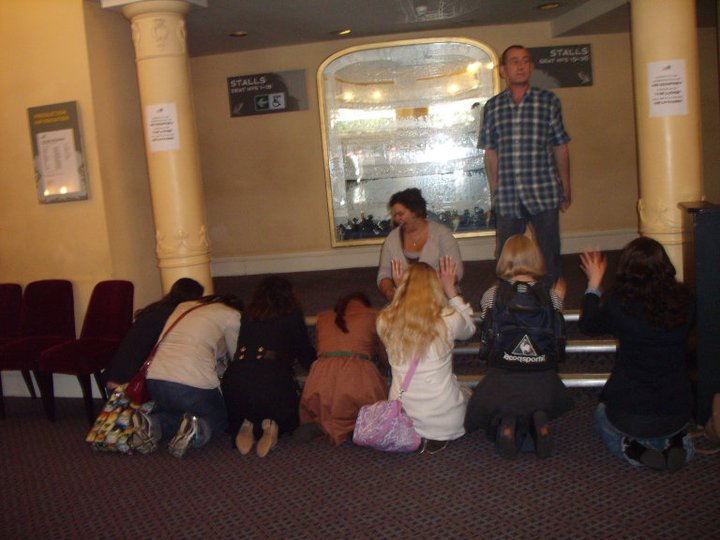
An activity with Ned the tour guide.

SATURDAY

A second tour of the Old Vic with Ned proved just as fantastic as the first one, and he even threw in some new information. Still not much info on the Oliviers, but I feel like I know the Old Vic by now! We then headed down to the cinema for a showing of That Hamilton Woman, followed by a talk by Hugo Vickers, a prominent Vivien Leigh biographer (also a biographer of the royal family and Cecil Beaton. You may have seen him on The Colbert Report, too). He signed books afterward, and answered questions (my question was about his research process–how researching Vivien Leigh was different from, say the royal family), and then we all went to dinner at an Italian place. We talked to Hugo Vickers some more at dinner, and got to know his opinions on various things related to Vivien and Laurence Olivier, which was a very special thing.

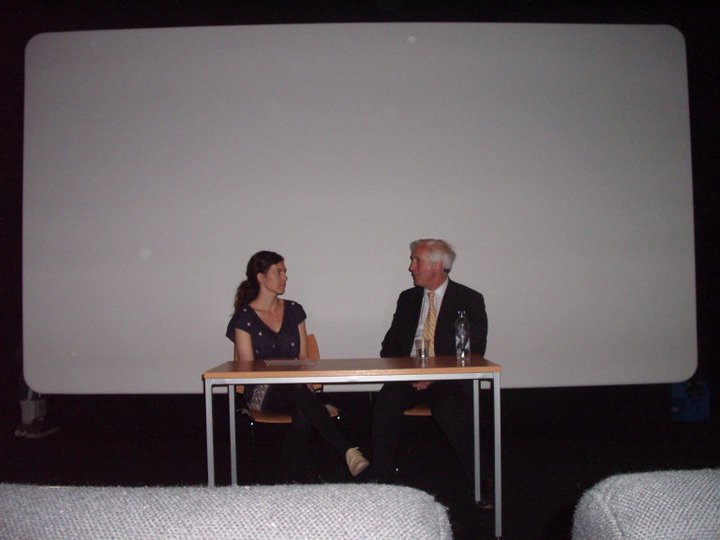
An interview with Hugo Vickers.

SUNDAY

Kendra took us on a walking tour of London on Sunday, which was very informative and we got to see different spots that were important to the Oliviers, in their careers and their lives. It took a bit longer than planned, because people kept disappearing into cafes and taking unplanned bathroom breaks (though one of the bathroom breaks was used for myself and some other people in the group to sneak off to the National Portrait Gallery to get Kendra a card). We ended up rushing to get to the Victoria and Albert Museum on time, where we saw a costume of Vivien Leigh’s from Duel of Angels, and one of Laurence Olivier’s from Oedipus Rex. From there we headed off to a performance by Susie Lindeman, an Australian woman who is putting on a one-woman show about Vivien Leigh, and who wanted to get our opinion of her performance. The opinion ended up divided, but among the supporters was Tarquin Olivier, Laurence Olivier’s son, who had shown up to watch with our group. We talked to him afterward about what he liked about the performance, and he seemed very taken with the rhythms of her speech. Interesting stuff. Anyway, this was the end of the official weekend, so we said goodbye to most of the people in the group before the few remaining went out to dinner and bid farewell at the end of the night.

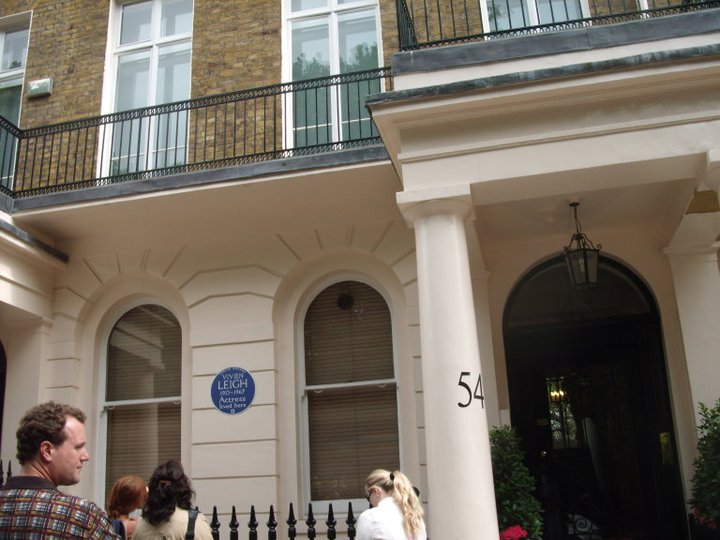
54 Eaton Square, the house where Vivien Leigh spent her last years.

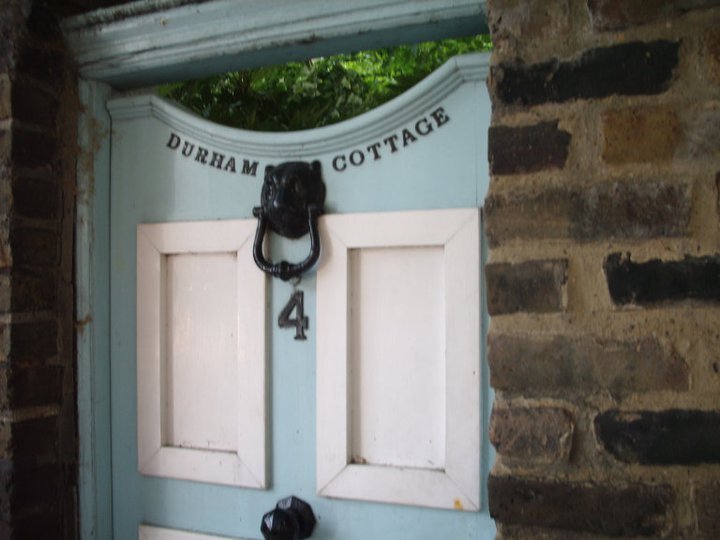
Durham Cottage, Larry and Vivien's London residence during the 1940's.

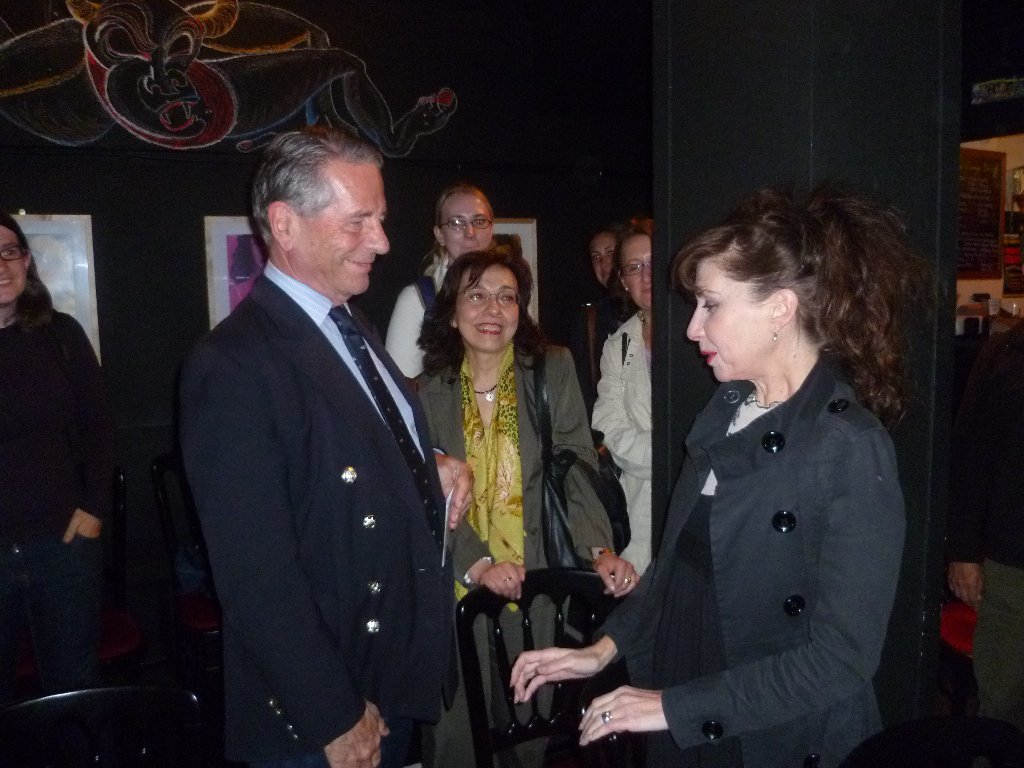
The group with Tarquin Olivier and Susie Lindeman.

MONDAY

On Monday there were 5 of us left, and we took an impromptu trip to Notley Abbey, Vivien Leigh and Laurence Olivier’s country house in Buckinghamshire. We took the train up, and then walked down the road to Notley Abbey, which is now used as a wedding venue. The house itself is monumentally beautiful, and even though we were only supposed to walk around the grounds, need of a bathroom necessitated our entry into the house to use one. Before we knew it, the groundskeeper was making us tea, to drink in the room that was Vivien and Larry’s living room. It was truly amazing.

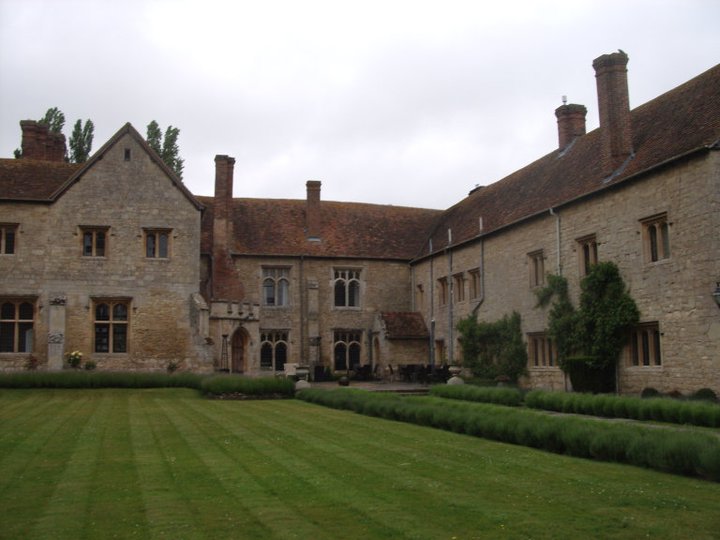
Notley Abbey.

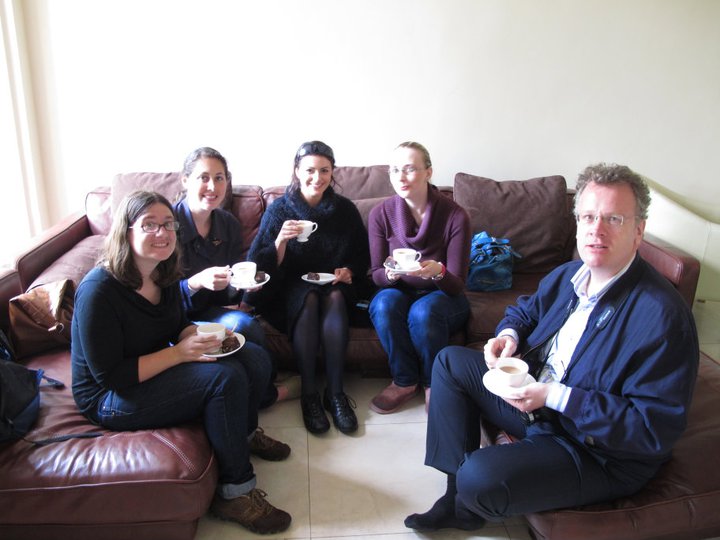
Tea at Notley.

In summation, this weekend was absolutely incredible, in all respects. We had an absolute ball, and I think all members of the group would agree that this was an experience of a lifetime. Thank you, Kendra!

SMALL WORLD, 1958 (with Vivien Leigh, Sam Goldwyn, Kenneth Tynan)

In 1958, Vivien Leigh met, via satellite, with Ken Tynan and Samuel Goldwyn to discuss various Hollywood subjects on Edward R. Murrow’s show “Small World.” The show brought together a critic (Tynan), an actress (Leigh) and a producer (Goldwyn) in an attempt to get the points of view of all aspects of the motion picture industry.

A bit of history between Tynan and Vivien Leigh: Kenneth Tynan held a historical professional dislike for Vivien, often speaking badly of her when he reviewed her stage performances. Vivien took these criticisms to heart, and began to be very self-conscious during her performances for fear of a bad review from Tynan. After they met personally, however, Tynan was taken by her grace and charm toward him despite his earlier criticisms, and immediately became enraptured with her. He stopped his harsh criticism of her and began to be a frequent guest at the home of Vivien Leigh and Laurence Olivier. By the time of this program, the friendship had been established, but it is noticeable that there is still a slight friction there. Tynan seems to be pressing her, and Vivien becomes a bit defensive.

In my opinion, Kenneth Tynan in this program is rather insecure. His claims are often a bit immature from the critical perspective, and he tries to justify them without really listening to the other speakers and taking their responses in. He was young here (29 years old), and I think his discussion  is not really on the same level as Vivien and Sam Goldwyn, who were much older, more experienced members of the industry. He still resorts to some attacks of Vivien (insinuating that her performance of Streetcar was not entirely believable, for example), and it is evident that many of his views on the industry are based in his youth and general inexperience.

If Kenneth Tynan was too insecure, Samuel Goldwyn was the opposite. He had just made The Best Years of Our Lives, and already referred to it as “a picture that will last,” a rather bombastic claim if you ask me, especially as it had just been finished. He also makes some ridiculous comments (my favorite moment of the entire interview is when he says “I am not yet ready to shove under the doors six or seven million dollars and go away fishing!” And Vivien responds with “What does that mean….?” Brilliant) for some reason he couldn’t remember the name of Gone With the Wind, and some remarks are just simply erroneous, like his comments about Orson Welles not having succeeded as a producer or writer. I think Vivien and Tynan were right on the target when they very loudly corrected him on that point. How he even had the idea to say something like that is beyond me.

The doubtless star of this program was Vivien. She essentially controlled the interview by making everything she said count, either by agreeing with Goldwyn or Tynan, or very articulately shooting down the silly comments they make. She also manages to work Olivier into the discussion on a number of occasions, and criticized the fact that Olivier didn’t get to do Macbeth, which was very justified I think. There is a real class in her discussion, that doesn’t manifest in the other two members of the discussion, who seemed more concerned with defending and promoting their egos than anything else.

It is a fascinating interview, and even though some silly remarks are made by the two men, all three people are very interesting to listen to. Here it is in its entirety:

JUDY ESSENTIALS

Since my Wizard of Oz post garnered so many comments and questions about Judy Garland, I’ll dedicate a blog post to the essentials of Judy, who is basically the love of my life, and the reason I got into classic film in the first place.

I outlined some biographical information in my Wizard of Oz post, but here are some of the basics. Judy was born Frances Ethel Gumm on June 10, 1922 in Grand Rapids, MN. She made her debut at the age of 2 and a half singing “Jingle Bells” at her father’s theater in Grand Rapids, and from there she joined her sisters in their vaudeville act, known as “The Gumm Sisters,” touring the country in what Judy later called “rotten vaudeville.” She was always the standout in the act, however, and was often known as “The Little Girl With the Great Big Voice.” She and her older sisters made their first short film in 1929 when Judy was 7, called “The Big Revue.”

Judy enters at 0:34.

In 1935 she was signed to MGM Studios and began to make radio appearances, notably “Zing Went the Strings of My Heart” on the Shell Chateau Hour, broadcast as her father was ill in the hospital, and it is said that her voice on the radio was the last thing he heard (he died later that night). Once signed to MGM, she began to make small, low-budget films, her first being “Every Sunday” in 1936, a short subject with Deanna Durbin. She was loaned to Fox for Pigskin Parade, which became her first full-length motion picture, and upon her return to MGM she starred in her first of 10 films with Mickey Rooney, Thoroughbreds Don’t Cry, in 1937. This was followed by Everybody Sing and her second film with Rooney, Love Finds Andy Hardy, in 1938.

“Swing, Mr. Mendelssohn,” from Everybody Sing, 1938.

Love Finds Andy Hardy, 1938. This scene also features a very young Lana Turner, who later became a rival of Judy’s over the clarinetist Artie Shaw.

She was cast as Dorothy in The Wizard of Oz just after completion of Love Finds Andy Hardy, and the film was not easy for her. Being 16 years old and playing 12, she had to be fitted with a restricting corset to hide her figure and had to deal with the pressures of preparing to graduate from high school while making a high-budget film like Oz. At the Oscars that year, however, she was awarded the Best Performance by a Juvenile Oscar for her performance.

The same year, Judy became smitten with clarinetist Artie Shaw, several years her senior. They went out together on numerous occasions, and Shaw led Judy to believe that he was seriously interested in pursuing a relationship with her, so when Shaw married Lana Turner after their very first date, Judy was completely heartbroken. When she got the news of their wedding, another musician, David Rose, happened to be there with her. He consoled her and took her out for a drink, and so started the relationship that would turn into Judy’s first marriage.

In my opinion, Judy’s heartbreak over Artie Shaw cemented Judy’s future of romantic troubles. Her self-esteem was already low, and to have Shaw reject her for a more classically beautiful (or so she thought) woman just made her feel as though she was not attractive to any man, and clung on to those who liked her. She had a total of 5 marriages.

Shortly after the completion of The Wizard of Oz, MGM began Judy on a strict regimen of diet pills, pep pills, and downers to keep her “in shape” for the movies they had planned for her. As such, as early as 1941, one can see the difference in her physical appearance as a result of too many pills.

‘How About You,” from Babes on Broadway, 1941.

She married her first husband, David Rose, at the age of 19 in 1941, and in 1943 they divorced. This left her open to marry Vincente Minnelli, her director in Meet Me In St. Louis, with whom she had fallen in love. They married in 1945, and their daughter Liza was born in 1946.

By this time, Judy’s dependence on pills had become severe. By 1948, Vincente was discovering pills lined in her costumes, and by 1949 she was becoming so difficult as a result of the pills that MGM couldn’t afford to risk her anymore, and she was fired in 1950.

After her release from MGM, Judy began a highly successful concert career, touring the country and playing for a whopping record 19 weeks at the Palace Theater in New York in 1951. She had divorced Vincente by this time and had fallen in love with Sid Luft, her manager. They married in 1952, and their daughter Lorna was born later that year. In addition to her addiction to pills, Judy was also beginning to struggle severely with her weight.

In 1954, Sid Luft began to prepare her comeback to the screen, in a remake of the 1937 classic A Star is Born. Judy played Esther Blodgett, the singer who was made into a movie star by a washed up legend who had descended into alcoholism, and becomes her husband. Many scenes in this movie reflect Judy’s own inner battles, and one can see her struggle with herself as she describes, as her character, her struggles with her husband’s alcoholism:

She was nominated for an Academy Award for her role, and as she had just given birth to her third child, Joe, she was laid up in the hospital as the awards were announced. The Hollywood community was so sure that she would win, they sent cameras to televise her acceptance speech.

The loss was an immense shock, and prompted letters of condolence from many people in Hollywood. Groucho Marx called it “The greatest robbery since Brink’s.”

Judy did, however, return to her concert career, but in 1958 began to rapidly gain weight, getting as heavy as 180 pounds (she was 4’11” tall). In 1959 she was diagnosed with hepatitis, and 20 quarts of fluid were drained from her body. She was told by doctors that her career was over, she would never sing again. But in 1961, in another triumphant comeback, she played Carnegie Hall for one glorious night on April 23. She garnered multiple awards for the concert and the ensuing album, including a Grammy, and the album spent 13 weeks as Billboard’s number one album.

In 1963, Judy embarked on a television series that, while short-lived, made a lasting impression. Some of the performances from The Judy Garland Show are considered to be the very best ever filmed.

It was cancelled after 26 episodes, due to problems with scheduling.

Judy’s final years were difficult. Her dependence on pills had made her often very “out of it,” and she began to experience withdrawal seizures. In 1965 she married Mark Herron, a marriage which lasted only 6 months. She married Mickey Deans, her last husband on March 22, 1969 and she gave her final concert on March 25, before her death on June 22, at her home in London, at the age of 47. The cause of death was an accidental overdose of Seconal.

Judy never wanted to be considered a tragedy. Many people, when learning that I’m a Judy fan, say “She had such a tragic life!” She never wanted to be thought of that way. She had a very keen sense of humor about herself, and would often make fun of the plights she experienced with pills, money, weight, and men. I think the most lasting thing we can give to her would be to not think of her as a tragedy, but rather as an immense actress and singer, and a wonderful personality.

Here are some of the essential movies:

For Me and My Gal, 1942

Girl Crazy, 1943

Meet Me In St. Louis, 1944

The Harvey Girls, 1946

The Pirate, 1947

A Star is Born, 1954

Judgment at Nuremberg, 1961

I Could Go On Singing, 1963.

Return of the Prodigal Classic Film Fan.

By the grace of horrendous internet problems in my apartment and having to resort to the free wifi at Parc Monceau (and thus the limited power of my computer battery), I haven’t posted in a long time. This is especially awkward because of all the classic film news that has since happened–in no particular order:

  • Elizabeth Taylor died.
A tragic moment for the entire industry, and it seems almost futile to try to do a tribute to her because she was SUCH a legend, that it’s impossible to put her into words.
I will, thus, simply  compile some of my favorite Elizabeth Taylor moments here. As Elizabeth lived her life with vivacity and endless humor, I celebrate her here with clips that demonstrate how she lived her life. RIP Liz, you were really something.
National Velvet, 1944. This is literally the only clip from National Velvet that I could find on youtube that wasn’t altered in some way. I ADORE this movie, and truthfully this is how I will always remember her. Now that she’s gone, I tear up when I watch it.


Lassie Come Home, 1943. This was the beginning of Elizabeth’s career at MGM, and she costars with Roddy McDowell, who would become her lifelong friend.


Elizabeth’s classic, hilarious performance on “What’s My Line?” in 1954.


Suddenly Last Summer, 1959. One of Elizabeth’s best, very well-known within the classic film community, but I’m not sure how well outside of it. It’s a wonderfully done, brave film for its time, and with marvelous performances by Katharine Hepburn and Montgomery Clift (another lifelong friend of Elizabeth’s), and it’s worth a viewing. TCM shows it from time to time.


The magnificent Cleopatra, 1963, in which she costars with her two-time husband, Richard Burton, and becomes the highest paid actress of her time, garnering a staggering (for the era) 1 million dollars for the role.


Boom!, 1968. PLEASE SEE THIS FILM. It is so rarely seen these days, and it is so campy that it’s absolutely brilliant. Favorite moments: When Elizabeth screams “SHIT on your MOTHER!!!” and does martial arts on the veranda wearing a veritable porcupine chandelier thing on her head. I can’t even. Just see it.


Jumping forward a few years, this is “These Old Broads” (2001) my ALL-TIME FAVORITE made-for-TV movie. Simply put, Elizabeth plays a housebound drunken agent, who represents 3 old movie stars trying to make a comeback. In this clip, Elizabeth’s character talks with Debbie Reynolds’ character about a shared ex-husband, called “Freddie Hunter.” In real life (for those of you living under a classic film rock), after Elizabeth’s husband, Mike Todd, died in a plane crash, Debbie’s husband, Eddie Fisher, left Debbie for Elizabeth. One of the many, many reasons I love this movie. Please, please see it.


Golden Globe Awards, 2000. I don’t think Elizabeth was drunk here, I really think this was just HER. This is one of the great Elizabeth moments out there.

And last, but certainly not least…

RIP Elizabeth. The world is a far less exciting place without you.

Begosh and Begorra, it’s LITTLE NELLIE KELLY!!

As I am writing to you on St. Patrick’s Day, I thought I would give you my own little pot o’ gold, an introduction and critique of that traditionally hard-to-find gem (though getting easier, it is now available on youtube and was just released on DVD!), everybody’s favorite little-known Judy Garland film, “Little Nellie Kelly!”

Released in 1940, it is the first of 2 films to team Judy Garland and George Murphy (actor and ahem…sometime governor of California), and one of a number, 3 I think, to team Judy and Charles Winninger, who really should be more well-known than he is because he is hilarious and adorable. In this movie he has a number of little motifs as Nellie’s father/grandfather (don’t worry, we’ll get to that in a minute!)–1) whenever he is angry at something, he drops his clay pipe, which promptly breaks, and 2) whenever something happens against his will, he pretends to have trouble with his heart, which is immediately cured with a swig of “medicine” (held in a very suspect flask). The film also stars the ill-fated Douglas McPhail, who looks a bit like a bonobo but we’ll forgive him because he had a hard time in life. In his day, McPhail was quite a good opera singer but never really made much out of it. He, of course, plays Nellie’s love interest. Hmmm. We know Judy’s taste in men was not the best, but MGM could have done a little better to help her out on this one.

The film begins in Ireland, at a time period we’re assuming to be sometime around 1920. A crotchety old man in a bar is yelling about work and how it is the curse of civilization. The other barflies agree with him and tell him how wise he is, and the scene makes very little sense. It does, however, introduce us to the character of Mr. Noonan, Nellie’s father (I know. Don’t worry.). He is a stubborn old Irishman who has never worked a day in his life, and is quite proud of it, much to the chagrin of his daughter, who is played by Judy doing a very unconvincing Irish accent. When he returns home he is lectured by his daughter’s bad Irish accent on the merits of working, and over the next few minutes it becomes clear that she has intended to marry a man by the name of Jerry Kelly (George Murphy). And, get ready–the man is looking for a job. OH THE HORROR. As her father refuses to have anything to do with someone looking for a job, especially when aforementioned job is in America, he tells Nellie that he cannot support this union and goes off to the bar for some more drinks.

A fine, upstanding member of society.

Of course, Nellie and Jerry DO get married, and the story begins. They move to America, as everyone seems to do if they are foreign in any movie before about 1960, and Nellie’s father ends up coming along too, even though he was insistent that he wanted to stay in Ireland, and still hates his son-in-law. They become American citizens, Jerry promptly gets a job as a policeman (after a very patriotic and somewhat awkward training scene), and Nellie promptly gets pregnant.

Ok now here is where things get interesting. Remember how I said I would explain everything with the Nellies and the fathers and the grandfathers? Here it comes. Nellie gets pregnant, has a child, and *SPOILER ALERT* (though not really because the story can’t really progress without this eventuality), dies in childbirth.

Now, people say that this film was really Judy’s beginning as a dramatic actress. Judy was only 18 when she filmed this scene, and it is incredibly powerful. She plays it as though she had the acting experience of someone twice her age–which is a recurring theme in Judy’s career, specifically in regards to her singing voice. Many people were dazzled and baffled as to how someone so young could have so much artistic power, and I think that almost dehumanizing of her led to some of her major problems in life. It is truly remarkable to see these dramatic scenes of hers so early in her career, and to remember that she was still a teenager.

Anyway, back to the movie. the daughter that Nellie has is also named Nellie (voilà). And if that weren’t confusing enough, when Nellie grows up, we can see that this is the movie in which Judy plays a dual role–she plays both Nellie AND Nellie. Good job, MGM, keep your viewers on their toes.

Nellie grows up and falls in love with a young man named Dennis Fogarty, with whom she sings the now-famous St. Patrick’s Day song, “It’s A Great Day For the Irish,” the movie version of which for some reason is not available on youtube, so I’m just going to post the version I found, from later on in Judy’s career:

The same basic story continues with Nellie as it had with Nellie (is your head spinning yet?)–yet this time little Nellie has the support of her father, who is so sweet and loving that he counteracts the temperamental grandfather. Eventually the grandfather is brought around and even gets a job! Cue musical happy ending.

The interesting thing about this movie is that it is indeed a musical, but there are a number of songs that are incidental. One of the more lovely songs in the movie is a simple lullaby, sung by the grandfather to baby Nellie, without any accompaniment. The token “Look at Judy, she can sing!” number that happens in every movie Judy did at MGM, this time occurs with a powerhouse rendition of “Singin’ In the Rain” performed as entertainment during a party. It is not by any means on the level of “A Star Is Born,” whose songs are pretty much entirely incidental (and thus may be disqualified from classification as a musical altogether), but “Little Nellie Kelly” does challenge a number of tenants of the traditional style. First off, there is rarely ever a tragic death scene in an MGM musical, and this one happens within the first 15 minutes. Also the tone is decidedly more somber than your average musical, which is accentuated by the black and white format. It is tempting to say that the black and white itself is not particularly a musical format, however I may remind myself and my readers that MGM churned out a lot of musicals in the early 1940s, and the vast majority of them were black and white because Louis B. Mayer was obsessed with saving money. However, it’s not unwise to notice that the colors on the screen do contribute to the overall tone of the film, and make it markedly more ethereal than your average MGM musical.

Then there is Judy in this movie. In my humble status as lifelong fan, I would say that this was Judy’s first stepping-stone toward real adult dramatic roles, and veritably the first film in which she actually played an adult. Many people cite “For Me And My Gal” (1942) and “Presenting Lily Mars” (1943) as her first grown-up roles, but this film tends to be overlooked by those who focus more on her second role, that which she plays for the majority of the film, of the young Nellie. Her dramatic intensity in the death scene packs a punch, especially for those used to her roles in the Andy Hardy movies and other light comedies of the 1930s. This little-known film paved the way for her work as a dramatic actress, an endeavor she achieved, notably, in “The Clock” in 1945 and the magnificent “Judgment at Nuremberg” in 1961.

If you would like to watch “Little Nellie Kelly,” it has just been released on DVD, but is not yet available through Netflix. The entire film, though of poor quality, can be found on youtube, and VHS versions are regularly for sale (averaging about $1 each!) on Amazon.com and eBay.

Happy watching!

So, I have a film blog.

This is Backlots, my answer to the repeated cries of  “Have you ever thought of making a film blog??” that have been ringing in my ears for some time now. I can now say to those parties that yes, I have thought of making a film blog–indeed, it has been created! This is a new endeavor for me, so let me outline exactly what I hope to accomplish with this site.

-I hope to give you, the reader, my take and analysis on classic movies, both familiar and unfamiliar. I’ll probably post lots of pictures.

-I would also like to choose an actor or actress of the week, write out his or her biography (most likely with my own commentary–I enjoy commentary), and dedicate the week’s post to that person’s films.

-I am definitely going to talk a lot about my favorite people, because that’s unavoidable. Prepare to hear a lot about Bette Davis, Judy Garland, Olivia de Havilland, Rosalind Russell, and other immensely fabulous people for whom I have a particular affinity.

-I want to dedicate one day a week to a specific director, in conjunction with the actor/actress of the week. This way, we can try to give the directors the credit they deserve and seldom get.

-I am going to try to make this blog as entertaining and informative as possible.

Thanks for reading! Welcome to Backlots!