Yearly Archives: 2011

MOVIE REVIEW: Leave Her to Heaven (1945)

As it was raining very hard last night and there was really nothing to do but go to a movie, I decided to go to the classic movie theater and watch the film Leave Her to Heaven, starring Gene Tierney, one of the most spectacularly beautiful actresses ever onscreen who does not get the credit she deserves. I’ve seen the film a number of times before, but never on the big screen, so this was a treat.

Upon entering the theater, I ran into a woman with whom I had befriended at a screening of “His Girl Friday,” the both of us sharing an undying love with Rosalind Russell, and I almost expected to see her here at this showing of Leave Her to Heaven because at our last meeting she expressed a similar admiration for Gene Tierney. I was not disappointed. There she was, and we spent the time before the film discussing the merits of aforementioned actress, with my using the French phrase “super belle” to describe her beauty. She insisted that her beauty was not everything, there was a fire and life to her that superseded her immense looks, and I must say that I agree. Her life was not to be envied–her marriage to designer Oleg Cassini produced a daughter born blind and mentally retarded, due to Gene’s acquisition of German measles while pregnant. She developed bipolar disorder, and spent much of her mid-adult life in and out of mental institutions. She wrote about the experience in her autobiography, “Self Portrait,” a very brave thing to do in that day. My friend and I discussed all that, until the movie started we were both enamored with it.

Ellen Berendt a woman who marries a man she meets on a train, proceeds to become so jealous of everything that comes between them that she will stop at nothing to destroy those things. In a famous scene, she encourages her husband’s teenage, disabled brother to go for a swim in a lake near their house, and *SPOILER ALERT*watches remorselessly as he tires and ultimately drowns. She makes herself fall down a flight of stairs while pregnant so that the unborn child will not come between her and her husband. The film wraps up with an incredible, mind-bending conclusion that you would never expect, so prepare to be surprised.

One of the interesting things about this film is that it is shot in a beautiful Technicolor. In a film that deals with murder, treachery, and revenge, the use of color is something very rare indeed during this time period, with the vast majority of these films being in black and white, as clear representatives of the film noir genre. The film itself is very much a part of the genre in its treatment of its subjects, and it is in fact largely classified as a noir film, despite its unusual use of color photography. For a film such as this, whose plot could be considered part of film noir, the use of such tranquil, almost pastel colors has an unusual effect. It sets a scene of calm and serenity, in the place of the traditional stark black and white photography of the genre, which almost makes you feel like something is bound to happen at any moment. Indeed, many of the horrid things that Ellen does in this movie are approached gradually, with a sense of calm and reserve. The scene with the boy in the lake is played with no background music, just the sounds of the water coupled with Tierney’s heartless gaze through her sunglasses. The fact that she wears sunglasses, too, is something quite remarkable to me. It masks any emotion that may be happening behind her eyes, and instead allows the viewer to imagine exactly what she is feeling behind those glasses.

The scene on the lake.

As the scene ends, she suddenly yanks off her glasses, revealing her bright blue eyes in a piercing gaze.
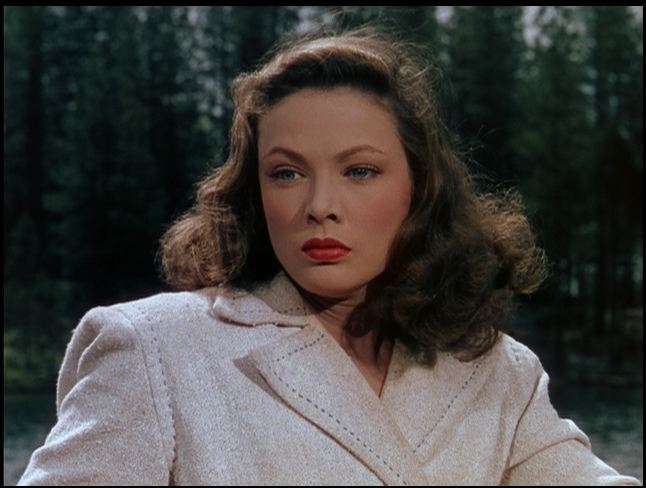
After the fact.

The film also stars the lovely and talented Jeanne Crain, who does quite a good job in the thankless role of younger sister Ruth, with not much action to speak of. Chill Wills has a supporting role, but his character does not advance to plot much at all, nor does the character of Ellen’s mother. Ellen’s father, who is never seen in the film (according to the plot, he died shortly before the main action took place), has more of an impact on the story than any of the other supporting characters, and it seems like much of what happens in terms of the supporting characters is simply filler. Many of them could have been cut out, but then again the more characters there are, the more action happens, no matter how tiny, the more evidence we have to think Ellen is a monster. I must say that one of the benefits of this movie is that it is VERY nice to look at–Cornel Wilde plays the husband, Gene Tierney the main character, and Jeanne Crain the supporting role. In all, this is a movie well-worth seeing. There is a recurring theme of eyes speaking emotions rather than words–in addition to the lake scene, there is one scene toward the end that Cornel Wilde plays completely with his eyes, absolutely brilliantly. He says not a word throughout the entire scene, but his eyes speak it all, which I say is a mark of a great actor.

If you would like to see Leave Her to Heaven, it is readily available on Netflix and in movie stores. It also happens to be shown often on public television.

Happy watching!

Star of the Week: OLIVIA DE HAVILLAND

Hello dear readers!

As promised, I am diving straight into Star of the Week mode. This segment is one where I will be focusing on one of the classic greats, showing you important clips and pictures from their work over the span of a week. This week’s honors go to a 2-time Oscar winner and living Hollywood legend, one of the last great ladies from the Golden Age of Hollywood, Olivia de Havilland.

Olivia de Havilland as Melanie Hamilton, in "Gone With the Wind."

The star of such great films as The Snake Pit (for which she was nominated for an Academy Award) and The Heiress (for which she won), her greatest success and fame was achieved through the epic 1939 masterpiece Gone With the Wind, in which she played the second lead, the demure Melanie Hamilton. She is also known for leading a high profile lawsuit against Warner Brothers in 1943, securing a release from her contract and defining what is currently known as The de Havilland Decision, a ruling that is found in law books today and is studied by those pursuing entertainment law. 5 times nominated for the Academy Award, and twice a winner, Miss de Havilland is truly one of Hollywood’s great leading ladies.

Olivia de Havilland was born in Tokyo, Japan, to British parents Walter and Lilian de Havilland, on July 1, 1916. The following year saw the birth of her sister Joan, later known to Hollywood as the actress Joan Fontaine (whom we may get to on another Star of the Week segment as she is a very fine actress in her own right), and due to the ill health of both toddlers, the family decided to uproot and resettle in the United States. The town that they found was a quaint little village by the name of Saratoga, 45 minutes south of San Francisco, and that is where they stayed. Walter soon returned to Tokyo and his practice as a patent attorney, and by 1925, Walter and Lilian were separated.

The de Havilland family in Tokyo, Japan, with some housemaids. When this picture was taken, her mother was pregnant with Olivia's sister, Joan.

Olivia and Joan were raised by their mother and a very overbearing stepfather by the name of George Fontaine, who ensured that the girls were brought up in a rigid, military fashion. This had a marked effect on both of them, and when Olivia was discovered participating in a play without permission, her stepfather gave her an ultimatum–leave the play, or leave the house. Olivia decided to leave. She was 16.

This did, however, give her the freedom to be in as many plays as she wanted, and soon became the star of such local productions as “Alice in Wonderland” and “A Midsummer Night’s Dream,” receiving accolades from The San Francisco Chronicle for her performance as Alice. She was soon discovered by Max Reinhardt, and declined a scholarship to Mills College to accept the role of Hermia in Reinhardt’s production of “A Midsummer Night’s Dream” at the Hollywood Bowl.

As Alice in Wonderland, 1932.

From there, her career took off. She reprised her role in Reinhardt’s film version of the play, and soon signed a contract to Warner Brothers studios, where she acted in a number of small-budget films before gaining status and acting alongside Bette Davis in It’s Love I’m After and Errol Flynn in The Adventures of Robin Hood, who would become her most frequent co-star and love interest. She describes her first meeting with Errol Flynn, in this adorable interview with the Academy of Achievement in 2006.

It was shortly thereafter that Olivia secured the role as Melanie Hamilton in Gone With the Wind. After convincing Jack Warner to lend her to Selznick Studios for the film, she gave a performance that secured her a nomination for Best Supporting Actress at the 1940 Academy Awards, losing, however, to Hattie McDaniel in the same film. The loss hurt Olivia at the time, but she soon came to realize what an important win that was–McDaniel was the first black actor to win an Academy Award.

Olivia and Hattie McDaniel in a scene from "Gone With the Wind."

Olivia continued to make films for Warner Brothers, notably with Errol Flynn, until 1943, when her contract expired. She was prepared to leave, until Warner Brothers told her that she had to stay on for time spent on suspension. Olivia, unsatisfied with that response and feeling an instinct that something was wrong, began researching law books and came upon an obscure California law stating that an employer may not hold an employee for a period longer than 7 years. She brought this law into court, and after a long, drawn-out battle between her and the studio, Olivia won the case, as she learned while in the South Pacific visiting wounded soldiers. She describes the experience in this interview from the Academy of Achievement:

The win was a monumental victory not only for her, but for the entire entertainment industry. Citing the de Havilland Decision, no actor may be held for more than 7 years by an employer.

In the years after the de Havilland Decision, she began to garner meatier roles,and began to establish a reputation as a raw, emotional actress. She earned her first Academy Award for To Each His Own in 1946, having been nominated twice previously (her 2nd nomination had been in 1941 for Hold Back the Dawn, for which the award ironically went to her sister, Joan Fontaine, for Suspicion), and followed that with another nomination for The Snake Pit in 1948 and a second Academy Award for The Heiress in 1949. With her husband, Marcus Goodrich (whom she had married in 1946), she had a son, Benjamin, but the marriage didn’t last, due to Goodrich’s controlling behavior toward her and their son. Shortly after their divorce, Olivia made a voyage to Paris with Benjamin, and met a charming Frenchman by the name of Pierre Galante, who would become her second husband. The family settled in the city, and Paris has been Olivia’s home for the past 50 years.

Working relatively infrequently due to her move to Paris, Olivia focused on her family, caring for Benjamin and her daughter Gisèle, born in 1956. She made some notable films in the 1960’s, including Hush…Hush, Sweet Charlotte with Bette Davis and The Light in the Piazza with Rossano Brazzi, but her life had shifted to France, where she served as the president of the Cannes Film Festival jury and was a presenter at the César Awards, France’s version of the Academy Awards. It is in Paris that she continues to live, a vibrant and active 94-year-old who is the recent recipient of the Legion d’Honneur, France’s highest accolade. She also received a standing ovation at this year’s César Awards when she was mentioned as being in the audience.

Olivia’s acknowledgment and standing ovation occur at 1:18. Sorry for those who don’t speak French, Jodie Foster’s speech is all in French. But the ovation is universal.

There is another, less happy aspect to Olivia’s life story–and that is her lifelong “feud” (though I hate that word) with her sister, Joan Fontaine. It is said that the two of them have argued since childhood, and the final blow came when Joan published her memoirs in 1978, saying not so nice things about Olivia. I don’t like to talk about the feud between them because it is SO talked about in articles about the sisters, but it is worth mentioning in a bio of her life. Both sisters refuse to comment on their relationship, which seems to be a series of miscommunications and missed opportunities between them. As I say when discussing them, it seems to be no one’s fault, simply a sad circumstance. However, it has no bearing on Olivia’s work, which is comprises a truly incredible group of films.

WHAT TO WATCH

  • The Snake Pit. This is my favorite Olivia performance. She plays a mentally ill patient in a mental hospital, and gives a number of absolutely chilling scenes as a woman who clearly does not know where she is or how she got there. A difficult role pulled off with tremendous skill. The full movie is available on youtube. Also available on Netflix and in the classic films sections of most movie stores.
  • The Heiress. Olivia’s most revered and respected performance. She plays Catherine Sloper, a naive heiress to her doctor father’s fortune, who is seduced by a man who may or not be courting her for her money. The character makes an absolutely chilling turnaround at the end, with one of the most intense final scenes in the history of film. Available on youtube and Netflix, but not usually available in movie stores.
  • The Adventures of Robin Hood. The most important of Olivia’s 8 films with Errol Flynn, and the most famous of the Robin Hood movies. Olivia plays Maid Marion, in a role typical of her early Warner Brothers days, and the movie is a great thrill to watch. Available in most movie stores.
  • Dark Mirror. Olivia plays a dual role, as twins accused of a murder. Something truly notable about this film is that the characters of the twins, though played by the same person, have completely different personalities as created by Olivia. Something very, very difficult. Also, it marks one of the early uses of split screen technology. A relatively rare film, it is not yet available on DVD, but can be found on VHS on Amazon.com and eBay. As I am hard-pressed to even come up with a clip on youtube, I give you the radio version as performed by Olivia in 1950.

I must add, too, that my choice of Olivia as this week’s Star of the Week is not entirely random. She is my favorite living actress, and I have seen just about all of her films, minus one or two that I haven’t been able to find anywhere. I also happen to be living currently in Paris, studying abroad for my university. By chance, this coming week, Olivia is introducing a new film she has narrated by the name of “I Remember Better When I Paint,” at the American Library in Paris. My friends (other Olivia de Havilland fans coming from all over Europe to see this event) and I are attending, and we are so incredibly excited about it that we can hardly stop talking about it. Of course, after this event is over, I will be reporting back with a post dedicated to our experience.

Happy watching!!

Begosh and Begorra, it’s LITTLE NELLIE KELLY!!

As I am writing to you on St. Patrick’s Day, I thought I would give you my own little pot o’ gold, an introduction and critique of that traditionally hard-to-find gem (though getting easier, it is now available on youtube and was just released on DVD!), everybody’s favorite little-known Judy Garland film, “Little Nellie Kelly!”

Released in 1940, it is the first of 2 films to team Judy Garland and George Murphy (actor and ahem…sometime governor of California), and one of a number, 3 I think, to team Judy and Charles Winninger, who really should be more well-known than he is because he is hilarious and adorable. In this movie he has a number of little motifs as Nellie’s father/grandfather (don’t worry, we’ll get to that in a minute!)–1) whenever he is angry at something, he drops his clay pipe, which promptly breaks, and 2) whenever something happens against his will, he pretends to have trouble with his heart, which is immediately cured with a swig of “medicine” (held in a very suspect flask). The film also stars the ill-fated Douglas McPhail, who looks a bit like a bonobo but we’ll forgive him because he had a hard time in life. In his day, McPhail was quite a good opera singer but never really made much out of it. He, of course, plays Nellie’s love interest. Hmmm. We know Judy’s taste in men was not the best, but MGM could have done a little better to help her out on this one.

The film begins in Ireland, at a time period we’re assuming to be sometime around 1920. A crotchety old man in a bar is yelling about work and how it is the curse of civilization. The other barflies agree with him and tell him how wise he is, and the scene makes very little sense. It does, however, introduce us to the character of Mr. Noonan, Nellie’s father (I know. Don’t worry.). He is a stubborn old Irishman who has never worked a day in his life, and is quite proud of it, much to the chagrin of his daughter, who is played by Judy doing a very unconvincing Irish accent. When he returns home he is lectured by his daughter’s bad Irish accent on the merits of working, and over the next few minutes it becomes clear that she has intended to marry a man by the name of Jerry Kelly (George Murphy). And, get ready–the man is looking for a job. OH THE HORROR. As her father refuses to have anything to do with someone looking for a job, especially when aforementioned job is in America, he tells Nellie that he cannot support this union and goes off to the bar for some more drinks.

A fine, upstanding member of society.

Of course, Nellie and Jerry DO get married, and the story begins. They move to America, as everyone seems to do if they are foreign in any movie before about 1960, and Nellie’s father ends up coming along too, even though he was insistent that he wanted to stay in Ireland, and still hates his son-in-law. They become American citizens, Jerry promptly gets a job as a policeman (after a very patriotic and somewhat awkward training scene), and Nellie promptly gets pregnant.

Ok now here is where things get interesting. Remember how I said I would explain everything with the Nellies and the fathers and the grandfathers? Here it comes. Nellie gets pregnant, has a child, and *SPOILER ALERT* (though not really because the story can’t really progress without this eventuality), dies in childbirth.

Now, people say that this film was really Judy’s beginning as a dramatic actress. Judy was only 18 when she filmed this scene, and it is incredibly powerful. She plays it as though she had the acting experience of someone twice her age–which is a recurring theme in Judy’s career, specifically in regards to her singing voice. Many people were dazzled and baffled as to how someone so young could have so much artistic power, and I think that almost dehumanizing of her led to some of her major problems in life. It is truly remarkable to see these dramatic scenes of hers so early in her career, and to remember that she was still a teenager.

Anyway, back to the movie. the daughter that Nellie has is also named Nellie (voilà). And if that weren’t confusing enough, when Nellie grows up, we can see that this is the movie in which Judy plays a dual role–she plays both Nellie AND Nellie. Good job, MGM, keep your viewers on their toes.

Nellie grows up and falls in love with a young man named Dennis Fogarty, with whom she sings the now-famous St. Patrick’s Day song, “It’s A Great Day For the Irish,” the movie version of which for some reason is not available on youtube, so I’m just going to post the version I found, from later on in Judy’s career:

The same basic story continues with Nellie as it had with Nellie (is your head spinning yet?)–yet this time little Nellie has the support of her father, who is so sweet and loving that he counteracts the temperamental grandfather. Eventually the grandfather is brought around and even gets a job! Cue musical happy ending.

The interesting thing about this movie is that it is indeed a musical, but there are a number of songs that are incidental. One of the more lovely songs in the movie is a simple lullaby, sung by the grandfather to baby Nellie, without any accompaniment. The token “Look at Judy, she can sing!” number that happens in every movie Judy did at MGM, this time occurs with a powerhouse rendition of “Singin’ In the Rain” performed as entertainment during a party. It is not by any means on the level of “A Star Is Born,” whose songs are pretty much entirely incidental (and thus may be disqualified from classification as a musical altogether), but “Little Nellie Kelly” does challenge a number of tenants of the traditional style. First off, there is rarely ever a tragic death scene in an MGM musical, and this one happens within the first 15 minutes. Also the tone is decidedly more somber than your average musical, which is accentuated by the black and white format. It is tempting to say that the black and white itself is not particularly a musical format, however I may remind myself and my readers that MGM churned out a lot of musicals in the early 1940s, and the vast majority of them were black and white because Louis B. Mayer was obsessed with saving money. However, it’s not unwise to notice that the colors on the screen do contribute to the overall tone of the film, and make it markedly more ethereal than your average MGM musical.

Then there is Judy in this movie. In my humble status as lifelong fan, I would say that this was Judy’s first stepping-stone toward real adult dramatic roles, and veritably the first film in which she actually played an adult. Many people cite “For Me And My Gal” (1942) and “Presenting Lily Mars” (1943) as her first grown-up roles, but this film tends to be overlooked by those who focus more on her second role, that which she plays for the majority of the film, of the young Nellie. Her dramatic intensity in the death scene packs a punch, especially for those used to her roles in the Andy Hardy movies and other light comedies of the 1930s. This little-known film paved the way for her work as a dramatic actress, an endeavor she achieved, notably, in “The Clock” in 1945 and the magnificent “Judgment at Nuremberg” in 1961.

If you would like to watch “Little Nellie Kelly,” it has just been released on DVD, but is not yet available through Netflix. The entire film, though of poor quality, can be found on youtube, and VHS versions are regularly for sale (averaging about $1 each!) on Amazon.com and eBay.

Happy watching!

So, I have a film blog.

This is Backlots, my answer to the repeated cries of  “Have you ever thought of making a film blog??” that have been ringing in my ears for some time now. I can now say to those parties that yes, I have thought of making a film blog–indeed, it has been created! This is a new endeavor for me, so let me outline exactly what I hope to accomplish with this site.

-I hope to give you, the reader, my take and analysis on classic movies, both familiar and unfamiliar. I’ll probably post lots of pictures.

-I would also like to choose an actor or actress of the week, write out his or her biography (most likely with my own commentary–I enjoy commentary), and dedicate the week’s post to that person’s films.

-I am definitely going to talk a lot about my favorite people, because that’s unavoidable. Prepare to hear a lot about Bette Davis, Judy Garland, Olivia de Havilland, Rosalind Russell, and other immensely fabulous people for whom I have a particular affinity.

-I want to dedicate one day a week to a specific director, in conjunction with the actor/actress of the week. This way, we can try to give the directors the credit they deserve and seldom get.

-I am going to try to make this blog as entertaining and informative as possible.

Thanks for reading! Welcome to Backlots!