In 1958, Vivien Leigh met, via satellite, with Ken Tynan and Samuel Goldwyn to discuss various Hollywood subjects on Edward R. Murrow’s show “Small World.” The show brought together a critic (Tynan), an actress (Leigh) and a producer (Goldwyn) in an attempt to get the points of view of all aspects of the motion picture industry.
A bit of history between Tynan and Vivien Leigh: Kenneth Tynan held a historical professional dislike for Vivien, often speaking badly of her when he reviewed her stage performances. Vivien took these criticisms to heart, and began to be very self-conscious during her performances for fear of a bad review from Tynan. After they met personally, however, Tynan was taken by her grace and charm toward him despite his earlier criticisms, and immediately became enraptured with her. He stopped his harsh criticism of her and began to be a frequent guest at the home of Vivien Leigh and Laurence Olivier. By the time of this program, the friendship had been established, but it is noticeable that there is still a slight friction there. Tynan seems to be pressing her, and Vivien becomes a bit defensive.
In my opinion, Kenneth Tynan in this program is rather insecure. His claims are often a bit immature from the critical perspective, and he tries to justify them without really listening to the other speakers and taking their responses in. He was young here (29 years old), and I think his discussion is not really on the same level as Vivien and Sam Goldwyn, who were much older, more experienced members of the industry. He still resorts to some attacks of Vivien (insinuating that her performance of Streetcar was not entirely believable, for example), and it is evident that many of his views on the industry are based in his youth and general inexperience.
If Kenneth Tynan was too insecure, Samuel Goldwyn was the opposite. He had just made The Best Years of Our Lives, and already referred to it as “a picture that will last,” a rather bombastic claim if you ask me, especially as it had just been finished. He also makes some ridiculous comments (my favorite moment of the entire interview is when he says “I am not yet ready to shove under the doors six or seven million dollars and go away fishing!” And Vivien responds with “What does that mean….?” Brilliant) for some reason he couldn’t remember the name of Gone With the Wind, and some remarks are just simply erroneous, like his comments about Orson Welles not having succeeded as a producer or writer. I think Vivien and Tynan were right on the target when they very loudly corrected him on that point. How he even had the idea to say something like that is beyond me.
The doubtless star of this program was Vivien. She essentially controlled the interview by making everything she said count, either by agreeing with Goldwyn or Tynan, or very articulately shooting down the silly comments they make. She also manages to work Olivier into the discussion on a number of occasions, and criticized the fact that Olivier didn’t get to do Macbeth, which was very justified I think. There is a real class in her discussion, that doesn’t manifest in the other two members of the discussion, who seemed more concerned with defending and promoting their egos than anything else.
It is a fascinating interview, and even though some silly remarks are made by the two men, all three people are very interesting to listen to. Here it is in its entirety:
In preparation for the Vivien Leigh and Laurence Olivier weekend in London this coming weekend that I have been looking forward to for months, I am dedicating this week’s Star of the Week honors to that talented and beautiful couple of the stage and screen. Though they were both tremendously gifted actors on both the stage and screen and made 3 very quality films together, it is their tumultuous, difficult, yet immensely loving 20 year marriage that make them truly one of the great romantic couples of the last century.
Each having left their respective spouses due to their love for each other (Olivier had been married to actress Jill Esmond and Leigh had been married to a barrister named Leigh Holman), their marriage was an examination of extreme emotion and volatility. Their devotion to each other was incredibly strong, strong enough to survive Vivien’s very severe case of bipolar disorder, untreatable with medication at the time, which left Olivier horrendously abused by manic episodes of which Vivien would later have no recollection. Often risking his life, Olivier stayed with her for 20 long years, trying desperately to help this woman with whom he was so in love, until concern for his own sanity forced him to leave. Their love continued even after their divorce, staying strong right up until Vivien’s death from tuberculosis in 1967.
Vivien Leigh is undoubtedly best remembered for her role in Gone With the Wind, that won her the Academy Award for Best Actress in 1939. Born Vivian Mary Hartley in Darjeeling, India, on November 5, 1913 to British parents, she was educated in England and enrolled at the Royal Academy of Dramatic Art in 1931, beginning her formal career as an actress. She married Leigh Holman the next year, and this was followed by her first film role, in a small project called Things are Looking Up. Her daughter Suzanne was born in 1933, and she embarked on a play entitled The Mask of Virtue in 1935. It was during the run of this play that Laurence Olivier first noticed her, and they began to fall in love. After playing opposite each other in Fire Over England in 1937, the deal was sealed, and they began conducting an affair that was, much to the chagrin of both their spouses, not quite secretive. By the time Vivien made Gone With the Wind in 1939 and became the first British actress to win an Academy Award, thus establishing her reputation in Hollywood, she and Olivier were already seeking divorces from their spouses in order to marry.
Vivien Leigh and Laurence Olivier in "Fire Over England."
One of the most famous scenes in Gone With the Wind.
Vivien Leigh accepts her Oscar for Best Actress.
Upon Vivien’s winning an Academy Award, Laurence Olivier was also a great stage star, having acted to great acclaim in plays by Shakespeare and Noel Coward, and had already garnered much respect for his acting style. Born in Dorking, Surrey, on May 22, 1907, Olivier spent his early career in minor theatrical roles before expanding his career to the point where he was playing the great characters such as Hamlet and Macbeth. He married Jill Esmond in 1930, and his son Tarquin was born in 1936. His affair with Vivien was especially felt by Jill, who was a friend of Vivien’s, and though she had legitimate reservations about granting Olivier the divorce he sought, she knew that she couldn’t keep him away from Vivien, so she conceded.
Laurence Olivier in Wuthering Heights, 1939.
The Oliviers married on August 31, 1940, and a Broadway production of Romeo and Juliet was followed by That Hamilton Woman, their first film as a married couple. In 1943, after a trip to North Africa, Vivien came down with what ended up being tuberculosis, a disease that would stay with her throughout the rest of her life. It was also during the mid-1940’s that Vivien began to show signs of serious mental illness–exploding at her husband with no provocation at all, then falling into a deep depression. This affected her career tremendously, limiting the roles she could perform and how often, and as the seriousness of the condition worsened, it took a terrible toll on their married life. Olivier won an Oscar in 1948 for Hamlet, and Vivien won another for A Streetcar Named Desire in 1951, but their personal life was a struggle, and after a nightmarish manic breakdown on the set of Elephant Walk in 1953 (in which she was replaced by Elizabeth Taylor), Vivien’s disorder began to control their life. In varying states of cognizance, she lashed out at Olivier and told of relationships with other actors, notably Peter Finch. According to Olivier, she never remembered these episodes, but would feel very guilty afterward and not know why. Though they officially divorced in 1960, Vivien felt that the marriage was over as early as 1958, when she began an affair with Jack Merivale. Olivier began a relationship with Joan Plowright, and married her soon after his divorce from Vivien. He was married to her until his death in 1989, and Vivien stayed with Jack Merivale until hers from the tuberculosis that had plagued her life since the mid-1940’s, in 1967. Even after their divorce, Vivien and Larry stayed very close and very much in love. Vivien wouldn’t hear of anyone speaking badly about Larry, and he was always the love of her life, and vice-versa.
It is worthwhile to note that Laurence Olivier gets a lot of hate within the Vivien Leigh community due to many of his reactions to Vivien’s episodes. One incident in particular gets a lot of attention, one in which Vivien refused to go onstage at a performance and Olivier slapped her face. However, Vivien slapped him right back, cussed at him, and did indeed go onstage. Vivien was no helpless creature, and Olivier knew that. What is also often overlooked is that through everything, all the lashing out, the sleeping around (part of bipolar disorder), the embarrassments in front of friends and guests, Olivier never left her for nearly 20 long years. That is a true testament to his character, and to his devotion to Vivien. I get upset whenever I hear people hating on Laurence Olivier, because truly, I can’t think of many other people who would do what he did for as long as he did. THAT is love.
At the end of this video, from about 6:43 to the end, he describes what it was like for him, before finally saying he can’t talk about it anymore:
Here are a few gems:
That Hamilton Woman, 1941. Their third film together, and I think it’s their best. Not only do we see these two beautiful people together at the height of their love, but we also get to hear Vivien speak French and Italian, two languages she spoke fluently in real life. Not bad.
Laurence Olivier’s “Hamlet,” 1941, for which he won an Oscar. I consider this to be one of the finest performances ever recorded onscreen. If you see one Olivier film, this is it. Brilliance.
Waterloo Bridge, 1940. I think this is my number 1 favorite Vivien Leigh film (Gone With the Wind is automatically disqualified). One thing I didn’t focus on in this post is Vivien Leigh’s absolutely stunning looks. In fact, I officially consider her the most beautiful woman I have ever seen. And this movie shows it. Playing a young ballet dancer who falls in love with a soldier during World War I, she is perfectly comfortable in the part and there are great performances all around. A must-see.
Wuthering Heights, 1939. In the glorious year that was 1939, this is one of the top contenders for the best of the best. Olivier too was at the height of his attractiveness here, and Merle Oberon is perfect as Cathy (even though Olivier wanted Vivien in the part). I know I showed a clip earlier in this post, but it’s worth showing another because it’s just so darn good.
Sidewalks of London, 1938. This is a total B-movie, but I had to add it in here because it’s so funny to hear prim and proper Vivien try to speak in a cockney accent. And there’s also one scene where Vivien tap dances across the floor, which is classic. If you can find this (it’s not easy…) it’s worth a look. Very funny stuff.
I hope you enjoyed! I will be spending this weekend in London for the Vivien Leigh and Laurence Olivier weekend, and I will be checking in as often as I can with updates about the stars of the week! Thank you Kendra, at vivandlarry.com!
For my second installment in the Woody Allen blogathon, I am going to profile one of my all-time favorites–Allen’s first directed film, What’s Up, Tiger Lily?
After the success of his script What’s New, Pussycat the previous year, Allen was ready to try his hand at directing. For his next project, he chose to not work so hard, and rely on the very simple comedy that comes from turning off the volume on a video and adding your own dialogue.
This movie is so ridiculous I feel like I can’t even communicate it properly. Basically, the premise is this: a secret agent, Phil Moskowitz, is hired by a king of a strange country (“nonexistent, but real-sounding”) to find the world’s best egg salad recipe that was stolen from him. The catch (as though there had to be more of a catch than that) is that this movie was not filmed or created, per se, by Woody Allen–it is simply a series of clips from a very serious Japanese spy movie, with all the dialogue cut out and replaced with Allen’s own.
The characters traverse all over the globe in search of this egg salad recipe, and in the process they get stuck in a safe, stuck on a boat getting shot at, and other ridiculous circumstances that could only happen in a movie like this.
The plot is so crazy that it’s quite hard to follow, if it was supposed to have been followed at all, which is doubtful. The jokes are silly and often quite dumb, which is part of its charm–to say this film doesn’t take itself seriously is a massive understatement. Actor Tatsuya Mihashi plays Phil Moskowitz (yes, I know), and his character is all over the map all the time. In fact, none of the characters have any sort of development, which makes it markedly different from the previous Woody Allen film I profiled, Annie Hall, but it gives the movie a feel of improvisation. Given the subject matter, that makes it all the more hilarious.
Interspersed in between scenes are oddly-placed musical numbers performed by The Lovin’ Spoonful:
These were added against Woody Allen’s wishes, and I really don’t know who had the strange idea to have a folk group appear in a movie like this. The songs are catchy and great, but they really don’t fit. After this experience, Allen sought to have creative approval for the rest of his films, which was probably a smart move.
The end credits may be the best part of What’s Up, Tiger Lily. They have nothing to do with the rest of the movie, but instead feature a striptease:
If the movie has a flaw, it would be that the general insanity of the plot makes it either absolutely fall-down funny, or very puzzling and boring. Especially with the interspersion of the Lovin’ Spoonful numbers, the movie has an air of being unfinished or badly edited, which might be a turnoff to some viewers, but in all honesty, if it had a real structure it would be a completely different film and probably a whole lot less funny.
If you would like to see What’s Up, Tiger Lily and you don’t have Netflix, you might have some trouble finding it. I know it’s available to buy on Amazon.com and to view on Netflix, but I have never found it in any mainstream video stores. I wish it were more widely available, because I think it’s a Woody Allen treasure that not a lot of people are familiar with.
Since my Wizard of Oz post garnered so many comments and questions about Judy Garland, I’ll dedicate a blog post to the essentials of Judy, who is basically the love of my life, and the reason I got into classic film in the first place.
I outlined some biographical information in my Wizard of Oz post, but here are some of the basics. Judy was born Frances Ethel Gumm on June 10, 1922 in Grand Rapids, MN. She made her debut at the age of 2 and a half singing “Jingle Bells” at her father’s theater in Grand Rapids, and from there she joined her sisters in their vaudeville act, known as “The Gumm Sisters,” touring the country in what Judy later called “rotten vaudeville.” She was always the standout in the act, however, and was often known as “The Little Girl With the Great Big Voice.” She and her older sisters made their first short film in 1929 when Judy was 7, called “The Big Revue.”
Judy enters at 0:34.
In 1935 she was signed to MGM Studios and began to make radio appearances, notably “Zing Went the Strings of My Heart” on the Shell Chateau Hour, broadcast as her father was ill in the hospital, and it is said that her voice on the radio was the last thing he heard (he died later that night). Once signed to MGM, she began to make small, low-budget films, her first being “Every Sunday” in 1936, a short subject with Deanna Durbin. She was loaned to Fox for Pigskin Parade, which became her first full-length motion picture, and upon her return to MGM she starred in her first of 10 films with Mickey Rooney, Thoroughbreds Don’t Cry, in 1937. This was followed by Everybody Sing and her second film with Rooney, Love Finds AndyHardy, in 1938.
“Swing, Mr. Mendelssohn,” from Everybody Sing, 1938.
Love Finds Andy Hardy, 1938. This scene also features a very young Lana Turner, who later became a rival of Judy’s over the clarinetist Artie Shaw.
She was cast as Dorothy in The Wizard of Oz just after completion of Love Finds Andy Hardy, and the film was not easy for her. Being 16 years old and playing 12, she had to be fitted with a restricting corset to hide her figure and had to deal with the pressures of preparing to graduate from high school while making a high-budget film like Oz. At the Oscars that year, however, she was awarded the Best Performance by a Juvenile Oscar for her performance.
The same year, Judy became smitten with clarinetist Artie Shaw, several years her senior. They went out together on numerous occasions, and Shaw led Judy to believe that he was seriously interested in pursuing a relationship with her, so when Shaw married Lana Turner after their very first date, Judy was completely heartbroken. When she got the news of their wedding, another musician, David Rose, happened to be there with her. He consoled her and took her out for a drink, and so started the relationship that would turn into Judy’s first marriage.
In my opinion, Judy’s heartbreak over Artie Shaw cemented Judy’s future of romantic troubles. Her self-esteem was already low, and to have Shaw reject her for a more classically beautiful (or so she thought) woman just made her feel as though she was not attractive to any man, and clung on to those who liked her. She had a total of 5 marriages.
Shortly after the completion of The Wizard of Oz, MGM began Judy on a strict regimen of diet pills, pep pills, and downers to keep her “in shape” for the movies they had planned for her. As such, as early as 1941, one can see the difference in her physical appearance as a result of too many pills.
‘How About You,” from Babes on Broadway, 1941.
She married her first husband, David Rose, at the age of 19 in 1941, and in 1943 they divorced. This left her open to marry Vincente Minnelli, her director in Meet Me In St. Louis, with whom she had fallen in love. They married in 1945, and their daughter Liza was born in 1946.
By this time, Judy’s dependence on pills had become severe. By 1948, Vincente was discovering pills lined in her costumes, and by 1949 she was becoming so difficult as a result of the pills that MGM couldn’t afford to risk her anymore, and she was fired in 1950.
After her release from MGM, Judy began a highly successful concert career, touring the country and playing for a whopping record 19 weeks at the Palace Theater in New York in 1951. She had divorced Vincente by this time and had fallen in love with Sid Luft, her manager. They married in 1952, and their daughter Lorna was born later that year. In addition to her addiction to pills, Judy was also beginning to struggle severely with her weight.
In 1954, Sid Luft began to prepare her comeback to the screen, in a remake of the 1937 classic A Star is Born. Judy played Esther Blodgett, the singer who was made into a movie star by a washed up legend who had descended into alcoholism, and becomes her husband. Many scenes in this movie reflect Judy’s own inner battles, and one can see her struggle with herself as she describes, as her character, her struggles with her husband’s alcoholism:
She was nominated for an Academy Award for her role, and as she had just given birth to her third child, Joe, she was laid up in the hospital as the awards were announced. The Hollywood community was so sure that she would win, they sent cameras to televise her acceptance speech.
The loss was an immense shock, and prompted letters of condolence from many people in Hollywood. Groucho Marx called it “The greatest robbery since Brink’s.”
Judy did, however, return to her concert career, but in 1958 began to rapidly gain weight, getting as heavy as 180 pounds (she was 4’11” tall). In 1959 she was diagnosed with hepatitis, and 20 quarts of fluid were drained from her body. She was told by doctors that her career was over, she would never sing again. But in 1961, in another triumphant comeback, she played Carnegie Hall for one glorious night on April 23. She garnered multiple awards for the concert and the ensuing album, including a Grammy, and the album spent 13 weeks as Billboard’s number one album.
In 1963, Judy embarked on a television series that, while short-lived, made a lasting impression. Some of the performances from The Judy Garland Show are considered to be the very best ever filmed.
It was cancelled after 26 episodes, due to problems with scheduling.
Judy’s final years were difficult. Her dependence on pills had made her often very “out of it,” and she began to experience withdrawal seizures. In 1965 she married Mark Herron, a marriage which lasted only 6 months. She married Mickey Deans, her last husband on March 22, 1969 and she gave her final concert on March 25, before her death on June 22, at her home in London, at the age of 47. The cause of death was an accidental overdose of Seconal.
Judy never wanted to be considered a tragedy. Many people, when learning that I’m a Judy fan, say “She had such a tragic life!” She never wanted to be thought of that way. She had a very keen sense of humor about herself, and would often make fun of the plights she experienced with pills, money, weight, and men. I think the most lasting thing we can give to her would be to not think of her as a tragedy, but rather as an immense actress and singer, and a wonderful personality.
And so starts Annie Hall, Woody Allen’s classic examination of love in the modern world.
I consider this to be his masterpiece–a very funny, smart, and often poignant look at modern relationships, from the perspective of a neurotic New Yorker. This movie has been a part of my life for a very long time, lines from it have been appropriated by my family and I know just about every scene by heart. Coming from a rather neurotic Jewish family myself, the main character is essentially a composite of every person in my family. And as such it is very much beloved.
The story concerns itself with Alvie Singer, a comedian who insists that he grew up in Brooklyn underneath the roller coaster, though his analyst says he exaggerates his childhood memories. He recalls being neurotic as a child about the universe expanding:
All this serves to strengthen Alvie’s character for the duration of the movie. Despite his neuroses (or perhaps because of them), Alvie is a VERY strong and well-developed character. In fact, I believe that the character development in this movie, of all the characters, is perhaps one of the best in the history of film. Even the minor characters that only appear in one scene (Annie’s grandmother, for example, who Alvie refers to as a “classic Jew-hater”) have a real biography and history behind them. The scenes with Alvie’s other relationship partners are also wonderful examples of this:
Carol Kane as “Allison Porchnik”
Shelley Duvall as “Pam”
The character of Annie Hall herself is established very skillfully right away, partly due to Allen’s brilliant writing, partly to the masterful direction and I think the majority is due to Diane Keaton’s completely natural ability in the character of Annie. It is said that Annie Hall was based on Keaton herself–she had dated Woody Allen in the early 1970’s, and if one is aware that her original last name was Hall and she was called “Annie” as a child, it certainly seems more than likely.
The story is told in a series of flashbacks, and the flashback sequence where Alvie meets Annie for the first time is a true testament to Keaton’s brilliance in capturing the character:
From this scene, we begin to see the relationship between Annie and Alvie develop, through a series of revelatory scenes that connect the two characters psychologically and develop their characters as they relate to each other. Their relationship is more one of “opposites attract” than a true kinship, and their status as an “unlikely couple” gives the film much of its quirky charm.
Another recurring theme in this movie is intellectualism, with an almost incessant dropping of names and references to major figures in literature, popular culture, and psychology. In a classic scene, at the very beginning of the film, we really see what intellect means to Alvie, for better or for worse:
Alvie, as we are reminded multiple times throughout the film, has been in therapy for 15 years and wants Annie to go, too. He pays for her sessions, and this concept of their both being in therapy paves the way for lots of intellectual discussions about the nature of psychology. Alvie seems very concerned about Annie and her lack of depth, as he perceives it, and he tries to get Annie to expand her intellectual horizons by going to adult education courses. When she does, and begins to crush on her professor, Alvie ridicules intellectualism in general because it interferes with his own intentions with Annie.
The whole film is really a game, playing with the audience in regard to the characters, their insecurities, and their general humanity. It lacks a traditional ending, with Allen preferring, I think, to keep the movie entirely real and more like an examination of characters rather than just a piece of entertainment. It certainly succeeds, and it won Best Actress (Diane Keaton), Best Director, Best Screenplay, and Best Picture at the 1977 Oscars.
Here is Diane Keaton giving her Oscar speech:
Annie Hall is a favorite of film fans and is widely available. You might have a tougher time finding it at the huge movie outlets, as it’s still considered an offbeat movie appealing only to certain audiences (because it’s so intellectual), but Netflix has it, and most independent movie outlets have it, and you generally shouldn’t have too much trouble finding it at all. It’s VERY funny, very quirky, the writing is impeccable and it is a truly joyful movie experience.
Well, no one saw this coming, did they? Those of you who know me know that The Wizard of Oz (or, more accurately, Judy Garland) is very special to me. When I learned there was to be a 1939 blogathon through YAM, I actually got a bit concerned because I didn’t know if my computer battery would last for an entire Wizard of Oz post and I thought of profiling other movies. But it would be sacrilege for me not to, so I am attempting it now.
The Wizard of Oz has been a part of my life since the age of 2. I watched it, wide-eyed, with my parents and apparently (though I don’t remember) wasn’t scared of anything and was more interested in watching the pretty colors and hearing “Over the Rainbow.” Two years later, when my grandmother showed me “Meet Me In St. Louis,” I became a full-fledged Judy Garland fan and have never turned back. I regularly attend the Judy Garland Festival in Grand Rapids, MN (about 3 hours plane ride from my home), and at the age of 13 I won a trivia contest there and was interviewed for NPR. Yeah. It’s pretty serious. Knowing that background, you can understand how The Wizard of Oz might be very important to me. Judy Garland’s signature film (though we’ll go into that later), and one that stayed with her right up until her very last concert, it has a place in the hearts and minds of everyone, whether they like it or not. It has had a place in our collective consciousness for 3 generations, and it showing no signs of stopping for the next, especially with the multi-annual showings on TBS that make it even more accessible for the younger generation. Its themes are timeless, and it has something for everyone, at every age.
In the interest of space and readability, I am going to refrain from doing too much analysis of the movie here. I will focus on biographical aspects of the actors, and some trivia–I could write for hours on end about this movie (and I have–I once wrote a paper on the themes of transference from child to adult in The Wizard of Oz and it was about 25 pages long), but for the purposes of this blog and this blogathon, I’m keeping myself back a bit in the interest of space and readability.
I’ll start with the casting and general information about the actors and their roles in this movie: The Wicked Witch of the West was played by Margaret Hamilton, who in my opinion deserved to win Best Actress (or at least Best Supporting Actress) for this movie. A former housewife turned movie actress to support her family, she was well-loved and a sweet person by all accounts. To demonstrate the kind of person she was, it is sufficient to say that throughout her life, both before and after her acting career, she taught Sunday School and kindergarten. After Oz, Hamilton continued her career in radio and television, before retiring in the late 1970s. She died in 1985.
Hamilton is often remembered for her commercials for Maxwell House coffee:
Another reason I think she should have gotten some kind of award for this role is the scene where she disappears after the famous line “I’ll get you, my pretty, and your little dog too!” For this scene, Hamilton was to step onto a hidden elevator, and be carried down under the scenery. During a rehearsal, when she stepped on the elevator door, there was an electrical malfunction and since Hamilton’s makeup was copper-toned, she ended up with horrendous burns on her face and had to be taken out of the picture for a number of weeks. If that doesn’t put you in the running for an Oscar, I don’t know what does.
The lovely Jack Haley was not the first choice for the Tin Man. The original choice was actually Ray Bolger, who ended up playing the Scarecrow. Bolger expressed his preference for the Scarecrow due to his idol, Fred Stone, having played the role on the stage, and an actor by the name of Buddy Ebsen (Beverly Hillbillies, anyone?), who was originally slated to play the Scarecrow, was switched to the Tin Man. He was all set to do the picture until the aluminum powder in his makeup got into his lungs and lay him up in the hospital, putting him out of the picture.
Are you sensing a theme? Forget “Poltergeist,” I swear this film had a curse.
They brought in Jack Haley, a vaudeville actor who had done a number of musical pictures in the early 1930’s, to replace Ebsen, and the brilliant men in the makeup department decided to change aluminum powder to aluminum paste, thereby rendering Haley presumably safe. Phew. But then he got an eye infection. See what I mean? Haley’s work in Oz was his true masterpiece, and though he continued to act in pictures and in television and radio, he never quite matched what he did with Oz. He died in 1979.
Ray Bolger’s preference for the Scarecrow, as I mentioned in the previous paragraph, was due to his idol, Fred Stone, having played the role on the stage. A brilliant dancer, he had been on Broadway in the early 1930’s, and signed with MGM in 1936. Prior to making The Wizard of Oz, and he had portrayed himself in The Great Ziegfeld, and in 1946 Bolger went on to do another film with Judy Garland, “The Harvey Girls,” and also made an appearance on Judy’s television series in 1963. He was the last surviving main cast member of Oz, until his death in 1987.
Bert Lahr was a successful actor in vaudeville and on the stage, who had worked with the great British comedienne Beatrice Lillie in The Show is On. He was chosen for this role early on in the film’s planning stages, likely due to his lion-like looks and charm. His costume was composed of real lion fur and was said to weigh upwards of 50 pounds, prompting him to complain outwardly of the heat under the hot MGM lights. He continued to act on the stage through the 1960’s, participating notably a rather disastrous run of Waiting for Godot in 1956, and passed away due to cancer in 1967.
A trivia bit about the scene with the Cowardly Lion: during rehearsals, Judy, then 16, was known for bursting into adolescent giggles. At one particular one, when the lion makes his first entrance and Judy slaps him on the nose, she couldn’t get a take without laughing. Apparently, Victor Fleming came down and, in an event that could never happen today without Fleming getting indicted for child abuse, slapped Judy across the face to get her to stop laughing. During the next take, Judy did not outwardly laugh, but you can see that Fleming had not completely won–Judy pushes Toto in front of her face to cover a visible smile. Watch for it.
Billie Burke, who had been married to Florenz Ziegfeld until his death in 1932, seemed the perfect choice for the gentle, slightly dotty Glinda, the Good Witch of the North. After a wonderful career on Broadway, she had played very successfully opposite Jean Harlow in 1933’s “Dinner at Eight,” and had made “Everybody Sing” with Judy Garland in 1938 (which, by the way, is one of my favorites). Typically playing dizzy, slightly neurotic women, she was nominated for an Oscar in 1938 for Merrily We Live. She made a number of other MGM films and acted on the stage until her retirement in 1960. She died in 1970.
The Munchkins are credited in the film as “The Singer Midgets.” A good portion of the munchkins were indeed performers with Leo Singer, a showman from Vienna who had a troupe of little people working in entertainment there. However, as Singer’s troupe only comprised about 30 little people, MGM hired him to find more to put in the film. There are a grand total of 124 munchkins in the film, along with a few children. 4 of the original little people are still living today, and received a star on the Walk of Fame in 2007.
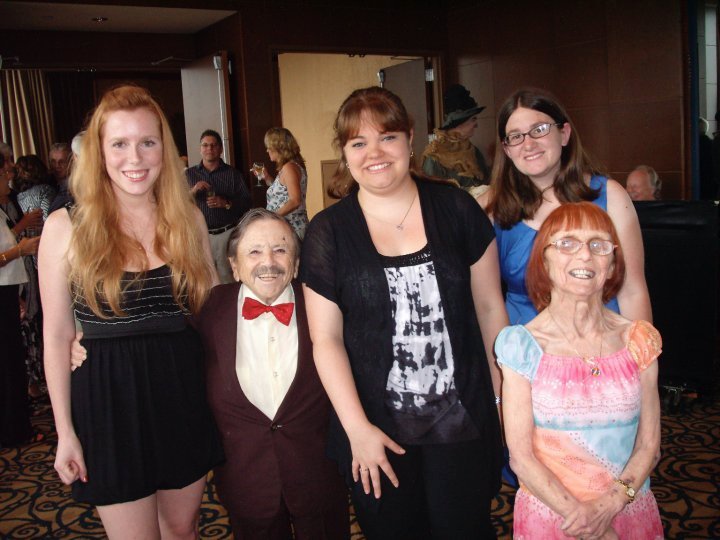
Some friends of mine and me at the Judy Garland Festival, with Jerry Maren (the Lollipop Kid munchkin) and his wife Elizabeth.
And last but not least…
Judy Garland came from a vaudeville family, making her stage debut at the age of 2 and a half, singing “Jingle Bells” at her father’s theater in Grand Rapids, MN. She continued acting with her sisters in their vaudeville routine until 1935, when she was signed to MGM at the age of 13. She began her MGM career with a number of small films, and then began to take off with a succession of films with Mickey Rooney, namely Thoroughbreds Don’t Cry in 1937 and Love Finds Andy Hardy in 1938. The Wizard of Oz was her 16th film with MGM.
True to Wizard of Oz fashion, Judy was also not the first choice for Dorothy. It’s rather well-known that they originally wanted Shirley Temple, who was quite a bit younger, but 1) Fox wouldn’t let her out of her contract, and 2) she couldn’t sing. The musical arranger at MGM, Roger Edens, had been working with Judy since her arrival at MGM 3 years before, and they had grown quite close. He was overwhelmed by her talent, and he supported her being cast in the role of Dorothy when Shirley Temple was unavailable and unfitting. The Wizard of Oz, and specifically “Over the Rainbow,” stayed with her until her death. It seemed to be an anthem for her, in a life that was often difficult, this song, with its themes of flying over the rainbow to a land “where troubles melt like lemondrops” seems fitting. Here are some other notable clips of her singing “Over the Rainbow throughout her career:
Command Performance for the troops, 1943
Ford Star Jubilee, 1955.
Performing with daughter Liza at the London Palladium, 1964.
And Judy’s very last performance of “Over the Rainbow,” on March 25, 1969 in Copenhagen. She died less than 2 months later.
Shortly after the filming of The Wizard of Oz, MGM began supplying Judy with a cocktail of pills, to put her to sleep, wake her up, and make her lose weight. She soon became addicted, and her addiction to pills is now what many people think of when they think of Judy’s private life. Due to her addiction and growing difficulty with the side effects in her private life, Judy began to become unreliable on the set and was fired from MGM in 1950. She began a very successful concert career, and made a comeback to films with A Star is Born in 1954, which garnered her an Oscar nomination.
Now, people say that The Wizard of Oz is Judy’s signature film. Though I think for most audiences it is, I don’t believe it’s her best. That honor, in my book, would have to go to “A Star is Born,” her comeback in 1954. But “Over the Rainbow” saved her. I don’t think she would have lived as long had she not lived for this song. She died of an accidental Seconal overdose at her home in London, on June 22, 1969, aged 47.
The Wizard of Oz is literally available everywhere. But I would venture to say that there is not one person reading this who has not seen it, multiple times. It is a true institution in this country and the world, and it holds a very important place in the history of film.
Thank you to YAM for hosting this 1939 blogathon, and happy watching!
A zany comedy with a script that is so absurd it’s almost surreal, “My Man Godfrey” is one of the films that I think deserves more credit outside the classic film community than it gets. A showcase of the very different comic styles of both Carole Lombard and William Powell, it is, I think, one of the more advanced comedies to come out of the 1930’s.
The story deals with a high society girl, Irene, who plucks a homeless man out of the ash pile to bring to a “scavenger hunt” at a high society party. See what I mean about absurd? The scavenger hunt had as its last requirement the finding of a “forgotten man,” and bringing him to the party, so this girl went down to the ash pile next to the Brooklyn Bridge and found a homeless man.
She wins the prize, much to the chagrin of her sister, who had tried to coerce the homeless man into coming with her first. Irene feels grateful to the homeless man, whose name we have learned is Godfrey, for helping her win the coveted prize, and as thanks, she offers him the position of butler in their house. Neither the sister nor the mother (who is truly nutty, and who had, by the way, had found a goat the scavenger hunt…) approves. He is hired nonetheless by Irene, and begins his work the next morning.
We learn straight away that this family is even more nutty than it seems. The mother has a protégé by the name of Carlo who eats too much and is a drama queen, the mother herself has a tendency to see pixies when she is hungover (which is often), Irene is prone to fake fainting spells when she doesn’t get her way (which Carlo attempts to quell by acting like a gorilla to make her laugh), the older sister is a spoiled brat and the father is on the brink of bankruptcy and bitter about how insane his family is. Godfrey is the only butler who has stayed more than a short period of time, and the father wonders why he decides to stay. His ability to stay with the family makes him suspicious of his actual identity. Irene, naturally, falls in love with him, and this only complicates things for Godfrey.
In fact, we learn that Godfrey is not a homeless man by necessity, but rather by choice. He came from a prominent Boston family, and embittered by society life, he admired the men who lived on nothing and decided to become one of them. The family does not know this, and he does not tell them. That is, until the end, after a series of mishaps ensue (namely the disappearance of the brat sister’s pearl necklace) and…well, I won’t tell you the end.
Carole Lombard is perfect in the role of Irene, with her sweet, eccentric humor, and William Powell plays the straight man very well with most of his humor being in his physical presence. There is one scene where he is simply walking up the stairs, and it is funny as can be. The mother, played by Alice Brady, however, may steal the show away from both of them. Her nuttiness is pretty much the comic center of the movie. Although Alice Brady is perfect, if I were to recast the film with other actors fitting the roles perfectly, I would cast Billie Burke as the mother.
“My Man Godfrey” is brilliantly well-written, on a number of levels. On one level, it is full of zingers and one-liners, many of which are delivered so quickly that it takes a moment to realize what was just said. One of my favorites, between Godfrey and the maid:
GODFREY: May I be frank?
MAID: Is that your name?
GODFREY: I’m Godfrey.
MAID: Oh. Be Frank.
As I mentioned earlier, another aspect of the script is its complete and unapologetic absurdity. When Irene has one of her fake fainting spells, Godfrey puts her in the shower and turns the cold water on to teach her a lesson, and Irene takes this to mean that Godfrey is in love with her. The mother says nothing but things that don’t make any sense, and her reactions to anything negative have to do with how they’re affecting Carlo. Toward the end of the movie, the father finally has enough of Carlo and throws him out the window. If this movie has a fault, it’s that it may be TOO absurd for many people. My personal taste says that nothing is too absurd, but it’s just way over the top and surreal.
The film also ends in a very strange way, leaving the viewer almost feeling like something was intended to be there but never made the final cut. When the film ended the first time I watched it I was very confused–is it really over? It leaves one expecting something more.
My Man Godfrey is not VERY widely available, but you should be able to find it on Netflix. They recently colorized it, and don’t get that version if you can avoid it. The original black and white is always the best option.
Since it was Katharine Hepburn’s birthday on Thursday, May 12, Backlots is acknowledging the occasion with a short biography of the legend, and a celebration of some of her great films and roles.
Born in Hartford, Connecticut on May 12, 1907, Katharine Houghton Hepburn was the second of 6 children born to Thomas Norval Hepburn and Katharine Houghton (yes, she was indeed named after her mother), a progressive couple well-regarded in the Hartford community. A generally happy childhood (marred, however, by the suicide of her older brother Tom, which had a tremendous effect on her throughout her life–she consistently listed her birthday as November 7, which was Tom’s) was followed by attendance at Bryn Mawr college, where she began her theatrical career in university productions. At the age of 25, she made her first onscreen appearance opposite John Barrymore in A Bill of Divorcement (1932), which was followed the next year by Morning Glory (1933) which garnered her the first of her 4 Academy Awards (the other three for Guess Who’s Coming to Dinner (1967) The Lion in Winter (1968, for which she tied with Barbra Streisand in “Funny Girl”) and On Golden Pond (1982). Her career spanned 6 decades, she influenced women’s fashion by popularizing pants, and was a true independent spirit. Her final film was made in 1994, and she remained active well into her final days. Reports say that she continued to ride a bicycle until a hip problem in her late 80’s precluded it, and she was sharp and witty right up until her death in 2003 at the age of 96.
Hepburn was an immensely versatile actress, capable of playing comedy and tragedy with equal skill, as evidenced in part by the screwball comedy Bringing Up Baby (1938) and the royal tragedy Mary of Scotland (1936), along with the hilarious The Philadelphia Story (1940) and the dramatic The Lion in Winter. She is widely considered to be the best actress of all time, and given her track record, Backlots does not dispute it.
Here are some of her best roles. I will start with her Oscar-winning performances:
Morning Glory (1933)
Guess Who’s Coming to Dinner (1967). The young girl at 0:38 is Hepburn’s niece, Katharine Houghton. She plays the main character in this film (although truthfully the movie is centered more on the older generation than the younger, in a commentary about changing times), and though she’s not a great actress, it’s interesting to watch her.
The Lion In Winter (1968). Hepburn plays Eleanor of Aquitaine, opposite Peter O’Toole. Katharine Hepburn was known for not attending the Oscars, and this fact was made clear when she shared the Oscar with Barbra Streisand in 1968, who was all too happy to give her speech while Hepburn did not attend.
On Golden Pond, 1982, opposite Henry Fonda. A lovely performance, also featuring Fonda’s daughter, Jane.
Some other greats:
Bringing Up Baby, 1938. One of my personal favorites. It’s the perfect screwball comedy, and Cary Grant is hilarious as well. Interestingly, shortly after this movie was made, Katharine Hepburn was voted “box office poison,” due to her string of flops, but “Bringing Up Baby”was loved by the critics.
The Philadelphia Story, 1940. Considered to be one of the best Hepburn films, I think she deserved the Oscar that year, though she was up against some tough competition (Joan Fontaine in “Rebecca,” and Ginger Rogers in “Kitty Foyle,” who won). It’s a very dignified comedy, and boasts great performances all around.
Holiday, 1938. Another one of my personal favorites. The story of a young spirited girl stifled by her society family, Hepburn is completely at ease in the role and it’s great fun to watch. Highly recommended.
In addition to the films I’ve profiled here, I would also recommend:
Little Women (1933)
Alice Adams (1935)
Woman of the Year (1942)
Adam’s Rib (1949)
The African Queen (1951)
Suddenly, Last Summer (1959)
Truthfully, I think you can’t go very wrong with Katharine Hepburn. With the exception of Spitfire (1934) and Dragon Seed (1942, where she plays a Chinese person. No, really), I don’t think she really made a completely bad film, even the “string of flops” that earned her the “box office poison” label in the late 1930’s are not so bad.
To close, I leave you with an interview clip that truly shows how much respect she had in the industry. She was known for being assertive and for being a powerful woman, and it shows here. Watch the tech guys as they cave to her every demand. They are just putty in her hands. Katharine Hepburn was more than a legend, she is immortal. Happy birthday, Kate!
My good friend Caroline over at GARBO LAUGHS had the brilliant idea of putting together a blogathon, in which various film blogs are invited to participate in celebrating LGBT presence in films. As a longtime proponent of all things both film and gay, I have decided to have Backlots participate in this blogathon, and the film I have chosen to profile is that always classic, always relevant winner of 1972’s Best Picture, Best Actress, and Best Supporting Actor Oscars (along with 5 more for cinematography, editing, art direction, song, and sound)–the immortal “Cabaret.”
If I could talk about “Cabaret” every week, I would. It is one of my favorite musicals (though as I will discuss later, I call into question its status as a legitimate musical), and it’s really no wonder why. Not only is it a brilliantly constructed film on every level–scenery, costumes, sound, visual effects, acting, singing, dancing, the list goes on and on–but it has the added bonus of having Liza Minnelli (gay icon, reason #1 for my choosing this movie), at the peak of her career, bringing the house down with her powerhouse vocals and dancing ability. Now, I am a big Liza fan. I have seen her in concert 4 times, seen all her movies, and just generally adore her, so when one is a big Liza fan, it generally follows that one is also a big “Cabaret” fan. This movie IS Liza. In fact, at the last concert of hers that I went to, there was a little girl, no more than 6, who was dressed as Sally Bowles from Cabaret. Liza pulled her out of the audience, stood her onstage, and had her take a bow. And everyone knew exactly who she was supposed to be.
The second reason I chose this film for the blogathon is that the male lead (Michael York) is gay. Or, more accurately, “doesn’t sleep with girls.” We become aware of this fact early on in the film, during a scene in which Sally has been trying unsuccessfully to come onto him. She mutters “Maybe you just don’t sleep with girls…” and noting his silence, she changes her tone and says “Oh….you don’t…!” We come to learn that he has slept with three girls, and all 3 times were disastrous, prompting him to forget all about them and switch to men. His sexuality is regarded as simply a fact, and throughout the film it is not called into question too often. There is, however, a very strong chemistry between him and one of the other male characters. It’s misleading (so to speak) to call this second man a lead, because he doesn’t have too much of a role other than as the sometime boy toy of Michael York. As the film progresses, Sally manages to bring him around to women, or more precisely, HER, until she realizes that they both have been sleeping with the same man, this second lead character.
A bit about the history of homosexuality onscreen, as it relates to this movie and its visibility: in the wake of the breakdown of the Hays Code in the late 1960’s, the liberation movement, and the Stonewall Riots, which occurred 3 years before the release of “Cabaret,” gay characters and situations were becoming more and more prominent onscreen. Under the code, the only way for a filmmaker to incorporate a gay character or scene into their film would be to resort to subtle innuendo–films like “Rebecca” (1940, my second choice for this blogathon) succeeded in showing a character’s sexuality by way of very strong innuendo, which proved effective in skillful hands. But more often than not, any sexual content would be nixed by the censorship board and the film would end up on the cutting room floor. Fortunately, the Hays Code broke down in 1968 in favor of the Motion Picture Association of America, which devised the current ratings system. Due to its themes, “Cabaret” is rated R, and my mother wouldn’t let me see it until I was 13. The themes were not so much the problem in my family, but instead the issue was scenes like this:
As the opening credits tell us, the story begins in Berlin in 1931. The Nazis were just coming into power, and the cabaret was the place where people retreated when “life was disappointing.” In the first scene, we are introduced to the character not named in the film, but who is known as “The MC.” Playing him is the brilliant Joel Grey, who came to the film from the Broadway production (interestingly, Grey is one of only three performers to have won a Tony and an Oscar for the same role, along with Rex Harrison and Yul Brynner).
Sally Bowles, an American chorus girl at the cabaret, meets Brian, a young English teacher newly arrived in Berlin, and offers him the spare room in the boarding house where she lives. They promptly become great friends and she attends an English lesson of Brian’s, only to make snarky remarks and teach the two students how to say naughty words. One of the students at the lesson is a young Jewish girl, Natasha, from a prominent Berlin family, and it is obvious that the other student, Fritz, is very taken with her. He ultimately falls in love with her, which proves problematic as the Jews face more and more persecution as the Nazis gain more power. Fritz also has a dark secret of his own, which complicates his feelings even further.
Sally and Brian remain friends, despite Sally’s attempts to make him fall for her, and when Sally meets a new friend named Maximillian, Brian feels left out. Ultimately, however, Brian and Maximillian begin sleeping together, Brian not knowing that Sally was doing the same.
A love triangle emerges, resulting in Sally’s pregnancy. Brian urges her to keep the baby, but Sally decides otherwise and terminates the pregnancy. This ruptures their relationship and the film ends as Sally leaves Brian at the train station, before going back to the cabaret to sing the final song, the triumphant “Cabaret.”
All the action takes place against the backdrop of the Nazis’ ascent to power, juxtaposed with the seemingly oppositional scenes at the cabaret. Interestingly, all the songs in this movie are incidental, performed either at the cabaret or in other appropriate places. The closest we get to an actual impromptu musical sequence is the chilling “Tomorrow Belongs to Me,” performed at a Nazi rally in a park. Here we see Brian and Maximillian courting as the Nazis have a rally in the background.
This is why I hesitate to classify “Cabaret” as a traditional musical. There is no “breaking out into song,” only music in places where it would exist in real life. This is similar to the masterpiece of Liza’s mother, Judy Garland (we’re going to discuss Judy later, because I can’t rein myself in when talking about her), “A Star Is Born,” which prompts similar questions about its status as a musical.
The character of the MC is eerie from the start, and through various songs he performs at the cabaret, we can deduce that he has some questionable leanings.
My general analysis of this film is that the MC represents Nazism itself, permeating all aspects of life and contaminating everything it touches.
After Liza’s triumph in “Cabaret,” the film abruptly ends, with the MC singing “Auf wiedersehn…a bientot…”, bowing, and exiting. The camera then rolls across the audience in a mirror, freezing on a Nazi soldier. The credits roll.
Chilling, right?
Cabaret is available just about everywhere, in movie stores, on Netflix, on TV, it’s very accessible. You won’t have any trouble finding it at all. And please do find it, it’s officially one of the best movies ever made, as the AFI regularly lists it in the top 100 films ever made.
To close, here is a clip of Liza accepting the Oscar for Best Actress of 1972:
Thank you, Caroline, for allowing me the opportunity to write for the Queer film blogathon! Everyone go check out http://garbolaughs.wordpress.com, she is absolutely marvelous.
By the grace of horrendous internet problems in my apartment and having to resort to the free wifi at Parc Monceau (and thus the limited power of my computer battery), I haven’t posted in a long time. This is especially awkward because of all the classic film news that has since happened–in no particular order:
Elizabeth Taylor died.
A tragic moment for the entire industry, and it seems almost futile to try to do a tribute to her because she was SUCH a legend, that it’s impossible to put her into words.
I will, thus, simply compile some of my favorite Elizabeth Taylor moments here. As Elizabeth lived her life with vivacity and endless humor, I celebrate her here with clips that demonstrate how she lived her life. RIP Liz, you were really something.
National Velvet, 1944. This is literally the only clip from National Velvet that I could find on youtube that wasn’t altered in some way. I ADORE this movie, and truthfully this is how I will always remember her. Now that she’s gone, I tear up when I watch it.
Lassie Come Home, 1943. This was the beginning of Elizabeth’s career at MGM, and she costars with Roddy McDowell, who would become her lifelong friend.
Elizabeth’s classic, hilarious performance on “What’s My Line?” in 1954.
Suddenly Last Summer, 1959. One of Elizabeth’s best, very well-known within the classic film community, but I’m not sure how well outside of it. It’s a wonderfully done, brave film for its time, and with marvelous performances by Katharine Hepburn and Montgomery Clift (another lifelong friend of Elizabeth’s), and it’s worth a viewing. TCM shows it from time to time.
The magnificent Cleopatra, 1963, in which she costars with her two-time husband, Richard Burton, and becomes the highest paid actress of her time, garnering a staggering (for the era) 1 million dollars for the role.
Boom!, 1968. PLEASE SEE THIS FILM. It is so rarely seen these days, and it is so campy that it’s absolutely brilliant. Favorite moments: When Elizabeth screams “SHIT on your MOTHER!!!” and does martial arts on the veranda wearing a veritable porcupine chandelier thing on her head. I can’t even. Just see it.
Jumping forward a few years, this is “These Old Broads” (2001) my ALL-TIME FAVORITE made-for-TV movie. Simply put, Elizabeth plays a housebound drunken agent, who represents 3 old movie stars trying to make a comeback. In this clip, Elizabeth’s character talks with Debbie Reynolds’ character about a shared ex-husband, called “Freddie Hunter.” In real life (for those of you living under a classic film rock), after Elizabeth’s husband, Mike Todd, died in a plane crash, Debbie’s husband, Eddie Fisher, left Debbie for Elizabeth. One of the many, many reasons I love this movie. Please, please see it.
Golden Globe Awards, 2000. I don’t think Elizabeth was drunk here, I really think this was just HER. This is one of the great Elizabeth moments out there.
And last, but certainly not least…
RIP Elizabeth. The world is a far less exciting place without you.
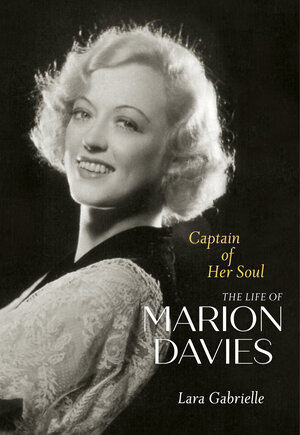
Captain of Her Soul: The Life of Marion Davies is now available at your favorite bookseller! Click hereto order it, and visit mariondaviesbook.com for all the latest.
Backlots is devoted to honoring and celebrating all aspects of classic film and is written by Lara Gabrielle, a California-based classic film writer and historian. Lara is the author of CAPTAIN OF HER SOUL: The Life of Marion Davies (UC Press, 2022).
Here you will find pieces on frequently seen classics and some lesser-known gems, as well as book reviews, festival coverage, and pieces on the history, theory and culture of film as it relates to the study of classic cinema.
Enjoy the site, and thanks for reading!
AFFILIATIONS & AWARDS
2019 CMBA Award for Best Profile of Classic Movie Performer or Filmmaker--"The Activism of Myrna Loy"
Winner of the 2018 CiMBA Award for Best Classic Movie Series, BACKLOTS AT THE COURTHOUSE: OLIVIA DE HAVILLAND VS. FX
Winner of the 2014 CiMBA Award for Best Profile of a Classic Movie Performer or Filmmaker: A Q&A WITH JOAN FONTAINE IN HONOR OF HER 96TH BIRTHDAY
Winner of the 2011 CiMBA Award for Best Classic Movie Discussion, THE FINAL SCENE OF THE HEIRESS
I am honored to be a judge of the Animal Film Festival in Grass Valley, CA.
EVENTS
BACKLOTS ON THE WEB
Join us at the Backlot Commissary, the place for Backlots' readers to share content and discuss movies!
Walter Pidgeon and Greer Garson in "Mrs. Miniver."



 Well, no one saw this coming, did they? Those of you who know me know that The Wizard of Oz (or, more accurately, Judy Garland) is very special to me. When I learned there was to be a
  The Wicked Witch of the West was played by Margaret Hamilton, who in my opinion deserved to win Best Actress (or at least Best Supporting Actress) for this movie. A former housewife turned movie actress to support her family, she was well-loved and a sweet person by all accounts. To demonstrate the kind of person she was, it is sufficient to say that throughout her life, both before and after her acting career, she taught Sunday School and kindergarten. After Oz, Hamilton continued her career in radio and television, before retiring in the late 1970s. She died in 1985.


















_03.jpg)

 Backlots