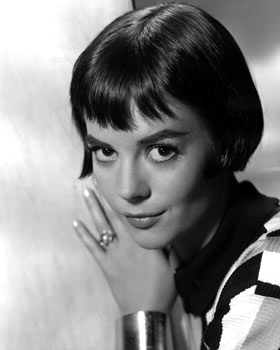
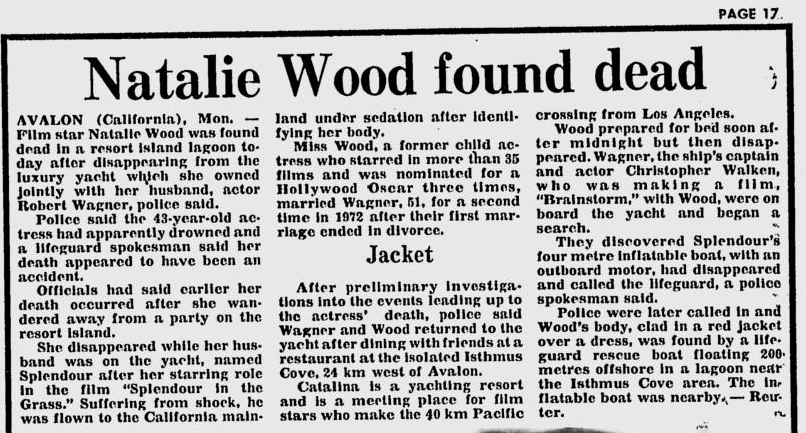
30 years after Natalie Wood’s tragic drowning off the coast of Catalina Island in 1981, the initial ruling that her death was accidental is being reexamined.
According to the Los Angeles Sheriff’s office, the captain of the boat off which Natalie Wood allegedly slipped and fell into the ocean has made some strange remarks about the 30th anniversary of her death. They won’t release what he said, but it seems that they’re going to start investigating this case as a homicide instead of an accidental drowning because of the captain’s remarks.
Spooky stuff, but not altogether surprising.
Back in 2001, Suzanne Finstad wrote a very classy, very exhaustive biography of Natalie Wood entitled Natasha. I read it when it first came out, and though I was just a little whippersnapper at 15, the official details of Natalie Wood’s drowning left gaping holes that sent chills up my spine. Finstad wrote about the details of that night, and about how there are some parts of the story that aren’t being examined closely enough. There was a fight on the boat…and there was drinking. There were reports of violence, and people heard cries. Finstad had some real reservations about saying that Natalie Wood’s death was accidental, and offers some possible explanations of her own.
I will be following this case closely. I hope justice, in whatever form it may come, is served, and we can continue to remember Natalie Wood as she deserves to be remembered.
In celebration of our Star of the Month Gene Tierney, I will be reviewing Tobacco Road, one of Gene’s earliest endeavors into film, and one in which despite efforts to the contrary, her striking looks win out over all the makeup to make her look like a hillbilly, and she simply looks stunning as usual. The movie itself, though directed by the legendary John Ford, was NOT a hit, but it’s an interesting movie to watch, and I will give you some of my own personal opinions later on in the post.
First of all, let me say that I saw this movie for the first time when I was in Paris. For those of you who have been following Backlots for some time, you know that there are 2 classic movie theaters in Paris, the Action Cinema Rue Christine, and the Desperado (which, oddly, was Action Écoles when I got there, and the Desperado when I left. Go figure–I’ve given up trying to understand anything that goes on in Paris). Obviously, I was constantly at one of them, and I saw some really fantastic movies on the big screen, as they were meant to be shown. Tobacco Road was at the Rue Christine, and I had never seen it before.
The plot has to do with a poor family living on inherited land, and their struggles to stay afloat during tough economic times. The story was taken from a novel, but the plot of the novel was more about the dramas of the family, while this movie chooses to focus more on the comic relief.
In fact, I find the film absolutely hilarious. I mean really:
Charley Grapewin, as Jeeter Lester, had me laughing all the way through the movie, as did many of the other supporting characters. A particular favorite recurring theme of mine is Jeeter’s obsession with turnips. Toward the beginning of the film there is a scuffle over a sack of turnips that is really very silly indeed. It is the at the height of randomness and zany surrealism, and that is my favorite kind of comedy.
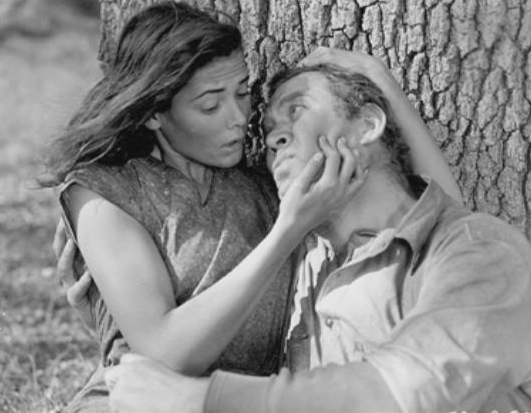
Gene Tierney and Ward Bond in "Tobacco Road."
As for Gene Tierney, she was 20 years old when this film was made, and though her role as the shy Ellie May Lester was small, she was noticed for her beauty that seemed to be beyond her years.
I highly recommend this movie if you are looking for some good laughs. There is one scene, however, that shows the more somber side of the story, in which Jeeter weeps over the loss of his land. It is very artfully done, and I would go so far as to say it’s done in a style very typical of John Ford, in stark contrast to the rest of the lighthearted, fun movie.
I leave you with a particularly funny gag from the film, when Jeeter discovers electric lighting and how much fun it is to turn on and off lamps. Thanks for reading!
Our Star of the Month Gene Tierney left this world 20 years ago today, succumbing to a long battle with emphysema at her home in Texas. Here is an article written by Richard Severo of the New York Times, appearing in the newspaper on November 8, 1991–2 days after Gene Tierney’s death.
Gene Tierney, 70, Star of ‘Laura’ And ‘Leave Her to Heaven,’ Dies
By RICHARD SEVERO
Published: November 08, 1991
Gene Tierney, the elegant actress whose beauty bewitched a tough detective in the 1944 film “Laura” and whose portrayal two years later of a diabolically selfish woman in “Leave Her to Heaven” won her an Academy Award nomination, died Wednesday night at her home in Houston. She was 70 years old.
Miss Tierney died of emphysema, a spokesman for the family said.
Miss Tierney had undergone years of treatment for stress and depression. She retired from films in 1965 after making “The Pleasure Seekers,” but made at least two television appearances after that. She told reporters that she preferred her life in Houston as the wife of W. Howard Lee, an oil man whom she married in 1960. He died in 1981.
A year before her marriage to Mr. Lee, when reporters found her working in a dress shop in Topeka, Kan. (a job she took as part of her psychotherapy at the Menninger Clinic there), she told them she attributed her illness to “my lack of understanding of what I could cope with and what I could not. . . . I tried to work harder and harder, thinking that work would cure everything. All it did was make things worse.”
With her blue-green eyes, brown hair, prominent cheekbones and what many young men of the 1940’s regarded as the most appealing overbite of the day (Miss Tierney said her movie contract stipulated that her slightly protruding front teeth were never to be fixed) she won plaudits for her patrician look but some criticism for her acting.
Even in “Laura,” which more than any other movie established her as a major star, Miss Tierney was faulted by some critics. In that film, a detective (Dana Andrews) falls in love with the portrait of a woman he believes has been murdered. For the first 30 minutes of the film, he and the other characters merely talk about her; then they discover she has not been murdered, and the character appears on screen.
For Thomas P. Pryor, who reviewed the film in The New York Times, Miss Tierney’s entrance was a bit of a letdown. She did not “measure up to the word portrait of her character,” he wrote.
Nevertheless, Miss Tierney received much praise over the years for the freshness and disarming directness she brought to her portrayal of Laura. The film is still regarded as a classic of its genre.
R.I.P. Gene Tierney. We are so lucky to still have her films with us.
Today, November 5, marks what would have been Vivien Leigh’s 98th birthday. Here is a tribute to mark the occasion of the birth of one of the 20th century’s best and most beautiful actresses, who encompasses far more than Scarlett O’Hara and Blanche DuBois. We’ll soon be revisiting Vivien at Backlots when we discuss the uncanny similarities of her life to that of our Star of the Month Gene Tierney–both strikingly beautiful women with enormous talent, suffocated by the same horrific mental illness.
But for now, just enjoy her for who she was and how much she contributed to the history of cinema. Vivien has throngs of fans throughout the world, and she deserves every ounce of praise she gets. Happy birthday, Vivien!
Passes for the 3rd annual TCM Classic Film Festival will go on sale November 9. GET YOUR PASSES EARLY–last year they had 25,000 attendees. The theme this year is Style in Movies, and the opening night Gala screening will be a newly remastered version of Cabaret, which promises to be spectacular.
The festival will open with "Cabaret."
Robert Osborne will be there as well as Ben Mankiewicz, and a whole slew of celebrity guests who haven’t been announced yet–but last year they had Debbie Reynolds, Angela Lansbury, Peter O’Toole…all kinds of amazing people.
This is the first year I will be able to afford to go. It’s not cheap by any stretch of the imagination, but by all accounts, it’s worth every penny. Obviously, I’ll be updating constantly while I’m there, and if Backlots gets its media accreditation (I’ll find out in early 2012), I’ll be able to have some behind-the-scenes info for the site. Fingers crossed!
First off, you may notice something different about the title of this entry. When you are not God, it is rather stressful to try to cram an entire lifetime into one 7-day period. I have, thus, converted Backlots’ regular Star of the Week feature to a celebration of one star per month, to try to relieve some of the rush that comes from trying to sufficiently cover the (often very full) life of a particular star. This will enable me to cover more information and provide a fuller, more in-depth analysis of the star, and to rest on the sabbath (can you tell I work at a Jewish school?)
The star who gets the honor of being Backlots’ first Star of the Month is the magnificently stunning, brilliantly talented, and tragically troubled Gene Tierney, whom I never tire of gazing at. She made a plethora of wonderful films, and her personal life was full and fascinating to say the least. But unlike many of Hollywood’s finest, Tierney came through her troubles, and we have the good fortune to be able to read about her life firsthand in her memoir entitled Self Portrait, which gives us a glimpse into the psyche that many of her peers unfortunately succumbed to, and did not live long enough to describe to us. For that, it is a very precious book for aficionados of classic Hollywood.
Tierney was born in Brooklyn, New York, on November 19, 1920. Her family was prominent socially, and Gene soon became bored with the social scene and decided to go to work on the stage, landing small parts on Broadway before breaking into the film world in 1940 with such pictures as The Return of Frank James (1940), Hudson’s Bay (1940), and Tobacco Road (1941). Her career continued steadily upward in the mid-1940’s, featuring notably Shanghai Gesture (1941), and Heaven Can Wait (1943), before the role that shot her to superstardom, the eponymous character in the 1944 film Laura.
Tierney’s first marriage was to Oleg Cassini in 1941, and their daughter Antoinette Daria (known simply as Daria) was born in 1943. During Tierney’s pregnancy, she had been exposed to the rubella virus, which was contracted by her daughter in utero, resulting in Daria being born blind, deaf, and severely mentally challenged. This may have been the impetus for Tierney’s future problems with mental health–Daria’s condition provoked intense stress on the family, and after the birth of their second daughter Tina in 1948, Tierney’s marriage to Cassini ended in divorce. Some years later and after a series of breakdowns, she was diagnosed with manic depression–today known as bipolar disorder.
With baby Daria.
Tierney was very upfront about her condition, writing about it candidly in her memoir in 1979, one of the first celebrities to do so. She thus helped to eradicate the stigma of the illness, and since then, a number of other celebrities have come forth with their own struggles. Self Portrait is, as I mentioned before, a very important book, and I don’t think it gets the attention it deserves as such.
She married a second time in 1960, and this time succeeded in her marriage to oil baron Howard Lee, remaining happily married until Lee’s death in 1981. Tierney died of emphysema 10 years later, after nearly 50 years of being a heavy smoker. Daria Cassini, her daughter who spent much of her life in institutions, also sadly passed away in September of last year. But Gene Tierney’s contribution to film has not been forgotten–she has received a star on the Hollywood Walk of Fame and is still widely remembered, even by those not familiar with classic film, as the famous Laura.
Throughout November, I will be highlighting aspects of Gene Tierney’s life and career. Stay tuned for more Gene, all this month!
Well, here is the final installment of Hitchcock Halloween, and I have picked probably Hitchcock’s most twisted tale. A creepy motel, multiple personalities, an Oedipus complex, and a whole lot of chocolate syrup take center stage in this immortal (!) thriller, in which Janet Leigh takes most famous shower in cinema history.
If lighting was the cornerstone of Rebecca, the genius of this film lies in the music. How can anyone forget those screeching violins (as a matter of fact, I’m listening to the crickets outside and as I write this post, they’re beginning to sound like the screeching violins…) and the suspenseful theme of Psycho? The composer, Bernard Hermann, disregarded Hitchcock’s request for a jazz soundtrack and instead composed one of cinema’s most memorable scores using a small string ensemble, making use of the film’s small music budget. To be frank, the movie isn’t particularly exciting for the first half an hour or so, but Hermann keeps the audience on their toes by providing a riveting, suspenseful undertone that seems to tell the viewer “Look, we know it’s boring…but it will get better, we promise!”
And indeed it does. Norman Bates, a strange, shy man whom we meet early in the film, has an odd relationship with his mother, who is heard but never seems to be seen. We hear her and Norman arguing about his relationship to Janet Leigh (her name is Marion in this film, but no one cares–she’ll always just be Janet Leigh), and suddenly, while Janet is taking a shower…
The scene in its entirety is just over 3 minutes, but uses close to 50 camera cuts (and yes, I counted). When I first saw it, I didn’t see what all the fuss was about, it’s not a particularly scary scene. But when you analyze it for more than its scariness, it’s remarkable how artful it is and how carefully planned.
The effects of the shower scene were achieved through a variety of clever methods–the sound of the knife puncturing flesh was made by a knife cutting through a melon, and the blood that runs down the shower was actually chocolate syrup, having a more realistic density than stage blood and showing up better on black-and-white film. There was a pervasive rumor for some time that the famous sound of the screeching violins were actually bird calls instead of real violins, but this has been proven false.
Anyway, so Norman Bates’ mom is a weirdo, right? More than anyone knows.
Norman finds Janet Leigh’s body and throws it, along with all her other things, into a car and throws the car in a swamp. Because no one’s trying to cover anything up here…
After a series of events, a revelation comes out. It turns out that Norman HAS no mother–Norman’s mother has been dead for 10 years. So who is this we’ve been hearing so much about?
Norman himself. Norman is both himself and his dead mother. Who, by the way, still hangs out in the basement, as we find out in a VERY freaky scene. You’ve been warned:
Norman is taken to the police station where a psychiatrist deconstructs his split personality, while Norman (now in the “Mother” personality) sits in the cell. The ending scene is chilling, as Norman/”Mother” recites an internal monologue, in the voice of a woman.
And what is particularly scary, is the vision of a skull, for a split second, on Norman’s face as it fades into the car being pulled out of the swamp.
This is one CREEPY MOVIE.
That’s it for Hitchcock Halloween! Thanks for reading, and I hope you have a fun and safe night partying, trick-or-treating, or doing whatever it is you do on Halloween. Stay tuned for more posts tomorrow!
I have been wanting to write a post about Rebecca for some time now, as in the list of the top 10 most brilliant Hitchcock films, this one takes the #1 spot in my book. It is the perfect thriller and mystery, one that stays with you long after you’ve finished the last scene. For years after I saw the film for the first time, I couldn’t shake the image of Mrs. Danvers’ face as she watches a piece of the burning house fall down on her, and I must say that it still haunts me.
Those who are familiar with my blog know that I am a total sucker for anything related to the de Havilland sisters (either Joan Fontaine or Olivia de Havilland), but the brilliance of this movie has nothing to do with my bias toward Miss Joan. Her presence certainly doesn’t hurt, but I legitimately think that this is one of the best movies that has ever been made. I love to praise, but I never come out and say “This is one of the best movies that has ever been made” unless I really mean it. And I do here.
The genius of this movie is in its use of visuals above anything else. Hitchcock, in his first American production, not only employs his well-known skill with lighting, but also some very subtle but very spooky photographic tricks. One of my favorites is during the scene in which the Second Mrs. de Winter notices the flickering shade across the house, and Mrs. Danvers moves in to talk to her. After the SMdW becomes frightened and runs off, Mrs. Danvers continues to herself, “Listen…listen to the sea…” As the camera fades out, the image of Mrs. Danvers is eerily frozen onscreen for a split second. If this had been directed by any other director, I would say it was a flaw in the camerawork. But not in a Hitchcock film. His perfectionism didn’t allow for problems with camerawork. Moreover, the illusion is so spooky, that if Hitchcock for some reason didn’t intend for it to be there, he definitely succeeded in creating an almost anachronistically creepy tone for that scene.
All throughout the movie, Mrs. Danvers is just really, really weird. We see her creepiness right from the beginning, in a fantastic entry shot that sums up her character perfectly.
And just when we thought she couldn’t be creepier, she shows this almost erotic fascination with the dead Rebecca de Winter, showing the SMdW all the lingerie she keeps folded in her drawers. “Look,” she implores the SMdW, as she holds up a garment to her, “You can see my hand through it!”
I’m not sure how that scene got past the Hays Office.
(By the way, in this clip, look for Mrs. Danvers’ frozen frame that I referenced earlier in this post. It comes in at the very end of this clip.)
I’m not sure how a lot of things in this movie got past the Hays Office, actually. In one scene, Mrs. Danvers tries to lure the SMdW off the balcony to suicide. I suppose they were allowed more liberties because Mrs. Danvers is given an unhappy demise. Under the code, the audience should “never be thrown to the side of the crime, wrong-doing, evil or sin” (Motion Picture Production Code; Reasons Underlying the General Principles; Section I), which generally necessitated the ultimate punishment of any wrongdoing. Still, it’s a pretty racy movie for 1940, and it undoubtedly gave the Hays Office a lot of grief.
The film was a smashing success and was nominated for 9 Academy Awards, becoming the only Hitchcock film ever to win Best Picture. Joan Fontaine’s future of “firsts” with Hitchcock continued when she won the Academy Award the next year in Suspicion, the only performer who has ever won for a Hitchcock performance.
I leave you with a funny story about my connection with this movie. It was always one of my favorites, and I felt ashamed that I didn’t have a copy, so I ordered one on Amazon for a dirt cheap price (I was a starving college student). When the movie came, I thought the cover looked very strange…it was really flimsy plastic, and the cover looked like it had been printed from a computer printer. I thought “Oh, ok…it’s a bootleg.” I didn’t really think much of it, as long as the DVD worked, I didn’t care. So I put the DVD in…and Korean subtitles come on. I had ordered a Korean bootleg of Rebecca. I watched it so much that I began to pick up what characters corresponded to what words were being said, and thus I learned how to write some things in Korean, which is a pretty neat thing to be able to do, if you’re not Korean (which I’m not).
Thanks for reading, and thank you, Rebecca, for teaching me Korean!
This scene is the marker for the beginning of the action in Dial “M” for Murder, a film that I think is far too overlooked in the Hitchcock pantheon. When most people hear the name “Alfred Hitchcock,” they tend to think of Rear Window or The Birds–if the person is slightly more versed in classic film, he or she might think of Rebecca or Vertigo. Rarely is Dial “M” for Murder included in the list of “essential” Hitchcock greats, and I think this oversight is massively unfair.
The story is really a brainteaser. When going over the plot here, I’m going to go over the bare basics, because if I told you every single detail, we’d be here all night. The main character (played by Ray Milland) is a cunning, brilliant criminal, who carefully plans every step of his crime to be one step ahead of the people on the other end.
The crime is that of getting rid of his wife (played by Grace Kelly), who had embarked on a secret affair with a crime novelist. His plan included getting an old college buddy over and convincing him to strangle her while he was out, leaving behind absolutely no trace of his ever being there, owing to his elaborate plan. However, he left one potential situation unplanned…
What follows is what can only be described as an elaborate game of “Clue.” A talented detective arrives, who questions everyone at the scene and through a series of circumstances, is convinced by Ray Milland that his wife murdered the man deliberately. Grace Kelly is taken to court, is convicted of murder, and is sentenced to death. The bit in court is brilliant, and features one of the most fantastic uses of color I have ever seen. Grace Kelly says not one word during the whole scene, and yet we FEEL her terror. It’s a real shame that the clip is not available on youtube. Even the still pictures give me goosebumps.
On the day of her execution, though, the detective comes to realize that there is evidence that would clear Grace of her crime. The final sequence is an absolutely brilliant mastery of suspense.
When people ask me my favorite Hitchcock film, I reply with this one and Rebecca. The first time I saw Dial “M” for Murder, I was literally on the edge of my seat the entire time, and when it was over, I wanted to watch the whole thing again. The fascination has not waned, this movie still holds me in rapture every time I see it. If you haven’t, you’re missing out. Given that it’s a major Hitchcock film, it is widely available, and you will be able to find it easily on Netflix or at the movie store.
Stay tuned for tomorrow’s installment of Hitchcock Halloween!
Starting later today, I am going to start what I am calling Hitchcock Halloween, which will be a 3-day countdown to the big day, Hitchcock-style. A new poll will show up in the “Polls” section, asking readers what they think is the scariest Hitchcock film, and I will profile what I consider to be the best. Feel free to leave your comments about the films profiled, and don’t forget to vote in the poll!
Here is Mr. Hitchcock on “What’s My Line?” I can’t wait!!
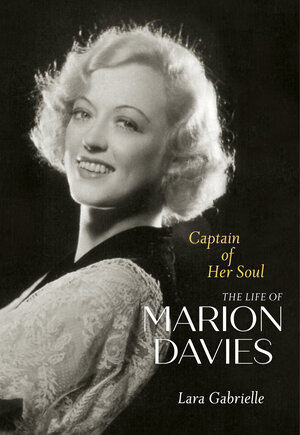
Captain of Her Soul: The Life of Marion Davies is now available at your favorite bookseller! Click hereto order it, and visit mariondaviesbook.com for all the latest.
Backlots is devoted to honoring and celebrating all aspects of classic film and is written by Lara Gabrielle, a California-based classic film writer and historian. Lara is the author of CAPTAIN OF HER SOUL: The Life of Marion Davies (UC Press, 2022).
Here you will find pieces on frequently seen classics and some lesser-known gems, as well as book reviews, festival coverage, and pieces on the history, theory and culture of film as it relates to the study of classic cinema.
Enjoy the site, and thanks for reading!
AFFILIATIONS & AWARDS
2019 CMBA Award for Best Profile of Classic Movie Performer or Filmmaker--"The Activism of Myrna Loy"
Winner of the 2018 CiMBA Award for Best Classic Movie Series, BACKLOTS AT THE COURTHOUSE: OLIVIA DE HAVILLAND VS. FX
Winner of the 2014 CiMBA Award for Best Profile of a Classic Movie Performer or Filmmaker: A Q&A WITH JOAN FONTAINE IN HONOR OF HER 96TH BIRTHDAY
Winner of the 2011 CiMBA Award for Best Classic Movie Discussion, THE FINAL SCENE OF THE HEIRESS
I am honored to be a judge of the Animal Film Festival in Grass Valley, CA.
EVENTS
BACKLOTS ON THE WEB
Join us at the Backlot Commissary, the place for Backlots' readers to share content and discuss movies!
Walter Pidgeon and Greer Garson in "Mrs. Miniver."

























_03.jpg)

 Backlots