CLFP: TO BE OR NOT TO BE (1942)

carole lombard

By Lara Gabrielle Fowler

A group of Polish actors infiltrate a Nazi spy plot, wreaking havoc with their impersonations of key Gestapo figures and screwball antics. This is essentially the plot of To Be or Not To Be, a highly complex film ahead of its time in many ways and unlike any other film in Lombard’s filmography. Far from the typical screwball comedy, it mixes traditional comedy technique with dramatic, sinister overtones to create a very unusual spectacle that leaves the viewer mildly uncomfortable with what is happening onscreen, not knowing whether or not it is acceptable to laugh.

One of the Polish actors trying to pass himself off as Hitler.

I have written about To Be Or Not To Be once before, to highlight the dualities intrinsic in the film and the problems that ensued upon release. Indeed, it is a film worth examining multiple times, as there are new and fascinating aspects of the movie each time one views it. Among classic film fans, it is highly regarded and revered as one of Carole Lombard’s great roles. Outside of the classic film community, it is rarely seen, perhaps due to the enormous complexity of the film that makes it more than a bit difficult to follow. The film builds upon itself almost exponentially, the plot moving so quickly with so much new information that the viewer’s attention has to be completely undivided in order to understand what is happening.

In this sense, To Be or Not To Be plays out rather like a Shakespearean comedy, complete with themes of mistaken identity and biting, witty lines. As the cast is performing Hamlet when they get involved in the Nazi spy plot, the film could be construed as a bit of a tribute to Shakespearean theater. In a move that would prove to be massively ironic, the Jewish character of Greenberg also recites Shylock’s famous “Hath not a Jew eyes?” speech from The Merchant of Venice sporadically throughout the film. At this point in World War II, the true horrors of German concentration camps were unknown to the outside world. Had they been public knowledge at the time of this film’s release, it is interesting to think how To Be or Not To Be would have turned out. Charlie Chaplin, who had made his similarly war-related epic comedy The Great Dictator two years prior, stated that if he had known about the extent of the concentration camps, he would not have made the movie at all.

As it was, To Be or Not To Be was received indignantly upon its release, the victim of extremely poor timing. Filming began in October of 1941, Pearl Harbor was bombed on December 7, and by the time the film was completed on December 23, the U.S. had entered the war. Emotions were running high, and U.S. audiences were reluctant to view the war as anything worthy of laughter or merriment. Shortly after filming completed Carole Lombard, always an enthusiastic patriot, had embarked on a bond rally to raise money for the war effort. After raising a staggering $3 million in her home state of Indiana, she boarded a plane with her mother and agent bound for Los Angeles.

They never made it. The plane crashed into Mount Potosi in the Sierra Nevadas, and all 22 passengers on the plane were killed. To Be or Not To Be was released in March 1942, 3 months after Carole Lombard’s death, contributing to the film’s problems at the box office.

Carole Lombard in Indiana.

This film is one of my favorite Carole Lombard movies, due to the uniqueness and controversial nature of the plot. The humor is advanced and layered, relying more on pure wit than on sight gags or cheap shots. The focus on verbal humor combined with the complexity of the plot makes it a challenge to watch casually, but when one has time to truly focus on the film and only the film, it is a delight. Mel Brooks released a remake in 1983, and from the present time looking back, it may be noted that the original version of To Be or Not to Be is indeed strangely Mel Brooks-ish in tone.

Despite the many marvelous qualities of the film, To Be or Not To Be is probably best known to audiences as Carole Lombard’s final film. Numerous edits to the film had to be made following the tragedy of Carole Lombard’s death, including the deletion of one very eerie line in which Carole Lombard exclaims “What can happen in a plane?”

See you next time!

Remembering Roger Ebert

By Lara Gabrielle Fowler

The film world grieves today.

Award-winning journalist, critic, screenwriter, and intellectual Roger Ebert passed away this morning after a very long battle with cancer, leaving behind him a journalistic legacy that spans 45 years. The first film critic to win the Pulitzer Prize, he spoke his mind fully and was known as one of the most influential people visible in pop culture.

Ebert was born in Urbana, Illinois, and began his journalistic career in 1967 as the movie critic for the Chicago Sun-Times. In 1975, he teamed up with Gene Siskel of the Chicago Tribune to create Sneak Previews, a television show in which Siskel and Ebert discussed an often argued about movies. They became known for their “thumbs up”/”thumbs down” method of reviewing movies, and created the phrase “two thumbs up” to label a movie that they both enjoyed. Today, it has entered the standard lexicon and is trademarked.

Siskel and Ebert review Taxi Driver.

Sneak Previews initially aired on PBS, but soon Siskel and Ebert began signing deals with other companies and Siskel and Ebert became household names with a new program entitled Siskel and Ebert and the Movies. After Gene Siskel’s death in 1999, Roger Ebert became the sole host of the show, later joined by Richard Roeper and the program was re-titled to At the Movies with Ebert and Roeper.

Ebert’s popularity was so great with the public that in 1998 Ebertfest, a film festival in his honor, began in Champaign, Illinois. The festival celebrates its 15th year in 2013, held between April 17 and 21 of this year.

Picture 24

Ebert’s voice was altered slightly after undergoing surgery for thyroid cancer in 2002, but after several follow-up surgeries on his salivary glands it became clear that his voice could not be preserved. He lost his ability to speak in 2006, and communicated through a voice on his laptop and through writing. As he was now unable to continue hosting television shows, he turned to the internet. Ebert continued his work as an online critic, gaining a significant following on social media where he often used the platform to express opinions on topics such as politics, food, and life.

Roger Ebert gives his “two thumbs up” following surgery that removed a portion of his jaw due to cancer of the thyroid and salivary glands.

I was a devoted follower of his tweets, and a few days ago I noticed that he had stopped tweeting. He wrote a blog post on April 2 indicating a leave of absence, and his final words were these:

“So on this day of reflection I say again, thank you for going on this journey with me. I’ll see you at the movies.”

ROGER EBERT

June 18, 1942-April 4, 2013

We’ll see you at the movies, Roger!

TCM Classic Film Festival Schedule

By Lara Gabrielle Fowler

After a long wait, TCM has finally announced its schedule for the 2013 TCM Classic Film Festival. While there are a few final slots left to fill, this is more or less the final tally of films. I will, of course, keep you updated on any changes.

The following list is taken from TCM’s website. As the theme is “Travel in the Movies,” TCM has divided most of the films into different categories as they relate to travel, leaving one category for the essential films that will be shown.

During the festival, please feel free to keep in contact with me, let me know your comments, thoughts, and requests for coverage.

Enjoy!

DISCOVERIES

CLUNY BROWN (1946)
THE DESERT SONG (1943)
I AM SUZANNE! (1933)
ISLAND OF LOST SOULS (1932)
IT ALWAYS RAINS ON SUNDAY (1947)
THE KILLING (1956)
LA TRAVERSÉE DE PARIS (1956)
LE MANS (1971)
LIBELED LADY (1936)
SCARECROW (1973)
SUDDENLY IT’S SPRING (1947)
THE SWIMMER (1968)
TRY AND GET ME (1950)
THE TWELVE CHAIRS (1970)

ESSENTIALS

AIRPLANE! (1980)
BEN-HUR (1959)
THE BIG PARADE (1925)
THE BIRDS (1963)
DIAL M FOR MURDER (1954)
FLYING DOWN TO RIO (1933)
FROM RUSSIA WITH LOVE (1963)
FUNNY GIRL (1968)
GIANT (1956)
GILDA (1946)
THE GREAT ESCAPE (1963)
GUYS AND DOLLS (1955)
LADY AND THE TRAMP (1955)
THE LADY EVE (1941)
THE LADYKILLERS (1955)
MY FAIR LADY (1964)
NINOTCHKA (1939)
NOTORIOUS (1946)
ON GOLDEN POND (1981)
ON THE TOWN (1949)
ON THE WATERFRONT (1954)
PLAN 9 FROM OUTER SPACE (1959)
ROAD TO UTOPIA (1946)
SHANE (1953)
SOUTH PACIFIC (1958)
TO SIR, WITH LOVE (1967)
YANKEE DOODLE DANDY (1942)

JOURNEYS OF SELF DISCOVERY

CAPTAINS COURAGEOUS (1937)
A FOREIGN AFFAIR (1948)
I KNOW WHERE I’M GOING! (1945)
THE RAZOR’S EDGE (1946)
RUGGLES OF RED GAP (1935)
SAFE IN HELL (1931)

A JOURNEY TO ITALY

COME SEPTEMBER (1961)
A ROOM WITH A VIEW (1985)
SUMMERTIME (1955)
VOYAGE TO ITALY (1954)

LOVERS ON THE RUN

BADLANDS (1973)
BONNIE AND CLYDE (1967)
IT HAPPENED ONE NIGHT (1934)
THEY LIVE BY NIGHT (1949)

RIDING THE RAILS

THE GENERAL (1926)
THE LADY VANISHES (1938)
THE NARROW MARGIN (1952)
THE TALL TARGET (1951)
THE TRAIN (1964)

THE RIVER AS ROAD

THE AFRICAN QUEEN (1951)
CAPE FEAR (1962)
DELIVERANCE (1972)
THE NIGHT OF THE HUNTER (1955)
RIVER OF NO RETURN (1954)

SPECIAL PRESENTATIONS

BUGS BUNNY’S 75TH BIRTHDAY BASH (VARIOUS YEARS)
CINERAMA HOLIDAY (1955)
THE DONOVAN AFFAIR (1929)
DON’T SAY NO UNTIL I FINISH TALKING: THE STORY OF RICHARD D. ZANUCK (2013)
EVA MARIE SAINT: LIVE FROM THE TCM CLASSIC FILM FESTIVAL
HONDO (1953)
IT (1927)
IT’S A MAD MAD MAD MAD WORLD (1963)
TARZAN FINDS A SON! (1939)

FESTIVAL TRIBUTES

TRIBUTE TO ANN BLYTH:
KISMET (1955)
MILDRED PIERCE (1945)

TRIBUTE TO ALBERT MAYSLES:
GIMME SHELTER (1970)
SALESMAN (1968)

TRIBUTE TO MAX VON SYDOW:
THE SEVENTH SEAL (1957)
THREE DAYS OF THE CONDOR (1975)

CLFP: The Princess Comes Across (1936)

carole lombard


By Lara Gabrielle Fowler

Murder mystery meets screwball comedy in this unique yarn, in which Carole Lombard stars as Princess Olga, a rather suspicious-sounding Swedish princess on a boat to the United States, and Fred MacMurray is her love interest with a criminal past.

We soon learn that Princess Olga is not a princess at all, but rather Wanda Nash, a Brooklyn girl who is posing as such in order to land a movie contract. Her love interest is King Mantell, a fellow passenger and famous concertina player who takes to Princess Olga immediately. As it turns out, King Mantell has been in trouble with the law, and there is a blackmailer on board by the name of Darcy who threatens to expose Mantell and Wanda for all they’re worth. When Darcy is mysteriously found dead in Princess Olga’s room, all hell breaks loose as the authorities try to figure out what happened.

The premise is good and clever, and there are some really golden comedy moments in this movie, mostly involving Carole. Her imitation of a Swedish princess is a clear tribute to the speaking style of Greta Garbo, and she pulls it off with great aplomb.

The Princess Comes Across allowed Carole to demonstrate her considerable skill in imitating accents. As a child in Fort Wayne, Indiana, Carole  (then known by her birth name of Jane Peters) was known among the residents in her neighborhood for her gift of mimicry. A favorite pasttime was putting on shows for her relatives and friends, in which she would imitate the great screen stars and delight her audience. Carole considered The Princess Comes Across to be one of her favorite movies, as it reminded her of the thrill she got as a child, imitating her favorite performers for friends and family.

This movie is available on the Carole Lombard Glamour Collection, which is really a terrific buy for any Carole fan. I have found it very helpful, as it consolidates 6 of Carole’s movies, some of which are relatively rare, into one set. Check it out, if you haven’t already!

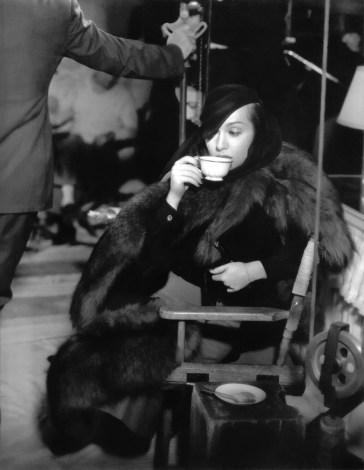
Carole takes a break on the set.

See you next time!

Backlots at the TCM Classic Film Festival, April 25-28 in Hollywood, CA

By Lara Gabrielle Fowler

I have just received confirmation that Backlots will be attending the TCM Classic Film Festival as an official member of the press. Headquartered at the Hollywood Roosevelt Hotel, this is a huge and important festival, and I wanted to make a post telling readers what they may expect of me and Backlots in terms of coverage.

As with any festival that I have covered in the past, I will be enabling live tweets so that you may follow along on the blog at any time. I will probably be attending as many as 5 screenings in a day, so posts will probably be similar to my coverage of the San Francisco Silent Film Festival and Cinecon–with reviews of all the films screened and details of conversations with guest speakers.

Club TCM at the Hollywood Roosevelt Hotel.

One of the unique aspects of the TCM Classic Film Festival is the existence of Club TCM, an array of classic movie-related activities that run all day for the duration of the festival. As a member of the press, I will have access to all of these events and I would be happy to take requests as to which events you, as a reader, would like to see covered. I will provide a list of activities and films scheduled, so that I might have a festival experience in accordance with what my readers would like to see.

So please let me know, and stay tuned for the list of films and Club TCM events that are scheduled for this year!

See you there!

The Goodbye Scene in THE GRADUATE (1967)

The camera zooms away from Mrs. Robinson and away from her relationship with Benjamin in THE GRADUATE (1967)

By Lara Gabrielle Fowler

Emotions run high and fast as The Graduate approaches its finish, and nowhere is the gamut of emotions so evident as in the scene in which Mrs. Robinson learns about Ben’s relationship with Elaine–and Elaine about Ben’s relationship with her mother.

In beginning to analyze this scene, it is extremely difficult to know where to begin. The Graduate is a cinematic legend, a cornerstone in film history, and in my humble opinion it is as near to a completely perfect film as has ever been created. In everything it attempts to do it succeeds, and in a way so innovative that it becomes a film far ahead of its time. I feel that the artistic and cinematic merits of The Graduate are worthy of a book all their own, but this scene stands apart as one of the more fascinating moments in the entirety of the film.

One of the most creative aspects of this movie is its treatment of the unusual plot structure–instead of following the traditional dramatic structure of rising action, climax, falling action, denouement and resolution, the film instead continues at a calm and still pace (flowing much like the water in the Braddocks’ pool that serves as a metaphor throughout the movie) until the final 30 minutes, in which the plot turns into a maelstrom, rising like a tsunami and crashing down in its last moments to create a sudden resolution. This scene, in which Benjamin’s relationships with the two Robinson women disintegrate, is the beginning of the storm.

Picture 13

By this point in the movie, Benjamin Braddock (Dustin Hoffman) has been maintaining a reluctant and secret relationship with Mrs. Robinson (Anne Bancroft), a family friend who seduced him during his graduation party. Their relationship is based solely on sex, and when Ben tries to draw her out through conversation she refuses–except to make Ben promise that he will never go out with Mrs. Robinson’s daughter, Elaine, who is Ben’s age. But when Ben’s parents set him up with Elaine, he is forced to break his promise lest his relationship with Mrs. Robinson be exposed. Ben intends on taking Elaine out once to placate his parents, but he ends up falling for her and they make another date to go for a drive the next day.

When Ben arrives at the Robinson residence, it is raining. Instead of Elaine emerging from the house for the drive, it is Mrs. Robinson, wearing a startlingly youthful outfit and soaking wet from the rain. She angrily orders Benjamin to drive around the block, and threatens that if he ever sees Elaine again, she will expose their relationship to her. Though he initially brushes off Mrs. Robinson’s threat, telling her that he doesn’t believe she would reveal their exploits to Elaine, he stops the car and runs up to tell Elaine himself rather than take the risk of having Mrs. Robinson do so.

Picture 14

Mrs. Robinson appears at the door of Elaine’s room.

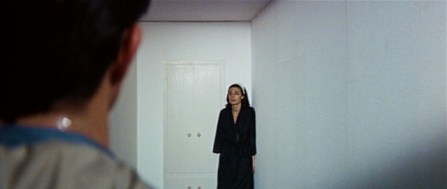
Elaine is in a great mood, getting ready for her date with Benjamin when he rushes in, panicked that Mrs. Robinson is also on her way up the stairs to tell Elaine. He grabs her and begins to tell her about his relationship with her mother, but before he can get the story out, Mrs. Robinson appears at the door and Elaine begins to understand the situation. She screams at Benjamin and orders him out, and outside the door stands Mrs. Robinson, looking sickly and pale. She feebly says “Goodbye Benjamin” and the camera zooms out, showing Mrs. Robinson against the large, empty white wall before it fades out. Mrs. Robinson’s figure lingers on the screen for a split second longer than the rest of the scenery as the camera fades.

The heavy rain in the scene is another example of the water symbolism throughout the movie. Up to this point, much of Benjamin’s time is spent in the pool, signifying the calm and uneventful nature of his postgraduate life. Even his secret relationship with Mrs. Robinson is calm and uneventful, and the minute it begins to unravel, his life becomes stormy. There are no more tranquil scenes in the pool, instead the state of his life is defined by the heavy rain in the moment where Benjamin’s life begins to unravel.

When Benjamin begins to tell Elaine about his relationship with her mother and Elaine sees Mrs. Robinson at the door, she is shot out of focus as she turns back to Benjamin. Slowly, as Elaine processes what has happened, the camera begins to focus in on her face, until she is completely in focus and says “Oh no.” By shooting her out of focus until she has processed the information, director Mike Nichols brings us inside of Elaine’s mind. As neither Benjamin nor Mrs. Robinson ever explicitly tells her the story, she is left to figure it out on her own, and we see this process through the camera’s focus. It is a subtle touch, but a very powerful one.

Picture 18

The most startling and lingering image in this whole scene is that of Mrs. Robinson waiting outside of Elaine’s door, weak and tired, with circles under her eyes. It is a completely different Mrs. Robinson than the confident and self-assured woman we see in the rest of the movie. From Anne Bancroft’s magnificent performance in this scene, we can perhaps deduce that Mrs. Robinson’s threat to Benjamin was an empty one–that, as Benjamin originally thought, she would not have told Elaine about their relationship herself. She appears close to tears as she says goodbye to Benjamin. The camera zooms quickly out, and Mrs. Robinson is frozen still against the white backdrop. She appears almost like a ghostly vision, and it is interesting to note that she is not looking at Benjamin–her eyes are frozen just to his left. It makes for a memorable image, and one that evokes a bit of the paranormal.

Director Mike Nichols won an Academy Award for his work in The Graduate and it was nominated for 7 more Oscars including Best Picture, Best Actor (Dustin Hoffman) and Best Actress (Anne Bancroft). It was also nominated in the category of Best Cinematography, and it is a terrible shame that the groundbreaking cinematography in The Graduate lost to Bonnie and Clyde that year. It is a movie that has stood the test of time for 55 years, and it seems just as new today as it did upon its release in 1967. That speaks volumes.

See you next time!
Backlots is 2!

By Lara Gabrielle Fowler

In 2011, having received various enthusiastic requests for a blog by which I could impart my passion for classic film to a wider audience, I decided it was time to heed the advice. After a few false starts and WordPress fumbles, that which we now know as Backlots was born in Paris on March 17, 2011. My first post was a lighthearted re-telling of Little Nellie Kelly, in honor of St. Patrick’s Day. I remember feeling like a novice, and fearing that no one would read. I was soon proven wrong!

It’s hard to believe that it has been 2 years since that evening, and wow, what a 2 years it has been for Backlots! I am extraordinarily proud of this blog, and I truly treasure my time here on the site researching, writing posts, and reading all of your wonderful comments. It has become quite a fruitful endeavor, as Backlots has a pretty impressive list of achievements in its 2 years on the web.

Here is a list of some of the blog’s accolades and achievements over the past 2 years:

-Inducted into the Classic Movie Blog Association, Large Association of Movie Blogs, Classic Movie Hub, and Vintage Association of Motion Picture Blogs

-Elected Board Member of the Classic Movie Blog Association

-Winner of the CiMBA Award for Best Classic Movie Discussion: “The Final Scene of The Heiress” (2011), nominated for the CiMBA Award for Best Blog Design (2012), nominated for the CiMBA Award for Best Blog Event: The Dueling Divas Blogathon (2012)

-Official Member of the Press for the San Francisco Silent Film Festival, Cinecon, Noir City, Noir City X-Mas, and Silent Winter

-And of course, have met and had meaningful discussions with countless fellow bloggers and readers of the site, for which I am most grateful of all.

I am so grateful to you, dear readers, for allowing Backlots to continue through your support and lovely comments, and the passion you share with me. I was so thrilled with your enthusiastic voting for the Carole Lombard Filmography Project, and your encouragement throughout the monumental (and probably slightly crazy) task that I face, wading through all of Carole Lombard’s movies. You are the reason I keep going!

Thank you, and please don’t be a stranger! I love to get comments, and I have gotten to know many readers through them. Here’s to many more years!

See you next time, and thanks again for these 2 years of joy!

CLFP: “True Confession” (1937)

carole lombard

By Lara Gabrielle Fowler

True Confession (1937) is one of the films marking the twilight of Carole Lombard’s short but illustrious career. By the time this film was made, Carole had shot 71 movies in a career spanning a total of 16 years, and after True Confession she would make 7 more before her sudden and untimely death. In this movie, Carole plays perhaps the strangest and screwiest heroine of her career, a pathological liar who runs the world amok with her fibs. A user review on iMDB rather aptly describes her antics as “right out of the Lucy Ricardo playbook.”

Helen Bartlett (Lombard) is a writer who has perpetual writer’s block and instead of writing, lives her life in a fantasy world of lies. Her husband Ken (Fred MacMurray) is an unfailingly honest lawyer who struggles with money because his principles do not allow him to take the case of any guilty party. After Ken refuses the case of a guilty ham thief, Helen takes a job as secretary to wealthy businessman Otto Krayler but on the first day of the job he seduces her. She flees and plans not to return, until she finds that she has left her hat and coat at his office. She goes back to get them and learns that Otto Krayler has been murdered during the time she was gone. She is arrested on suspicion of the murder and then Helen, the pathological liar, relays a vivid account of how she did indeed kill Otto Krayler. Then she gives conflicting testimony, saying that she did not. She is put on trial for his murder, wherein her husband defends her and she pleads self-defense, as they reason that no one will believe her innocence.

To complicate matters, a man named Charley Jasper (John Barrymore), a noted criminologist, is convinced that she is indeed innocent. Helen panics at this, as she believes a plea of “not guilty” will result in her conviction. Jasper keeps his thoughts to himself, and Helen is found innocent in the court.

After her acquittal, Helen writes a successful novel about her life story and she buys a house on Martha’s Lake with Ken. Charley comes over to visit and tries to blackmail them with Krayler’s wallet, saying that HE killed Krayler, therefore rendering Helen’s testimony perjury. He then reveals that his brother-in-law killed Krayler, and Ken leaves the house fuming over Helen’s lie to the court. She tries to get him to come back by saying that she is pregnant, which is another lie. He returns, but then finds out that she is not. The movie ends as Ken brings Helen into the house vowing to teach her not to lie.

The whole movie is completely backward and this not only makes it great fun to watch, but also almost a brain teaser, as nothing is as it should be. Much of the movie is spent trying to figure out how far Helen’s lies will take her before they backfire. She is an unlikely heroine, someone who deliberately fools the courts and her husband, but yet due to Carole’s portrayal of the character of Helen, we somehow find ourselves rooting for her. It is likely that if this movie were made today it would not be accepted as a comedy. Instead, I would venture to say that it would be presented as a courtroom drama, ending with Helen receiving the psychological help that she so clearly needs.

The cast of “True Confession” (missing: John Barrymore) eats lunch between scenes.

During the filming of “Twentieth Century” three years earlier, Carole and John Barrymore became good friends. By 1937, John Barrymore was in the ravages of severe alcoholism and an illness that could have been the then-unknown Alzheimer’s Disease. His career was in a steep decline, as he was often on a binge and when he was sober, he could barely remember his lines. Carole advocated passionately for him, using her significant power with Paramount to demand that her friend be given the role of Charley Jasper in True Confession. Though Barrymore was a very risky hire at that point, Carole did not back down and Paramount conceded to Barrymore as Charley. He gave a performance that demonstrated, as it did in Twentieth Century, that he had a great talent for comedy and had these films come earlier in his career, he may have developed this talent to his professional advantage. As it was, though, despite Carole’s efforts, this film could not turn Barrymore’s life around and he died of cirrhosis of the liver brought on by his lifetime of alcohol consumption.

Carole remained his friend to the end. She was extremely well liked in Hollywood, an easygoing and friendly personality who made friends with all her costars. She was a loyal friend, and often went to the bat for them, as she did with Barrymore on this film.

See you next time!

Creative Direction and Editing in the Symphony Scene of “The Man Who Knew Too Much” (1956)

Doris Day sees the shooter during the Royal Albert Hall scene of “The Man Who Knew Too Much” (1956).

By Lara Gabrielle Fowler

Overall, the 1956 version of The Man Who Knew Too Much is not considered one of Hitchcock’s best endeavors. Of the two versions made (the other was an early success of Hitchcock’s in his home country of England in 1934), the earlier version garners more overall critical praise, and the 1956 version was, sadly, greatly overshadowed by the earlier films that the American public had come to associate with Hitchcock’s unique style. There are, however, two glorious scenes in this movie in which we see the full extent of Hitchcock’s artistic genius. Along with the famous “Que Sera Sera” scene in which Doris Day sings to her hostage kidnapped son held upstairs (I hereby promise you a post on this scene in the near future), the scene we are about to discuss stands not only as an extreme example of the power of music to create suspense, but also as one of the most perfect scenes in the entire Hitchcock pantheon. For 10 minutes, the film skyrockets into a masterwork of suspense and intrigue, and keeps the viewer firmly on the edge of her seat anticipating the murder at the finale of the symphony.

An assassin who has kidnapped the son of Jo and Ben McKenna (Doris Day and Jimmy Stewart) is hired to kill the Prime Minister at the Royal Albert Hall during a performance. This information is unknown to the McKennas, but they are aware that Scotland Yard Inspector Buchanan will be at the Royal Albert Hall for a concert, and they attend to enlist his help in locating their son. There, Jo sees the assassin who threatens to harm her son if she interferes with the plot to murder the Prime Minister. When Jo sees the barrel of his gun as he points it at the Prime Minister, she screams. The bullet misses its target, and the assassin falls to his death trying to escape.

We are first given a preview of the murder plot when the assassin learns how he is to carry it out. He hears the final few bars of the symphony on a record, which include a loud cymbal crash. It is then that he is to fire the shot into the Prime Minister, as the sound of the gunshot will be masked. This is officially where the scene begins. We hear the final bars of the symphony over and over again, enough times so that we the audience know precisely when the murder is to take place. This is the setup to all the suspense that is to happen later, and Hitchcock masterfully starts the recording on a strange and rather eerie note, forcing the audience to remember the jarring tone it has on the ear.

The orchestra getting ready to play.

At the Royal Albert Hall, the symphony the orchestra plays is a work by Arthur Benjamin, a piece specially commissioned by Hitchcock for his 1934 version of the same film. Leading the orchestra is the legendary Bernard Hermann, composer of the score for The Man Who Knew Too Much and famous for his musical collaborations with Hitchcock on such significant films as North By Northwest, Vertigo, and later and perhaps most significantly, Psycho. This marks his only appearance as an actor.

Aside from the sounds of the symphony, the scene at the Royal Albert Hall is completely silent. The events that unfold are communicated solely through gesticulations and expressions, and in this way the scene is very reminiscent of the days of silent cinema. The symphony serves as the background music that would be played at movie houses during the silent era, while the large movements and exaggerated facial expressions seem to be an ode to Hitchcock’s predecessors in silent cinema. At one point, Ben runs up the stairs in order to alert the inspector of what is happening. As he runs, we see the influence of the original swashbucklers in the adventure movies of the 1920’s, something the thin and gangly Stewart likely never achieved again in his career.

Jo nervously keeps her eye on the assassin as the orchestra plays. Suddenly, the assassin carefully reaches over the lap of the woman sitting next to him and pulls out a long black object. It is a moment worthy of a gasp, as the audience is led to believe that the assassin has taken his gun and will now start to get ready for the shooting. The assassin slowly pulls the object toward him…..and raises it to his eyes. He has taken out opera glasses.

It is worth pointing out that all of the assassin’s movements are slow and measured. This contributes to the viewer’s suspense and anxiety about what we know will eventually happen, and to the stoic creepiness of the assassin on the whole. Reggie Nalder gives a remarkable physical performance as the assassin, and his dramatic timing is flawless. His character is short-lived, but Nalder’s eerie portrayal of the assassin may be the best performance in the movie.

Reggie Nalder as the assassin.

As the symphony reaches its climax, around the 7:30 mark of the scene, the camera cuts begin to occur in synchronicity with the musical line. Hitchcock waits until the end of a musical phrase to move the camera, subtly correlating the actions onscreen with  the music as if to remind the audience that this is the moment of truth. The camera scans the musical score of the symphony, and we see the musical direction “poco a poco crescendo”–instructing the musicians to get “louder, little by little.” The musical direction “poco a poco crescendo” correlates exactly with the acceleration and slow building of the scene, and at the time the shooting occurs, the climax of the scene and that of the symphony collide physically and metaphorically with the crash of the cymbals.

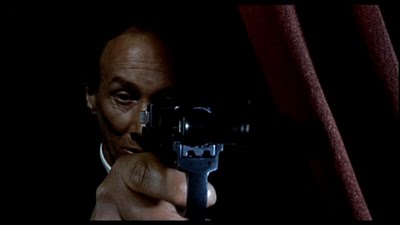
Just before the shooting, we see the assassin’s gun inch out from behind the curtain, and angle itself slowly toward the camera. Allowing a gun to emerge from offscreen often elicits a scared gasp from the audience, and this is one of the more famous moments in The Man Who Knew Too Much. Notably, the technique was also used to great effect in the finale of American Beauty (1998). We then see a rather frightening image of the assassin with gun poised, ready to shoot the Prime Minister, his face completely still and focused.. This is an image I have trouble getting out of my head, as it is what I imagine an assassin in real life would look like.

Jo’s scream and the assassin’s bullet missing its target marks the divorce of the music from the actual scene. At that moment, the camera makes a series of quick cuts to the patrons around the theater, while the symphony plays its powerful and sustained final notes. The chaos that ensues at the crash of the cymbals can be viewed as the murder plot’s official unraveling–as the symphony ends gracefully and powerfully, the murder plot is botched and the assassin accidentally falls to his death in a clumsy finale.

Doris Day’s wordless performance in this scene is truly worthy of a silent melodrama. During shooting, Doris Day was concerned that Hitchcock was more interested in directing the lights and cameras than he was about directing her performance. She took this to mean that he was displeased with her performance, and approached him about it. He responded “My dear Miss Day, if you were not giving the performance I wanted, THEN I would have to direct you!

I am attaching the clip here for you to reference.

See you next time!

CLFP: “Virtue” (1932)

carole lombard

By Lara Gabrielle Fowler

When I learned that Virtue was to be a part of the pre-code festival at the Roxie Theater in San Francisco this evening, I knew I had to go. This is one of Carole Lombard’s more well-known movies, but one which is rarely seen. This was, perhaps, my one chance to see this movie and review it for the Carole Lombard Filmography Project.

At the outset, the movie plays like a pretty standard pre-code. Mae, a streetwalker, is banned from town after being caught picking up men. Despite the court order to stay away, she returns and strikes up a relationship with a cab driver named Jimmy, not telling him she has been a streetwalker. They marry and on their wedding night, they come home to find a detective in their house. The detective says he is on to Mae and informs her husband that he has married a former streetwalker. Hurt and confused, Jimmy nonetheless decides to make a go of their marriage.

Mae learns that she has been found out.

Jimmy has a dream of being part owner of a gas station, and he has made plans with his friend Flanagan to purchase one to operate together. Though he has vowed to make the best of his marriage to Mae, he is constantly paranoid about her activities when he is not around. Mae assures him that he has nothing to worry about–their bank account shows only what he brings home from work, no more, no less. He is thrilled and excited about getting closer to his dream of owning a gas station, and Mae joins him in his excitement.

This is the point where the movie turns from a run-of-the-mill pre-code to something rather unique.

One day, Mae’s friend Gert falls ill and asks Mae for $200 for an operation. At first Mae says no, but ultimately gives in when Gert tries to commit suicide by drinking poison. When Mae comes home after lending Gert the money, she finds that her husband thinks he met his financial goal that day–not knowing that he was short the $200 that Mae lent Gert.

Later that evening, a friend comes over saying that Gert had asked HIM for $200 for an operation, then pretended to drink poison when he said no. Though she said nothing in order to keep her secret, Mae realizes that Gert was scamming them, and sets out to find her. She is nowhere to be found. Finally Mae tracks her down and starts beating her up, telling her that if she didn’t get the money back she would kill her. Gert swears she will, and tells her to come back tomorrow evening.

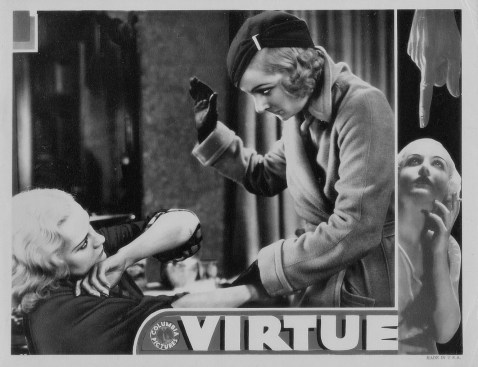
Mae beats Gert in this poster for the movie.

The next morning Jimmy, still suspicious, asks her what she did the previous evening. In order to maintain the secret of the $200, she replies that she had just stayed home. When asked what she would do that evening, she replies that she will probably do the same. When the evening rolls around and Mae sets out for Gert’s house, the jealous husband follows her. She enters Gert’s apartment, and her husband assumes that she is there to prostitute herself.

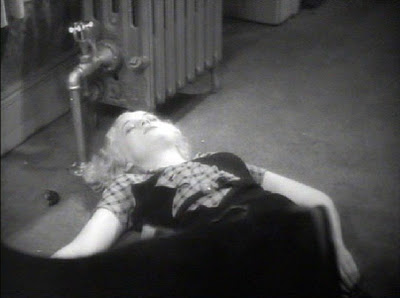
Meanwhile we learn that Gert has been giving the scammed money to a man named Toots O’Neill, the pimp of Lil, Mae and Gert’s mutual friend and fellow prostitute. In order to pay Mae back, Gert steals the money out of Toots’ wallet. When Toots finds out that she stole the money, he starts a fight with her to get it back, ultimately throwing her to the ground. She hits her head on a heater, killing her instantly.

Jimmy sees the silhouette of Toots lifting Gert’s dead body, and it looks like an embrace. He assumes it is Mae, and he is furious.

Meanwhile, Mae finds the door unlocked and enters. Toots hides with Gert’s body but watches her through a crack in the door. Mae finds the $200 on the table and takes it–but accidentally leaves her coat and purse.

She returns home to a furious Jimmy, and when she tries to explain, he will not listen to her and leaves. She hands him the $200 telling him that it is his, but he assumes it is her money from streetwalking and will not take it.

Mae’s coat and purse are found by detectives investigating Gert’s murder, and as they believe she was the only one there with Gert, they identify her as the guilty party in the murder and throw her in jail.

Forlorn about the failure of his marriage, Jimmy has passed out drunk at a local bar. A friend finds him and notifies him of Mae’s murder charge. He sobers up to defend her, and through a series of circumstances he sees Toots’ silhouette and recognizes it as the silhouette he saw in Gert’s apartment. He knows she couldn’t have been alone that night. When he confronts Toots with Lil present, Toots pulls a gun on him and Lil offers him an alibi, saying that she will testify that he was with her that evening. She convinces him to go to the courthouse instead of running out of town, as that will show that he is innocent and has nothing to hide.

Jimmy sees Toots’ silhouette.

Toots and Lil show up at the courthouse and Toots presents his testimony that he was with Lil all night. The judge asks Lil if this is true….and Lil replies that no, this is not true. She had to tell him that she would vouch for him to get him down to the courthouse, and says that he was about to run out of town. Toots is arrested, and Mae set free. The movie ends as Mae and Jimmy get back together, and Jimmy’s dream of a gas station has finally come true.

This was an extraordinarily complex, tight and well put together story. In writing this review, I felt an obligation to write out the entire story instead of the general skeleton, as the film unravels in such a straight and unwavering line that it is impossible to describe one event without all the others. Carole gives a wonderful performance, and the supporting cast is also magnificent. It is interesting to see how versatile of an actress Carole was. She plays this streetwalker with as much aplomb as her later dizzy screwball roles, and she could easily have remained a dramatic actress had her career not gone toward comedy. Had Carole lived longer, I would venture to say that she could have been comparable to someone like Barbara Stanwyck, capable of playing a wide variety of genres with equal skill.

Virtue is a movie that deserves to be seen by anyone with an interest in pre-code Hollywood, or simply classic Hollywood in general. It is unusually thorough in its treatment of its characters and its plot is meticulously thought out and detailed. The fact that this movie is so rare is a real shame, as it would be enjoyed by so many people if it were more widely available.

See you next time!